
Why Automotive Equipment Repair Matters for Your Shop's Success
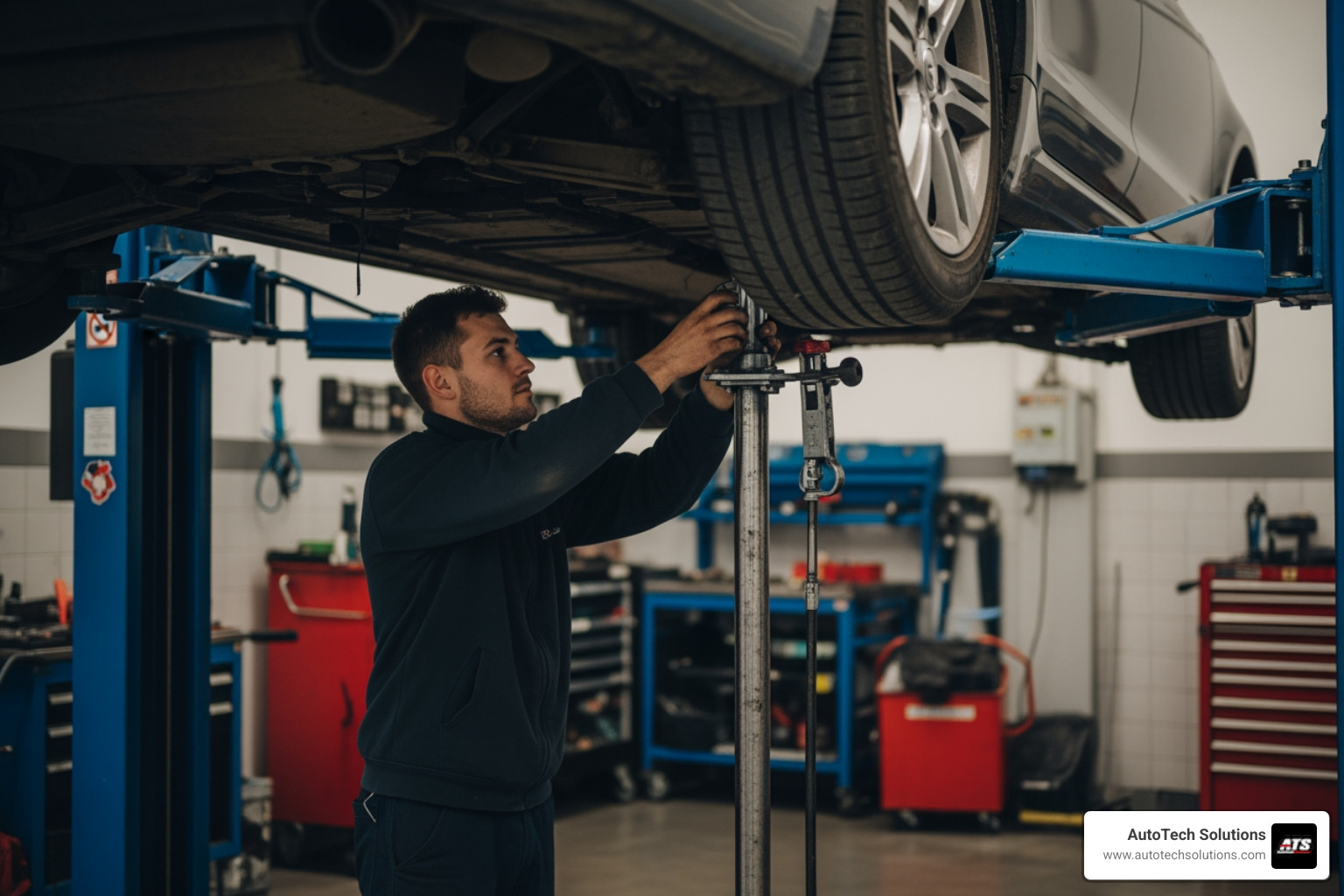
Automotive equipment repair is the process of maintaining, diagnosing, and fixing the specialized machinery and tools that keep service bays, collision centers, and industrial facilities running. For shop managers and facility operators, every minute of equipment downtime translates directly to lost revenue, frustrated technicians, and delayed customer service.
Quick Answer: Core Elements of Automotive Equipment Repair
| Equipment Type | Common Issues | Maintenance Frequency |
|---|---|---|
| Two-post & four-post lifts | Hydraulic leaks, worn cables, safety latch failures | Monthly inspection, annual certification |
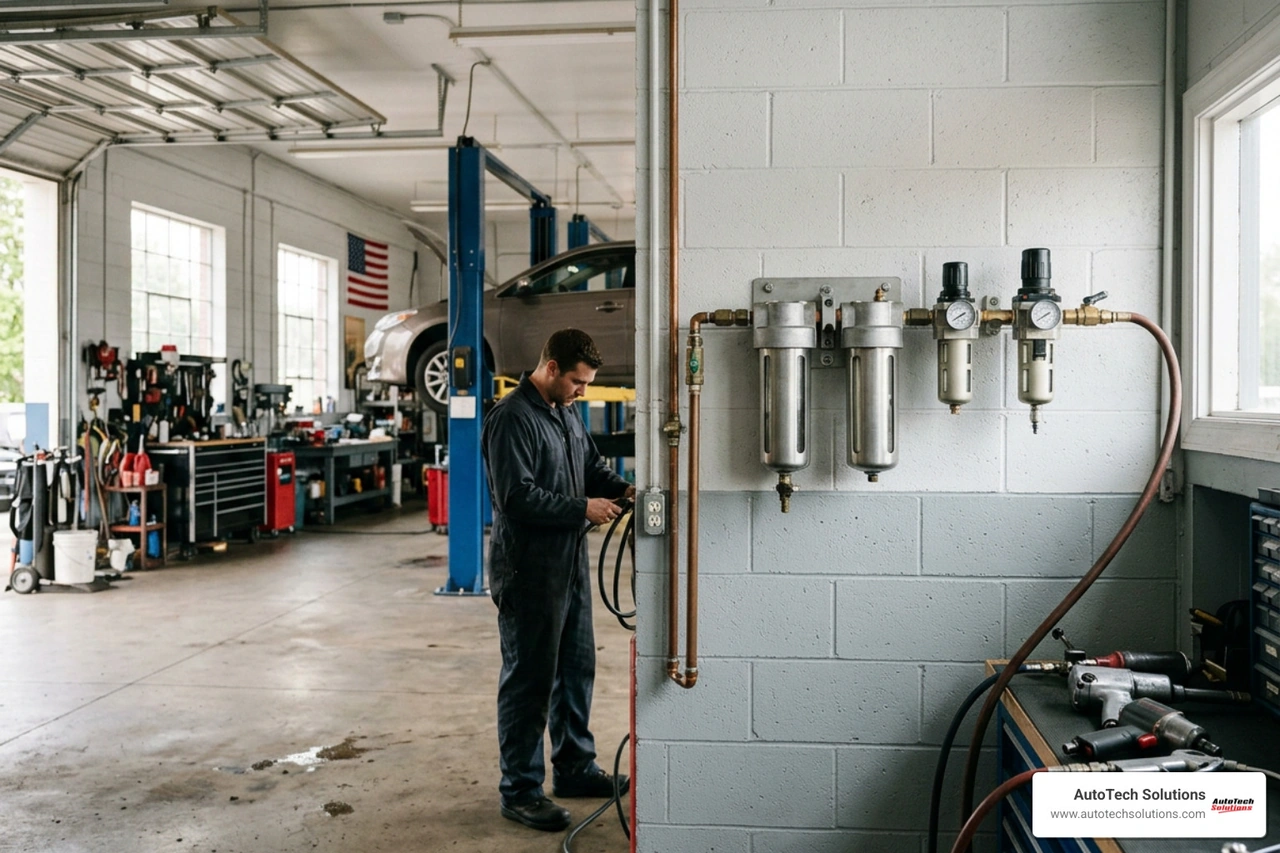
| Air compressors | Moisture buildup, filter clogs, pressure loss | Weekly draining, quarterly filter changes |
| Wheel service equipment | Calibration drift, tire changer arm wear, balancer sensors | Daily calibration checks, semi-annual service |
| Lubrication systems | Hose leaks, pump failures, contaminated oil | Weekly inspection, monthly fluid checks |
The automotive repair and maintenance market is valued at over $798 billion globally and growing at nearly 5% annually. Yet many shops still treat equipment maintenance as an afterthought—until a lift fails mid-service or a compressor quits during a busy afternoon.
Modern vehicles are more complex than ever. Electric vehicles require specialized high-voltage tools and battery management systems. Advanced diagnostics demand software integration and sensor calibration. Your equipment must keep pace, or your shop falls behind.
The best shops don't just react to breakdowns. They follow manufacturer-recommended maintenance schedules, keep common parts in stock, and work with certified technicians who understand both mechanical and electronic systems. Whether you're managing a small independent garage or a multi-bay dealership, your equipment's reliability directly impacts your bottom line.
From hydraulic lifts to diagnostic computers, every piece of shop equipment needs regular attention. State regulations—like California's Bureau of Automotive Repair requirements—mandate safety inspections and documentation. Consumer protection laws require written estimates and detailed invoices. And your insurance carrier expects you to maintain equipment properly.
The following guide breaks down everything you need to know: troubleshooting common lift problems, maintaining hydraulic and pneumatic systems, preparing for the EV service revolution, understanding legal requirements, and choosing the right repair partners. We'll also explore emerging trends like augmented reality training, 3D-printed parts, and connected workshop systems that are reshaping the industry.
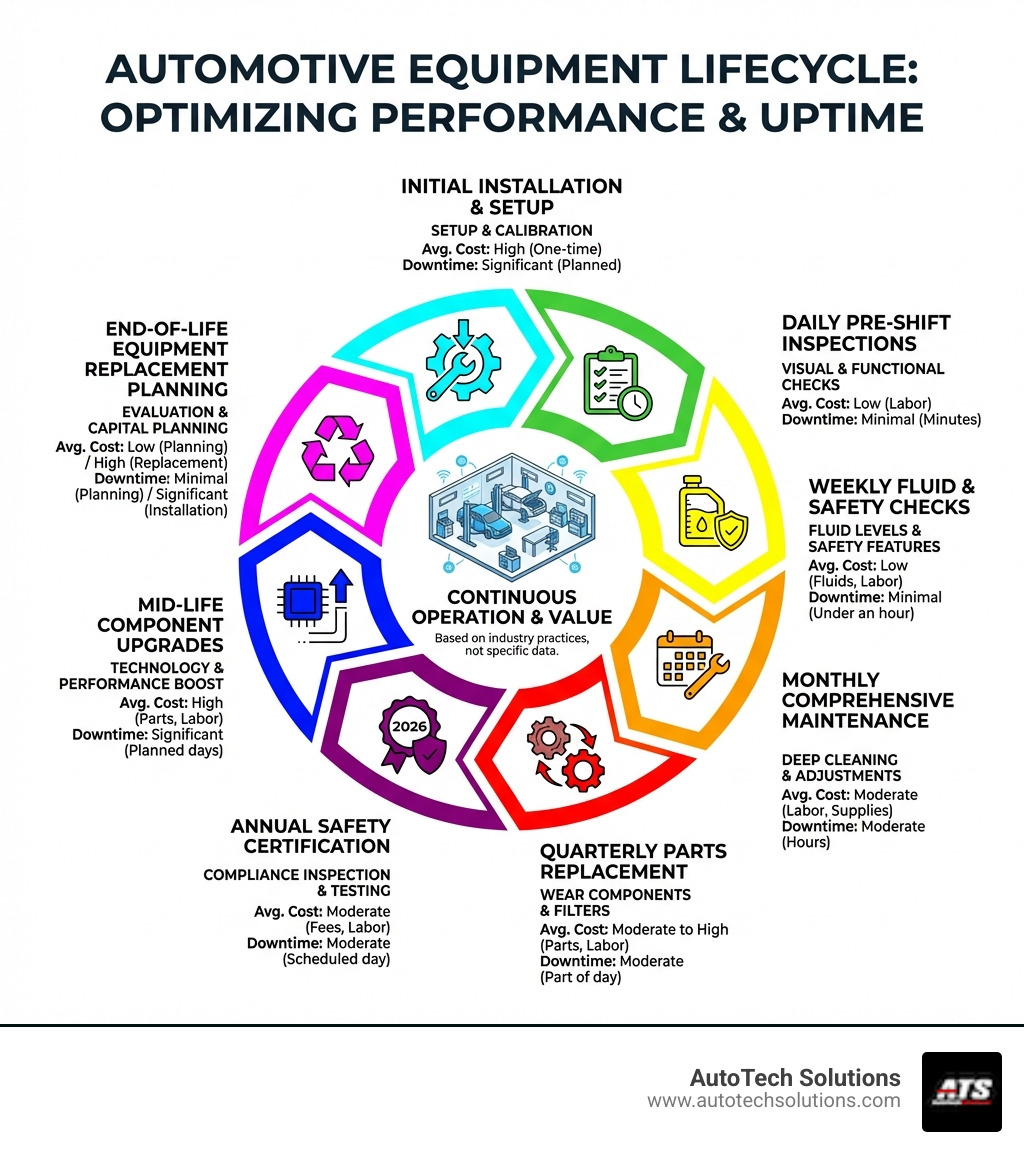
Mastering Automotive Equipment Repair for Maximum Uptime
In our experience serving shops from Michigan to the Carolinas, we have seen that the most successful businesses view their equipment as an investment rather than an expense. When a vehicle lift or an air compressor fails, the "domino effect" begins: bay productivity stops, technician morale drops, and customer wait times skyrocket.
To prevent this, we focus on Preventative Maintenance Programs that target the most critical shop components. Whether you are running a light-duty tire shop or a heavy-duty fleet facility, your equipment requires a proactive approach. This involves more than just "fixing what's broken." It requires a deep understanding of Automotive Service Excellence standards to ensure every repair meets safety and performance benchmarks.
Common Troubleshooting Steps for Automotive Equipment Repair
Lifts are the backbone of any workshop. Whether you use two-post, four-post, scissor, or in-ground lifts, each has unique failure points.
- Two-Post Lifts: These are workhorses but prone to cable stretch and synchronization issues. If one side is rising faster than the other, check the equalization cables immediately.
- Four-Post Lifts: Often used for storage or alignment, these lifts rely on pulleys and cables. A common issue is the safety latch failing to engage simultaneously on all four posts.
- Scissor Lifts: These space-savers often face hydraulic synchronization issues. If the platforms aren't level, it’s usually air in the lines or a failing seal.
- In-Ground Lifts: Because components are recessed, they are susceptible to moisture and corrosion. Regular inspections of the casing and hydraulic fluid are mandatory to prevent catastrophic leaks.
Table: Lift Maintenance Quick-Check
| Maintenance Task | Frequency | Why It Matters |
|---|---|---|
| Lubricate lift columns/arms | Weekly | Reduces friction and premature wear |
| Inspect hydraulic hoses/fittings | Monthly | Prevents high-pressure leaks and sudden drops |
| Test safety latches/locks | Daily | Essential for technician safety |
| Check floor anchoring bolts | Semi-Annually | Ensures structural stability under load |
Essential Maintenance for Hydraulic and Pneumatic Systems
Hydraulic and pneumatic systems are the "muscles" of your shop. For brands like Champion, keeping the air clean and the fluid pure is the secret to longevity.
- Fluid Levels & Quality: Low hydraulic fluid leads to "spongy" lift operation or failure to reach full height. Check for aeration (bubbles) which indicates a leak on the suction side.
- Hose Inspection: Look for "sweating" or cracks. A hydraulic hose failure under load is a major safety hazard.
- Moisture Control: In pneumatic systems, water is the enemy. It rusts internal components of air tools and tire changers. We recommend draining air tanks daily and ensuring your filtration systems are serviced quarterly.
- Seal Replacement: If you see "weeping" around cylinders, replace the seals immediately. Waiting until they blow out completely will result in significantly higher automotive equipment repair costs and longer downtime.
Specialized Equipment for Electric Vehicles and Advanced Diagnostics
The shift toward electric vehicles (EVs) is no longer a "future" trend—it is happening now. Servicing these vehicles requires a different breed of equipment. You can't just use standard tools when dealing with 400V to 800V battery systems. We provide specialized Service, Repair, and Equipment Support to help shops transition safely.
The Role of Advanced Diagnostics in Automotive Equipment Repair
Modern automotive equipment repair is as much about software as it is about wrenches.
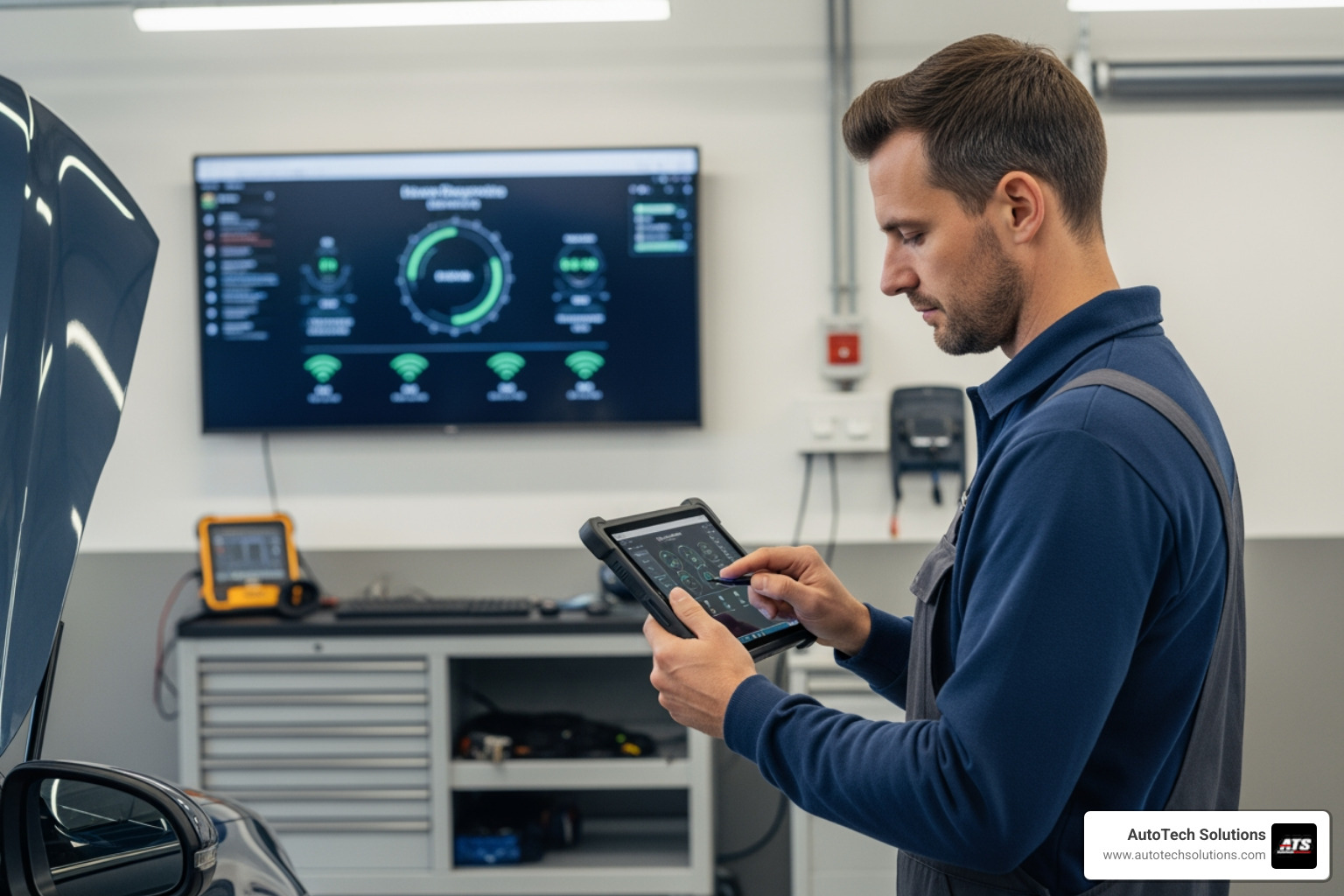
Advanced diagnostic tools now integrate directly with a vehicle's onboard computer (OBD-II). This allows for:
- Interpretive Data: Instead of just reading codes, modern tools provide guided diagnostics to pinpoint the exact failure.
- Sensor Calibration: With the rise of ADAS (Advanced Driver Assistance Systems), equipment like wheel aligners must now calibrate cameras and radar sensors.
- Software Updates: Much like your smartphone, your shop equipment—especially balancers and aligners—needs regular software patches to recognize new vehicle models and specs.
Technician Duties and Specialized EV Training
According to the Bureau of Labor Statistics, Automotive Service Technicians and Mechanics must now be proficient in electronic sensors and high-voltage safety.
For EV service, technicians must be trained in:
- Battery Management: Identifying issues in battery performance and cooling.
- Regenerative Braking: Servicing systems that use the motor to slow the vehicle.
- Safety Protocols: Using insulated tools and PPE (Personal Protective Equipment) to prevent electrocution.
Legal Standards, Consumer Rights, and Safety Recalls
Navigating the legalities of repairs is crucial for shop owners and consumers alike. While our primary focus is the Michigan to Carolinas region, many industry standards follow the lead of the California Bureau of Automotive Repair (BAR) because of their stringent consumer protections.
Understanding Repair Estimates and Invoices
A professional automotive equipment repair service should always provide clear documentation. This isn't just good business—in many states, it's the law.
- Written Estimates: These must identify the condition to be repaired, the parts needed, and the anticipated labor charge.
- Authorization: A shop cannot exceed the estimate without your explicit permission.
- Final Invoices: These should be itemized. Look for a breakdown of new, remanufactured, or salvage parts, as well as the odometer reading at the time of repair.
- Replaced Parts: You have the right to request your old parts back (though you might have to pay a "core charge" if you keep a part that was meant to be remanufactured).
For more on your rights, we recommend reviewing Auto Repair Basics.
Navigating Safety Recalls and Consumer Protection
Safety recalls occur when a manufacturer or the NHTSA determines a vehicle has a safety-related defect.
- Checking for Recalls: Consumers should visit www.NHTSA.gov/recalls and enter their 17-character VIN.
- SaferCar App: You can download the SaferCar app to get automatic alerts.
- Dispute Resolution: If a shop fails to perform a repair correctly, start by talking to the manager. If that fails, contact your Attorney General or local consumer protection agency.
Future Trends in Automotive Workshop Technology
The industry is evolving at breakneck speed. We are seeing a move toward "Connected Workshops" where every piece of equipment talks to the others via the Internet of Things (IoT).
The Shift Toward Mobile and Eco-Friendly Solutions
Sustainability is a massive trend. Brands like Hunter Engineering are leading the way with equipment that reduces waste.
- Eco-Friendly Equipment: This includes solvent recyclers that allow shops to reuse cleaning fluids and energy-efficient lighting that slashes overhead costs.
- Mobile Workshop Solutions: Some shops are now bringing the service to the customer. Mobile units equipped with compact tire changers and diagnostic kits allow for onsite maintenance at the customer's home or office.
Automation and IoT in Modern Service Equipment
Automation is reducing the physical strain on technicians while increasing accuracy.
- Connected Systems: Imagine a wheel balancer that automatically uploads its data to the shop's management software, updating the inventory of wheel weights in real-time.
- Predictive Maintenance: Smart sensors on a lift can alert us when a motor is running too hot or a cable has stretched beyond safety limits before it breaks. This is the ultimate goal of modern Products we offer.
Best Practices for Choosing Repair Services and Parts
When your equipment goes down, who do you call? We recommend looking for providers that offer "turnkey" solutions—sales, installation, and long-term service. Avoid shops that don't honor warranties or lack certifications. For lift-specific needs, we often point our clients toward the reliability of Rotary Solutions.
Evaluating Parts: New vs. Remanufactured vs. Salvage
The type of parts used in your automotive equipment repair significantly impacts cost and longevity.
- New Parts: Made to original manufacturer specifications. They offer the best reliability but the highest cost.
- Remanufactured/Rebuilt: These are old parts that have been completely overhauled. They are often just as good as new but at a lower price point.
- Salvage: Used parts taken from other machines. We generally advise against these for critical safety equipment like lifts, as their history is unknown.
Always Learn more about your vehicle warranty rights to ensure that using non-OEM parts doesn't void your coverage.
Identifying Vehicle Trouble Using Your Senses
You don't always need a computer to know something is wrong. We teach technicians to use their senses to catch problems early.
- Sight: Look for puddles. Yellowish-green is often coolant; red is usually transmission or power steering fluid.
- Smell: "Burned toast" often indicates an electrical short. "Rotten eggs" usually means a catalytic converter issue.
- Sound: Squeals are often belts; screeches are usually brake wear indicators.
- Feel: Vibrations in the steering wheel or a "pulling" sensation indicate alignment or suspension trouble.
Frequently Asked Questions about Automotive Equipment
What are the most common issues with automotive lifts?
The most common issues include hydraulic leaks (seals and hoses), equalization cable stretch, and safety latch synchronization. In older lifts, motor failure due to poor electrical connections is also frequent.
How often should shop equipment undergo safety inspections?
We recommend daily visual inspections by the operator. However, a formal, documented safety inspection by a certified professional should occur at least once a year to comply with safety standards and insurance requirements.
What specialized tools are required for EV battery repair?
You need high-voltage insulated hand tools, a battery lift table (as EV batteries are extremely heavy), a megohmmeter for insulation testing, and specialized diagnostic software capable of communicating with the Battery Management System (BMS).
Conclusion
At AutoTech Solutions, we understand that your shop’s heartbeat is its equipment. From Michigan to the Carolinas, our mission is to minimize your downtime through expert installation, rapid automotive equipment repair, and robust preventative maintenance.
Don't wait for a equipment failure to disrupt your business. Whether you need a new set of Products or a service team that responds faster than the competition, we are here to support your success. Keep your bays moving, your technicians safe, and your customers happy by making equipment health a top priority.