Why Heavy Duty Jacks Are Essential for Professional Automotive and Industrial Operations
Heavy duty jacks are the backbone of safe and efficient vehicle lifting in professional automotive shops, fleet maintenance facilities, and industrial operations. These robust hydraulic tools enable technicians to lift heavy vehicles and machinery with precision while minimizing the risk of equipment damage and workplace injuries.
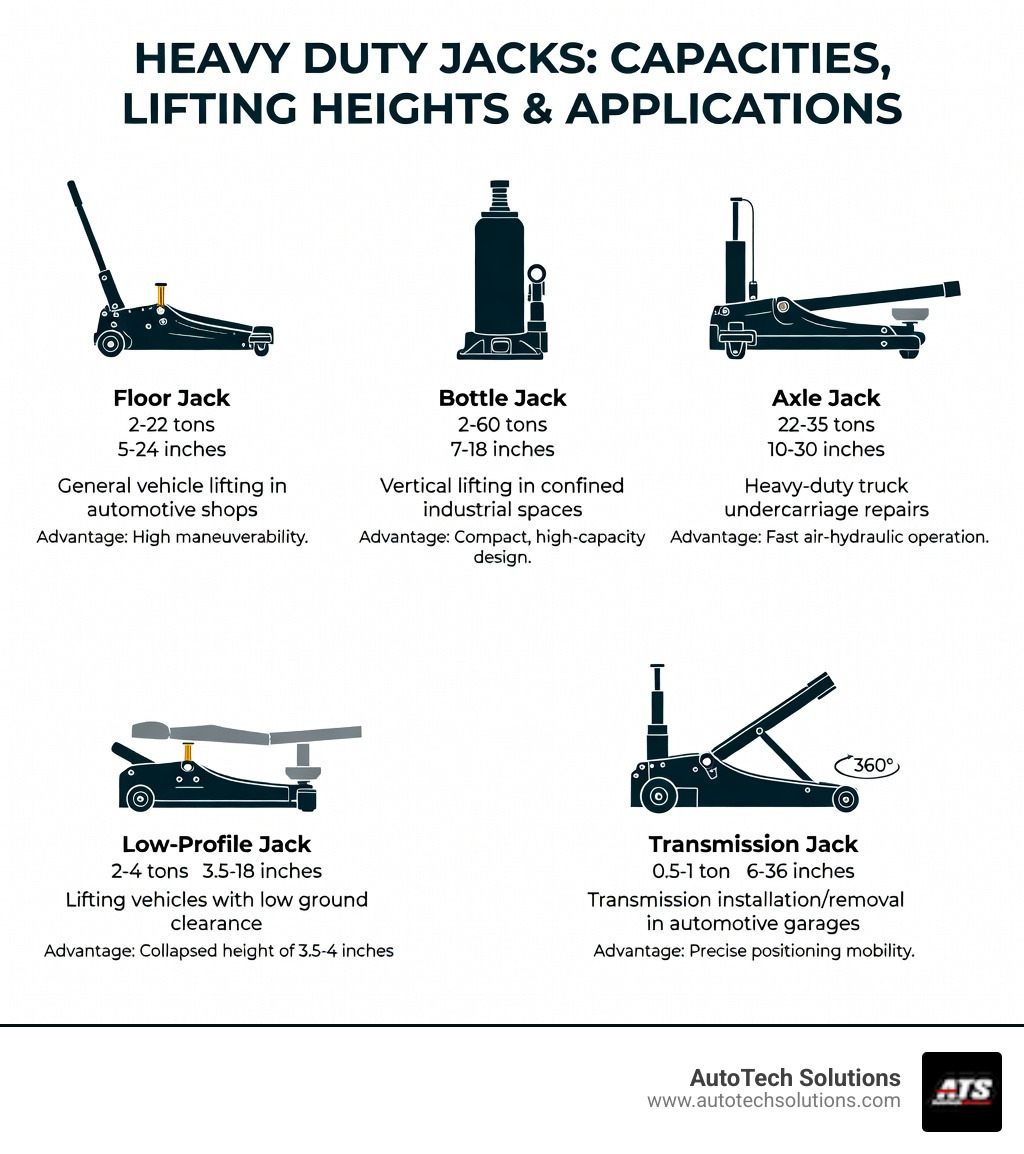
Quick Reference: Heavy Duty Jack Types and Capacities
| Jack Type | Typical Capacity | Primary Use | Key Advantage |
|---|---|---|---|
| Floor Jacks | 2-22 tons | General vehicle lifting | Maneuverability with swivel casters |
| Bottle Jacks | 2-60 tons | Vertical lifting in tight spaces | Compact design, high capacity |
| Axle Jacks | 22-35 tons | Heavy truck undercarriage work | Air hydraulic for faster operation |
| Low-Profile Jacks | 2-4 tons | Vehicles with minimal ground clearance | 7.5-8" collapsed height |
| Transmission Jacks | 0.5-1 ton | Transmission removal/installation | 360-degree swivel mobility |
The challenge facing facility managers is clear: conventional jacks are slow, heavy, and require multiple pieces of equipment to complete a single lift safely. As one manufacturer notes, business owners waste countless hours with equipment that poses risks of injury and vehicle damage during operation.
Modern heavy duty jacks solve these problems through engineered hydraulic systems and durable steel construction. Industrial floor jacks can handle loads from 6,600 lbs (3 tons) up to 77,000 lbs (35 tons), with specialized models like air hydraulic systems that eliminate manual pumping entirely. These tools are designed specifically for demanding environments where downtime directly impacts profitability.
For shop managers evaluating equipment investments, the key factors are weight capacity, hydraulic efficiency, construction durability, and safety features like overload protection valves. Whether you're lifting a sedan for routine maintenance or positioning a heavy-duty truck for undercarriage repairs, selecting the right jack type and capacity determines both technician productivity and workplace safety.
Understanding the Primary Uses and Benefits of Heavy Duty Jacks
In our experience at AutoTech Solutions, we have seen how the right lifting equipment transforms a shop's workflow. Heavy duty jacks are not just about lifting; they are about providing a stable, controlled environment for complex mechanical work. In automotive settings, these tools are essential for everything from simple tire rotations to complete engine swaps. In industrial environments, their role expands to handling heavy machinery and supporting agricultural equipment during critical repairs.
Vehicle Repair and Fleet Maintenance
For fleet managers in Michigan and North Carolina, minimizing downtime is the top priority. When a commercial truck or bus enters the bay, every minute it spends on the ground is a minute of lost revenue. Heavy-duty floor jacks, such as the TMG-AJL20 which offers a massive 44,000 lb lifting capacity, allow technicians to access undercarriage components quickly. These jacks are engineered for durability, ensuring they can withstand the repetitive stress of a high-volume shop.
Machinery Handling and Precision Engineering
Beyond standard vehicles, heavy duty jacks are vital for industrial machinery handling. Precision is key here. A jack like the TMG-AJX35, with its 35-ton (77,000 lb) capacity, provides the steady lift required to align heavy components without the "jerking" motion often associated with lower-quality equipment. This precision protects both the equipment and the personnel working in close proximity.
Safety Improvements and Ergonomics
One of the most significant benefits of modern heavy-duty designs is the improvement in workplace ergonomics. Many of these units feature foot-pedal operations and long-reach chassis, which reduce the physical strain on technicians. By using air hydraulic systems, we can eliminate the manual pumping that often leads to repetitive strain injuries. Safety is further improved by features like the three-stage locking mechanisms found in premium models, which ensure the load remains secure even if the hydraulic system experiences a failure.
For more information on high-performance options, you can explore Heavy Duty Jacks - AC Hydraulic.
Essential Features for Selecting Heavy Duty Jacks
When we help our clients at AutoTech Solutions design their shops, selecting the right jack is a critical part of the process. It isn't just about picking the highest weight rating; it’s about matching the tool's features to your specific operational needs.
Key features to evaluate include:
- Lifting Capacity: Always choose a jack that exceeds your heaviest expected load.
- Construction Material: Steel offers maximum durability for stationary shop use, while aluminum provides the portability needed for mobile service units.
- Hydraulic Efficiency: Systems with double pistons or air-assist mechanisms significantly reduce the time required to reach the load.
- Safety Valves: These prevent the jack from being used beyond its rated capacity, protecting the internal seals and the user.
For professional guidance on how to integrate these tools into your facility, visit our shop design and consulting services.
Weight Capacity and Construction Material
The "heavy duty" label usually starts at the 3-ton mark, but industrial needs often go much higher. For instance, the TMG-AJT80 is a two-stage truck jack capable of lifting up to 80 tons.
Steel vs. Aluminum:
- Steel: Most heavy duty jacks in professional bays are made of heavy-gauge steel. Steel is less prone to flexing under extreme loads and can handle the rough-and-tumble environment of a busy shop.
- Aluminum: While less common for 20-ton+ applications, aluminum is excellent for 2-ton to 3-ton jacks used by mobile repair teams in Raleigh or Charlotte. It offers a high strength-to-weight ratio, making it easier to maneuver in and out of service vans.
Hydraulic Systems and Double Piston Heavy Duty Jacks
The hydraulic system is the heart of the jack. Modern professional-grade jacks often use a double piston (or "double pumper") system.

This design allows the jack to reach the vehicle's frame in just a few pumps, whereas a single piston might take twice as many. Once the jack begins lifting the weight, the system automatically shifts to a higher-pressure, lower-volume mode to provide the necessary force. This "Quick Lift" technology is a favorite among our technicians because it saves time on every single job. Furthermore, many industrial jacks are now "air hydraulic," meaning they use compressed air to drive the hydraulic fluid, providing effortless lifting at the push of a button.
Comparing Types: Floor Jacks, Bottle Jacks, and Specialized Lifts
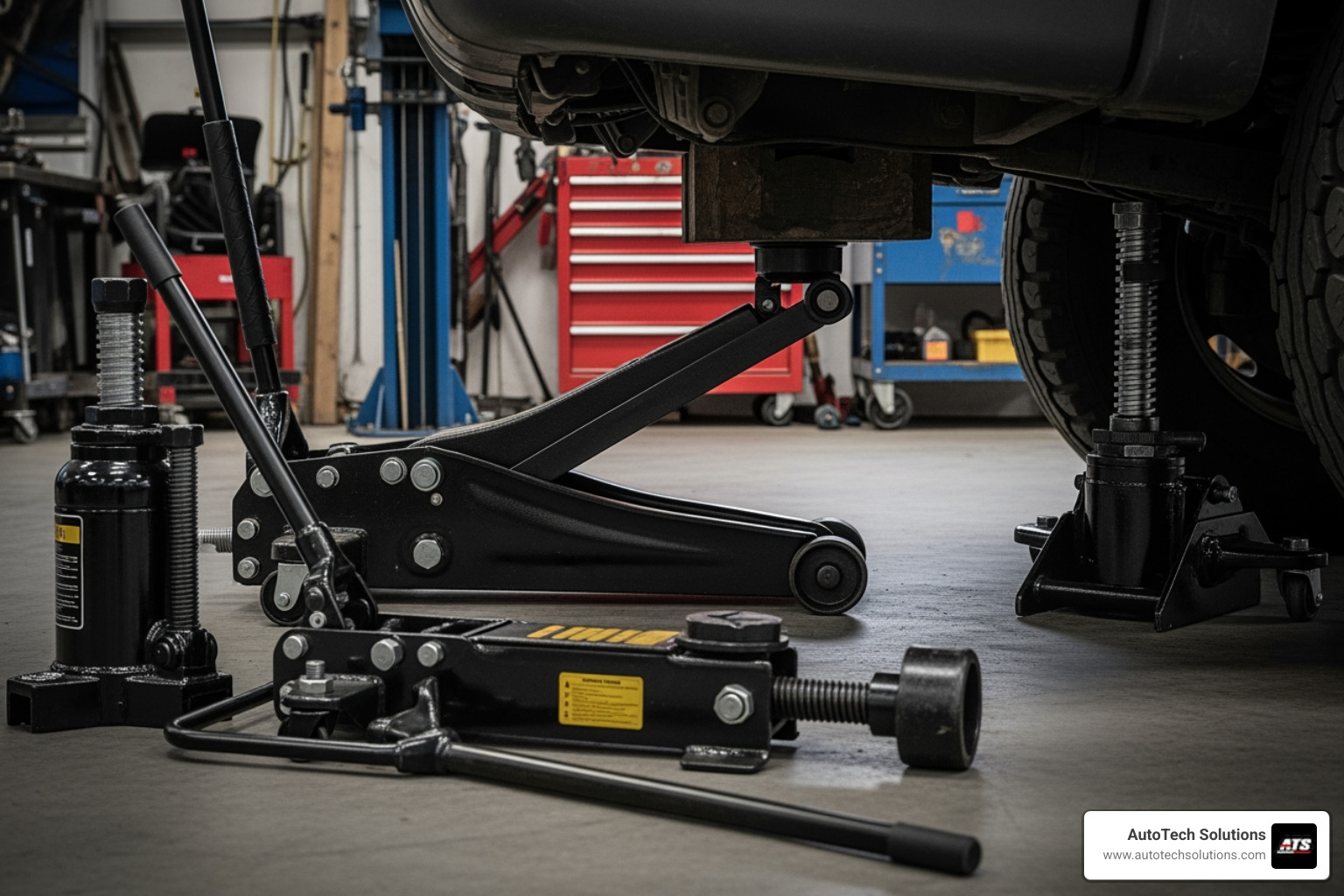
Understanding the differences between jack types is essential for safe operation. While they all lift, they do so in very different ways.
| Feature | Floor Jack | Bottle Jack | Axle Jack |
|---|---|---|---|
| Direction | Horizontal pump/Vertical lift | Vertical pump/Vertical lift | Air-powered vertical lift |
| Stability | High (wide base with wheels) | Moderate (narrow base) | High (heavy duty chassis) |
| Portability | Rolling (heavy) | Hand-carried (compact) | Rolling (very heavy) |
| Best For | General shop repairs | Emergency roadside/Construction | Heavy fleet maintenance |
For those looking for the gold standard in heavy-duty lifting, we often recommend Rotary Solutions for heavy lifting.
Low-Profile and Long-Reach Heavy Duty Jacks
Low-profile jacks are a necessity for modern shops servicing sports cars or vehicles with custom suspensions. A jack like the TMG-AJF04L features a low-profile design that can slip under vehicles with as little as 3.5 inches of ground clearance.
Conversely, long-reach chassis jacks are designed to reach deep under a vehicle to hit a specific lifting point, such as a crossmember or a differential, without the jack's handle hitting the vehicle's body. These often come with foot pedals for rapid saddle positioning.
Specialized Lifts: Transmission and Air Hydraulic Axle Jacks
Some tasks are too specific for a standard floor jack.
- Transmission Jacks: These feature a wide base and a specialized cradle that can tilt and swivel 360 degrees. This allows for the precise alignment needed when mating a heavy transmission to an engine.
- Air Hydraulic Axle Jacks: These are the workhorses of the heavy trucking industry. With capacities like the STRONGARM 722SHD (22 tons), these jacks use shop air (typically 115-200 PSI) to lift the heaviest axles in seconds.
For material handling needs beyond vehicle lifting, we also provide insights into Pallet Jacks and material handling.
Safety Protocols and the Essential Role of Jack Stands
We cannot stress this enough: A jack is a lifting tool, not a support tool. Once a vehicle is raised, it must be supported by jack stands before anyone places a limb or their body under the vehicle.
The Role of Jack Stands
Jack stands, such as the TMG-AJS06 (6-ton capacity), provide a mechanical lock that cannot fail like a hydraulic seal might. When using heavy duty jacks, we recommend:
- Matching Capacity: If you lift a 10-ton truck, you must use jack stands rated for at least that weight.
- Level Ground: Always operate on a flat, concrete surface. Asphalt can soften in the North Carolina heat, causing a jack or stand to sink and tip.
- ANSI Standards: Ensure your equipment meets ANSI/ASME safety standards. Many professional-grade stands now feature double-locking pins for an extra layer of security.
Safety is a core value at AutoTech Solutions, which is why we trust Forward Lift safety features for our larger installation projects.
Maintenance and Troubleshooting for Hydraulic Systems
To ensure your heavy duty jacks last for decades, regular maintenance is required. Hydraulic systems are susceptible to air contamination and fluid degradation.
Common Maintenance Tasks
- Bleeding the Air: If your jack feels "spongy" or won't lift to its full height, air is likely trapped in the system. Most jacks have a specific bleed screw or procedure to release this air.
- Checking Fluid Levels: Only use high-quality hydraulic jack oil. Never use brake fluid or engine oil, as these will destroy the seals.
- Inspecting Seals: Look for leaks around the piston. High-quality jacks, like those from JET, use industrial-grade seals designed for 40+ years of reliability, but even these need inspection.
- Cleaning the Ram: Keep the lifting ram clean of grit and debris. If dirt gets pulled into the cylinder, it will score the metal and cause permanent leaks.
If you encounter issues you can't solve, our team provides comprehensive Service Repair and Equipment Support across our service areas.
Frequently Asked Questions about Heavy Duty Jacks
What are the typical price ranges for professional-grade jacks?
Professional heavy duty jacks are an investment. A high-quality 3-ton floor jack typically ranges from $250 to $600. Industrial air hydraulic axle jacks (20-35 tons) can range from $800 to over $2,500 depending on the stage count and brand. While retail-grade jacks are cheaper, they lack the rebuildable components and safety certifications required for professional shop use.
Are there specialized jacks for lawnmowers or construction tasks?
Yes. Lawnmower lifts are specialized jacks designed to tilt a mower back safely to access the blades, typically with a 300-500 lb capacity. For construction, mechanical screw jacks are often used because they can hold a load indefinitely without the "creep" associated with hydraulic systems.
What are the most common maintenance requirements for hydraulic units?
The most frequent requirement is "bleeding" the system to remove air. Beyond that, keeping the hydraulic fluid clean and the external moving parts (like wheels and hinges) lubricated with grease is essential for smooth operation.
Conclusion
Selecting and maintaining the right heavy duty jacks is fundamental to the success of any automotive or industrial operation. From the precision of a double-piston floor jack to the sheer power of an 80-ton air hydraulic truck jack, these tools define the safety and efficiency of your workspace.
At AutoTech Solutions, we are dedicated to helping shops in Novi, Charlotte, Raleigh, and beyond stay operational with the best equipment and support in the industry. Whether you need a single replacement jack or a complete facility buildout, we have the expertise to minimize your downtime and maximize your productivity.
Browse our full range of professional products to find the perfect lifting solution for your shop today.