
Why Proper Air Compressor Installation for Automotive Shop Operations Can Make or Break Your Business
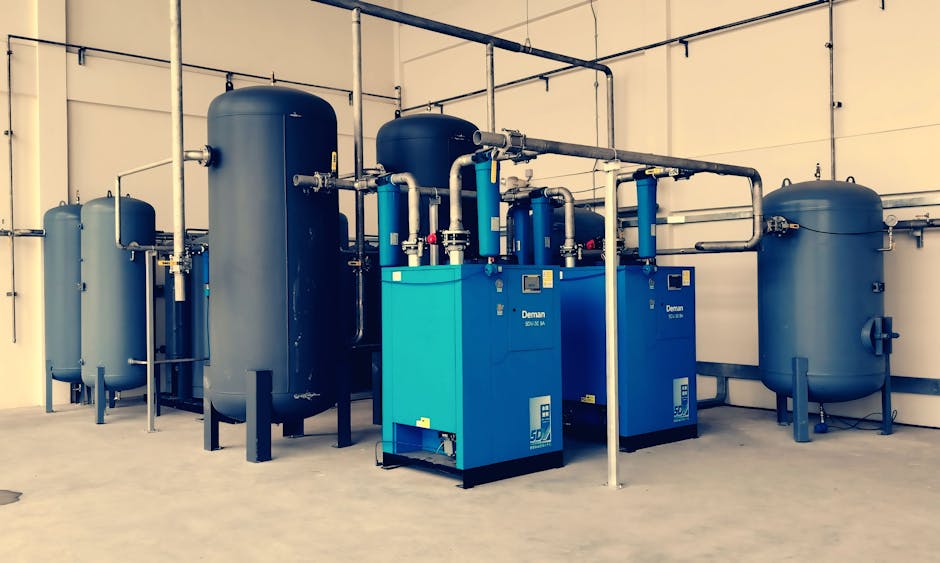
Air compressor installation for automotive shop environments is one of the most critical infrastructure decisions a shop owner or facility manager will make. Get it right, and your technicians work faster, tools last longer, and downtime stays low. Get it wrong, and you're looking at pressure drops, moisture-damaged equipment, and costly do-overs.
Here's a quick overview of what a successful shop air system installation involves:
- Choose the right compressor type - Reciprocating for smaller or intermittent-use shops; rotary screw for continuous, multi-technician operations
- Size for your actual demand - Plan for roughly 5 CFM per technician, plus capacity for your highest-draw tools (sandblasters, spray guns)
- Match your electrical service - Three-phase power is strongly preferred for shop compressors 5 HP and above
- Use the right piping - Black iron, copper, or aluminum for distribution; never PVC (it can shatter under pressure)
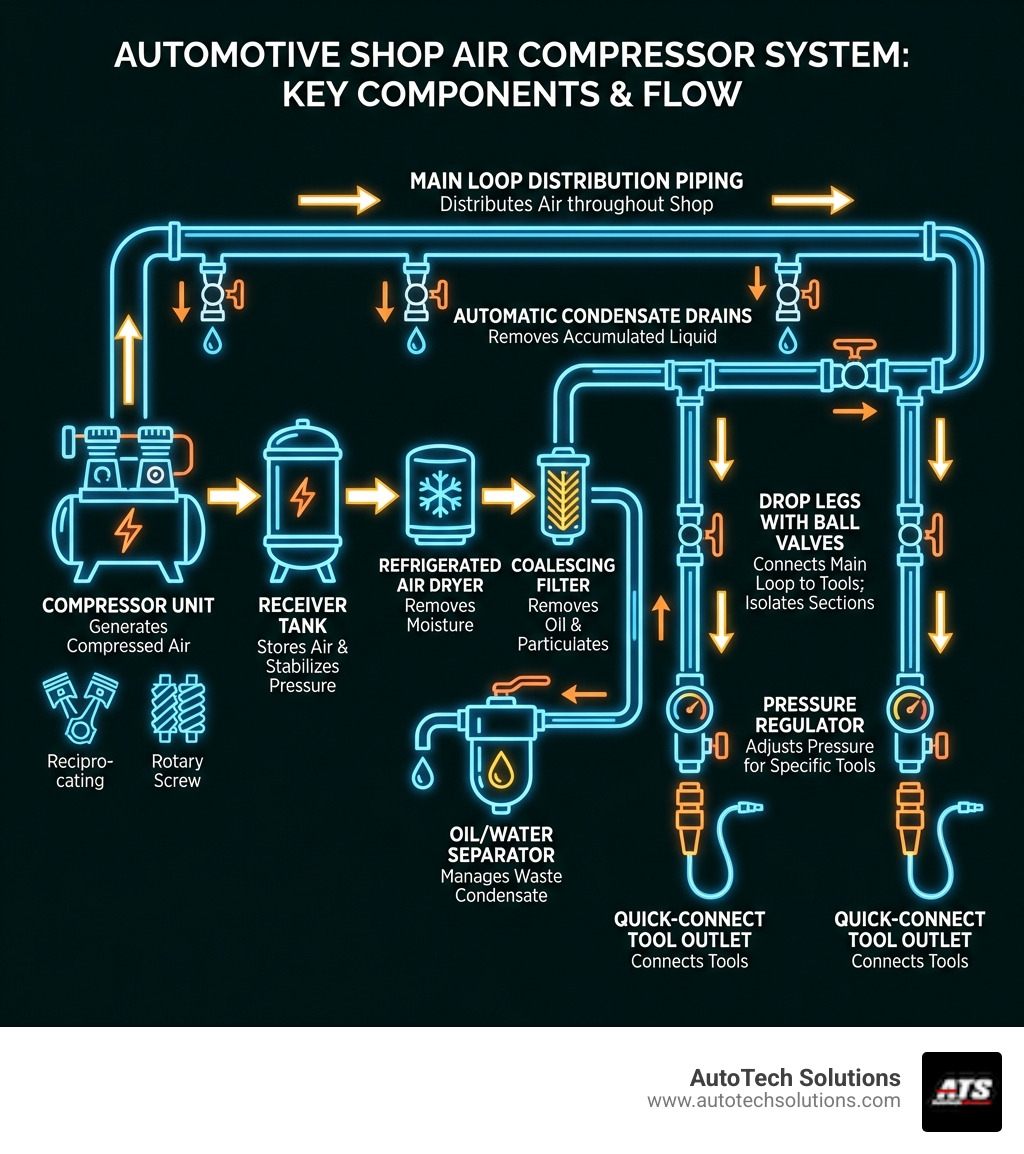
- Add air treatment components - Refrigerated dryer, coalescing filter, oil/water separator, and automatic drains
- Test before you commission - Check every joint with soapy water, verify pressure at the drop points, and confirm no pressure drop under load
Most air tools in a shop setting need 80–90 PSI to operate correctly. But raw pressure is only part of the equation. Volume (CFM), air cleanliness, and system layout are just as important — especially if you run spray guns, sandblasters, or multiple bays simultaneously.
Whether you're building a new facility or upgrading an existing one, this guide walks you through every step of designing and installing a compressed air system that will serve your shop reliably for years.
Must-know air compressor installation for automotive shop terms:
Selecting the Right Air Compressor Installation for Automotive Shop Success
When we help clients in Michigan or the Carolinas select a unit, we start by looking at the "heart" of the system. Choosing between reciprocating and rotary screw technology isn't just about price; it’s about how your shop breathes.
Reciprocating (Piston) PumpsThese are the traditional workhorses. They work like a car engine, using pistons to compress air. They are excellent for smaller shops where tools are used intermittently. However, they have a limited duty cycle—usually around 60% to 75%. If you run a reciprocating pump for more than 30 to 45 minutes out of every hour, you risk overheating and premature failure.
Rotary Screw TechnologyFor a busy multi-bay shop, a rotary screw compressor is often the "cat's meow." These units use two interlocking helical screws to compress air continuously. They are designed for a 100% duty cycle, meaning they can run 24/7 without breaking a sweat. They are also significantly quieter, often allowing them to be installed closer to the work area without requiring hearing protection.
| Feature | Reciprocating Compressor | Rotary Screw Compressor |
|---|---|---|
| Duty Cycle | Intermittent (60-75%) | Continuous (100%) |
| Noise Level | High (80-85+ dBA) | Low (60-70 dBA) |
| Initial Cost | Lower | Higher |
| Maintenance | Simple/Frequent | Specialized/Less Frequent |
| Air Quality | Higher oil carryover | Low oil carryover |
Sizing Your Air Compressor Installation for Automotive Shop Technicians
Sizing is where many shops stumble. If you undersize, your technicians will be standing around waiting for the tank to recover. If you oversize too drastically (especially with rotary screws), you can actually cause moisture problems because the unit never gets hot enough to burn off internal condensate.
A good rule of thumb is to allocate 5 CFM (Cubic Feet per Minute) per technician for general service. However, you must account for your "hungriest" tools. For example, a 1/2-inch impact wrench might only need 5 CFM in short bursts, but a dual-action (DA) sander or a spray gun can pull 10–15 CFM continuously.
If you are looking for a robust starting point, many professional shops look at units like the Eaton 5 hp 2-stage unit, which can deliver roughly 17 CFM at 175 PSI. This provides enough "oomph" for a couple of techs to work simultaneously without the compressor constantly cycling. Always add a 10% buffer to your calculated needs to account for future growth and minor system leaks.
Electrical Requirements and Power Phase
Before you bolt anything to the floor, we need to talk about juice. Most residential or very small commercial buildings have single-phase power. While you can run a 5 HP compressor on single-phase, it requires a hefty dedicated circuit—often 30 to 50 amps.
For professional automotive shops, three-phase power is the gold standard. Three-phase motors are more efficient, run cooler, and experience fewer electrical breakdowns. They also draw significantly fewer amps during startup. A 5 HP motor on 230V single-phase might pull 23 amps, while the same motor on three-phase might only pull 12–15 amps.
Always ensure you have a dedicated circuit with a properly sized fused disconnect near the unit. Attempting to run a large compressor on an extension lead or a shared circuit is a recipe for tripped breakers and "brownouts" that can damage the motor's windings. For more technical details on setting up your facility’s power, check out our guide on automotive equipment installation and service.
Designing an Efficient Air Distribution Layout
The layout of your piping is just as important as the compressor itself. We often see shops install a "dead-end" system where air travels in a single line to the last bay. This results in the last technician having significantly less pressure than the first.
The Main LoopThe best practice for air compressor installation for automotive shop success is a loop main. By connecting the piping in a continuous circle around the shop, air can reach any drop from two directions. This effectively balances the pressure and reduces friction loss.
Drop Legs and SlopingYour main header should be sloped slightly—about 1/4 inch per 10 feet—away from the compressor. At the end of the run (or at low points), install a moisture leg with a drain valve. When you create a workstation "drop," always take the air from the top of the main line using a 180-degree "gooseneck" or a tee pointing upward. This prevents water running along the bottom of the pipe from falling directly into your air tools.
For a versatile and easy-to-install DIY solution, many shops utilize Rapid Air System options, which use high-quality nylon tubing and push-to-connect fittings that can be reconfigured as the shop grows.
Recommended Piping Materials for Air Compressor Installation for Automotive Shop Use
Choosing the right material is a matter of safety and performance.
- Black Iron/Steel: The traditional choice. It’s incredibly strong and handles heat well. However, it is heavy, difficult to install (requires threading), and will eventually rust internally, sending flakes of scale into your tools.
- Copper (Type L or K): Excellent for air. It doesn't rust, it helps dissipate heat (which drops moisture out of the air), and it looks professional. The downside is the high cost of materials and the need for soldering skills.
- Aluminum (Modular): This is our top recommendation for modern shops. Systems like Transair or AIRnet use powder-coated aluminum pipe. They are lightweight, never corrode, and use compression fittings that make installation a breeze.
- PEX/Composite: Specialized compressed air PEX (like the Rapid Air system) is great for smaller shops. It’s flexible and corrosion-proof.
The PVC Danger ZoneWe cannot stress this enough: Never use PVC pipe for compressed air. While it’s cheap and easy to glue, PVC becomes brittle over time when exposed to the heat and oils found in compressed air. When it fails, it doesn't just leak—it explodes into razor-sharp shrapnel. Using PVC is a direct violation of OSHA regulations on safety, which also mandate hearing protection if your shop environment exceeds 85 dBA.
Strategic Placement and Ventilation
Where you put the compressor matters. It needs "room to breathe." Compressors generate a massive amount of heat; if you tuck one into a tiny, unventilated closet, it will overheat and shut down (or worse, cook the expensive lubricant).
Ideally, place the unit in a well-ventilated area with at least 40 inches of clearance around all sides for maintenance access. If noise is a concern, consider a sound enclosure or a remote intake. A remote intake pulls cool, clean air from outside the building, which is denser and easier to compress than the hot, dusty air inside a shop. Finally, always mount the unit on vibration isolation pads to prevent the floor from acting like a giant drum, echoing the pump's vibrations throughout the building.
Essential Air Treatment and Moisture Management
Compressing air squeezes the moisture out of it like a sponge. A 100 HP compressor can produce up to 10 gallons of water in a single shift! If that water reaches your tools, it washes away lubrication and causes rust. If it reaches your paint booth, it ruins the finish.
The Air Treatment Train:
- Aftercooler: Usually built into the compressor, it drops the air temperature.
- Coalescing Filter: Removes oil aerosols and fine particles.
- Refrigerated Air Dryer: This is the most important component for a professional shop. It chills the air to about 35–40°F, forcing moisture to condense so it can be drained away.
- Oil/Water Separator: Essential for environmental compliance.
For a reliable setup, we recommend high-quality water separator components at every critical drop, especially for painting or precision engine work.
Environmental Compliance and Condensate Disposal
You can't just dump the "gunk" from your compressor tank down the drain. The condensate collected is a mix of water and compressor lubricant. Under the Clean Water Act, it is illegal in most areas to discharge water containing more than 100 ppm of oil into the municipal sewer system.
We recommend installing an oil/water separator. These units filter the oil out of the condensate, allowing you to dispose of the clean water safely while collecting the oil in a separate container for recycling. Using zero-loss drains on your tank and dryer is also a smart move—they only open when water is present, preventing the waste of expensive compressed air. You can browse air system products on our site to find the right filtration and disposal solutions for your facility.
Installation Best Practices and Safety Compliance
Once the piping is up and the compressor is wired, it's time for the "smoke test"—hopefully without actual smoke.
Leak TestingEven a tiny leak (the size of a pinhole) can cost hundreds of dollars in wasted electricity over a year. Pressurize the system and spray every joint with a mixture of dish soap and water. If you see bubbles, you have a leak. We recommend using pipe dope rather than Teflon tape on threaded joints, as tape can shred and clog delicate valves in your air tools.
Safety Relief and ShutoffsEvery system must have a safety relief valve on the tank to prevent over-pressurization. We also recommend installing a main shutoff ball valve right after the compressor. This allows you to isolate the entire shop for maintenance without draining the tank. Furthermore, install ball valves at the top of every drop leg so you can service a single workstation without shutting down the whole shop.
Properly installed air lines are also crucial for the safe operation of heavy equipment. For instance, many automotive lift installation requirements specify a clean, consistent air supply for pneumatic safety locks.
Frequently Asked Questions about Shop Air Systems
Why should I avoid using PVC for my air lines?
As mentioned earlier, PVC is not rated for compressed air. It becomes brittle and can explode into shrapnel. OSHA specifically forbids the use of PVC for transporting compressed air in commercial environments. Stick to aluminum, copper, or black iron.
How often does a professional shop compressor need maintenance?
For a typical automotive shop, we recommend a "mini" service every 3 months (checking belts and cleaning filters) and a full service every 6 to 12 months (changing oil, separators, and air/oil filters). Rotary screw units often have specific hour-based intervals (e.g., every 2,000 or 4,000 hours).
What is the difference between a single-stage and two-stage pump?
A single-stage pump compresses air to its final pressure in one stroke (usually up to 125 PSI). A two-stage pump compresses air in one cylinder, cools it, and then compresses it a second time in a smaller cylinder (reaching up to 175 PSI). Two-stage pumps are generally more efficient for the higher pressures required in professional shops.
Conclusion
A high-performance air compressor installation for automotive shop use is an investment in your business’s future. By choosing the right technology, sizing for growth, and using safe, efficient piping layouts, you ensure that your technicians can focus on turning wrenches rather than fighting the equipment.
At AutoTech Solutions, we specialize in taking the guesswork out of facility design. From the initial compressor selection to the final leak test, we provide expert support across Michigan and the Carolinas to keep your shop running at peak efficiency. Don't let a poor air system deflate your productivity.
Ready to upgrade your air system or plan a new facility? Schedule your facility buildout with us today and let our experts handle the heavy lifting.