What Is Automotive Equipment Installation and Service?

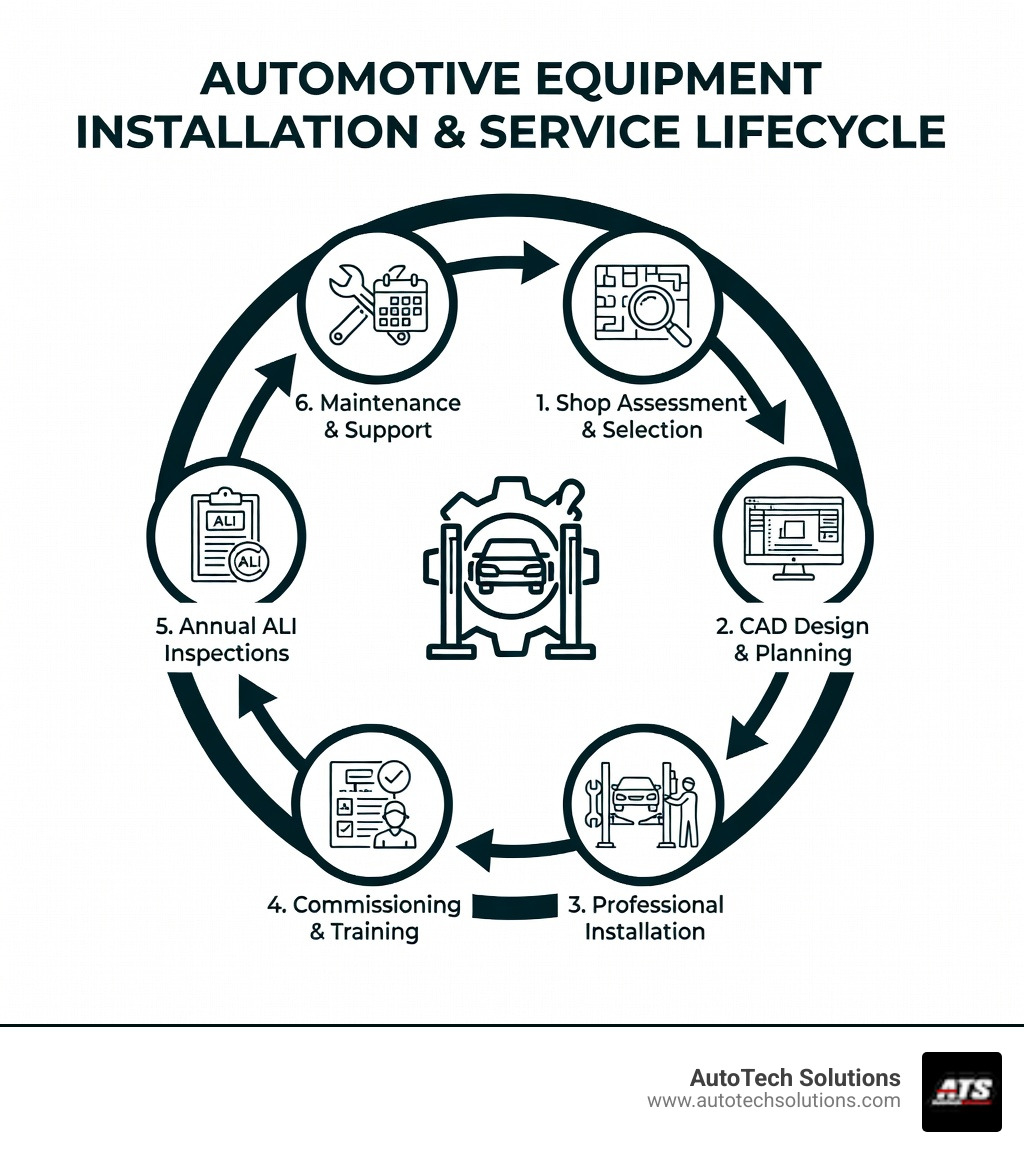
Automotive equipment installation and service covers the full lifecycle of shop equipment — from selecting and installing vehicle lifts and alignment systems to ongoing maintenance, inspections, and repairs that keep your facility running safely and profitably.
Here is a quick overview of what professional service typically includes:
- Sales and selection - choosing the right equipment for your shop's needs and vehicle types
- Installation - proper mounting, anchoring, and commissioning by certified technicians
- Inspections - annual ALI-certified lift inspections required for safety and compliance
- Preventative maintenance - scheduled service to reduce breakdowns and downtime
- Emergency repair - fast response when equipment fails unexpectedly
- Project management - CAD design, permitting, and full facility buildouts
Running a busy service facility means your equipment cannot let you down. A lift that fails mid-job, an alignment rack that drifts out of spec, or a compressor that quits on a Monday morning — these aren't just frustrating. They cost you money, productivity, and customer trust.
But here's the problem many shop managers run into: equipment is only as reliable as the people who install and maintain it. Cutting corners on installation — wrong anchor depth, insufficient concrete thickness, skipped calibration — creates safety hazards and expensive callbacks down the road.
This guide walks you through everything you need to know about professional automotive equipment installation and service, so you can make smarter decisions for your shop.
Essential Types of automotive equipment installation and service
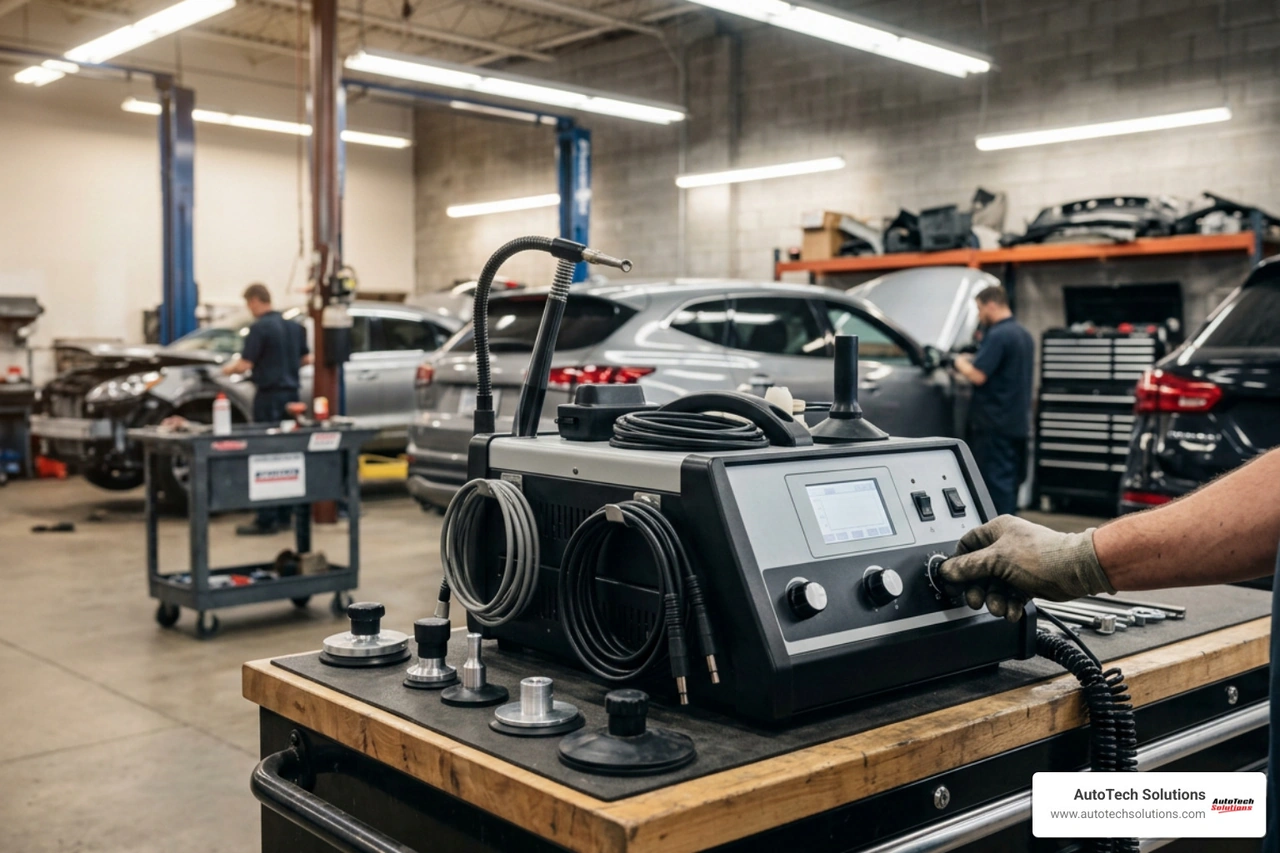
When we talk about outfitting a modern garage, we aren't just talking about a few wrenches and a floor jack. Modern automotive equipment installation and service involves highly sophisticated machinery that requires precise calibration and heavy-duty structural mounting. Whether you are running an independent repair shop in Novi, MI, or a massive dealership in Charlotte, NC, the core equipment remains the heartbeat of your operation.
At AutoTech Solutions, we specialize in the Products that keep these bays moving. This includes everything from the air compressors that power your tools to the complex Shop Design and Consulting required to make sure your workflow isn't bottlenecked by poor equipment placement.
Common equipment types we handle include:
- Vehicle Lifts: The literal backbone of the shop, ranging from light-duty two-posts to massive heavy-duty four-posts.
- Wheel Service Tools: High-speed balancers and tire changers that handle everything from low-profile performance tires to bus wheels.
- Lubrication Systems: Bulk fluid tanks, pumps, and reels for oil, coolant, and grease.
- Exhaust Removal: Systems designed to keep your technicians safe by venting harmful gases out of the workspace.
- Compressed Air: The "utility" of the shop, requiring professional piping and compressor setup to ensure consistent pressure.
Precision Wheel Service and Alignment Systems
In wheel service, accuracy is everything. A fraction of a degree in alignment or a few grams off in balance can lead to premature tire wear and unhappy customers. We lean heavily on Hunter products because their award-winning R&D team has developed hundreds of patented features that make these tools the most productive in the industry.
For example, the HD Elite™ Wheel Balancer uses a patented vision system to automate dimension entry. This isn't just a "cool gadget"—it eliminates manual errors and speeds up the process significantly. When you combine this with diagnostic balancers that can solve vibration issues that standard balancers miss, your shop's productivity skyrockets.
Professional installation ensures these units are perfectly level and calibrated from day one. If a balancer isn't anchored or leveled correctly, the internal sensors can give "ghost" readings, leading to a cycle of re-balancing that wastes your technicians' time.
Heavy-Duty and Light-Duty Vehicle Lifts
Selecting the right lift is about more than just weight capacity; it’s about how you use your space. Automotive Lift Installation is a high-stakes task. Whether it's a two-post lift for quick service or a heavy-duty four-post for commercial trucks, the installation must follow strict manufacturer specs.
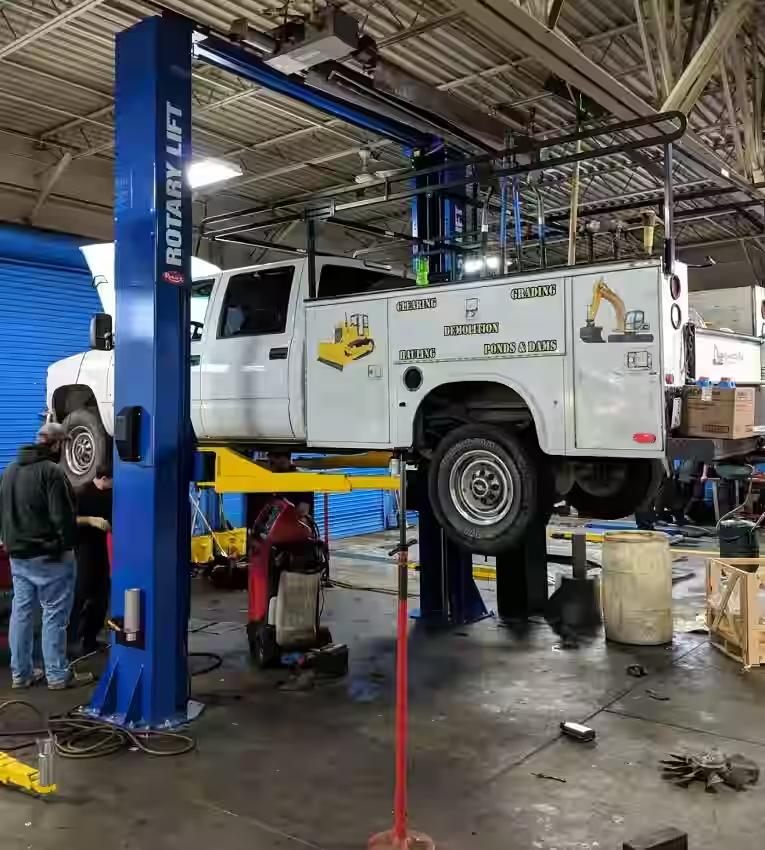
To help you decide which is right for your bay, consider these standard requirements:
| Feature | 2-Post Lift | 4-Post Lift |
|---|---|---|
| Primary Use | General repair, brakes, suspension | Alignments, storage, heavy-duty |
| Concrete Req. | 4" to 6" (3000 PSI min) | 4" (3000 PSI min) |
| Space Footprint | Compact | Larger footprint |
| Lifting Capacity | Typically 9k – 18k lbs | Typically 7k – 60k+ lbs |
| Installation | Requires heavy anchoring | Can be bolt-down or portable |
For heavy-duty applications, such as those found in municipal fleets or bus depots, we often install specialized pit racks or galvanized four-post lifts. These are designed to withstand the grit and grime of heavy-duty environments while providing up to 35,000 lbs of lifting capacity.
Why Professional automotive equipment installation and service is Critical
It might be tempting to think, "It's just some bolts and a motor, my guys can handle it." But professional automotive equipment installation and service is about much more than just getting the machine to turn on. It is about Service, Repair and Equipment Support that protects your investment and your employees.
According to the Automotive Service Technicians and Mechanics Occupational Outlook, modern vehicles are becoming increasingly complex, integrating electronic sensors for braking and accident avoidance. The equipment used to service these vehicles must be equally precise. If your lift is slightly out of level, or your alignment rack isn't perfectly calibrated, you risk damaging these sensitive vehicle systems.
The Importance of Professional automotive equipment installation and service for Safety
Safety isn't just a buzzword; it's a regulatory requirement. The Automotive Lift Institute (ALI) and ANSI standards dictate how lifts should be installed and maintained. Professional installers ensure that every safety latch, equalizing cable, and hydraulic limit switch is functioning exactly as intended.
Beyond the initial setup, Preventative Maintenance Programs are essential. Annual ALI-certified inspections are a preventable measure to avoid:
- Loss of productivity: A broken lift is a dead bay that generates zero revenue.
- Costly repairs: Catching a frayed cable during an inspection costs hundreds; replacing a crashed carriage costs thousands.
- Dangerous conditions: The safety of your technicians is paramount. A sudden mechanical failure can be catastrophic.
Technical Requirements for Secure Equipment Mounting
The foundation is the most overlooked part of equipment setup. Most two-post lifts require a minimum of 4-1/4 inches of 3000 PSI concrete. If your floor has cracks within 36 inches of the base plates or seams within 6 inches, the structural integrity of the lift is compromised.
During a professional Automotive Equipment Repair or installation, we use specialized tools to ensure every anchor bolt is torqued to exactly 150 ft-lbs. If the concrete is too thin or too weak to hold that torque, the lift could literally pull out of the floor under load. We also manage hydraulic pressures—often up to 3000 psi—ensuring that lines are bled of air and fittings are sealed to prevent the "spongy" lifting or fluid leaks that plague DIY installations.
Expert Qualifications for automotive equipment installation and service Technicians
Who is actually turning the wrenches on your equipment? In our industry, experience is measured in years and thousands of hours. An MECP Skilled Certification is the industry standard for installation technicians, requiring mastery of modern vehicle systems and aftermarket integration.
Furthermore, becoming a journeyperson in the automotive trade is no small feat. It typically requires an apprenticeship of roughly 7,220 hours. This includes:
- 6,500 hours of on-the-job work experience.
- 720 hours of in-school technical training.
When you hire AutoTech Solutions, you are getting technicians who have spent years learning the nuances of hydraulics, electronics, and structural mechanics. This level of expertise is what allows us to provide fast repair responses across our service areas from Michigan to the Carolinas.
Specialized Training and Certification Standards
Beyond general mechanical knowledge, our technicians undergo factory-specific training. This is vital because a Rotary lift has different service requirements than a Challenger or a Hunter alignment rack.
Technicians must be proficient in:
- Diagnostic Software: Using PC-based oscilloscopes and scan tools to troubleshoot equipment control boards.
- Hydraulic Repair: Understanding the flow, seals, and valving of high-pressure systems.
- Electrical Systems: Safely handling the 208-230V power units that drive shop machinery.
- Compliance Standards: Staying up to date with Automotive Service Technician - Skilled Trades Ontario guidelines and local U.S. safety regulations.
Best Practices for Selecting and Installing Shop Equipment
The most successful shop owners don't just buy equipment; they plan for it. A "turnkey" approach to Installations, Upfits & Facility Buildouts involves looking at the big picture.
- Workflow Optimization: Use CAD design to visualize how a vehicle moves from the parking lot to the lift, then to the alignment rack. Poor placement can cost a technician 10 minutes per car—that adds up to hours of lost labor every week.
- Future-Proofing: Are you prepared for the weight of electric vehicles? EVs are significantly heavier than their internal combustion counterparts. Installing a 12,000 lb lift today might save you from needing an upgrade in three years.
- Project Management: Professional installers handle the "boring" but critical stuff—permits, air piping, and electrical coordination. This prevents the dreaded "change order" that blows your budget mid-project.
Frequently Asked Questions about Shop Equipment
How often should automotive lifts be inspected?
Annual inspections are the industry standard and, in many jurisdictions, a legal requirement for shop safety compliance. These inspections must be performed by ALI-certified technicians who check everything from the structural integrity of the columns to the functionality of the safety locks. Regular inspections are a "preventative measure" that helps you avoid unexpected downtime and ensures you stay compliant with OSHA and insurance requirements.
What are the concrete foundation requirements for lifts?
For most standard 2-post lifts, you need a minimum of 4-1/4 inches of 3000 PSI reinforced concrete. However, for heavier 12,000 lb or 14,000 lb lifts, we often recommend 6 inches or more. The concrete must be fully cured (usually 28 days) before anchors are drilled. If your floor doesn't meet these specs, we can perform "slab-on-grade" repairs or pour new footings to ensure the lift is safely secured.
What financing options are available for new equipment?
Purchasing high-end equipment like Hunter alignment systems or heavy-duty lifts is a major capital investment. Most leading providers offer financing through specialized industry lenders. The goal is to ensure the monthly revenue generated by the new equipment (the ROI) far exceeds the monthly lease payment. We can help guide you through the support services and sales process to find a plan that fits your shop's cash flow.
Conclusion
At AutoTech Solutions, we know that your shop is more than just a building—it’s a precision machine. From our headquarters in Novi, MI, to our service hubs in Charlotte, Raleigh, and Wade, NC, we are dedicated to providing the most reliable automotive equipment installation and service in the industry.
Whether you need a single lift installed in a home garage or a full-scale Installations, Upfits & Facility Buildouts for a new dealership, we lead with service. Our goal is always to minimize your downtime and maximize your shop's potential. Don't risk your safety or your bottom line by "bolting it alone"—trust the experts who have the certifications, the experience, and the passion to do it right the first time.