
Understanding the Different Types of Automatic Parts Washers

Are you searching for an automatic parts washer for sale? For managers of busy automotive shops, industrial facilities, and manufacturing plants, finding the right cleaning solution is critical. These powerful machines streamline a labor-intensive task, ensuring parts are thoroughly cleaned while boosting efficiency and safety across your operations.
When considering an automatic parts washer, here's what to keep in mind:
- Boosts Efficiency: Automates the cleaning process, allowing your team to focus on higher-based tasks.
- Improves Safety: Reduces manual handling of dirty parts and exposure to harsh cleaning agents.
- Saves Money: Lowers labor costs, extends the lifespan of components, and reduces maintenance needs.
- Versatile Options: Available in various types, including aqueous (water-based) and solvent-free systems, and different loading styles.
- Industry Standard: The global industrial parts washer market is growing, projected to reach $1.6 billion by 2030, reflecting the increasing demand for automated cleaning.
This guide will walk you through everything you need to know to select the perfect automatic parts washer for your operation.

When you begin looking at an automatic parts washer for sale, you'll quickly realize there isn't a "one size fits all" machine. The market offers several configurations designed to handle everything from tiny carburetor needles to massive 2,500-lb diesel engine blocks. At AutoTech Solutions, we've seen how choosing the right configuration can make or break a shop's workflow.
Top-Load Spray Cabinets
These are the "compact heroes" of the parts washing world. Ideal for smaller components and shops with limited floor space, top-load washers allow you to drop parts into a basket or onto a turntable from above. They typically use high-pressure spray manifolds to blast away grease.
Front-Load Spray Cabinets
For heavier lifting, front-load models are the industry standard. They feature a large door that opens to reveal a turntable. These are perfect for heavy engine components because you can often use a hoist or a crane to position parts directly onto the turntable.
Immersion and Agitation Lift Systems
Sometimes, a spray isn't enough. Immersion washers submerge the entire part in a heated cleaning solution. Agitation lift systems take this a step further by moving the part up and down through the liquid, creating a "scrubbing" action that reaches deep into blind holes and internal galleries.
Ultrasonic Washers
For precision cleaning - think fuel injectors or delicate aerospace components - ultrasonic washers use high-frequency sound waves to create cavitation bubbles. These bubbles implode against the part surface, microscopically scrubbing away contaminants without damaging the base material.
| Feature | Aqueous Systems | Solvent-Based Systems |
|---|---|---|
| Cleaning Agent | Water + Biodegradable Detergent | Petroleum or Synthetic Solvents |
| Safety | Non-flammable, Low VOCs | Flammable, High VOCs |
| Environmental | Eco-friendly, easier disposal | Requires hazardous waste hauling |
| Heat | Required for effectiveness | Often works at room temp |
| Cost | Lower long-term chemical cost | Higher disposal and chemical costs |
For a deeper dive into these systems, you can explore our full catalog of automatic parts washers.
Comparing Aqueous and Solvent-Based Automatic Parts Washer for Sale Options
The industry is shifting rapidly toward aqueous (water-based) cleaning. Why? Because it's safer for our teams and better for the planet. Aqueous washers use a combination of heat, high-pressure spray, and biodegradable detergents to break the molecular bond between the grime and the metal.
Unlike old-school solvent tanks that can be harsh on the skin and lungs, aqueous systems are typically solvent-free. This reduces the risk of fire and eliminates the need for expensive hazardous waste contracts. When you look at modern industrial parts washing standards, you'll see that modern detergents are now just as effective as solvents, especially when heated to the 150-180°F range.
Key Features to Look for in an Automatic Parts Washer for Sale
Buying a parts washer is an investment in your shops future. To ensure you get the best ROI, you need to look past the paint color and focus on the technical specs.
- Turntable Diameter and Working Height: Measure your largest part. Then add a few inches. If youre cleaning diesel heads, a 28-inch or 36-inch turntable is usually the minimum.
- Load Capacity: Don't just think about size; think about weight. Heavy-duty front-loaders can handle 1,000 to 2,500 lbs. Overloading a turntable will lead to premature motor failure.
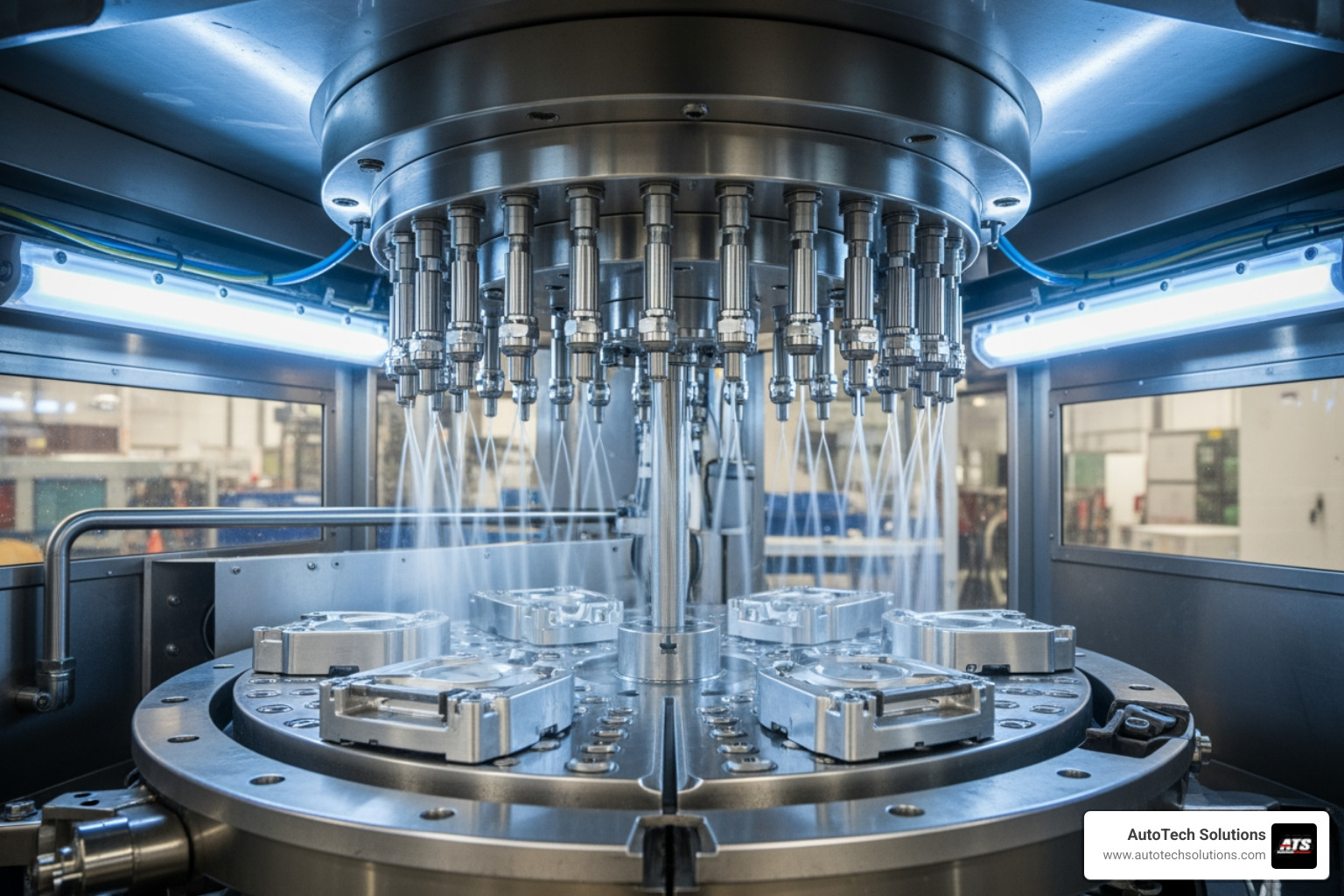
- Pump Performance (GPM and PSI): The pump is the heart of the machine. A high-flow pump (e.g., 110 GPM at 50 PSI) ensures that enough volume hits the part to flush away loosened debris.
- Heating Elements: Look for powerful heaters (9 kW to 18 kW) that can bring the water up to temperature quickly and maintain it during heavy use.
- Oil Skimmers: This is a "must-have" feature. An integrated oil skimmer removes floating oil and grease from the top of the water, significantly extending the life of your cleaning solution.
If you ever run into trouble with these components, our team at AutoTech Solutions provides expert equipment support services to keep your machines running at peak performance.
Determining the Best Automatic Parts Washer for Sale for Heavy-Duty Applications
In heavy-duty settingslike OTR truck repair or construction equipment maintenancethe requirements change. You need a vertical seal-less pump. Standard pumps with mechanical seals often fail when exposed to the abrasive "sludge" found in heavy-duty cleaning. A seal-less design eliminates this common point of failure.
You should also look for "Sump Capacity." A larger sump (100+ gallons) stays cleaner longer because the dirt has more room to settle at the bottom, away from the pump intake. For technical drawings and deeper specs, you can access technical resources on our site.
Improving Shop Efficiency and Safety with Automated Cleaning
We’ve all seen it: a skilled technician standing over a manual sink with a brush for forty minutes. That’s forty minutes of billable time lost. By switching to an automatic parts washer for sale, that technician can "set it and forget it." They load the part, turn the timer, and walk away to perform an oil change or a brake job.
Labor and Efficiency Gains
The math is simple. If an automatic washer saves just one hour of labor per day, it can pay for itself in less than a year. Statistics show that the automotive repair industry is the largest consumer of these machines precisely because labor is the highest expense in the shop.
Safety and Compliance
Safety isn't just a buzzword; it's about protecting your people.
- Fire Safety: Many units come with a "fusible link" on the lid. In the event of a fire, the link melts, and the lid slams shut to smother the flames.
- Low Water Shut-off: This prevents the heating elements from burning out if the water level gets too low, protecting your investment.
- Door Safety Switches: These automatically stop the pump if someone opens the door during a cycle, preventing hot water burns.
Selecting the Right Size and Capacity for Your Industry
Your industry dictates your needs. We serve a wide range of clients from our locations in Novi, MI, down to Raleigh and Charlotte, NC. Here is how we typically categorize needs:
- Automotive and Light Truck: Usually requires a top-load or mid-sized front-load washer (24" to 30" turntable).
- Diesel and Heavy Equipment: Requires large front-load cabinets with 1,000+ lb capacities to handle engine blocks and transmissions.
- Manufacturing and Factory Parts: Often requires high-throughput systems or "pass-through" washers that can handle a high volume of small parts consistently.
- Agriculture and Oil Services: These industries deal with thick, baked-on mud and crude. They need high-PSI systems and robust filtration to handle the heavy solids.
When selecting, always consider your "throughput." How many parts do you need to clean per shift? If the machine is always running, you might need a larger unit or a second machine to avoid a bottleneck.
Maintenance and Operational Best Practices for Longevity
An automatic parts washer for sale is a rugged piece of equipment, but it isn't indestructible. To get twenty years of service out of your machine, follow these best practices:
- Daily Oil Skimming: Run the skimmer every morning before the water gets agitated. This removes the oils that rose to the top overnight.
- Weekly Sump Inspection: Check the bottom of the tank for "sludge" buildup. If the sludge reaches the pump intake, it will sandblast your nozzles and pump internals.
- Nozzle Alignment: Over time, nozzles can get bumped or clogged. Periodically check the spray pattern to ensure 360-degree coverage.
- Scale Removal: If you have hard water, use a de-scaler to prevent calcium buildup on the heating elements. A scaled-up heater takes longer to reach temperature and uses more electricity.
- Solution Management: Don't just add water; maintain the proper detergent concentration. Too little detergent leads to poor cleaning; too much is a waste of money.
Frequently Asked Questions about Automatic Parts Washers
What is the typical cost range for an automatic parts washer?
The price varies wildly based on capacity. A small, 20-gallon manual-to-automatic hybrid for a hobbyist might cost around $1,300. However, professional-grade industrial aqueous washers typically range from $6,000 to $25,000+. Factors influencing the price include pump horsepower, heating capacity, stainless steel construction, and advanced filtration upgrades. While the upfront cost is higher, the ROI is usually achieved quickly through labor savings.
How often does the cleaning solution need to be changed?
This depends on your "soil load." A shop cleaning greasy engine parts will need to change the water more often than a shop cleaning light dust from machined parts. However, with a high-quality oil skimmer and a full-flow filtration system, many shops find they only need to perform a full sump clean-out every 3 to 6 months.
Are aqueous parts washers as effective as solvent-based ones?
Absolutely. The secret is the "Triple Threat": Heat, Chemistry, and Mechanical Action. When you heat water to 170°F and mix it with the right biodegradable detergent, it softens grease instantly. The high-pressure spray then provides the mechanical force to blast the grease away. In many "blind-hole" tests, heated aqueous spray cabinets actually outperform cold solvent soaking.
Conclusion
Finding the right automatic parts washer for sale doesn't have to be a daunting task. By focusing on your specific industry needs—whether you're in a diesel shop in Raleigh, NC, or a manufacturing plant in Novi, MI—you can select a machine that will save you time, money, and headaches for years to come.
At AutoTech Solutions, we pride ourselves on being your one-stop-shop. From the Carolinas to Michigan, we don't just sell you a machine; we provide the installation, preventative maintenance, and fast repair response you need to minimize downtime. Our expert support ensures that when your equipment is down, your shop isn't.
Ready to upgrade your cleaning process? Browse our full catalog of automatic parts washers or contact us today to find the perfect fit for your facility.