Why the Right Spray Gun Cleaning Machine Can Make or Break Your Shop's Productivity
A spray gun cleaning machine is one of the most overlooked — yet most impactful — pieces of equipment in a professional collision or paint shop.
Quick Answer: Best Spray Gun Cleaning Machines by Shop Need
| Shop Need | Best Fit |
|---|---|
| High-volume production shop | Fully automatic dual-gun washer (e.g., UG4000D, Crystal Clean 2784) |
| Mid-size collision repair facility | Semi-automatic air-operated twin-gun cleaner |
| Budget-conscious or smaller shop | Manual enclosed solvent washer with filtration |
| Eco-compliance or waterborne paint system | Aqueous or citrus-based automatic cleaning system |
Here's the reality: every minute a technician spends manually flushing a spray gun is a minute not spent painting. Multiply that across a busy shop with multiple painters, and you're looking at a serious drag on throughput and profitability.
Beyond time, there's the compliance side. Solvents used in traditional gun cleaning emit VOCs, create fire hazards, and generate hazardous waste — all of which carry real regulatory and liability risk for shop operators.
The good news? Modern spray gun washers can clean two guns and their cups in under 60 seconds, dramatically cut solvent consumption, and help your facility stay on the right side of environmental regulations.
This guide breaks down the top options across every budget — so you can find the right machine for your shop's volume, paint system, and compliance requirements.
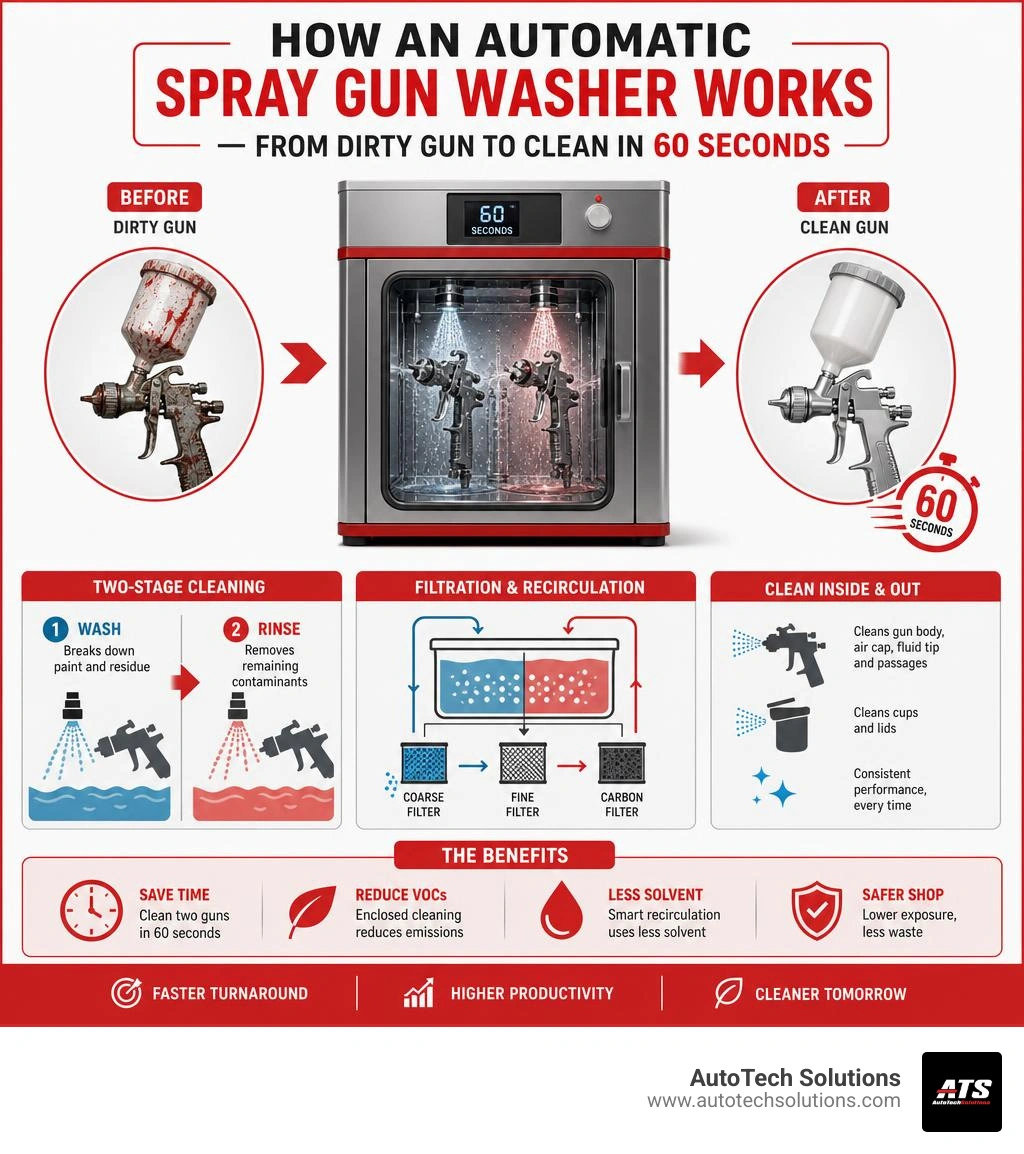
Spray gun cleaning machine vocabulary:
What is a Spray Gun Cleaning Machine and How Does It Work?
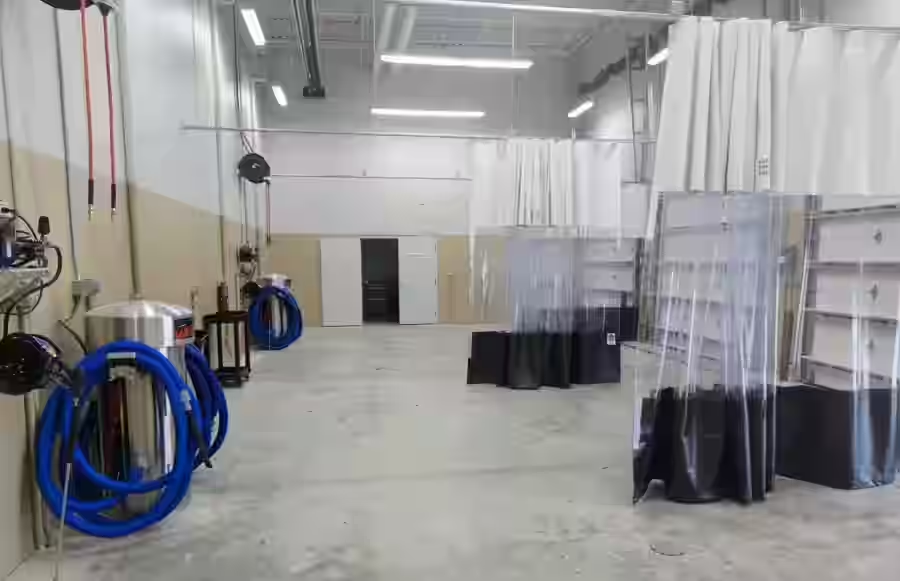
At its core, a spray gun cleaning machine is an enclosed workstation designed to flush, wash, and rinse paint spray guns after use. Instead of a technician standing over a sink with a brush and open thinner, these machines automate the process. They use air pressure, specialized pumps, and strategically placed nozzles to clear paint residue from both the internal fluid passages and the external body of the gun.
Having high-quality cleaning systems on hand is just as crucial as having the right Auto Collision Repair Tools for structural repair operations. Without clean guns, even the best refinishing work will be compromised by a poor paint finish.
The Mechanics of a Spray Gun Cleaning Machine
These machines are typically powered by compressed air rather than electricity, which eliminates the risk of electrical sparks in volatile paint-mixing rooms.
When a technician places a spray gun inside, they hook up the gun’s fluid passageway to a specialized nozzle. An air-operated diaphragm pump (such as a Kalrez pump) draws cleaning solvent or water-based fluid from an underlying reservoir and forces it through the machine's internal spray jets.
Advanced systems, like the Fast Mover Air Operated Twin Spray Gun Cleaner (FMT3067) , use high-velocity fluid streams to wash two guns and two paint pots simultaneously. Many units feature an automatic timer. Once the lid is closed and the timer is set, the machine runs for 40 to 60 seconds, utilizing a series of swirl-action jets to blast away wet or dried paint before executing a clean rinse and air-flush drying cycle.
Manual vs. Automatic Spray Gun Washers
While manual spray gun washers still exist—featuring foot-pedal-operated flow-through brushes and sink-style basins—the industry has heavily shifted toward enclosed automatic cabinets.
| Feature | Manual Washers | Enclosed Automatic Washers |
|---|---|---|
| Labor Time | 5–10 minutes per gun | < 60 seconds (hands-free) |
| Solvent Evaporation | High (open to shop air) | Minimal (fully enclosed cabinet) |
| Worker Exposure | High inhalation & skin contact risk | Extremely low (integrated fume extraction) |
| Consistency | Highly dependent on technician effort | Uniform, repeatable inside-out cleaning |
For high-production facilities, investing in an automatic solvent spray gun washer like the Automatic Solvent Spray Gun Washer | Solutex is a no-brainer. It frees up technicians to prep the next job while the machine does the dirty work.
Key Types of Spray Gun Cleaners and Solvent Options
Choosing the right cleaner depends heavily on the paint chemistry your shop uses. If you are sourcing your Auto Body Shop Supply Near Me, you must decide between solvent-based, water-borne, or hybrid cleaning configurations.
Solvent-Based vs. Water-Based Spray Gun Cleaning Machine Systems
Traditional solvent-based paints require chemical thinners (like xylene or acetone) to dissolve cured paint binders. Solvent-based washers are highly effective but come with strict VOC (Volatile Organic Compound) limits, flammability hazards, and higher waste disposal costs.
With the rise of waterborne paint systems, water-based (aqueous) spray gun cleaners have become standard. Unlike solvents that dissolve paint, water-based cleaners use surfactants to lift paint binders away from the metal. Systems like the Paint Gun Washers | US manufacturer of Herkules, EnKon and ... or the Paint Gun Cleaning | Spraygun Cleaning Machine - Crystal Clean are specifically engineered to optimize waterborne paint removal, often incorporating coagulation powders to separate paint solids from the water for easy filtration.
Alternative and Aqueous Cleaning Solutions
Many shops in 2026 are adopting eco-friendly alternative chemistries. These include:
- Aqueous Solutions: Formulated with water and specialized detergents (such as Mirachem QX483). They are non-flammable, low-VOC, and highly effective for waterborne paints.
- Citrus-Based (d-limonene) Solutions: These natural solvents are derived from citrus peels. They lift paint effectively and reduce chemical hazards, though they require dedicated filtration systems. On average, citrus-based filters are changed once a month, while the core cleaning solution only needs replacement once or twice a year.
- Hybrid Systems: Some advanced machines, such as the Automatisches Reinigungssystem für Lackierpistolen , utilize specialized low-VOC formulas like PROLAQ WS (which has 45% VOC content and requires no hazardous labeling) alongside a water-based, surfactant-free rinse. This reduces traditional solvent consumption by 5 to 10 times.
Essential Features to Look For When Buying a Spray Gun Washer
Before browsing an Automatic Parts Washer for Sale, make sure the spray gun cleaning cabinet you select has the right industrial-grade features:
- Construction Material: Look for a welded, high-grade stainless steel wash chamber. It resists chemical corrosion and provides a bright, reflective interior without light-absorbing plastic.
- Pump Reliability: The pump is the heart of the machine. Premium models use a Kalrez diaphragm pump, which is highly resistant to over 1,800 different chemical compounds, ensuring years of trouble-free operation.
- Safety Certifications: Look for ATEX-approved (Zone 1 or Zone 2) and CE/UKCA-compliant units. Because these machines operate in explosive atmospheres, compliance with fire and explosion codes is non-negotiable.
- Lid Safety Interlocks: The air supply should automatically shut off the moment the cabinet lid is opened to prevent solvent blowback.
- Integrated Fume Extraction: Built-in extraction vents should pull toxic vapors away from the operator when the lid is raised.
Here is a quick look at how entry-level units compare to high-capacity commercial spray gun washers:
| Feature | Entry-Level Air-Powered Washer | Premium Multi-Gun Washer |
|---|---|---|
| Typical Model | Power-TEC 92544 Air Powered Spray Gun Washer | Automatic Spray Gun Cleaner - Guan Piin Painting Professional Spraying, Conveying and Mixing Solutions |
| Capacity | 2 Guns (Suction or Gravity) | 2 Guns + 2 Paint Cups simultaneously |
| Average Wash Cycle | 40–60 seconds | 60 seconds (Solvent wash + Clean rinse + Air flush) |
| Pump Type | Standard Diaphragm Pump | Heavy-Duty Dual Pumps (Wash & Brush) |
| Best For | Medium-duty collision shops | High-volume production & industrial lines |
Maximizing Efficiency and Regulatory Compliance in the Shop
Operating a spray gun cleaning machine isn't just about saving labor time; it's also about environmental compliance and waste reduction.
To keep your shop running smoothly and avoid costly downtime, consult our Automotive Shop Equipment Repair Guide to implement a solid preventative maintenance schedule.
1. Implement Two-Stage Cleaning
Two-stage cleaning is the single best way to extend solvent life and reduce hazardous waste disposal costs.
- Stage 1 (Pre-Wash): The machine cycles used, dirty solvent to flush out the bulk of the wet paint residue.
- Stage 2 (Final Rinse): The machine sprays a small metered amount of completely fresh, clean solvent (typically only 100 cc per cycle) to clear away any remaining film.
- The Cycle: When the Stage 1 solvent becomes too heavily soiled, it is discarded or recycled. The Stage 2 solvent is then moved to the Stage 1 reservoir, and fresh solvent is added to Stage 2.
2. Use Disposable Paint Cup Liners
Using disposable cup liners in your paint booth virtually eliminates the need to clean traditional paint pots. This simple practice reduces solvent consumption and hazardous waste volume by up to 70%.
3. Ensure Proper Venting
Ensure your automatic venting systems are properly calibrated. The extraction fan should only run when the cabinet lid is open. If the exhaust fan runs continuously, it will accelerate solvent evaporation, wasting expensive chemicals and venting VOCs unnecessarily.
Frequently Asked Questions about Spray Gun Washers
How fast can a spray gun cleaning machine clean a gun?
Most automatic air-powered spray gun washers complete a full wash, rinse, and air-flush drying cycle in 40 to 60 seconds. High-capacity dual-gun washers can clean two complete spray guns and two paint pots simultaneously in under a minute, drastically reducing the bottlenecks common in busy paint mixing rooms.
What safety and fire codes apply to spray gun washers?
Because spray gun cleaners handle highly flammable solvents and operate in volatile mixing rooms, they must comply with strict fire codes and environmental regulations. Look for units with ATEX Zone 1 or Zone 2 certification and CE/UKCA compliance. Key safety features must include an automatic air shutoff when the lid is opened, a grounding wire to prevent static discharge, and integrated vapor extraction.
How do you maintain a spray gun washer to minimize operational costs?
Regular maintenance is essential to prevent paint sludge from destroying internal pumps and nozzles.
- Daily: Wipe down the stainless steel chamber and clean the drain strainer.
- Weekly: Check the inline fluid filters and replace them if pressure drops. Clear paint buildup from the spray nozzles.
- Monthly: Flush the system to remove accumulated sludge and inspect the diaphragm pump for wear.
If your washer stops pumping or experiences a pressure loss, prompt professional Automotive Equipment Repair is critical to prevent paint from drying inside your technicians' expensive spray guns.
Conclusion: Keep Your Paint Line Moving with AutoTech Solutions
A high-performing spray gun cleaning machine is an investment that pays for itself in reclaimed technician hours, reduced solvent purchases, and lower waste disposal fees.
At AutoTech Solutions, we understand that paint booth downtime is a bottleneck your shop cannot afford. As a comprehensive provider of automotive equipment sales, installation, service, and preventative maintenance across Michigan and the Carolinas (including our hubs in Charlotte, NC, Raleigh, NC, Wade, NC, and Novi, MI), we focus on keeping your collision center operating at peak efficiency.
Ready to upgrade your paint shop infrastructure or set up a preventative maintenance plan for your spray booth equipment?
Get professional collision center solutions from AutoTech Solutions today, and keep your production line moving without a hitch.