
The Real Cost of Choosing Between Preventive and Curative Maintenance
Preventive and curative maintenance are the two core strategies that determine whether your shop runs smoothly — or grinds to a halt.
Here's the quick answer most shop managers need:
| Preventive Maintenance | Curative Maintenance | |
|---|---|---|
| When it happens | Before failure | After failure |
| Goal | Stop problems before they start | Restore equipment to working condition |
| Examples | Compressor oil changes, intake filter swaps, lift belt inspections | Emergency lift repairs, hydraulic cylinder replacement, compressor motor restoration |
| Cost impact | Lower long-term costs | Higher per-event costs (3-5x more than planned work) |
| Best for | Critical, high-use equipment | Non-critical assets or unpredictable failures |
The short version: no shop can run on one strategy alone. You need both — and the ratio matters.
In a busy automotive service or collision facility, equipment downtime isn't just an inconvenience. It stops technicians cold, delays customer vehicles, and burns through budget fast. Unplanned downtime in manufacturing environments can cost anywhere from $50,000 to $250,000 per hour — and shop-floor failures carry the same logic, just at a smaller scale.
Yet despite the clear numbers, more than 55% of maintenance activity in the average facility is still purely reactive. Teams fix things after they break, pay premium rates for emergency labor and expedited parts, and repeat the cycle.
The good news? A smarter approach exists — and it doesn't mean abandoning curative maintenance entirely. It means combining both strategies intentionally, so your shop infrastructure stays productive, your costs stay predictable, and your technicians stay working.
This guide breaks down how both strategies work, why you need them together, and how to build a program that actually holds up in a real shop environment.
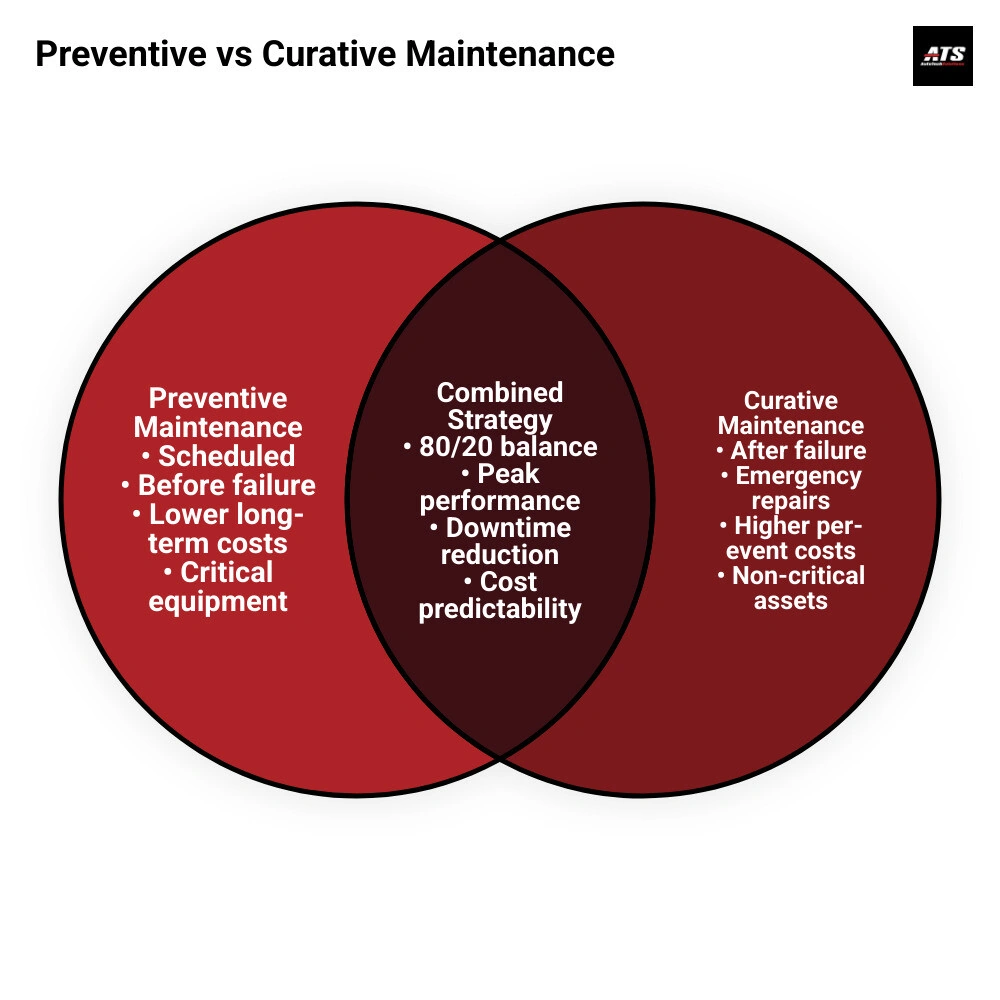
Common preventive and curative maintenance vocab:
Defining Preventive and Curative Maintenance in the Modern Shop
As we look toward the landscape of May 2026, the terminology in the maintenance world has sharpened. While "preventive" and "curative" might sound like medical terms, they are the lifeblood of asset reliability in a professional B2B shop environment.
At AutoTech Solutions, we see these as two sides of the same coin. Preventive maintenance is proactive care. It is the act of performing tasks on a piece of equipment while it is still in good working order to prevent it from ever failing. This approach ensures that your service bays remain operational and profitable.
Curative maintenance (often used interchangeably with corrective or reactive maintenance) is the act of repairing or replacing a system after a failure has occurred. This is the reactive response required when equipment is ignored for too long, leading to unplanned downtime.
Understanding the Preventive vs. Corrective Maintenance: Key Differences is the first step toward reclaiming your shop's productivity. According to our Preventative Maintenance Service Guide, the goal isn't to eliminate curative work but to manage it so it doesn't manage you.
The Proactive Nature of Preventive and Curative Maintenance Planning
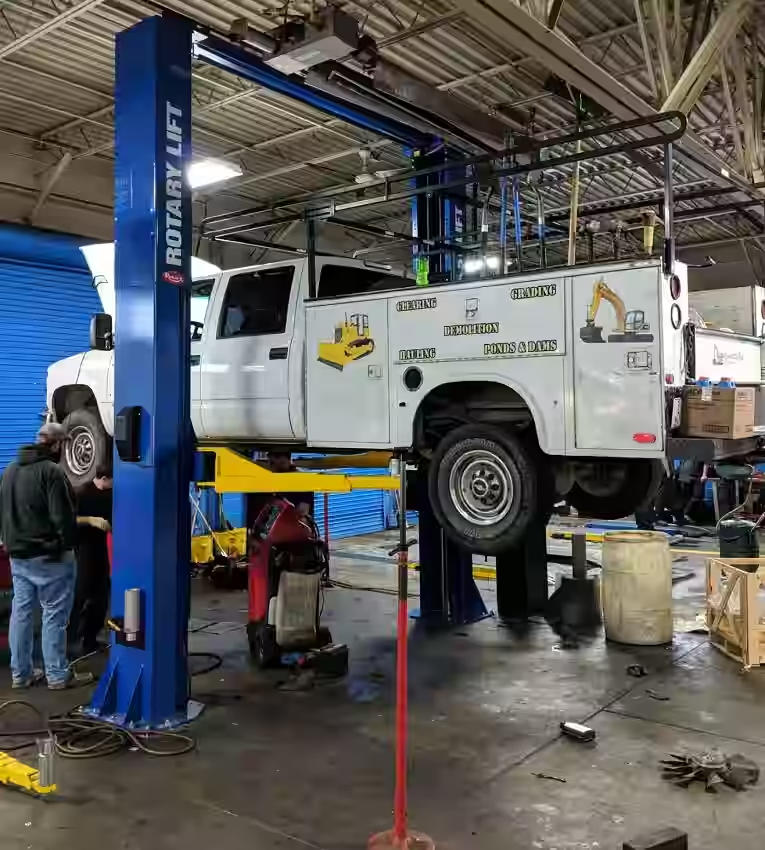
The "preventive" half of the equation is all about the calendar and the clock. It involves scheduled inspections, lubrication of moving parts, and precise calibration of electronic systems. For example, in a heavy-duty shop, a two-post lift requires regular checks on synchronization cables and hydraulic fluid levels. If you catch a frayed cable during a Tuesday morning inspection, you've prevented a catastrophic failure on a Friday afternoon.
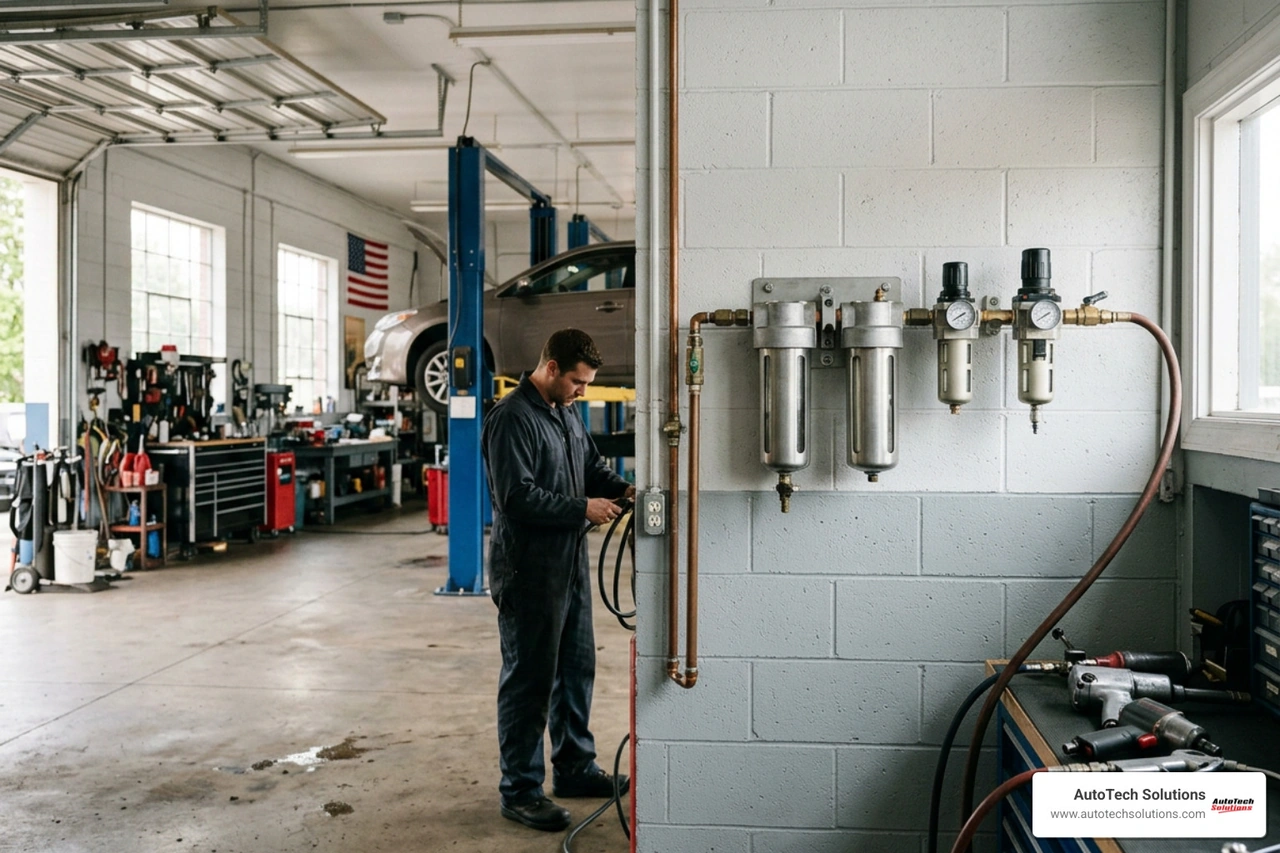
One of the most critical assets in any Michigan or North Carolina shop is the air compressor. Our Air Compressor Preventative Maintenance Guide highlights that these systems are the "heart" of the shop. Preventive tasks here include:
- Changing intake filters to maintain airflow.
- Draining moisture from tanks to prevent internal rust.
- Checking belt tension to ensure efficient power transfer.
- Testing safety relief valves.
By performing these tasks on a schedule, you extend the equipment's life by 30% to 40% and ensure your air tools and lifts always have the pressure they need.
The Necessity of Curative Maintenance
Even with the best planning, parts eventually wear out or fail unexpectedly. This is where curative maintenance steps in. Curative work is focused on restoration. It involves Automotive Equipment Repair such as replacing a blown hydraulic seal, fixing a snapped belt, or restoring a malfunctioning exhaust extraction system.
Curative maintenance is often seen as the "bad guy," but it is a necessary part of a balanced strategy. There are some non-critical assets—like a simple shop fan or a low-cost tool—where it might actually be more cost-effective to "run-to-failure" and simply replace the unit when it dies. The danger arises when curative maintenance becomes the only strategy for critical infrastructure. When your primary air compressor fails without warning, you aren't just paying for a repair; you're paying for the idle time of every technician in the building.
Strategic Benefits of Preventive and Curative Maintenance Integration
The real magic happens when you stop viewing these as competing strategies and start using them as a unified program. Research shows that organizations implementing a structured preventive program can reduce overall maintenance costs by 20% to 40% compared to a purely reactive approach.

| Factor | Reactive (Curative Only) | Integrated (PM + Curative) |
|---|---|---|
| Cost per HP/yr | ~$18 | ~$13 |
| Downtime | High & Unpredictable | Low & Scheduled |
| Safety Risk | Higher (Unexpected failure) | Lower (Controlled monitoring) |
| Asset Lifespan | Shortened | Extended by 30-50% |
When we integrate these at AutoTech Solutions, we focus on the O&M Best Practices Guide which suggests that emergency repairs cost 3 to 5 times more than planned work. This is due to overtime labor, expedited shipping for parts, and the massive opportunity cost of lost service hours.
Cost Savings and ROI Benchmarks
For a shop owner in Novi, MI, or Charlotte, NC, the ROI of Preventative Maintenance Programs is undeniable. Beyond just avoiding repairs, well-maintained equipment is more energy-efficient. A compressor with clean filters and no leaks uses significantly less electricity to maintain the same PSI.
Furthermore, budget predictability becomes a reality. Instead of wondering when a $10,000 repair bill will hit your desk, you can allocate a steady, smaller amount for monthly or quarterly service. This labor optimization allows your team to focus on billing hours rather than troubleshooting broken machinery.
Balancing Preventive and Curative Maintenance for Peak Performance
The industry gold standard is the 80/20 ratio: 80% of your maintenance should be proactive (preventive or predictive), and 20% should be curative.
To achieve this, you need a PMS Planned Maintenance System. This system starts with a "Criticality Assessment." We help shops rank their equipment:
- Tier 1 (Critical): If this breaks, the shop stops (Air compressors, main lifts). These get high-frequency PM.
- Tier 2 (Important): If this breaks, we slow down (Tire changers, alignment racks). These get standard PM.
- Tier 3 (Non-Critical): If this breaks, we can wait (Individual workbenches, shop vacuums). These may stay on a curative-heavy schedule.
By understanding the "failure modes"—the specific ways a machine is likely to break—we can tailor the preventive tasks to catch those specific issues before they manifest.
Implementing a Hybrid Maintenance Program for Shop Infrastructure
Transitioning from a "fix-it-when-it-breaks" culture to a proactive one doesn't happen overnight. It usually takes 12 to 18 months to fully migrate, but the results are worth the effort.
The first step is a complete asset inventory. You cannot maintain what you haven't documented. Our Automotive Shop Equipment Repair Guide recommends tracking the make, model, age, and service history of every major piece of equipment in your shop.
Step-by-Step Implementation Strategy
- Inventory & Rank: List every asset and rank it by criticality.
- Standardize Tasks: Create checklists for each asset based on manufacturer recommendations. For instance, Collision Center Equipment Maintenance requires specific checks on paint booth airflow and filtration that differ from mechanical shop needs.
- Set the Schedule: Use calendar-based triggers (every 6 months) or usage-based triggers (every 2,000 hours).
- Train the Team: Ensure your staff knows how to spot "abnormalities" during their daily use of the machines.
- Track Performance: Measure your Mean Time Between Failures (MTBF). If a machine keeps breaking despite PM, it’s time to adjust the schedule or replace the asset.
The Role of CMMS and IoT in Maintenance Management
In May 2026, we no longer rely on paper logs hanging from a clipboard. Computerized Maintenance Management Systems (CMMS) and the Internet of Things (IoT) have revolutionized the shop floor.
For high-value assets like advanced Paint Booth Maintenance systems, IoT sensors can monitor pressure drops across filters in real-time. Instead of changing a filter because the calendar says so, you change it because the sensor shows it’s actually clogged. This is "Condition-Based Maintenance," a sophisticated sub-type of the preventive strategy.
A CMMS allows us at AutoTech Solutions to provide fast repair response across our service areas. When a work order is generated digitally, our technicians have the full history of that machine at their fingertips before they even arrive at your shop in Raleigh or Wade.
Frequently Asked Questions about Preventive and Curative Maintenance
What is the ideal ratio between preventive and curative maintenance?
The industry-recommended balance is 80% preventive and 20% curative. While 100% preventive sounds great, it is virtually impossible and often leads to "over-maintenance," where you spend more money on inspections than you save on repairs. The 20% curative allowance accounts for those unpredictable "acts of God" or minor, non-critical failures that don't justify a heavy preventive schedule.
How does predictive maintenance differ from standard preventive tasks?
Standard preventive maintenance is scheduled (e.g., "Change compressor oil every 6 months"). Predictive maintenance is data-driven (e.g., "Change the oil because the sensor shows high metal particulate levels"). Predictive maintenance uses tools like vibration analysis, infrared thermography, and IoT sensors to catch failures even earlier than a visual inspection could. It can provide an additional 8% to 12% savings over standard PM alone.
Why is curative maintenance still necessary in a preventive-heavy shop?
No preventive program is perfect. Parts can have manufacturing defects, or a technician might accidentally damage a piece of equipment. Additionally, for low-cost, non-critical assets (like a $50 shop light), it is often cheaper to let it fail and replace it (curative) than to pay a technician to inspect it every month. A smart shop manager knows when to be proactive and when to be strategically reactive.
Conclusion
At AutoTech Solutions, we believe that a shop is only as strong as its weakest piece of equipment. Whether you are running a high-volume dealership in Novi, MI, or a specialized collision center in Charlotte, NC, the integration of preventive and curative maintenance is the only way to ensure long-term profitability and safety.
By shifting your focus from emergency fires to planned care, you reduce downtime by 30% to 50%, extend the life of your expensive assets, and create a safer environment for your technicians. We are here to help you build that bridge. From the initial installation to the long-term Preventative Maintenance Programs that keep your shop humming, our expert support is just a call away.
Don't wait for the next breakdown to realize the value of a plan. Let’s work together to keep your shop moving forward.