Automotive Paint Booth Design Starts With the Airflow Path
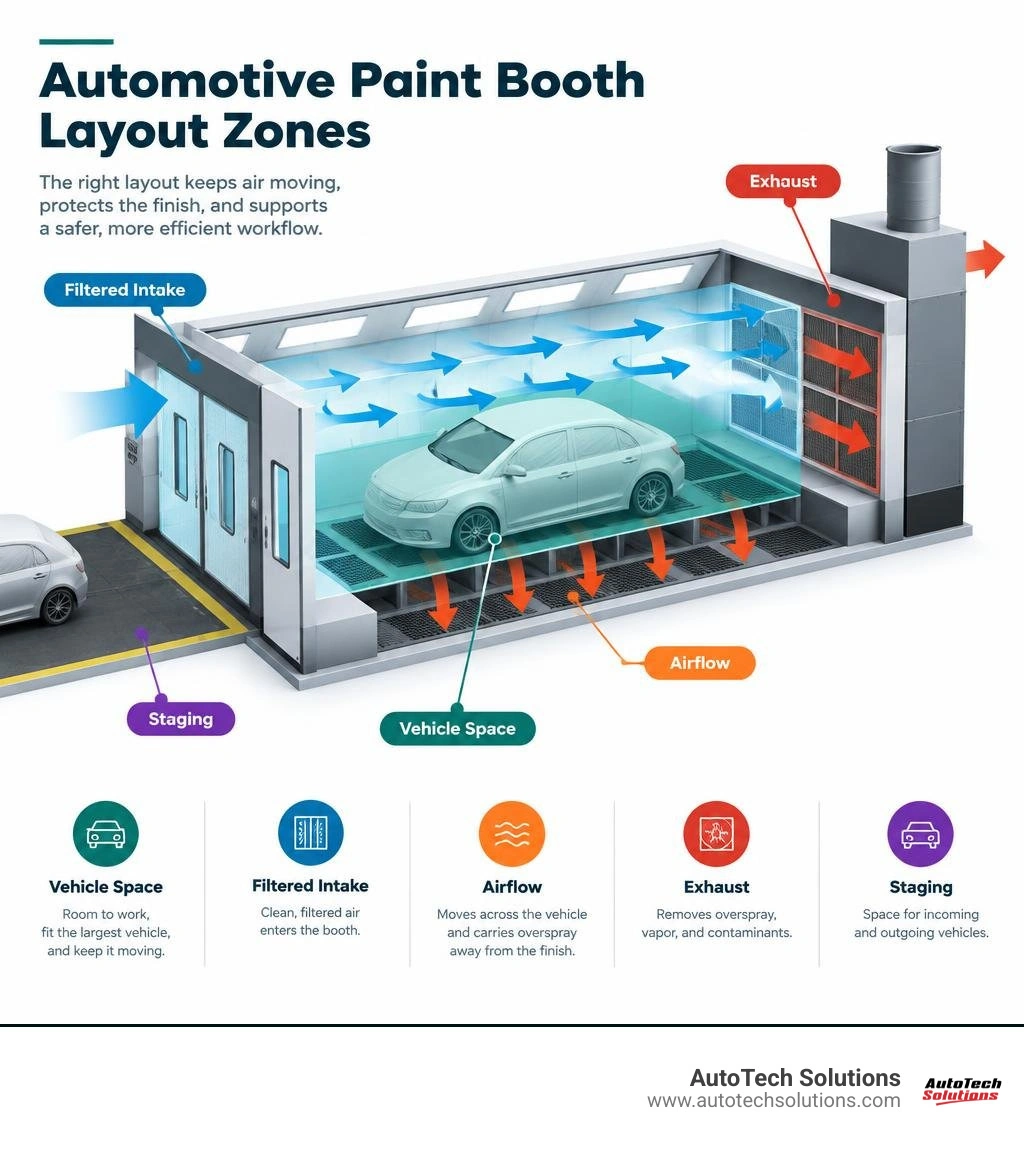
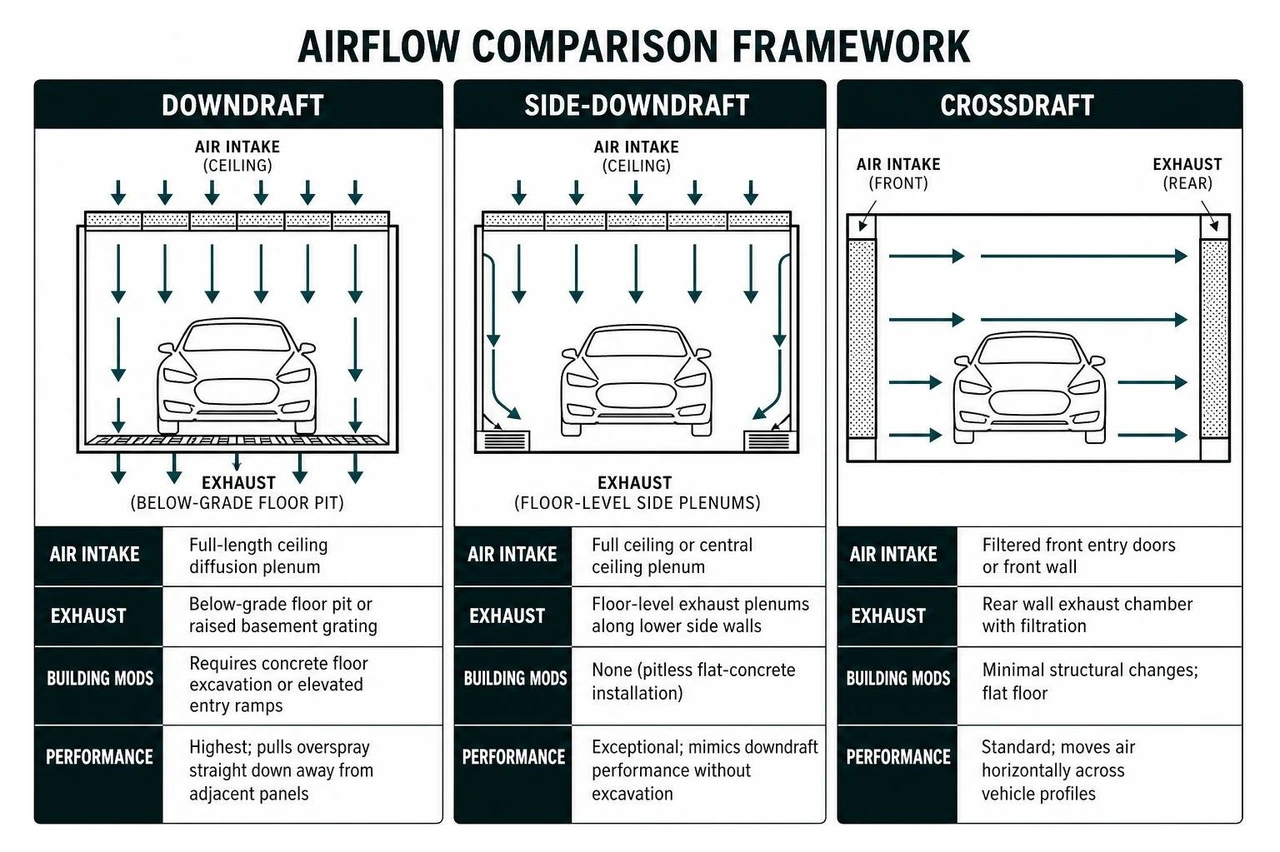
Start with the largest vehicle your shop paints. Allow room for technicians to work around it, then choose an airflow layout that fits the building: downdraft for floor exhaust, side-downdraft for floor-level exhaust without a full pit, or crossdraft when space and construction limits call for a simpler setup. Place filtered air intake and exhaust so air moves across the vehicle and carries overspray away from the finish.
Next, plan for an air make-up unit, lighting, filter access, and vehicle staging. Have the layout checked against applicable fire, ventilation, and local permit requirements before construction begins. These choices affect finish quality, paint cycle time, and how easily the booth can be maintained.
We are AutoTech Solutions Staff, and this guide walks through the critical choices in automotive paint booth design, supporting commercial facilities with everything from commercial garage equipment planning to end-to-end shop design consulting.
Core Principles of Automotive Paint Booth Design and Layout
Achieving a clean, factory-level paint finish in a commercial collision repair facility demands precise environmental control. Spray application generates an atomized cloud of paint particles, solvent vapors, and airborne aerosols. The primary mission of spray enclosure engineering is to move air smoothly around vehicle bodies, extract atomized overspray immediately, and prevent airborne micro-particulates from landing on wet clearcoats.
The foundation of booth layout planning rests on matching vehicle dimensions to optimal internal clearances. Technicians require sufficient space to navigate around panels with spray equipment held at a perpendicular angle and constant standoff distance. Sizing calculations must begin with the largest expected vehicle envelope, adding a minimum of 4.9 feet in length and width, along with at least 2 feet of overhead clearance above the roofline.
When planning new installations or retrofits, choosing the right auto body paint booth configuration determines cycle efficiency, building modification requirements, and overall capital expenditure.
| Airflow Style | Air Intake Location | Exhaust Location | Building Modification Requirements | Refinishing Quality & Overspray Efficiency |
|---|---|---|---|---|
| Full Downdraft | Full-length ceiling diffusion plenum | Below-grade floor pit or raised basement grating | Requires concrete floor excavation or elevated entry ramps | Highest; pulls overspray straight down away from adjacent panels |
| Side-Downdraft | Full ceiling or central ceiling plenum | Floor-level exhaust plenums along lower side walls | None (pitless flat-concrete installation) | Exceptional; mimics downdraft performance without excavation |
| Semi-Downdraft | Ceiling intake plenum located at front of booth | Rear exhaust chamber at floor or lower wall | Minimal ducting footprint; flat concrete floor | Moderate-High; moves air diagonally down and back |
| Crossdraft | Filtered front entry doors or front wall | Rear wall exhaust chamber with filtration | Minimal structural changes; flat floor | Standard; moves air horizontally across vehicle profiles |
Downdraft and Pit Design Configurations
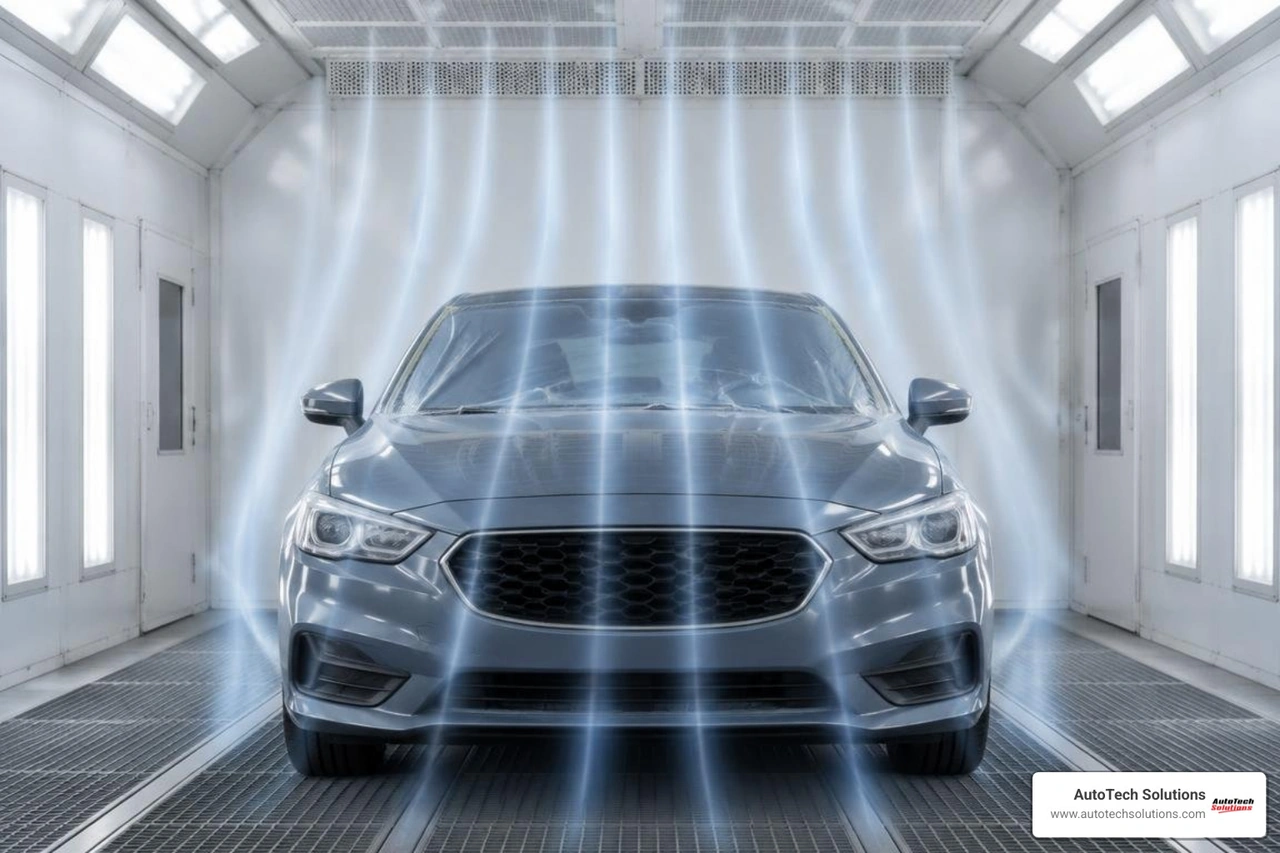
Full downdraft booths represent the global benchmark for high-throughput automotive refinishing. Air enters through a full ceiling filter bank and descends in a uniform, vertical curtain across the entire vehicle body. This vertical draft pulls overspray straight down toward the floor grates, virtually eliminating the risk of atomized clearcoat drifting across freshly painted adjacent surfaces.
Standard configurations vent through below-grade concrete exhaust pits engineered with structural steel support and heavy-duty floor grating rated for commercial axle loads. For facilities where cutting deep concrete trenches is impractical due to post-tension cables or high water tables, modern engineering provides elevated options. Advanced systems utilize raised floor designs or compact 4.5-inch mini-pit basement configurations. These low-profile basements incorporate integrated internal baffles and air deflectors to maintain uniform downward velocity across the cabin without deep subfloor civil engineering. For shops ready to establish this level of performance, executing a downdraft paint booth installation delivers the cleanest possible operating environment.
Crossdraft and Side-Downdraft Alternatives
Facilities restricted by ceiling heights or concrete excavation limits can achieve professional finishes using engineered alternatives. Side-downdraft systems pull clean, filtered air through a ceiling plenum and channel it down toward floor-level exhaust chambers built into the bottom of the sidewalls. This setup eliminates subfloor concrete work while maintaining downward draft characteristics that draw overspray away from active spray zones.
Crossdraft systems introduce air through filtered front access doors or a front intake bank, pulling it horizontally across the vehicle body toward rear exhaust filters. While crossdraft systems represent a lower entry cost and require simple structural accommodations, managing airflow velocity is critical. Air passing over freshly painted front panels travels past rear panels before exiting, which demands careful spray sequencing by technicians to maintain flawless finishes.
Engineering Critical Airflow and Ventilation Systems
Proper booth ventilation requires high air exchange rates to clear VOC concentrations and eliminate overspray. Commercial spray cabins operate at airflow rates between 10,000 and 19,000 CFM (cubic feet per minute), delivering over six complete air changes per minute within the enclosure.
Maintaining a linear velocity between 50 and 100 feet per minute (FPM) across the vehicle cross-section keeps paint mist moving without creating localized eddies. If air moves too slowly, overspray hangs suspended in the cabin; if air moves too quickly or unevenly, boundary-layer turbulence disrupts atomization patterns from the spray gun. Commercial facilities maintain production consistency by routinely validating paint booth airflow using thermal anemometers and smoke testing to identify dead zones.
Air Make-Up Units (AMU) and Temperature Management
An Air Make-Up Unit (AMU) is an essential component for any high-volume commercial shop. Because spray booths exhaust thousands of cubic feet of air every minute to outside ventilation stacks, that air must be replaced with conditioned, filtered outdoor air. Unconditioned replacement air creates massive negative pressure swings inside the building, drawing drafts, dirt, and unconditioned air from adjacent service bays.
Direct-fired gas burners integrated into the AMU heat incoming supply air rapidly, stabilizing internal temperatures during spray cycles and driving curing temperatures up to 140–158°F during bake cycles. Modern units feature variable frequency drives (VFDs) that automatically modulate fan speeds between spray, flash, and cure modes, optimizing energy consumption. Precise thermal and humidity control is particularly crucial when operating accelerated waterborne paint drying systems, where evaporating water carriers requires controlled air velocity and stable ambient temperatures.
Filtration Stages and Overspray Extraction
Refinishing cleanliness relies on multi-stage filtration engineered to trap particulates before they enter the cabin and capture paint solids before exhaust air vents outdoors.
- Intake Pre-Filtration: Inexpensive 20x20-inch tacky filters trap coarse shop dust, atmospheric debris, and larger airborne particles before air reaches the main supply ductwork.
- Ceiling Diffusion Blankets: High-efficiency, non-flammable ceiling diffusion blankets provide uniform laminar airflow distribution while capturing fine sub-micron dust particles.
- Exhaust Filtration: High-capacity multi-layered fiberglass or synthetic Wave exhaust media capture paint overspray. Premium wave-style exhaust filters hold up to 4.4 pounds of solid overspray per square yard before reaching maximum pressure drops.
- Pressure Monitoring: Differential pressure manometers mounted on external control panels measure static pressure drops across filter banks, notifying technicians exactly when filter loading requires media replacement.
- Exhaust Fans: Non-sparking tube axial exhaust fans with sealed external motor bearings safely move flammable vapor mixtures into certified duct stacks, meeting all regulatory guidelines for exhaust extraction system approvals.
Structural Specifications and Equipment Integration
High-performance paint cabins require rigid, non-combustible building materials that withstand continuous thermal cycling during 160°F bake cycles without warping, panel separation, or air leakage.
Structural Components in Automotive Paint Booth Design
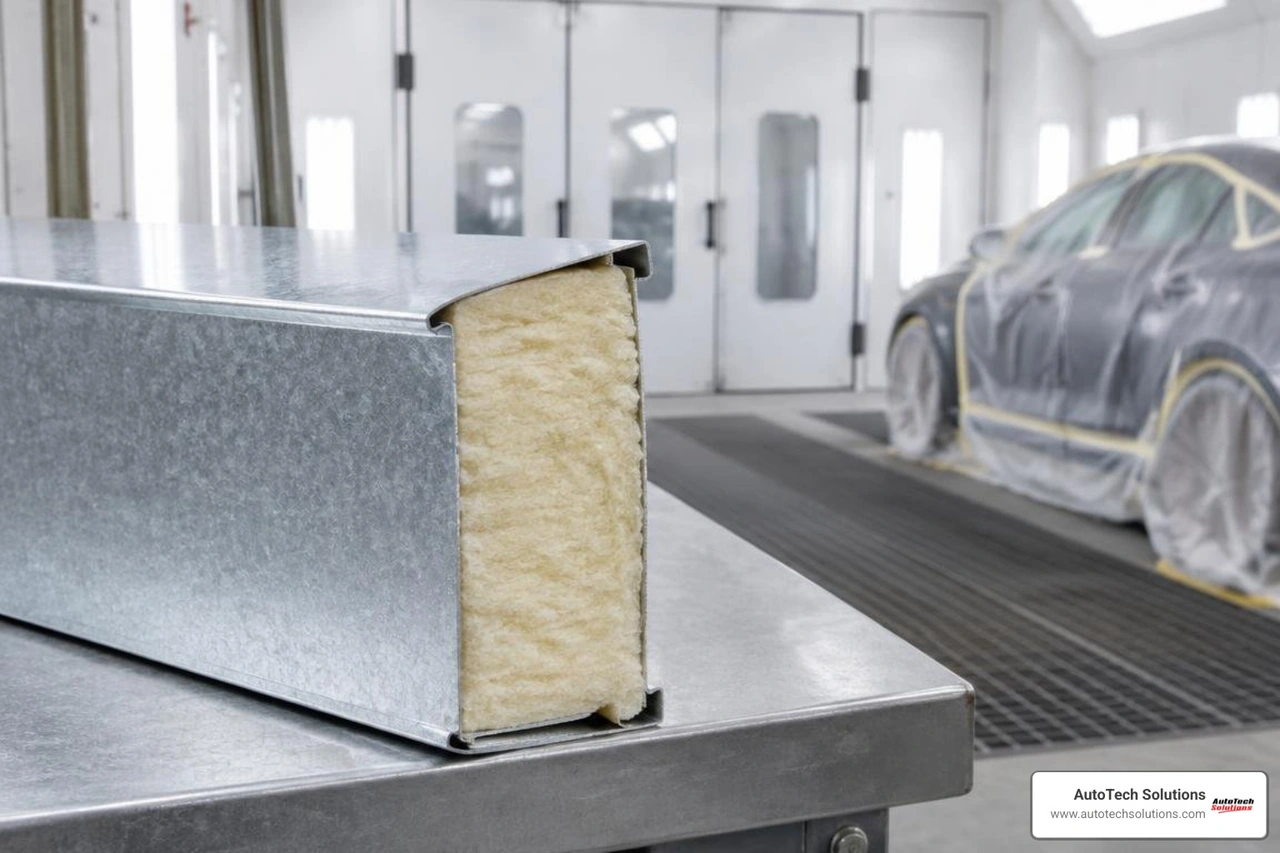
Commercial booths are constructed using CNC-formed 18-gauge galvanized steel panels. While budget single-skin panels offer structural rigidity, premium commercial installations utilize dual-skin insulated wall construction. Dual-skin panels feature 1-inch to 2-inch dense insulation cores (such as glass wool or expanded foam) sandwiched between galvanized steel sheets.
This insulated construction provides three primary operational advantages:
- Thermal Efficiency: Reduces heat loss through booth walls, lowering natural gas and electrical utility consumption during high-temperature bake cycles.
- Acoustic Dampening: Lowers ambient motor and fan noise in surrounding shop work zones.
- Internal Cleanliness: Pre-coated white interior panel finishes maximize ambient light reflectivity while providing smooth, non-porous surfaces that resist overspray adhesion and clean easily.
Entry and egress designs incorporate heavy-duty trifold doors or automatic RollSeal fabric roll-up doors with airtight perimeter gaskets to eliminate draft leakage. Large observation windows manufactured with clear, tempered safety glass allow exterior monitoring of paint operations without opening personnel doors and disturbing internal air balance.
Pressurized vs Non-Pressurized Automotive Paint Booth Design
Understanding pressure balancing is essential when planning a commercial refinishing space.
Pressurized paint booths utilize dedicated intake supply fans matched with exhaust fans to force slightly more air into the cabin than the exhaust system extracts. This positive internal pressure means that whenever a technician cracks open a personnel door, clean air pushes outward into the shop. Airborne dust, metallic sanding shavings, and shop debris are physically blocked from entering the painting environment.
Non-pressurized booths rely solely on an exhaust fan pulling air through filtered product doors, operating under slight negative pressure. While cost-effective, negative pressure systems pull air inward through every micro-gap or unsealed door seam. If the surrounding shop atmosphere contains airborne dust, contaminants can migrate directly onto wet vehicle finishes. For this reason, high-production commercial facilities rely almost exclusively on pressurized designs.
Curing Systems and Precision LED Lighting
Flawless color matching, metallic flake orientation, and clearcoat leveling demand glare-free, uniform illumination. Modern spray booths incorporate Class I, Division 2 UL-listed LED light fixtures sealed behind tempered safety glass.
Design specifications require lighting arrays mounted in hip ceiling panels and vertical side walls to generate light levels of at least 1,000 Lux (with high-volume production facilities aiming for 1,500 to 2,000 Lux). Color accuracy requires LED fixtures calibrated to a 5,000K daylight color temperature with a Color Rendering Index (CRI) rating of 90 or higher, preventing metamerism and mismatched panel tinting.
To accelerate throughput, facilities frequently integrate auxiliary curing equipment, including overhead or rail-mounted infrared curing lamps. Shortwave infrared systems penetrate through paint layers directly to the substrate, curing primer surfacers, basecoats, and spot clearcoats in minutes without firing the full-cabin air make-up burner.
Safety Compliance, Advanced Tech, and Workflow Integration
Automotive finishing generates flammable concentrations of atomized solvents and hazardous air pollutants. Booth engineering must comply strictly with national, state, and municipal life-safety codes.
The primary safety standards governing paint enclosure design include:
- NFPA 33: Standard for Spray Application Using Flammable or Combustible Materials, defining booth construction, minimum air velocities, separation distances, and automatic interlocks.
- OSHA 1910.107: Federal requirements covering spray finishing ventilation rates, worker respiratory safety, and electrical grounding.
- EPA 6H (40 CFR Part 63 Subpart HHHHHH): Clean Air Act standards mandating 98% capture efficiency on exhaust filtration systems for commercial paint stripping and refinishing facilities.
Facilities must integrate certified automatic dry-chemical or wet-pipe fire suppression systems directly into the intake and exhaust plenums. Electrical systems require safety interlocks that disable spray equipment if exhaust ventilation fans are turned off or if airflow sensors detect insufficient cabin air velocity. Additionally, safety codes dictate that dedicated paint storage and preparation spaces must feature specialized paint mixing room equipment with continuous mechanical ventilation and explosion-proof electrical controls.
Modular Production and Recirculation Technology
Advanced production facilities are transforming energy efficiency by implementing modular cabin engineering and closed-loop air recirculation systems. High-efficiency systems can recirculate up to 95% of cabin air, requiring only 5% fresh air make-up during automated application cycles. This technology lowers thermal energy consumption by up to 80% compared to traditional wet scrubber booths and cuts energy use by 45% relative to conventional dry scrubbers.
Modular layouts also allow parallel vehicle processing. Instead of single linear production bottlenecks, modular parallel cells accommodate varying vehicle sizes while integrating automated robotic cleaning and service cubicles in exterior corners, maximizing booth uptime.
Integrating Booths into Complete Collision Center Workflows
A spray booth should not operate as an isolated island on the shop floor. Maximum throughput requires tight integration with surrounding repair stages. Proper shop layout aligns prep stations, masking bays, mixing rooms, and cool-down staging areas in a linear, unidirectional progression.
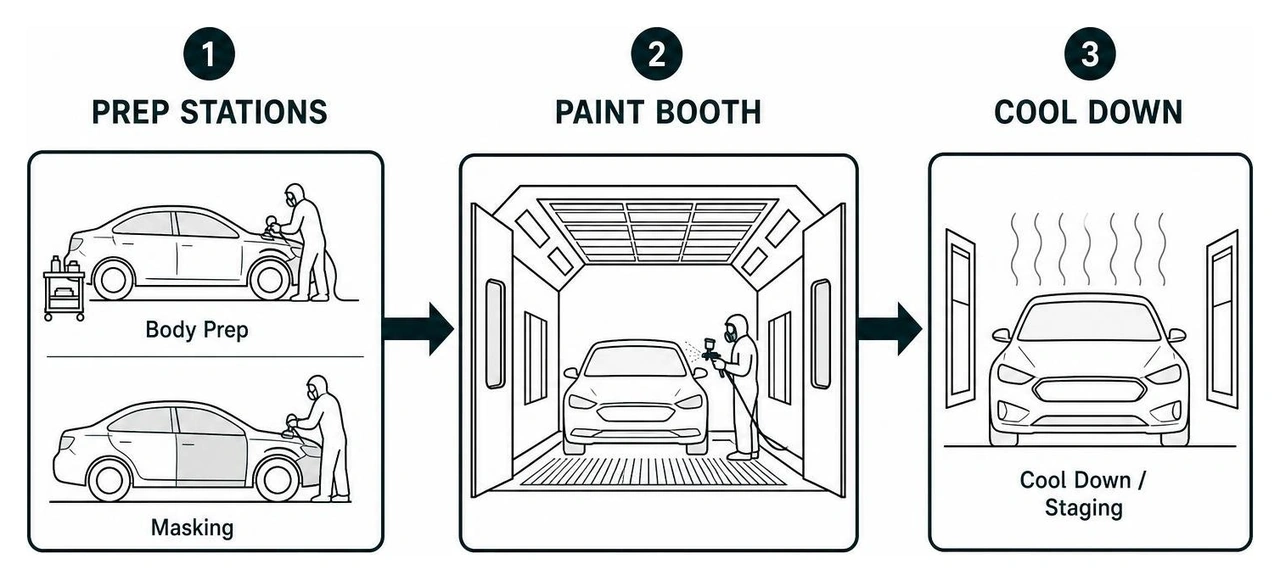
Positioning prep areas immediately adjacent to booth entry doors reduces vehicle transfer times, while ensuring that doors do not open directly into heavy grinding or body repair areas prevents dust contamination. For businesses expanding their footprint across Michigan and the Carolinas, selecting comprehensive collision center solutions ensures that every piece of equipment—from vehicle lifts to air compressor piping and spray cabins—is synchronized for maximum production volume.
Frequently Asked Questions about Automotive Paint Booth Design
How do I calculate the required CFM for a commercial paint booth?
Airflow requirements are calculated using target linear air velocity and the cross-sectional area of the booth perpendicular to airflow direction.
For a standard crossdraft booth:CFM = Booth Width (feet) × Booth Height (feet) × Target Velocity (FPM)
For a full downdraft booth, air moves vertically from ceiling to floor, making the footprint area the cross-section:CFM = Booth Width (feet) × Booth Length (feet) × Target Velocity (FPM)
For example, a standard 14-foot wide by 24-foot long downdraft booth with a targeted downward velocity of 50 FPM requires:14 × 24 × 50 = 16,800 CFM
This volume provides continuous overspray evacuation and supplies more than six complete cabin air changes per minute.
Why is positive pressure preferred in automotive refinishing booths?
Positive pressure creates a clean air seal around the entire spray enclosure. By delivering slightly more filtered air through the ceiling intake than the exhaust fan removes (typically a 3% to 5% volume differential), the internal cabin pressure remains higher than the surrounding shop floor.
When door seals flex or technicians enter through personnel doors, clean air pushes outward into the shop environment. This outward airflow physically blocks ambient shop dirt, metallic sanding particles, and airborne shop contaminants from drifting into the booth, protecting fresh basecoats and clearcoats from costly defects.
What are the building clearance requirements around a commercial spray booth?
Under NFPA 33 guidelines, commercial spray booths require clear perimeter space to allow maintenance access, filter changes, inspection, and fire defense operations. Booth walls and exhaust plenums must maintain a minimum 3-foot clearance from combustible building walls, structural columns, and adjacent shop equipment unless the surrounding building walls are constructed with certified two-hour fire-resistant assemblies.
Furthermore, adequate vertical overhead clearance is mandatory to install and service roof-mounted exhaust fans, intake ductwork, fire suppression dampeners, and direct-fired air make-up systems.
Conclusion: Building a High-Performance Refinishing Facility
A well-designed paint enclosure is the centerpiece of a profitable, high-throughput collision repair shop. Balancing proper airflow dynamics, dual-skin insulated wall construction, precision LED lighting arrays, and multi-stage filtration creates an environment that eliminates refinish rework, reduces cycle times, and protects technicians.
Planning, permitting, and installing commercial spray equipment demands meticulous attention to structural, mechanical, and fire-safety codes. AutoTech Solutions specializes in commercial facility planning, equipment installation, and long-term preventative maintenance across Michigan and the Carolinas.
Whether upgrading an existing spray cabin, retrofitting a pitless side-downdraft system, or designing a ground-up facility layout, our team delivers complete commercial shop solutions. Connect with our experts today to explore our full suite of shop design and consulting services and engineer a refinishing facility built for maximum performance.