Keep Shop Equipment Maintenance in View
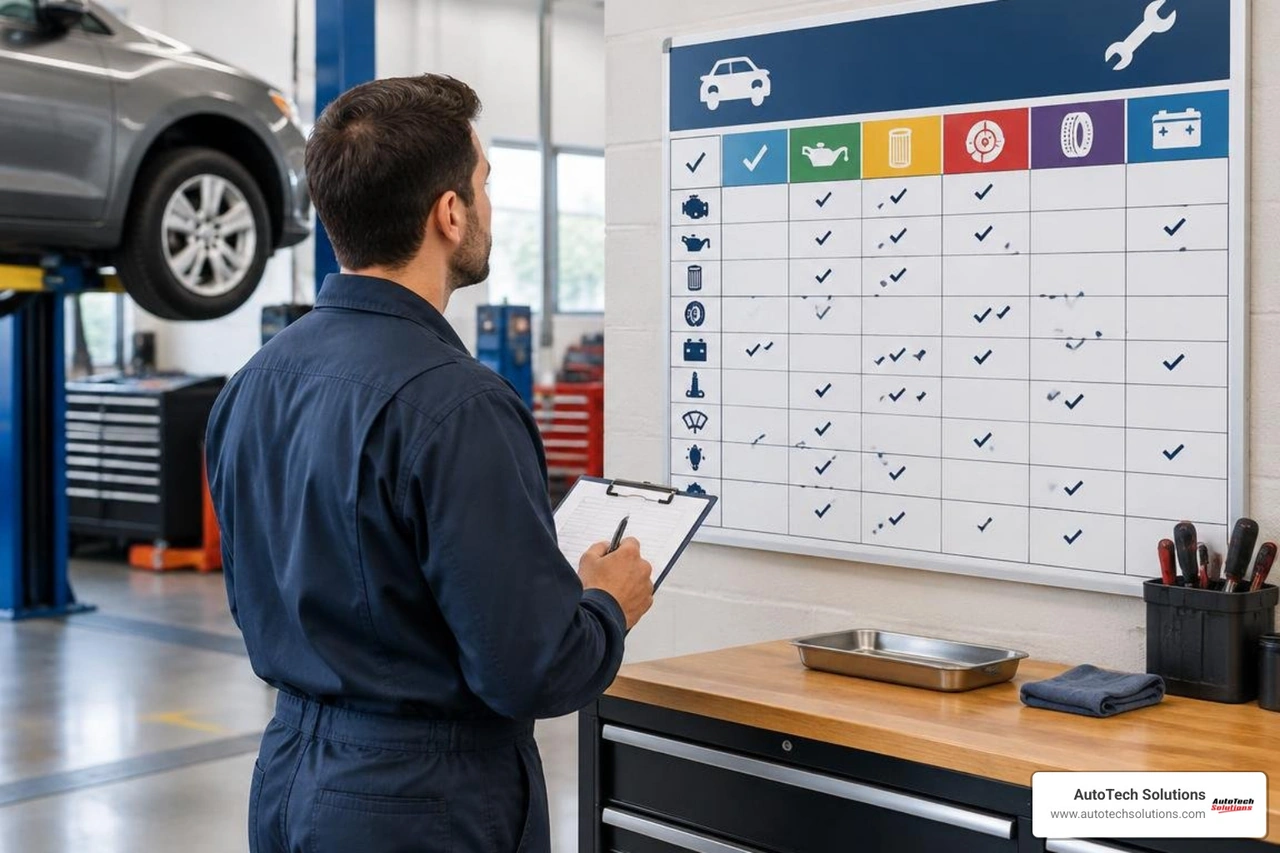
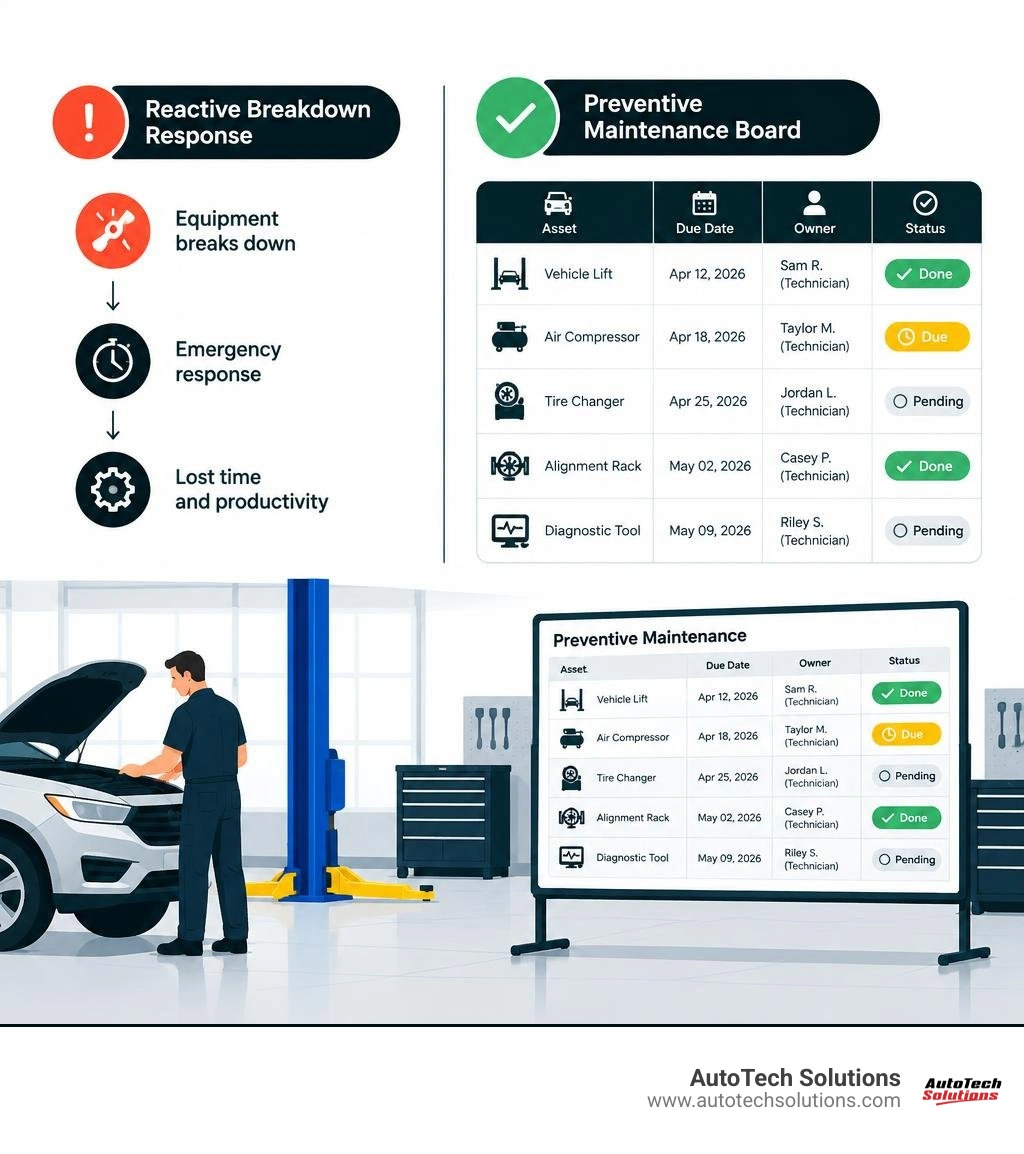
A preventive maintenance board shows which shop equipment needs service, when it is due, who owns the task, and whether it is done. Start with your most critical assets, give each task an owner and due date, and review the board at every shift change. A whiteboard can do this for one shop; a digital board can help when crews need shared updates across bays or locations.
The point is simple: catch routine work before a lift or other critical tool goes down. We are AutoTech Solutions Staff, and this guide will help you choose a board your crew will use.
Similar topics to preventive maintenance board:
- preventive maintenance planning and scheduling
- planned preventative maintenance companies
- pms planned maintenance system
What Is a Preventive Maintenance Board and Why Do Shops Need One?
A preventive maintenance board is a centralized visual management tool designed to track, schedule, and assign routine upkeep for commercial shop machinery. In busy dealership service departments, commercial fleet maintenance facilities, and heavy collision centers, daily workflow moves fast. When equipment servicing lives only in someone's head or inside an unread binder, routine care gets neglected until a machine fails.
Unscheduled machine downtime halts shop throughput. Across the industrial and automotive repair sectors, manufacturers and facilities face average downtime costs reaching $125,000 per hour. When high-volume equipment goes offline unexpectedly, billable hours vanish, customer delivery times slip, and bay utilization plummets.
Using a visual board establishes immediate technician accountability. When tasks, machinery IDs, assigned technicians, and upcoming deadlines are mounted in plain view, maintenance becomes part of the daily operating rhythm rather than an afterthought. Learning how to reduce equipment downtime in an automotive shop begins with clear visibility across every bay. Following a structured preventative maintenance service guide ensures that critical shop-level systems—such as compressed air distribution, overhead fluid delivery reels, and exhaust extraction systems—receive consistent servicing before minor wear turns into an operational crisis.
Preventive Maintenance Board vs Digital Schedules and CMMS
Modern facilities often debate whether to deploy a physical board, a custom digital display, or a computerized maintenance management system (CMMS). Each format serves a distinct purpose, but they differ significantly in technician adoption, visibility, and setup overhead.
While comprehensive platforms excel at multi-year cost auditing, they can introduce software overload for floor technicians. Technicians often bypass complex digital forms when rushing to finish a job. A visual board acts as a practical floor companion, translating broader schedules into an actionable daily cue. Implementing a planned maintenance system allows facilities to link big-picture scheduling with shop-floor execution.
Transitioning Small Commercial Crews from Reactive to Proactive Service
Small to mid-sized service departments often operate in a continuous firefighting loop. They wait for a component to break, clear the bay, and scramble to complete an emergency repair. National reliability benchmarks indicate that facilities relying heavily on reactive maintenance experience 3.3 times more downtime than those using proactive programs. Furthermore, organizations prioritizing preventive protocols achieve 52.7% less unplanned downtime compared to reactive operations.
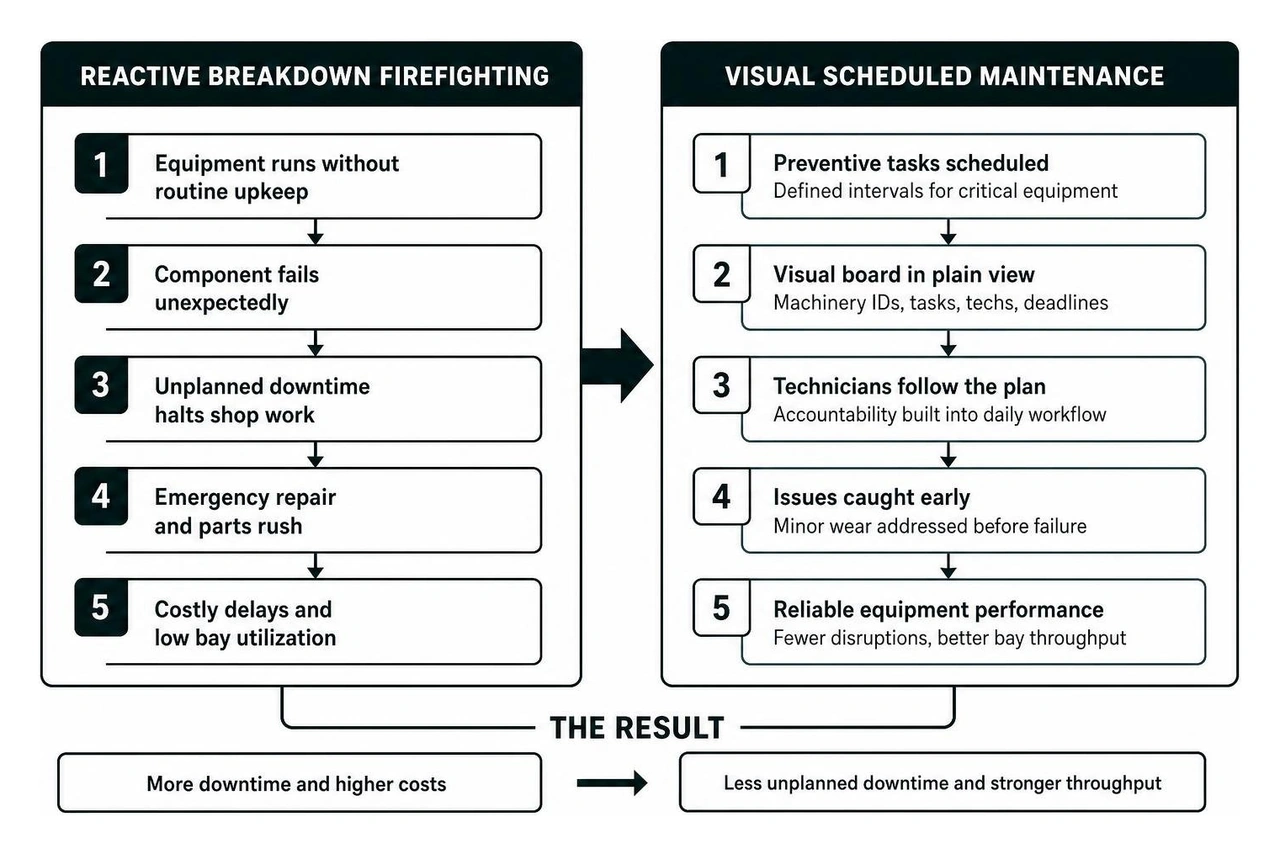
Shifting shop culture requires separating emergency repairs from scheduled preservation. Understanding the functional differences between preventive and curative maintenance helps service directors allocate technician labor efficiently. When unplanned issues arise, documenting them as structured corrective maintenance ensures that the visual board captures both proactive upkeep and scheduled corrective jobs without derailing daily operations.
Essential Information and Features to Include on a Preventive Maintenance Board
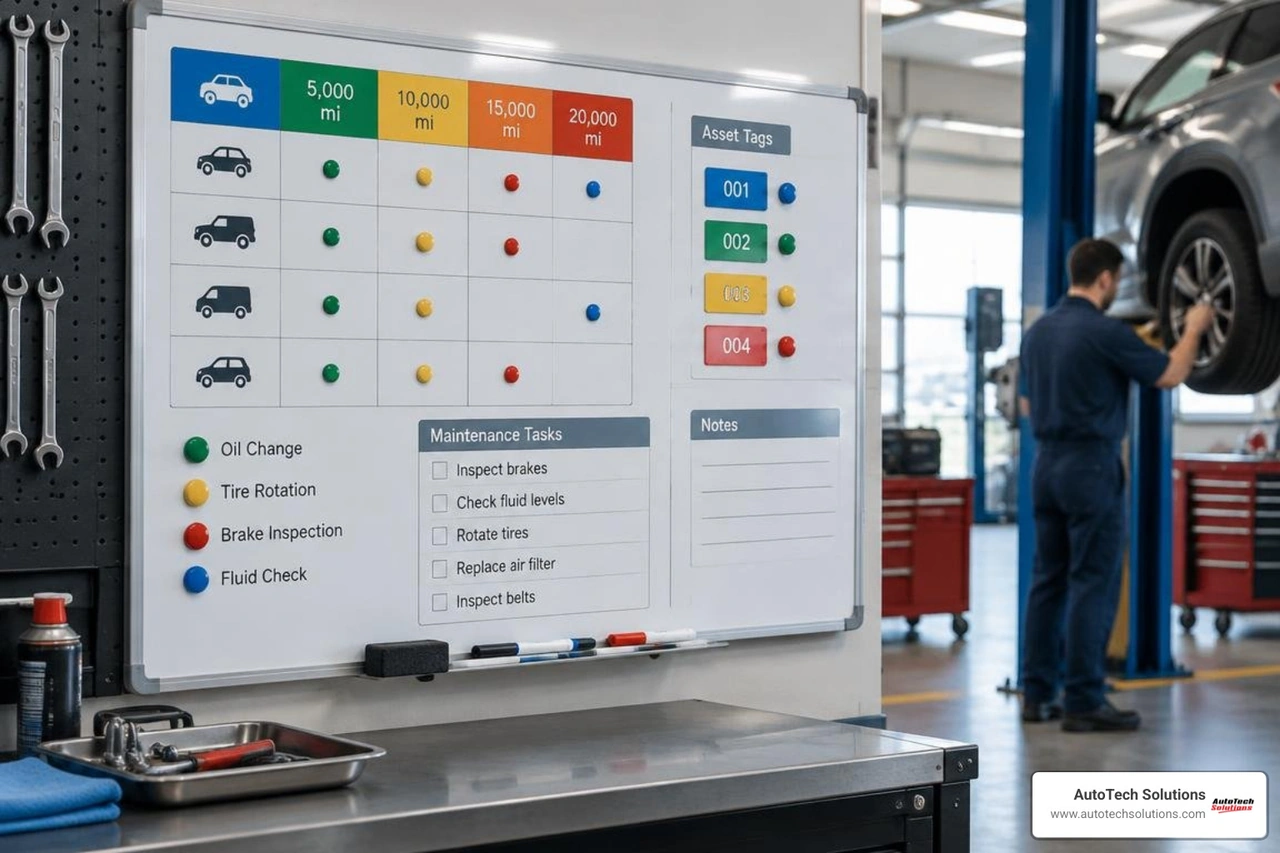
An effective maintenance tracking board must communicate equipment status in seconds. If the layout is cluttered, technicians will ignore it. The board needs a clear hierarchy that balances machine identification, task frequency, ownership, and safety protocols.
To keep operations running smoothly, every board layout should incorporate:
- Asset Identifier & Location: Machine name, internal asset tag, and specific bay number.
- Service Interval Category: Daily inspections, weekly lubrications, monthly safety verifications, or annual overhauls.
- Assigned Technician: The specific person responsible for performing the check.
- Target Due Date & Status: Due date, in-progress indicators, and sign-off spaces.
- Safety & Lockout/Tagout Reminders: Prominent alerts for isolation protocols prior to servicing high-power machinery.
Incorporating structured frequency guidelines, such as the NETA frequency matrix guidelines, helps service managers establish clear intervals for visual, mechanical, and electrical checks based on equipment operating conditions.
Structuring Daily, Monthly, and Annual Service Intervals
Organizing service intervals prevents maintenance bottlenecks. Daily tasks should take mere minutes, while monthly and annual checkpoints require dedicated downtime.
| Interval | Key Equipment Checkpoints | Typical Action Items | Primary Responsibility |
|---|---|---|---|
| Daily | Vehicle lifts, air compressors, bay doors | Visual safety latch checks, drain tank condensation, check oil levels | Bay Technicians / Operators |
| Monthly | Overhead reels, exhaust extraction, tire balancers | Inspect hoses for wear, test motor emergency stops, calibrate sensors | Lead Technician / Shop Foreman |
| Quarterly | Hydraulic power units, alignment racks | Check fluid clarity, inspect mechanical fasteners, verify torque specs | Senior Maintenance Tech |
| Annual | Heavy hydraulic lifts, structural framing, main air lines | Complete cable replacement review, full hydraulic flush, anchor bolt torque audit | Certified Equipment Specialist |
When servicing lifting systems, adhering to a dedicated preventative maintenance lift guide ensures compliance with ANSI/ALI ALOIM standards, keeping safety latches, hydraulic seals, and equalizer cables operating reliably under heavy commercial loads.
Key Hardware and Layout Features for High-Traffic Service Bays
Boards located in commercial shop environments must withstand grease, airborne dust, and high physical activity.
- Heavy-Duty Construction: Choose porcelain-on-steel magnetic surfaces mounted in anodized aluminum frames. These resist chemical cleaners and shop grime better than painted whiteboards.
- Color-Coded Status Magnets: Use standardized magnetic signals (green for completed, yellow for upcoming/due, red for overdue or locked out) to provide an instant overview of equipment health.
- Integrated Document Sleeves: Attach heavy vinyl document holders directly to the board to store standardized checklists, such as a preventive maintenance checklist PDF template, ensuring technicians reference consistent step-by-step procedures.
Physical Whiteboards vs. Spreadsheets vs. Digital PM Boards: Choosing Your Setup
Selecting the best tracking medium depends on your shop floor layout, team size, and facility distribution.
| Evaluation Metric | Magnetic Dry-Erase Board | Spreadsheet (Excel / Google Sheets) | Digital PM Schedule Board (Cloud App) |
|---|---|---|---|
| Setup Cost | Low ($200 – $600 one-time) | Very Low (Included with office software) | Moderate ($10 – $50/user monthly) |
| Shop Floor Visibility | Maximum; visible across open bays | Low; hidden in closed files | High; displays on bay monitors/tablets |
| Update Ease for Techs | Immediate with marker/magnet | Moderate; requires computer access | Easy via mobile app or bay kiosk |
| Historical Data Tracking | Poor; erased each cycle | Moderate; prone to accidental overwrites | High; automatic logs and audit trails |
| Multi-Location Scaling | Difficult; requires physical visits | Poor; fragmented file versions | Excellent; centralized multi-shop dashboard |
| Process Friction | Near zero | High; requires desktop logging | Low once technicians are onboarded |
Shops running single-facility locations often succeed with physical magnetic boards due to their immediate visibility. Growing operations with multiple service facilities benefit from cloud-based visual boards. To evaluate digital tools that balance visibility with low maintenance friction, review the preventive maintenance software and schedule board guide alongside your core preventive maintenance planning and scheduling strategy.
Integrating Visual Boards with Work Order and Parts Inventory Systems
A visual maintenance board should directly connect to your shop's spare parts room and work order stream. When a technician notices a worn hydraulic hose during a scheduled morning inspection, the board must trigger an immediate operational handoff:

Connecting daily visual checks to overall equipment lifecycle management for automotive facilities ensures that routine wearable components—such as compressor filters, hydraulic fluids, and lift arm pads—are stocked ahead of demand. When specialty parts or external technicians are required, implementing vendor consolidation for dealership equipment service streamlines dispatching, keeping bay disruptions to a minimum.
Cost Analysis: Visual Boards vs. Heavy Enterprise Maintenance Software

Enterprise asset management platforms often carry high software licensing fees, multi-month onboarding periods, and per-user monthly costs that strain independent service centers and dealership groups. Small to mid-sized shops frequently utilize less than 20% of the complex modules included in enterprise suites.
Adopting a preventive maintenance program can lower overall maintenance spending by 12% to 18% compared to reactive repairs. Research shows that every $1 invested in preventive maintenance yields $4 to $5 in saved breakdown and emergency repair expenses.
In large commercial facilities, equipment downtime leads to an average loss of 27 critical operating hours per month. For high-volume service centers, calculating the true cost of downtime in dealership service departments proves that the right tracking tool—whether a $300 custom magnetic board or a streamlined digital schedule board—pays for itself immediately by preventing a single unplanned equipment outage.
Common Mistakes When Implementing a Preventive Maintenance Board and Best Practices
Many shops invest in a high-quality maintenance board only to see it neglected within three months. Avoiding common implementation pitfalls ensures long-term process adherence:
- Board Abandonment: The board is treated as a decorative wall hanging rather than an active operational hub during morning meetings.
- Information Overload: Tracking too many non-critical assets creates clutter, causing technicians to miss vital machine checkpoints.
- Unassigned Accountability: Writing down tasks without assigning a specific technician's name leads to missed deadlines.
- No Response Protocol: When an inspection reveals damaged equipment, the team lacks an established breakdown response plan for critical shop equipment, leaving broken machinery unresolved.
Best Practices for Scheduling and Tracking Shop Equipment Tasks
To maintain operational momentum, establish a clear routine around your visual board:
- Conduct Daily Standups: Spend three minutes at shift kick-off reviewing open checkpoints, upcoming services, and equipment statuses.
- Standardize Visual Signals: Keep magnet color meanings consistent across all bays and shifts.
- Single-Point Responsibility: Assign each task row to one specific technician or bay leader.
- Incorporate Predictive Signals: Pair visual tracking with real-time equipment observations, linking predictive maintenance planning (such as tracking motor temperatures and unusual operating vibrations) to target the common causes of automotive lift downtime before catastrophic component failure occurs.
Avoiding Over-Maintenance and Process Fatigue on the Shop Floor
Performing maintenance too frequently can waste shop labor and drive up consumable costs. Use asset criticality scoring to balance runtime hours against fixed calendar dates.
Apply the 10 percent rule: if annual routine maintenance and component repairs on a secondary asset exceed 10% of its total replacement value, re-evaluate your service frequency or schedule an equipment replacement. Aligning your strategy with a complete preventative maintenance systems guide ensures you protect vital revenue-generating shop machinery without burdening technicians with unnecessary checklists.
Frequently Asked Questions About Preventive Maintenance Boards
How often should a preventive maintenance board be updated?
A maintenance board should be updated during daily shift handoffs or morning meetings. Technicians should change status tags immediately upon completing an inspection or scheduled service, ensuring real-time operational visibility across all working shifts.
What are the most critical equipment metrics to display on a PM board?
The most critical items to display include the specific machine ID, service frequency tier (daily, monthly, annual), the designated technician responsible, the target completion deadline, and clear operational status flags (Operational, Pending Service, or Locked Out).
Can a visual PM board scale across multiple commercial shop locations?
Yes. Multi-location operations can standardize physical board layouts across every shop floor while aggregating data into a centralized cloud-based dashboard. This approach provides regional service directors with standardized oversight, as detailed in our guide to managing shop equipment maintenance across multiple locations.
Conclusion
A visual maintenance board transforms equipment upkeep from an unorganized scramble into a structured, predictable routine. By keeping machine health, upcoming service intervals, and technician accountability visible across every bay, commercial shops can cut unplanned downtime by half, extend asset lifespans by up to 40%, and safeguard their daily billable output.
Whether you run a dealership service center in Charlotte, NC, an expansive commercial fleet repair depot in Novi, MI, or specialized collision facilities across Raleigh and Wade, NC, dependable machinery is the foundation of your profitability. At AutoTech Solutions, our mission is to eliminate equipment downtime with professional installation, rapid field service, and certified equipment support.
Ready to replace equipment breakdowns with maximum bay efficiency? Partner with our team to implement preventative maintenance programs customized for your commercial facility today.