
Commercial Power: Choosing a Professional Battery Charger Jump Starter
Every minute a commercial vehicle sits idle in your service bay due to a dead battery, your shop loses money. Investing in a professional battery charger jump starter is the fastest way to eliminate this downtime and keep your technicians productive.
If you need a quick decision guide for your fleet or commercial workshop, here is the essential breakdown:
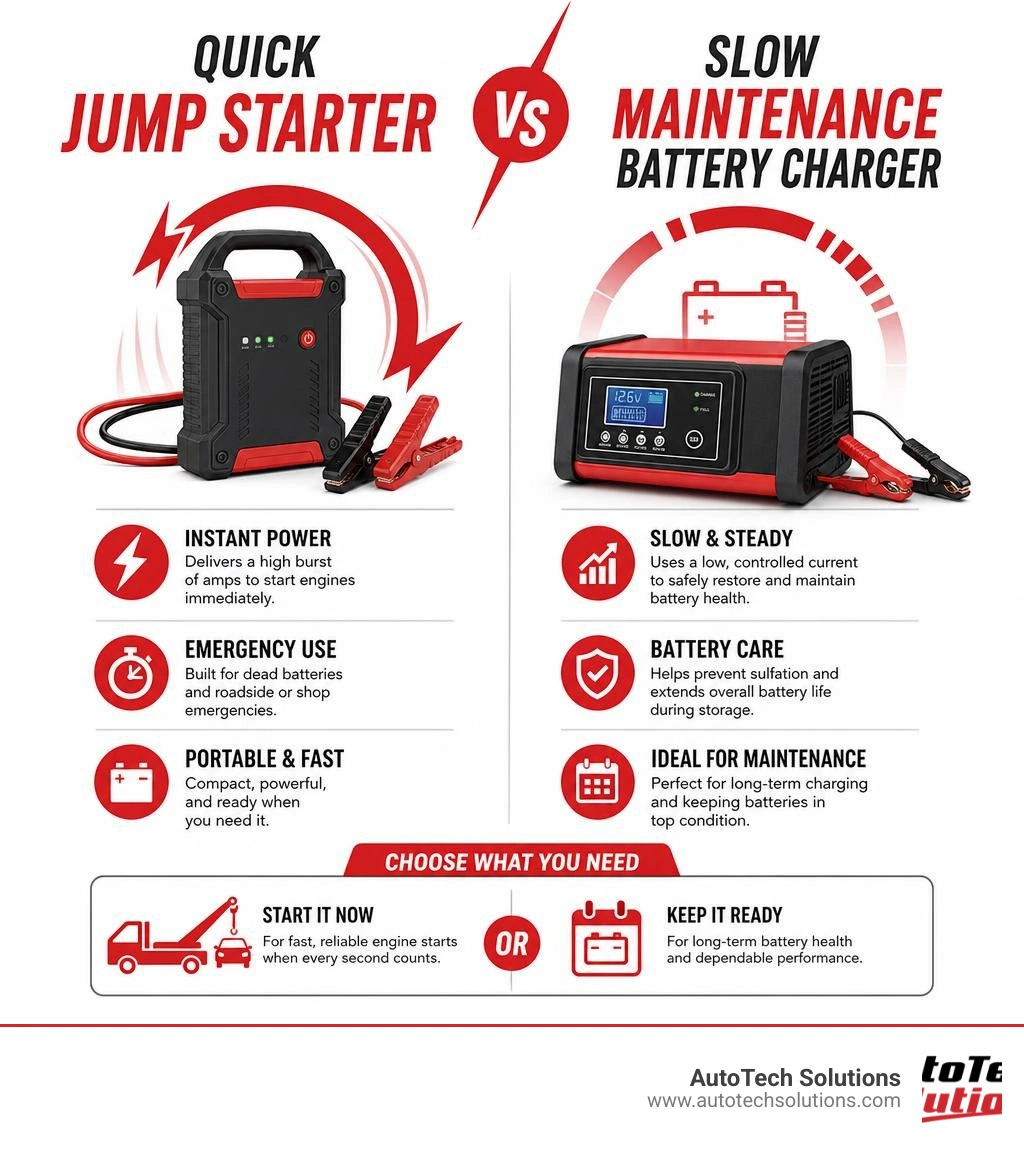
- For Long-Term Battery Maintenance: Choose a dedicated smart battery charger/maintainer. It uses a slow, steady current to restore battery health and prevent sulfation during vehicle storage.
- For Immediate Emergency Starting: Choose a portable high-output jump starter. It delivers a massive, temporary boost of peak amps (typically 1,000 to 2,000+ amps) to crank engines instantly without relying on another vehicle.
- For Maximum Shop Versatility: Choose a hybrid 2-in-1 commercial unit that combines both functions, allowing technicians to switch between fast diagnostic charging and instant emergency jump-starting.
At AutoTech Solutions, we understand that commercial fleet maintenance demands rugged, reliable equipment that can withstand daily shop abuse. Selecting the right power infrastructure prevents costly service delays and protects sensitive vehicle electronics from power surges.
Battery charger jump starter helpful reading:
In a heavy-duty fleet environment or a busy commercial repair shop, standard consumer-grade battery packs simply won't cut it. Commercial vehicles, delivery trucks, and heavy machinery require massive cranking power to overcome high-displacement engines and cold-weather drag. When a flat battery halts operations, a professional-grade battery charger jump starter is an indispensable tool.
Technicians need equipment that can deliver sustained peak current while also offering smart maintenance features. A hybrid unit like the Battery Tender Charge N Start 1100 provides a dual-purpose solution: it features a 1 Amp smart battery charger/maintainer alongside a 1000 Amp lithium jump starter. This combination allows shops to prevent battery failures via continuous monitoring or immediately jump-start light-duty fleet vehicles when prevention wasn't enough.
Jump Starter vs. Battery Charger: Understanding the Core Differences
To maximize shop efficiency, it is critical to understand the technical differences between these two functions:
- Jump Starters: Engineered to deliver an instantaneous, high-amperage jolt (typically lasting 2 to 5 seconds in lithium units) to crank a dead engine. They do not deeply recharge the vehicle's battery; rather, they provide just enough initial power to start the vehicle, after which the vehicle's alternator takes over the recharging process.
- Battery Chargers: Designed to supply a slow, steady, low-amperage current over several hours. This process safely reverses sulfation, restores chemical balance, and maintains the battery at an optimal voltage level during long-term storage or diagnostic procedures.
How a Battery Charger Jump Starter Keeps Commercial Fleets Moving
For commercial operations from Michigan down to the Carolinas, unexpected battery failures directly translate to missed delivery windows and idle technicians. Integrating a high-capacity battery charger jump starter into your shop's preventative maintenance workflow ensures that every vehicle in your fleet is ready to roll.
Modern commercial units support multi-chemistry charging, meaning they can safely service standard flooded lead-acid, AGM, gel, and lithium (LiFePO4) batteries. For shops servicing larger commercial vehicles, the Battery Tender Charge N Start 4120 steps up the game with a 4 Amp smart charging output and a 1200 Amp jump starter. This faster 4 Amp charging rate reduces battery recovery time from over 20 hours down to approximately 5 hours, making it ideal for commercial environments.
Key Specifications for Heavy-Duty Shop Environments
When procuring fleet equipment, looking past marketing buzzwords to analyze raw specifications is essential. A professional shop needs to evaluate peak amps, cranking amps, and battery capacity to ensure the tool matches the demands of their heaviest vehicles.
Peak Amps, Cranking Amps, and Battery Capacity
- Peak Amps: The absolute maximum current a unit can discharge in a fraction of a second. While premium commercial jump starters can provide up to 1,000 to 2,000+ peak amps, lithium-ion units typically sustain this peak for only 2 to 5 seconds to prevent thermal runaway.
- Cranking Amps (CA) & Cold Cranking Amps (CCA): Measured at 32°F (CA) and 0°F (CCA), these ratings represent the sustained power output a unit can deliver for 30 seconds. For heavy-duty commercial applications, matching or exceeding the vehicle's battery CCA rating is critical.
- Battery Capacity: Often measured in milliamp-hours (mAh) or Watt-hours (Wh). Commercial-grade portable jump packs feature internal capacities ranging from 8,000mAh up to heavy-duty 26,000mAh reservoirs. High-capacity units, such as those found in the Clore Jump-N-Carry Jump Starters lineup, ensure technicians can perform multiple consecutive jump-starts across a large yard without needing to recharge the booster pack itself.
Safety Features and Built-In Power Guide Assistance
Commercial shops are environments where mistakes can be costly. High-output electrical equipment requires robust, integrated safety protections to safeguard both technicians and expensive vehicle ECUs:
- Reverse Polarity Protection: Prevents current flow and alerts the operator via audible alarms or digital screens if the clamps are connected to the wrong terminals.
- Spark-Proof Clamps: Ensures no sparking occurs during connection, minimizing the risk of igniting escaping battery gases.
- Overcurrent and Short-Circuit Protection: Automatically cuts power if an electrical short or excessive draw is detected.
- Smart Displays: High-end units feature intelligent LCD screens that provide real-time diagnostic feedback, including battery percentage, current output wattage, and temperature warnings.
Advanced Features of Modern Professional Jump Packs
The transition from heavy, lead-acid wheeled jump boxes to compact, high-density lithium-ion packs has introduced a range of utility features designed to make remote fleet service safer and more convenient.
| Feature / Specification | Professional Lead-Acid Jump Packs | Professional Lithium-Ion Jump Packs |
|---|---|---|
| Weight & Portability | Heavy (typically 15 to 30+ lbs); often wheeled or bulky | Lightweight (typically 1.5 to 5 lbs); highly portable |
| Energy Density | Lower energy density; larger physical footprint | High energy density; fits easily in service vehicle cabs |
| Maintenance Needs | Requires monthly top-off charges; high self-discharge | Low self-discharge; requires recharging every 3 to 6 months |
| Cold Weather Performance | Consistent but suffers from voltage drop in extreme cold | Delivers rapid peak amps, but must be kept above freezing |
| Lifespan (Cycles) | Typically 300–500 cycles | Typically 1,000+ cycles |
Wireless Charging Power Banks and Integrated Flashlights
For technicians performing roadside assistance or remote fleet service at night, a jump pack is more than just an engine cranker; it is a mobile power station. Modern professional jump packs include high-capacity wireless charging power banks to keep diagnostic tablets, rugged phones, and thermal cameras powered up in the field. Built-in multi-mode LED flashlights (providing floodlight, strobe, and SOS functions) ensure safe working conditions during low-light emergency service calls.
Comparing Top Professional Brands and Value
When equipping a commercial garage, balancing upfront cost against long-term reliability is key. Entry-level units with basic power bank functionality start around $89.99, while premium commercial-grade models like the Harbor Freight Viking 1700 Peak Amp Jump Starter combine 1700 peak amps of starting power with a heavy-duty 150 PSI air compressor. This dual-purpose design allows fleet service vehicles to jump-start heavy-duty trucks and inflate commercial tires using a single, rugged tool.
Maintenance, Storage, and Safety Protocols for Fleet Operators
To ensure your shop's battery charger jump starter is always ready for duty, operators must establish clear maintenance and storage protocols. Neglecting lithium or lead-acid jump packs can lead to premature battery degradation or complete tool failure when an emergency strikes.
Shelf Life, Recharging Schedules, and Remote Safety Tips
- Recharging Schedule: Even when sitting unused, jump starters experience minor self-discharge. Lithium units should be fully recharged at least once every six months. Lead-acid units require more frequent attention and should be inspected and topped off every 30 days or whenever the charge level drops below 50%.
- Temperature Restrictions: Store jump packs in a climate-controlled environment when possible. Extremely high temperatures (above 140°F) can permanently damage lithium cells, while extreme cold temporarily reduces the unit's ability to deliver peak cranking amps.
- Remote Safety: When jumping a vehicle in a remote yard or roadside environment, always position the jump starter securely on a flat surface away from moving engine parts. Confirm the vehicle's ignition is off before making clamp connections, and ensure the safety indicator light shows a green "ready" status before attempting to crank the engine.
Can You Jump Start a Dead Battery Charger Jump Starter?
A common question among fleet managers is whether a completely dead portable jump starter can be jump-started using a vehicle's battery. The short answer is no, and you should never attempt it.
Attempting to jump-start a portable jump pack's internal lithium or lead-acid battery directly from a running vehicle's high-output alternator can cause rapid overheating, catastrophic thermal runaway, or an electrical fire. Portable jump starters must only be recharged using their designated AC wall adapters, DC car chargers, or USB-C Power Delivery ports according to strict manufacturer guidelines.
Frequently Asked Questions about Professional Jump Starters
What is the difference between peak amps and cranking amps in commercial units?
Peak amps represent the maximum initial current spike a jump starter can deliver in a split second to break engine stiction. Cranking amps (CA) and Cold Cranking Amps (CCA) measure the sustained, continuous current the unit can supply for 30 seconds at specific temperatures (32°F and 0°F, respectively) to reliably turn over a heavy-duty engine.
How do warranties and return policies impact commercial procurement?
For commercial shops, equipment reliability is paramount. Standard consumer warranties often do not cover heavy commercial or industrial use. When procuring fleet equipment, look for manufacturers that offer dedicated commercial warranties and flexible return policies (such as 60-day return windows). This ensures your investment is protected against early component failures and reduces unexpected shop downtime.
How often should a shop-grade lithium jump starter be recharged?
To maintain optimal battery health, a shop-grade lithium jump starter should be recharged every 3 to 6 months if stored unused. In high-volume shops where the device is used weekly, technicians should top off the unit's charge at the end of every shift to ensure maximum peak amperage is always available.
Conclusion
Selecting the right battery charger jump starter is a critical decision for maintaining high productivity in commercial repair garages and fleet operations. By matching your equipment's peak current, cold cranking amps, and battery capacity to the specific demands of your fleet, you protect your vehicles' electronic systems and ensure your technicians can resolve battery failures instantly.
At AutoTech Solutions, we specialize in providing commercial shops with high-performance automotive equipment, professional car lift installation, and comprehensive preventative maintenance services across Michigan and the Carolinas.
Ready to minimize downtime and elevate your workshop's operational efficiency? Optimize your shop with AutoTech Solutions collision center solutions and discover how our expert team can support your commercial equipment needs.