Why Every Shop Needs a Breakdown Response Plan for Critical Shop Equipment

A breakdown response plan for critical shop equipment is a documented, step-by-step protocol that tells your team exactly what to do when a lift, compressor, frame machine, or paint booth fails unexpectedly.
Here's what a solid plan covers, fast:
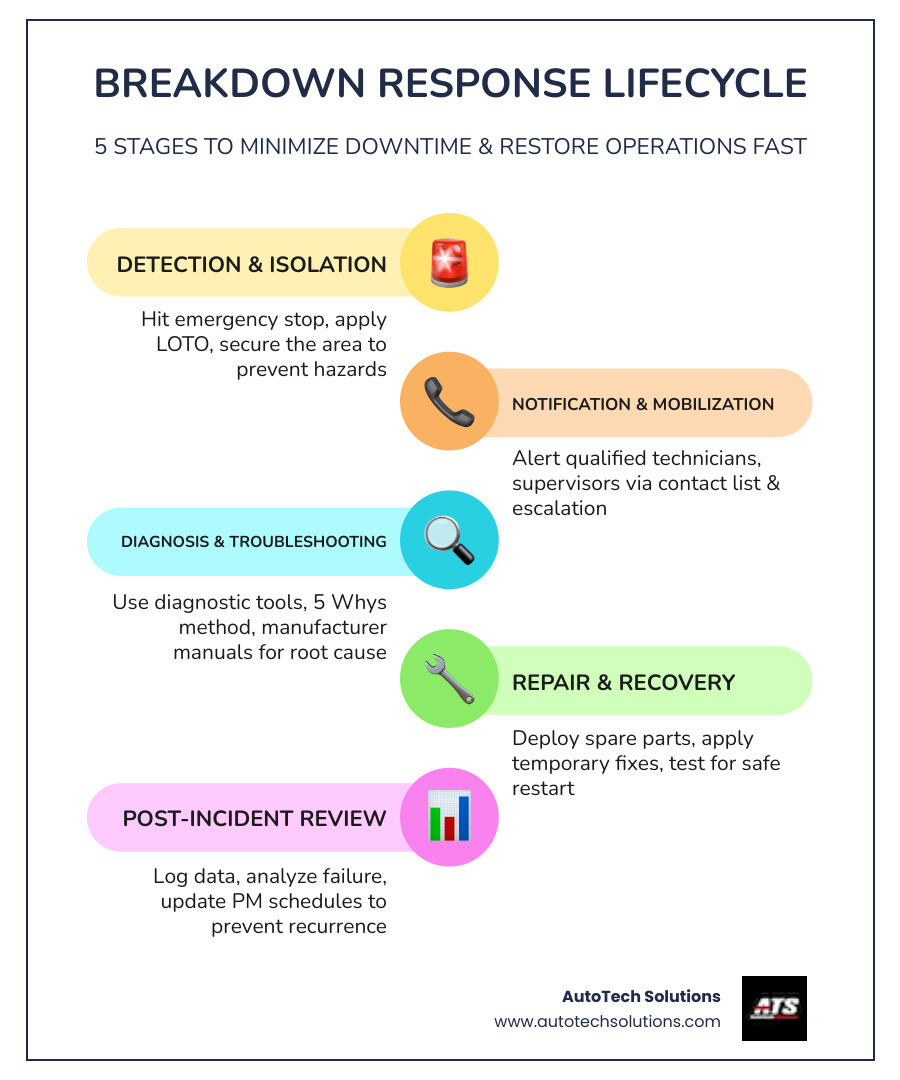
- Detect and isolate - Stop the equipment, secure the area, cut power
- Notify the right people - Alert qualified technicians and supervisors immediately
- Diagnose the fault - Use systematic troubleshooting to find the root cause
- Execute repairs - Fix or temporarily work around the failure to restore operations
- Review and prevent - Analyze what went wrong and update your maintenance schedule
Unplanned downtime costs industrial manufacturers $50 billion per year. For a busy automotive or collision shop, even a single lift going down mid-job can cascade into lost revenue, frustrated customers, and idle technicians.
The hard truth? Reactive maintenance can cost 5 to 9 times more than planned maintenance.
Most shops have some form of maintenance routine. But far fewer have a clear, written plan for when things go wrong anyway — and that gap is exactly where operations fall apart.
This guide walks you through building a practical, shop-specific breakdown response plan: from identifying your most critical assets to deploying the right technology and training your team to respond fast and safely.
Defining the Breakdown Response Plan for Critical Shop Equipment
At AutoTech Solutions, we define a breakdown response plan as your shop’s "emergency playbook." It isn't just a list of phone numbers taped to a wall; it is a structured strategy designed to handle emergency maintenance with surgical precision. When a 12,000 lb. two-post lift stops mid-rise or a paint booth’s ventilation fails during a clear coat application, emotions run high. A written plan replaces panic with process.
Safety protocols are the heartbeat of this plan. It is vital to remember that employee safety or the environment It's important not to overlook the failure of critical equipment maintenance, which could have severe consequences foremployee safety or the environment. A malfunctioning lift isn't just a productivity killer; it’s a potential life-safety hazard. By establishing clear response steps, we ensure operational continuity while protecting our most valuable asset: our people.
To minimize the frequency of these "emergencies," we always recommend integrating your response plan with robust preventative maintenance programs. While a response plan handles the "when," preventative maintenance handles the "before," reducing the likelihood of a catastrophic failure in the first place.

Why Your Shop Needs a Breakdown Response Plan for Critical Shop Equipment
The primary goal of a breakdown response plan for critical shop equipment is risk mitigation. In the automotive world, risks come in many forms—financial, physical, and legal.
- OSHA Compliance: Regulatory bodies like OSHA require documented emergency procedures for hazardous equipment. If an accident occurs and you don't have a plan, the fines can be staggering.
- Litigation Reduction: Following ALI standards and keeping detailed maintenance logs protects your shop from liability. If equipment fails, being able to prove you had a response plan and a history of automotive equipment repair is your best defense.
- Customer Trust: Nothing kills a shop’s reputation faster than missed deadlines. A fast response plan ensures that a breakdown in Bay 4 doesn't delay a customer’s car in Bay 1.
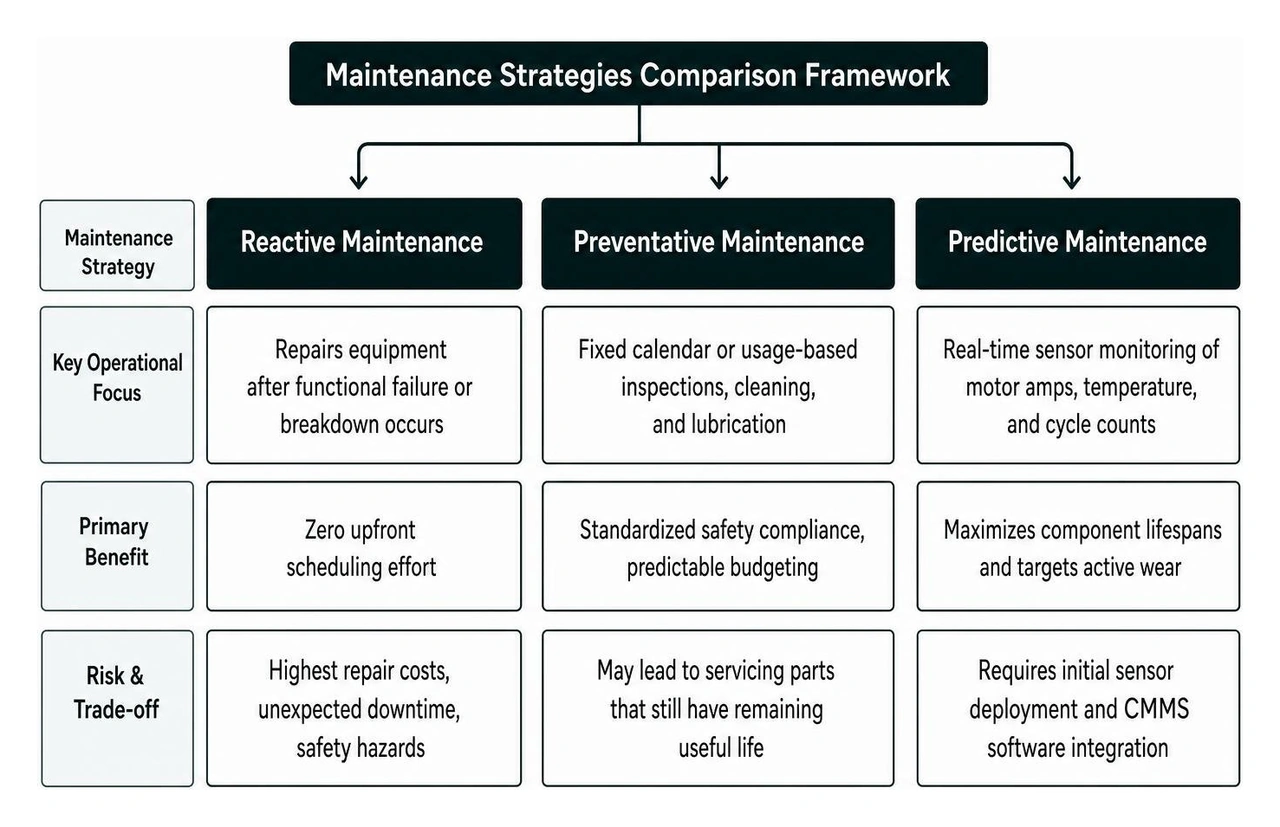
Breakdown vs. Preventive Maintenance Strategies
It helps to understand where a breakdown plan fits into the broader maintenance spectrum. While we strive for proactive care, knowing the difference between these strategies is key to managing shop expectations.
| Feature | Reactive (Breakdown) | Preventive (PM) | Predictive (PdM) |
|---|---|---|---|
| Timing | After failure occurs | Scheduled intervals | Based on equipment condition |
| Cost | 5-9x higher per repair | Moderate/Controlled | High initial tech investment |
| Downtime | Unplanned and high | Planned and minimal | Extremely low |
| Goal | Restore function | Prevent failure | Predict failure before it happens |
Key Performance Indicators (KPIs) like Mean Time Between Failures (MTBF) and Mean Time To Repair (MTTR) help us measure effectiveness. A high MTBF means your gear is reliable; a low MTTR means your breakdown response plan is working efficiently. The goal is to maximize Overall Equipment Effectiveness (OEE), ensuring your shop stays profitable.
Identifying Assets via Equipment Criticality Analysis
Not every piece of equipment is created equal. If a handheld impact wrench breaks, your shop keeps moving. If your main air compressor dies, the entire shop grinds to a halt. This is where Equipment Criticality Analysis comes in.
We use a systematic approach to rank gear based on:
- Severity: How bad is the impact of failure? (Safety, cost, production)
- Frequency: How often does this equipment tend to fail?
- Bottleneck Analysis: Is this machine a "single point of failure" for your workflow?
When planning an automotive lift installation, we consider where that lift sits in the shop’s hierarchy of importance. Using a Failure Modes and Effects Analysis (FMEA) allows us to assign a Risk Priority Number (RPN) to each asset, helping us decide which machines need the most comprehensive response plans.
Classifying Criticality Tiers for Shop Gear
To make this practical for your shop in Michigan or the Carolinas, we suggest grouping equipment into four tiers:
- Tier A (Mission Critical): Equipment that causes immediate shop shutdown if it fails. Examples: Main air compressor, frame racks, paint booth burners.
- Tier B (High Impact): Equipment that significantly slows down production or affects safety. Examples: Primary heavy-duty lifts, alignment machines.
- Tier C (Moderate): Equipment with available workarounds or backups. Examples: Tire changers (if you have two), specialized diagnostic tools.
- Tier D (Non-critical): Assets that don't impact revenue or safety immediately. Examples: Shop vacuums, individual hand tools.
environmental risks Critical equipment maintenance ensures every gear counts and every part plays a crucial role in keeping operations running smoothly. A leak in a Tier A hydraulic system isn't just a repair job—it’s an environmental hazard that requires immediate containment.
Determining the Impact of Failure
When a Tier A asset goes down, the costs add up fast. Recent data shows that the average cost of unplanned downtime in industrial settings is approximately $25,000 per hour, though large operations can see costs exceed $500,000 per hour.
Beyond the dollar signs, consider the "soft" impacts:
- Safety Hazards: A sudden mechanical failure can lead to dropped loads or electrical fires.
- Repair Complexity: Some failures require specialized parts that may have long lead times.
- Revenue Loss: Idle technicians still need to be paid, even if they can't turn wrenches.
To get a better handle on your asset data and history, many shops Try for free Get a Free WorkTrek Demo to see how digital tracking can simplify this analysis.
Core Steps to Build an Effective Emergency Response Plan
Building your breakdown response plan for critical shop equipment requires a structured approach. You want to move from "What happened?" to "It’s fixed" as quickly as possible.
- Identify Scenarios: List the most likely failures for your Tier A and B gear (e.g., motor burnout, hydraulic leak, sensor failure).
- Define Protocols: Create a step-by-step "if-this-then-that" guide for each scenario.
- Communication Hierarchy: Who gets called first? Who calls the vendor? Display this contact chart prominently.
- Escalation Levels: Define when a "glitch" becomes an "emergency" requiring external support from AutoTech Solutions.
For specialized equipment like paint booths, having a paint booth repair tips guide on hand can help technicians identify simple fixes before calling in the cavalry.
Immediate Actions and Systematic Troubleshooting
The first 60 seconds of a breakdown are the most important. Your plan should mandate:
- Isolation: Immediately hit the emergency stop and clear the area.
- Lockout/Tagout (LOTO): Ensure the machine cannot be restarted while someone is inspecting it. This is a non-negotiable safety step.
Once the scene is safe, use systematic troubleshooting. We recommend the "5 Whys" method:
- Why did the lift stop? The motor overheated.
- Why did it overheat? It was working harder than usual.
- Why was it working harder? The columns weren't lubricated.
- Why weren't they lubricated? The grease fitting was clogged.
- Why was it clogged? It wasn't checked during the last inspection. (Root Cause!)
By finding the root cause, you prevent the breakdown from happening again. If the issue is complex, our equipment support services provide the expert diagnostics needed to get you back online.
Managing Spares and Personnel in a Breakdown Response Plan for Critical Shop Equipment
You can’t fix what you don't have parts for. Breakdown maintenance is a strategy for managing equipment and machinery in various industries, but it only works if you have a "battle box" of critical spares.
- Inventory Management: Keep high-wear items like seals, filters, and common sensors on-site.
- Qualified Personnel: Ensure your team knows who is authorized to perform repairs. Trying to "DIY" a complex hydraulic repair can lead to more damage and longer downtime.
- Vendor Coordination: Have AutoTech Solutions' number on speed dial. Our rapid mobilization across North Carolina and Michigan ensures that when you need a pro, we’re already on our way.
Leveraging Technology and Training for Preparedness
In the era of Industry 4.0, your breakdown response plan for critical shop equipment should be high-tech. Computerized Maintenance Management Systems (CMMS) can store your entire plan, track your spare parts, and even send automated alerts when a machine shows signs of trouble.
- IoT Sensors: Modern sensors can monitor vibration and heat, warning you of a motor failure before it happens.
- Simulation Drills: Just like a fire drill, run a "lift failure drill." See how long it takes your team to isolate the equipment and notify the right person.
- Staff Training: Regular training sessions help workers stay ready. If your team hasn't practiced the response plan, they won't follow it when the pressure is on.
Post-Incident Analysis and Continuous Improvement
Every breakdown is a lesson. After the equipment is back in service, hold a "post-mortem" meeting.
- Data Logging: Record what broke, why it broke, and how long the repair took.
- Incident Reporting: Review the response. Did the communication hierarchy work? Were the tools accessible?
- Update PM Schedules: If a part failed prematurely, adjust your preventive maintenance intervals.
Measuring Maintenance Effectiveness through these reviews ensures your shop is constantly evolving and becoming more resilient.
Frequently Asked Questions about Breakdown Response
What are the most common causes of critical equipment failure?
In our experience servicing shops from Michigan to the Carolinas, the "Big Four" are:
- Mechanical Wear: Bearings, cables, and chains reaching the end of their service life.
- Electrical Faults: Blown fuses, loose wiring, or power surges damaging sensitive PLCs.
- Lack of Lubrication: The silent killer of lifts and compressors.
- Human Error: Overloading equipment or bypassing safety sensors.
How often should a breakdown response plan be updated?
We recommend an annual review at a minimum. However, you should update the plan immediately if:
- You install new equipment.
- You change your shop layout.
- Key personnel (the "who to call" list) leave the company.
- A post-incident analysis reveals a flaw in the current plan.
What KPIs measure the effectiveness of a response plan?
To see if your plan is actually working, track these three metrics:
- MTTR (Mean Time To Repair): Is your team getting faster at restoring service?
- OEE (Overall Equipment Effectiveness): How much of your scheduled production time is actually productive?
- PMC (Preventive Maintenance Compliance): Are you doing the work that prevents the breakdowns in the first place?
Conclusion
A breakdown response plan for critical shop equipment is the difference between a minor hiccup and a major financial catastrophe. By identifying your critical assets, training your team, and partnering with experts, you can turn unplanned downtime into a manageable part of doing business.
At AutoTech Solutions, we specialize in helping shops across Michigan and the Carolinas stay operational. From expert installation to lightning-fast repair response, we are your one-stop-shop for all things automotive equipment. Don't wait for a failure to realize you need a plan—proactive care is the best investment you can make for your shop’s future.
Contact AutoTech Solutions for Service Repair and Equipment Support today and let us help you build a more resilient shop.