_compressed.webp)
Why the Right Car Body Paint Booth Defines Your Shop's Output and Profitability
A car body paint booth is one of the highest-impact investments a collision or refinishing shop can make. Get it right, and you gain faster cycle times, cleaner finishes, and a safer work environment. Get it wrong, and you're dealing with contaminated paint jobs, compliance violations, and costly downtime.
Here's a quick overview of the main paint booth types and what they're best suited for in a professional shop setting:
| Booth Type | Airflow Direction | Best For | Key Advantage |
|---|---|---|---|
| Crossdraft | Horizontal | Entry-level shops, lower budgets | Lower installation cost |
| Semi-Downdraft | Angled downward | Mid-volume shops | Balance of cost and performance |
| Full Downdraft | Vertical (top to floor) | High-volume collision and refinishing shops | Cleanest finish, best overspray control |
| Prep Station | Filtered, contained | Sanding, priming, spot repairs | Increases main booth throughput |
| Custom Engineered | Configured to spec | Large commercial operations, mixed fleets | Handles SUVs, vans, commercial vehicles |
Choosing the right system means matching booth dimensions, airflow design, filtration stages, and heating capability to the volume and vehicle types your shop handles every day.
Modern professional booths — like full downdraft systems with heated baking cycles and EU5 ceiling filtration — are built to deliver dust-free environments, accurate color matching (typically above 1,000 Lux of illumination), and rapid curing at temperatures between 60°C and 80°C. These aren't optional extras. In a busy shop, they directly affect throughput, finish quality, and technician safety.
The gap between an undersized booth and the right one isn't just about paint quality — it's about how many jobs you can complete per week and whether you stay on the right side of OSHA, NFPA 33, and EPA regulations.
Here at AutoTech Solutions, we work exclusively with commercial automotive and collision facilities to help them select, install, and maintain the right refinishing systems — and in this guide, we'll walk you through everything you need to evaluate before making that decision.
Explore more about Car body paint booth:
Selecting the Right Car Body Paint Booth: Standard vs. Custom Engineered Systems
Selecting a commercial car body paint booth requires a thorough assessment of your shop's long-term production goals. While some facilities can integrate a pre-engineered standard model, high-volume collision centers and specialized fleet maintenance shops often require custom-engineered systems to handle diverse vehicle profiles and complex floor plans.
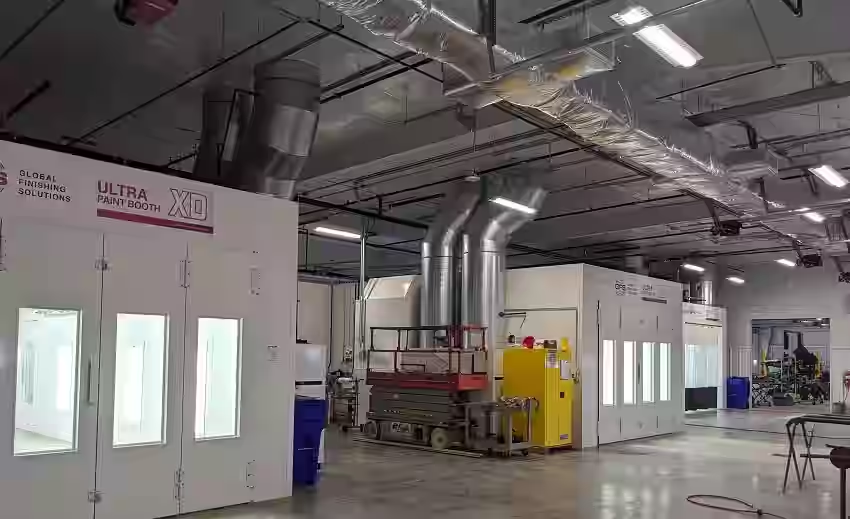
A standard auto body paint booth offers a reliable, fast-to-deploy solution. These pre-configured systems are manufactured to set dimensions—typically around 7.0 meters in length, 4.0 meters in width, and 2.8 meters in height—making them highly effective for shops focusing primarily on standard passenger cars. They feature robust, dual-skin insulated wall panels (often using 50mm to 75mm EPS or fireproof Rockwool insulation) and standard LED lighting arrays that provide the baseline illumination required for professional work.
However, when your shop routinely services high-roof commercial transit vans, heavy-duty trucks, or complex industrial components, a standard booth can quickly become a bottleneck. This is where custom-engineered systems excel. Custom setups allow you to specify extended heights, heavy-duty floor grid configurations, and modular configurations that integrate seamlessly with your existing production lines.
To help you decide which path is right for your facility, let's compare standard and custom-designed booths across key performance metrics:
| Feature/Metric | Standard Pre-Engineered Booths | Custom-Designed Paint Booths |
|---|---|---|
| Primary Use Case | Standard passenger cars, SUVs, and light trucks | Mixed fleets, high-roof transit vans, heavy machinery |
| Dimensional Flexibility | Fixed configurations (e.g., 7.0m x 4.0m x 2.8m) | Scalable length, width, and height to match shop constraints |
| Airflow Customization | Standard crossdraft or semi-downdraft setups | Full downdraft with custom pit or raised basement ducting |
| Heating & Curing | Standard direct-fired gas or diesel burners | Advanced multi-zone burners, infrared curing panels |
| Floor Load Capacity | Standard light-to-medium duty grids | Heavy-duty grids (rated up to 900kg+ per wheel for heavy vehicles) |
| Integration Capabilities | Standalone operation | Direct integration with prep stations and paint mixing rooms |
If you are looking to purchase a new system, exploring a professional paint booth for sale mi will give you a clear view of the standard models available, as well as the engineering modifications that can be made to suit your regional utility hookups and space constraints.
Sizing and Layout Configurations for Commercial Refinishing
A common mistake in shop design is selecting a booth based solely on the size of the vehicles you paint today. To ensure maximum operational efficiency and future-proof your investment, you must design your layout around vehicle clearance, technician maneuverability, and overall shop workflow.
Modern commercial shops must accommodate taller vehicle profiles, such as high-roof transit vans and large utility trucks. A booth with insufficient vertical clearance forces technicians to work in cramped, poorly illuminated conditions, leading to paint runs, uneven clear coats, and increased physical fatigue. By utilizing precise CAD shop layouts during the planning phase, you can visualize how a new booth fits into your shop's physical footprint alongside your prep stations, paint mixing rooms, and curing ovens.
To understand the financial and structural requirements of installing these heavy-duty systems, consult our comprehensive paint booth installation cost guide. Proper planning ensures that structural foundations, electrical service upgrades, and gas line runs are accounted for before delivery day. For high-volume environments, a professional downdraft paint booth installation is the gold standard, drawing overspray and airborne contaminants straight down into a filtered exhaust pit or raised metal basement.
Determining the Ideal Car body paint booth Dimensions
When calculating the internal dimensions of your car body paint booth, you must account for the "working envelope." This envelope includes the vehicle's physical dimensions plus a minimum of 3 feet (approximately 0.9 meters) of clear space on all sides, including the front, rear, and top. This clearance is critical for:
- Technician Mobility: Allowing painters to maintain the correct spray gun distance (typically 6 to 8 inches) and angle relative to the panels.
- Unobstructed Airflow: Preventing "dead zones" where overspray can swirl and settle back onto freshly painted surfaces.
- Hose and Equipment Clearance: Ensuring air lines and paint hoses do not drag against wet panels.
For shops handling commercial fleets or larger utility vehicles, investing in an industrial paint booth with extended height (3.0 meters or more) and reinforced floor grids is necessary to handle the heavy axle loads and physical height of modern commercial vehicles.
Integrating Prep Stations and Paint Mixing Rooms
To maximize the throughput of your primary spray booth, it should only be used for spraying and curing. All prep work—such as sanding, priming, and masking—should be performed in dedicated preparation stations.
A highly efficient collision shop layout utilizes a strategic ratio of multiple prep stations (typically 3 to 4) to every 1 or 2 active spray booths. This parallel configuration ensures that the spray booth is constantly loaded with ready-to-paint vehicles, minimizing idle time.
Additionally, your paint mixing room must be located immediately adjacent to the spray booth. Equipping this space with professional paint mixing room equipment and an automated spray gun cleaning machine keeps technicians within a controlled, clean environment. This layout minimizes the risk of carrying dust and lint from the main shop floor into the clean booth environment, ensuring flawless finishes on every cycle.
Airflow Dynamics, Filtration, and Heating Systems
The core performance of any car body paint booth is determined by its mechanical systems: how it moves air, how it filters out particulates, and how it cures the paint. High-volume commercial booths require heavy-duty air makeup units (AMUs) capable of handling massive cubic feet per minute (CFM) requirements while maintaining stable static pressure.
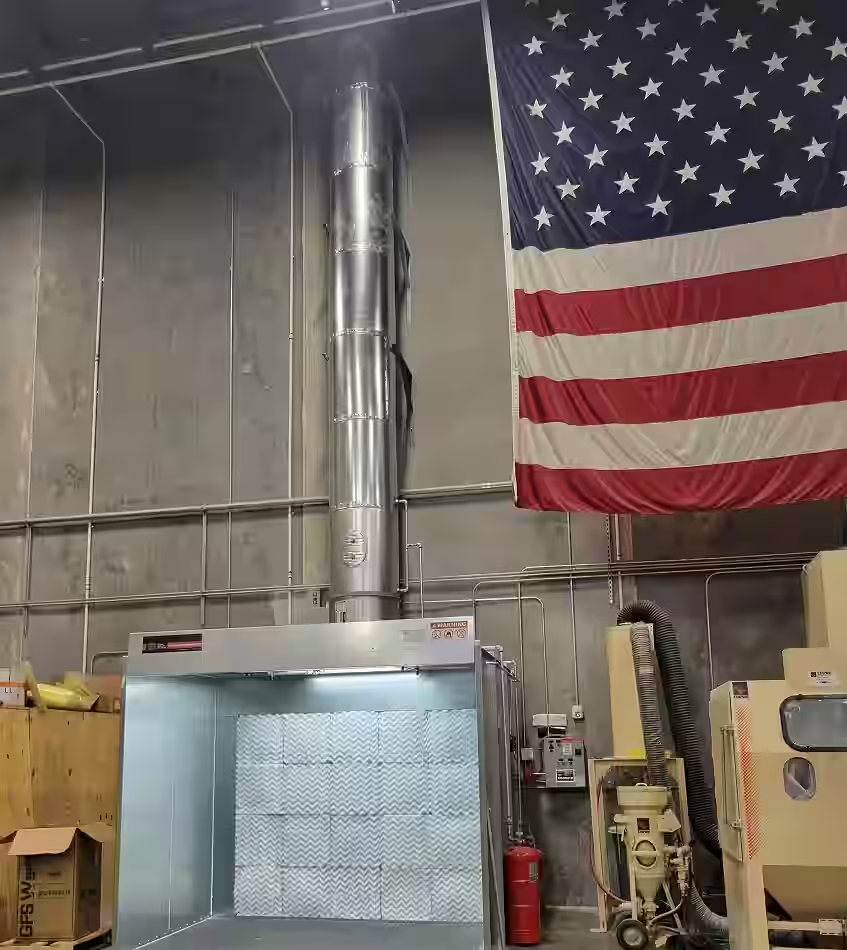
To speed up production times, modern commercial booths incorporate advanced drying configurations, such as a specialized waterborne paint drying system. These systems utilize high-velocity air nozzles or ceiling-mounted blowers to break the boundary layer of air over wet paint, accelerating the evaporation of water-based solvents and cutting flash times in half.
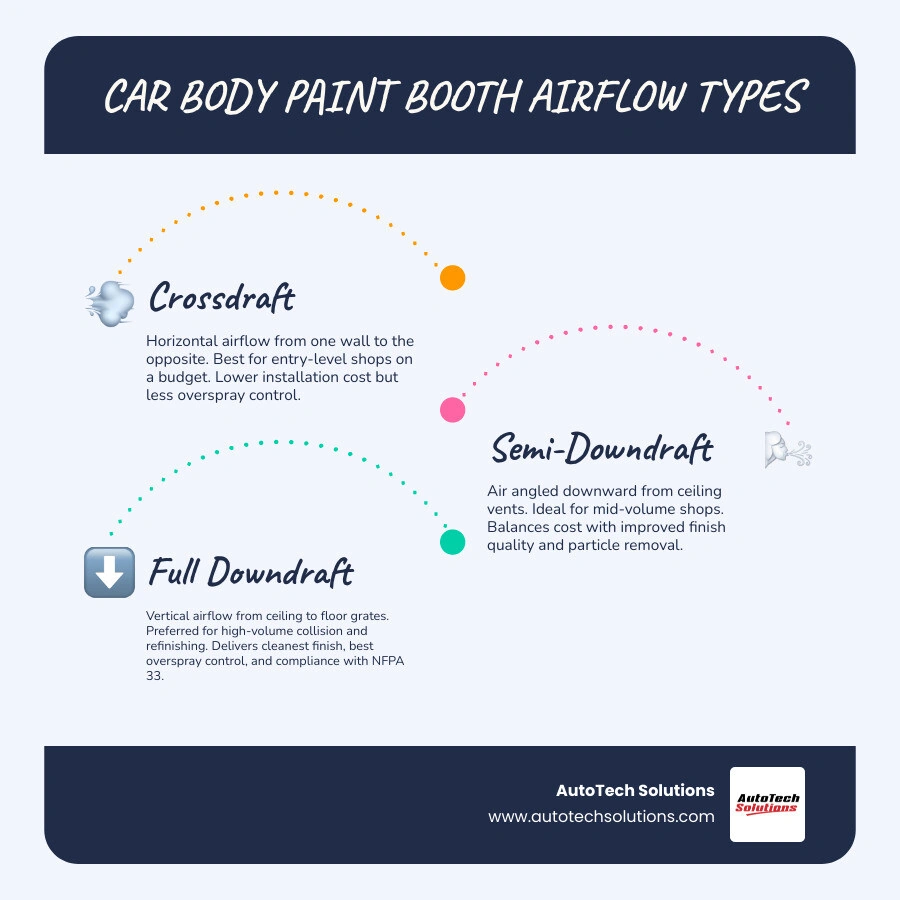
Optimizing Airflow in a Car body paint booth
Airflow is designed to do two things: protect the painter from toxic fumes and pull paint overspray away from the vehicle surface before it can dry and settle.
- Full Downdraft: Air enters through high-efficiency ceiling filters and is pulled vertically downward past the vehicle, exiting through floor grates. This is the most effective design for preventing paint defects, as gravity and mechanical draft work together to pull overspray down and away.
- Semi-Downdraft: Air enters through the ceiling at the front of the booth and is pulled diagonally toward exhaust grates located at the lower rear of the booth. This provides a clean draft pattern at a lower installation cost than a full concrete pit downdraft system.
- Crossdraft: Air enters through filters in the front doors and is pulled horizontally across the vehicle, exiting through exhaust filters in the back wall. While cost-effective, this design increases the risk of overspray settling on adjacent panels during longer spraying sessions.
For professional refinishing, maintaining a consistent air velocity of 0.25 to 0.35 m/s under loaded booth conditions is critical to ensure that airborne particulates are evacuated immediately.
Advanced Heating and Curing Technologies
To achieve rapid cycle times, commercial booths rely on a dedicated "Baking Mode." During this cycle, the booth's air makeup unit recirculates heated air (up to 95% recirculation to conserve energy) and utilizes high-output direct-fired gas or diesel burners to raise the cabin temperature to between 60°C and 80°C (140°F to 176°F).
This rapid heat application accelerates the chemical cross-linking of modern clear coats, reducing curing times from several hours at room temperature to just 20 to 30 minutes. Advanced multi-tasking spray booth designs, such as modular parallel-box configurations, utilize dry paint overspray separation systems instead of traditional wet scrubbers. This technology reduces energy consumption by up to 75% compared to wet scrubbers, lowering operating costs while maintaining the high thermal stability required for consistent, high-volume curing.
Safety Compliance, Ventilation, and Maintenance Standards
Operating a commercial paint booth involves handling volatile organic compounds (VOCs), flammable solvents, and hazardous air pollutants. Consequently, strict compliance with federal and local safety standards is not optional—it is a legal and operational necessity.
In the United States, commercial spray operations must comply with several key regulatory frameworks:
- **OSHA**: Regulates worker exposure to hazardous chemicals, requiring proper respiratory protection, continuous fresh air changes, and safe noise levels.
- NFPA 33 (National Fire Protection Association): Governs the design and construction of spray application booths to minimize fire hazards. This includes strict requirements for spark-proof exhaust fans, explosion-proof LED lighting fixtures, and automatic fire suppression systems.
- EPA 6H Rule (National Emission Standards for Hazardous Air Pollutants): Mandates that all commercial spray booths achieve at least 98% filtration efficiency using approved multi-stage exhaust filters to prevent toxic overspray from entering the atmosphere.
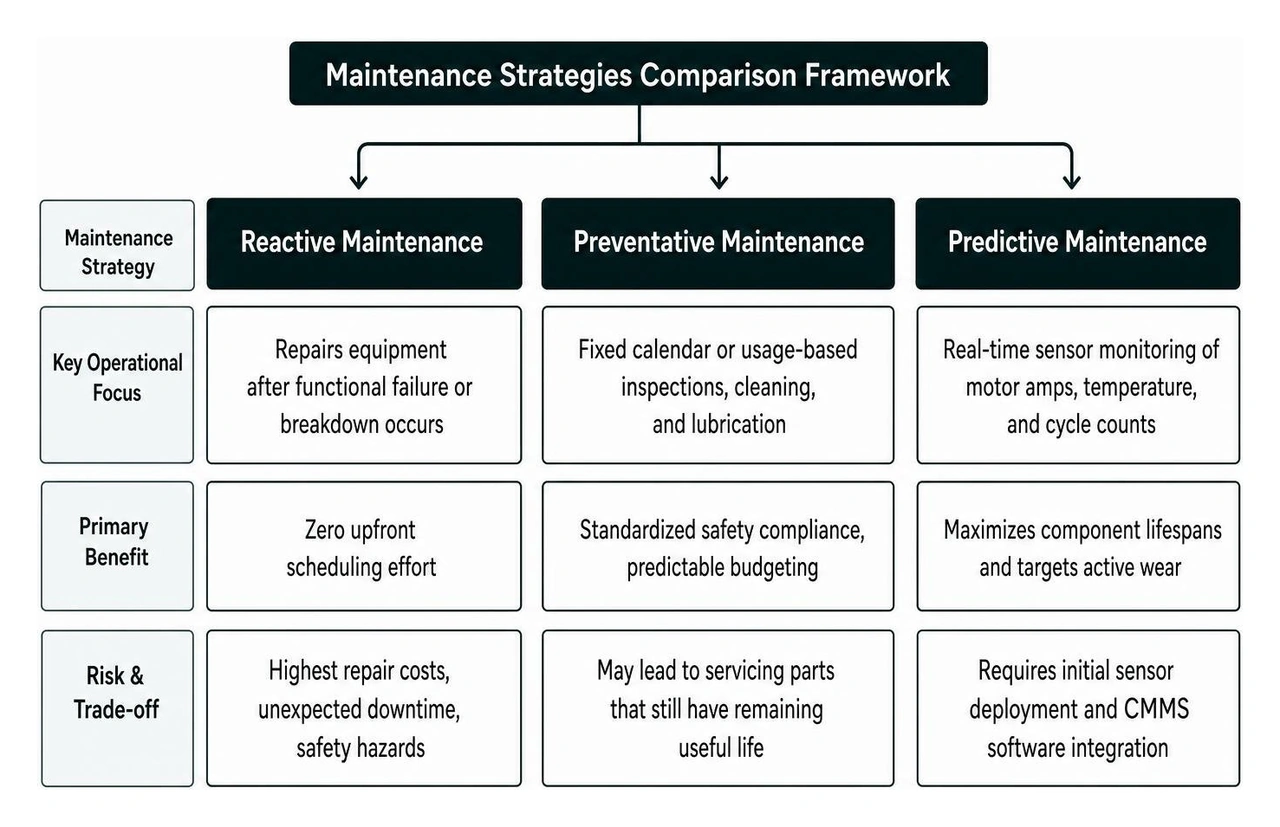
To maintain these safety levels and prevent unexpected equipment failure, shops must implement a rigorous preventative maintenance schedule. Utilizing a professional automotive paint booth maintenance service keeps your systems running at peak efficiency.
From routine burner tuning to mechanical inspections, securing expert paint booth service is the best way to prevent catastrophic failures. For day-to-day operations, keeping a paint booth repair tips guide on hand allows your shop foremen to quickly troubleshoot minor electrical or pressure issues before they cause production delays.
Professional Installation and Sourcing in Michigan and the Carolinas
Installing a commercial-grade car body paint booth is a complex engineering project. It requires precise concrete work (for downdraft exhaust pits), heavy structural assembly, high-voltage electrical hookups, gas line plumbing, and custom exhaust ducting that must clear your facility's roofline.
Attempting to self-install or cut corners on a commercial refinishing system is a recipe for compliance failures, structural hazards, and voided manufacturer warranties. Partnering with certified professionals ensures that your booth is installed safely, calibrated correctly, and fully compliant with local building codes.
If you are planning an upgrade or setting up a new collision facility, our team at AutoTech Solutions provides turnkey services across our service areas—from professional car lift installation to complete refinishing infrastructure setup. Our paint booth experts michigan guide outlines the entire process, from local zoning permits to initial system startup.
We offer comprehensive paint booth sales in michigan to help you find the exact system configuration for your space, backed by certified mi paint booth installers who handle every aspect of the physical setup.
For shops looking for alternative acquisition paths, we can assist in sourcing a high-quality used auto body paint booth for sale that has been fully inspected and reconditioned to meet safety standards. Alternatively, if you need a temporary or flexible setup for a short-term commercial contract, our paint booth rent complete guide explores how to secure professional-grade equipment without a long-term capital commitment.
Frequently Asked Questions about Commercial Paint Booths
What are the ventilation requirements for an indoor commercial paint booth?
An indoor commercial paint booth must maintain continuous, high-volume exhaust extraction to prevent the buildup of flammable vapors and toxic overspray. NFPA 33 and local mechanical codes typically require a minimum air velocity of 100 feet per minute (LFM) across the open face of a crossdraft booth, or a corresponding volumetric flow rate (measured in CFM) that ensures complete air changes inside the cabin multiple times per minute.
Additionally, the exhaust system must utilize spark-proof, limit-switch-protected exhaust fans where the motor is completely isolated from the exhaust air stream to eliminate ignition risks.
How often should commercial paint booth filters be replaced?
The replacement frequency of your filters depends on your daily paint volume, but it should always be guided by pressure readings on your booth's differential pressure gauge (manometer).
- Pre-Filters (Intake): Typically replaced every 2 to 4 weeks to protect the fine ceiling filters from large shop dust.
- Ceiling Diffusion Filters (EU5/Fine): Usually replaced every 6 to 12 months (or approximately 1,000 operating hours) to ensure uniform, laminar airflow.
- Floor/Exhaust Filters (Fiberglass Paint-Stop): Typically replaced every 40 to 60 operating hours (often weekly in high-volume shops) to prevent overspray from coating the exhaust fan blades and ductwork.
Operating with overloaded filters increases static pressure, reduces airflow velocity, and causes paint overspray to linger in the cabin, resulting in poor finish quality and increased wear on your air makeup unit.
Can a standard automotive paint booth be used for industrial equipment?
Yes, but with several critical caveats. While the chemical application process is similar, industrial equipment—such as agricultural machinery, structural steel fabrications, or heavy construction components—is significantly heavier and bulkier than passenger vehicles.
Before spraying industrial equipment in an automotive booth, you must verify that the floor grid carrying capacity (which is rated at 900kg per wheel on premium automotive booths) can handle the heavy axle loads. Furthermore, industrial coatings often have different solvent profiles and drying requirements, which may necessitate adjustments to the booth's exhaust filtration stages and baking cycle times to maintain environmental compliance.
Conclusion
Investing in a high-performance car body paint booth is one of the most effective ways to elevate your shop's refinishing quality, protect your technicians, and maximize daily vehicle throughput. Whether you require a standard pre-engineered downdraft booth or a custom-designed parallel refinishing system integrated with advanced prep stations, selecting the right equipment is only the first step. Long-term success relies on professional installation, strict safety compliance, and a dedicated preventative maintenance program.
At AutoTech Solutions, we are committed to minimizing your shop's downtime with expert sales, seamless turnkey installations, and rapid-response repair services. Serving commercial facilities from Michigan to the Carolinas, our factory-trained technicians ensure your equipment remains fully compliant and operational.
Ready to optimize your shop's refinishing capabilities? Schedule a consultation with AutoTech Solutions in Novi, MI today, and let our team design, install, or service the perfect paint booth solution for your business.