Why Facility Buildout Equipment Planning Makes or Breaks Your Shop

Facility buildout equipment planning is the process of identifying, selecting, budgeting, and integrating equipment into your shop's physical design — before construction begins.
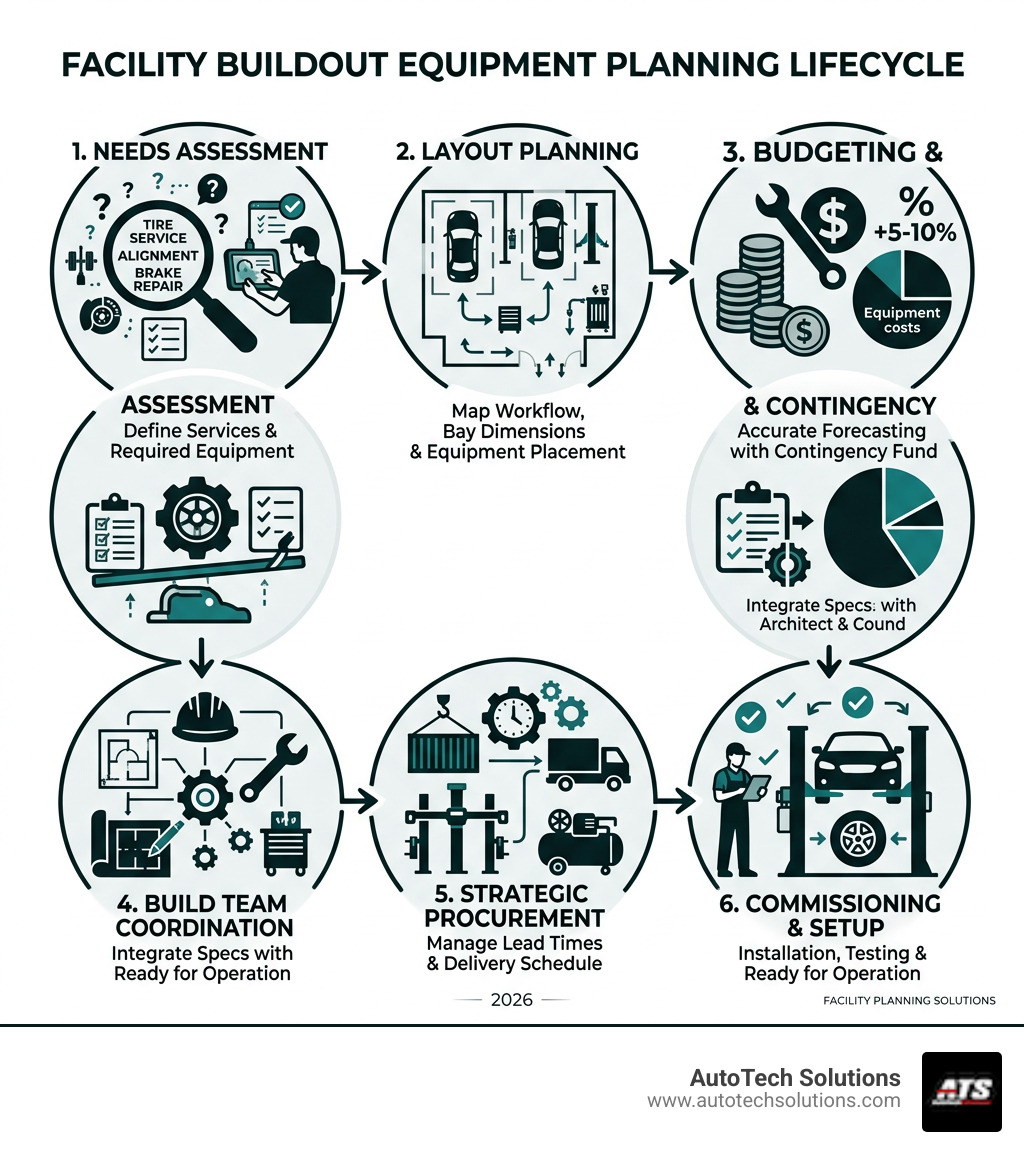
If you're looking for the short version, here's what successful shop equipment planning involves:
- Assess your needs - Define the services you'll offer and the equipment required to deliver them
- Plan your layout - Map vehicle flow, bay dimensions, and equipment placement early in the design phase
- Budget accurately - Equipment typically represents a significant share of total project cost; include a 5-10% contingency
- Coordinate with your build team - Integrate equipment specs with your architect and contractor from day one
- Procure strategically - Account for lead times, installation requirements, and commissioning before opening day
- Plan for the long term - Factor in maintenance costs, scalability, and future technology upgrades
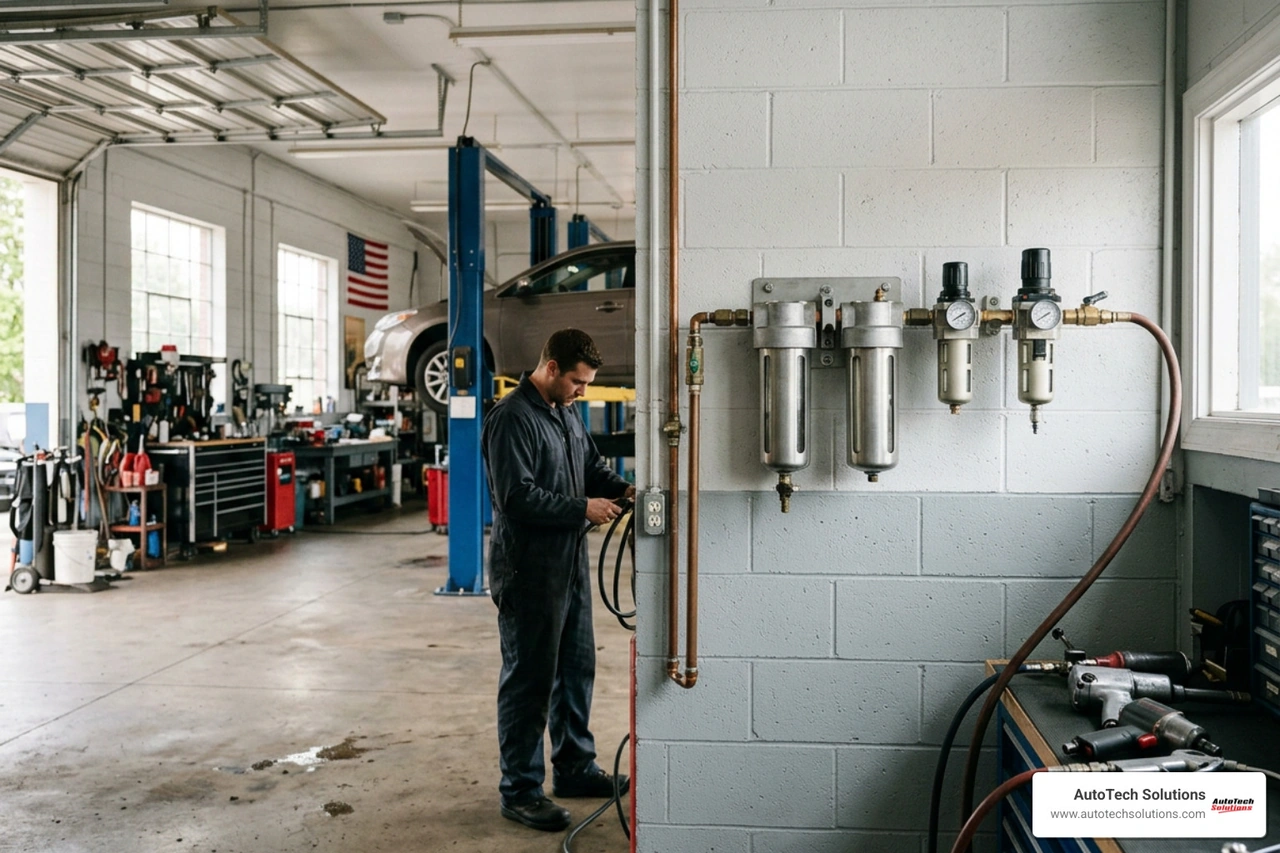
Running an auto shop is demanding enough without discovering mid-construction that your alignment rack won't fit the bay, or that you're missing the electrical capacity for your new tire mounting equipment.
The decisions you make before a single wall goes up will shape your technicians' productivity — and your profitability — for years.
Yet many shop owners treat equipment as an afterthought, something to figure out once the building is done. That's a costly mistake. As one planning principle puts it, poor initial strategic planning is one of the most common and expensive pitfalls in any facility construction project.
The good news? With the right process, facility buildout equipment planning turns a stressful build into a competitive advantage.
Must-know facility buildout equipment planning terms:
- ADAS Equipment Installation and Setup
- Automotive Equipment Installation and Service
- Automotive Lift Installation
The Strategic Process of Facility Buildout Equipment Planning
At AutoTech Solutions, we’ve seen how a well-developed facility master plan can save a business hundreds of thousands of dollars. It isn't just about selecting the latest equipment; it’s a systematic process to manage financial investments in your physical assets.
Effective facility buildout equipment planning requires a "big picture" approach. We start by looking at the asset lifecycle—from the moment you buy a piece of equipment to the day it’s decommissioned. This ensures your choices align with your long-term business goals. If you plan to expand from light-duty repair into heavy-duty truck service in three years, your current buildout needs to reflect that vision now.
Stakeholder engagement is also a non-negotiable. This means consulting with lead technicians, service writers, and even your finance team. Your techs know where the bottlenecks happen, and your finance team knows the budget constraints. By performing a thorough condition assessment of any existing gear and auditing your infrastructure, we can identify exactly what stays, what goes, and what needs an upgrade. For those looking for expert guidance, our shop design and consulting services provide the roadmap needed to navigate these complex decisions.
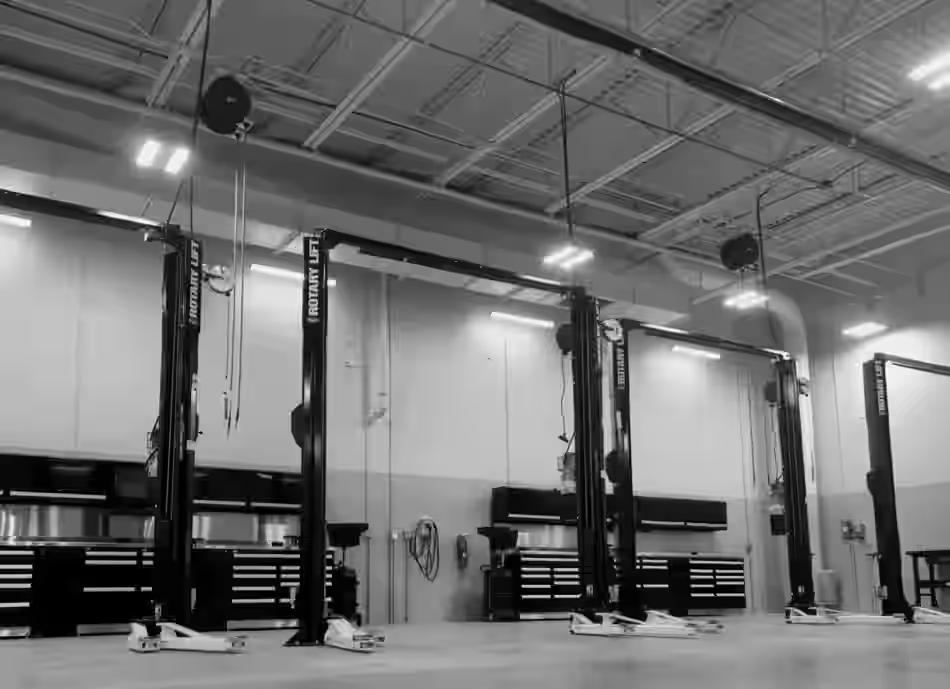
Essential Deliverables for Facility Buildout Equipment Planning
To keep a project on track, we rely on specific technical documents that act as a "single source of truth" for the construction team:
- Room Data Sheets (RDS): These detail the specific requirements for every bay or room, including dimensions, weight limits, and required utilities.
- Room Layout Sheets (RLS): Usually prepared at a 1:50 scale, these provide a visual map of where every piece of equipment sits, including ceiling clearances for high-rise lifts.
- Schedule of Equipment (SOE): A comprehensive list that tracks every item, its cost, quantity, and utility requirements (power, air, water).
Modern planning also utilizes Building Information Modeling (BIM) integration. This allows us to "see" the equipment in a 3D digital model of your shop before a single wrench is turned, preventing costly clashes between lifts and overhead lines.
| Feature | Fixed Equipment (Group 1) | Loose Equipment (Group 2/3) |
|---|---|---|
| Examples | In-ground lifts, paint booths, built-in compressors | Floor jacks, scan tools, stethoscopes |
| Installation | Requires structural/utility integration | Plug-and-play or battery-operated |
| Lead Time | Long (10-12 weeks or more) | Short (Immediate to 2 weeks) |
| Planning Need | High - must be in blueprints | Moderate - requires storage space |
Future-Proofing Your Facility Buildout Equipment Planning
The automotive industry is changing faster than ever. A shop built today must be ready for the electric vehicle (EV) revolution and the rise of autonomous systems. Scalability and modular design are your best friends here. Instead of pouring concrete that can only ever hold one specific type of lift, we look for flexible layouts that can be adapted.
Automation readiness is another key factor. Industry 4.0 isn't just for massive manufacturing plants; it's coming to the automotive service facility in the form of connected diagnostics and automated fluid management. Planning for high-bandwidth data lines and robust electrical capacity now prevents expensive retrofitting later. According to the U.S. Department of Energy’s industrial energy efficiency programs, incorporating energy-efficient lighting and HVAC systems during the buildout doesn't just save the planet—it significantly slashes your monthly overhead.
Integrating Equipment into Architectural Design and Workflow
A well-designed facility is ineffective if the layout creates workflow bottlenecks for technicians. We use lean principles like "spaghetti diagrams" and value stream mapping to track how a vehicle moves from the parking lot to the service bay and back. The goal is simple: remove every possible bottleneck.
Workflow Optimization for Light and Heavy Duty Shops
In facility buildout equipment planning, size matters. A light-duty shop focusing on sedans has very different clearance and bay dimension requirements than a heavy-duty shop servicing Class 8 trucks. We ensure your bays have the "swing room" needed for large vehicles and that technician ergonomics are prioritized. If a technician must walk 50 feet to get to a parts washer or a computer terminal twenty times a day, the facility loses billable hours.
Our team at AutoTech Solutions specializes in installations and buildouts that optimize this flow, ensuring that vehicle movement is fluid and that every square foot of your shop is generating revenue.
Technical Infrastructure and Smart Shop Readiness
The "guts" of your building—the power, air, and data—must be sized for peak demand.
- Power Capacity: Modern shops, especially those with EV charging or heavy welding equipment, require significant electrical appetite. It’s wise to plan for 30% growth headroom in your grid capacity.
- Compressed Air and Fluids: Gone are the days of messy hoses everywhere. We plan integrated fluid management systems that deliver oil, coolant, and air exactly where they are needed, tracked by digital meters.
- Connectivity: With 75% of enterprise data expected to be processed at the "edge" by 2025, your shop needs more than just basic Wi-Fi. We help plan network segmentation to keep your customer data safe while your diagnostic tools run at lightning speed.
Prioritizing Regulatory Compliance and Risk Management
Safety isn't just a checkbox; it's the foundation of a professional shop. During the facility buildout equipment planning phase, we navigate the maze of OSHA safety regulations to ensure your shop is compliant from day one. This includes proper ventilation for exhaust, secondary containment for hazardous fluids (EPA compliance), and clear emergency egress paths.
Risk Mitigation in Equipment Procurement
One of the biggest risks in a buildout is the "waiting game." Some heavy-duty equipment, like specialized paint booths or large-capacity lifts, can have lead times of several months. We manage this through rigorous vendor assessments and by building "contingency sums" into your budget.
We recommend a 5-10% budget buffer for new construction and up to 20% for renovations. Why? Because "surprises" like hit rock during excavation or a change in local zoning laws can derail a project that is stretched too thin. Managing change orders effectively—and keeping them to a minimum through better planning—is how we keep your project on budget.
Lifecycle Cost Analysis and Maintenance Planning
The purchase price of a piece of equipment is just the tip of the iceberg. To understand the "Total Cost of Ownership," you have to look at the annual maintenance. For complex automotive equipment, the annual cost of comprehensive service (including parts and labor) can range from 5% to 15% of the purchase price.
At AutoTech Solutions, our USP is minimizing downtime. We don't just sell you a lift; we provide the preventative maintenance and fast repair response needed to keep that lift servicing vehicles. If a bay is down, the facility's revenue-generating capacity is compromised. Asset tracking tools help us monitor the health of your equipment, so we can fix a problem before it stops your production.
Procurement, Installation, and Commissioning Strategies
Once the plans are signed and the equipment is ordered, the real work begins on-site. We provide site supervision to ensure the "builder’s work"—the concrete slabs, electrical stubs, and air lines—is exactly where it needs to be.
Best Practices for Equipment Contracts
When signing procurement contracts, we recommend a few strategic best practices:
- Direct Agreements: Whenever possible, work directly with the manufacturer or a certified primary dealer like AutoTech Solutions to avoid the markups and communication gaps of "middleman" brokers.
- Performance-Based Design: Ensure the contract specifies that the equipment must perform to certain standards once installed, not just "look like the picture."
- Payment Holdbacks: It’s standard practice to hold back about 5% of the final payment in an escrow account until the equipment is fully commissioned and your staff is trained.
Check out our full range of automotive products to see the quality standards we stand behind.
Relocation and Brownfield Site Considerations
Moving an existing shop (a brownfield project) is often more complex than building a new one (greenfield). You have to deal with existing site constraints, potential structural reinforcement needs, and the challenge of moving heavy machinery without interrupting your service for weeks. We conduct inventory audits to see what is worth moving and what should be replaced, ensuring your utility upgrades are ready before the old equipment arrives at the new site.
Frequently Asked Questions about Shop Planning
What percentage of a buildout budget should be allocated to equipment?
In most professional automotive facilities, equipment costs represent roughly 20% of the overall project cost. However, this can fluctuate. For specialized facilities like collision centers with high-end paint booths or heavy-duty shops with massive lifts, equipment can represent a significantly higher portion of the budget.
When is the best time to engage an equipment planner in the construction process?
Ideally, you should engage an equipment planner during the master planning phase, but no later than the design-development phase. If you wait until the walls are being framed, you will almost certainly face expensive change orders to accommodate utility needs or structural requirements.
How do I choose between fixed hinges and sliding mechanisms for heavy-duty lifts?
For heavy-duty applications, we generally recommend lifts with fixed hinges. Fixed hinges provide a smoother, more even lifting motion and tend to have a longer lifecycle with less mechanical stress than sliding mechanisms, which can wear down or bind under the extreme weights of commercial vehicles.
Conclusion
Planning a shop buildout is a marathon, not a sprint. From the first blueprint to the final safety inspection, every detail matters. By focusing on facility buildout equipment planning early, you ensure that your shop isn't just a building, but a high-performance machine designed for maximum efficiency.
At AutoTech Solutions, we pride ourselves on being a one-stop-shop for sales, installation, and service. Whether you are running a light-duty repair shop, a heavy-duty fleet center, or a high-volume collision shop, our mission is to minimize your downtime with expert support across Michigan and the Carolinas. We don't just plan shops; we build long-term partnerships that keep your business moving forward.
Ready to turn your vision into a reality? Plan your facility buildout with AutoTech Solutions and let our experts handle the heavy lifting.