Why Fleet Tire Service Solutions Are Critical for Commercial Operations
Fleet tire service solutions are specialized programs, equipment setups, and managed maintenance systems designed to keep commercial vehicles rolling safely and cost-efficiently. If you're evaluating your options, here's a quick summary:
Top fleet tire service solutions include:
- Managed tire programs — outsourced tire leasing and maintenance (e.g., pay-per-mile models) from providers like Michelin and Goodyear
- 24/7 roadside assistance — emergency response networks covering thousands of locations nationally
- Preventive maintenance programs — scheduled inspections, inflation checks, rotation, and alignment
- Tires-as-a-Service (TaaS) — all-inclusive subscriptions combining premium tires, sensors, and remote monitoring
- In-house commercial tire bays — shops equipped with heavy-duty tire changers, balancers, alignment systems, and lift racks
- Predictive monitoring technology — real-time tire pressure, temperature, and tread depth tracking via connected sensors
For fleet operators, tires aren't just a maintenance line item — they're a direct driver of uptime, fuel costs, and safety. A single underinflated tire (by just 10 PSI) can wipe out 7%–15% of tread life and accelerate casing fatigue. Multiply that across dozens or hundreds of vehicles, and the financial impact is significant.
The numbers back this up. A real-world pilot program with nearly 50 trucks using a subscription-based tire management model achieved 94% of tires maintained at optimal pressure, a 91% reduction in breakdowns, and a 5.1% reduction in total cost of ownership (TCO).
The bottom line: how you manage tires determines how efficiently your fleet runs.
Whether you're a commercial tire shop looking to equip your bays for fleet-level service, or a fleet manager evaluating outsourced programs, the right combination of equipment, processes, and technology makes the difference between reactive firefighting and predictable, profitable operations.

The Evolution of Fleet Tire Service Solutions
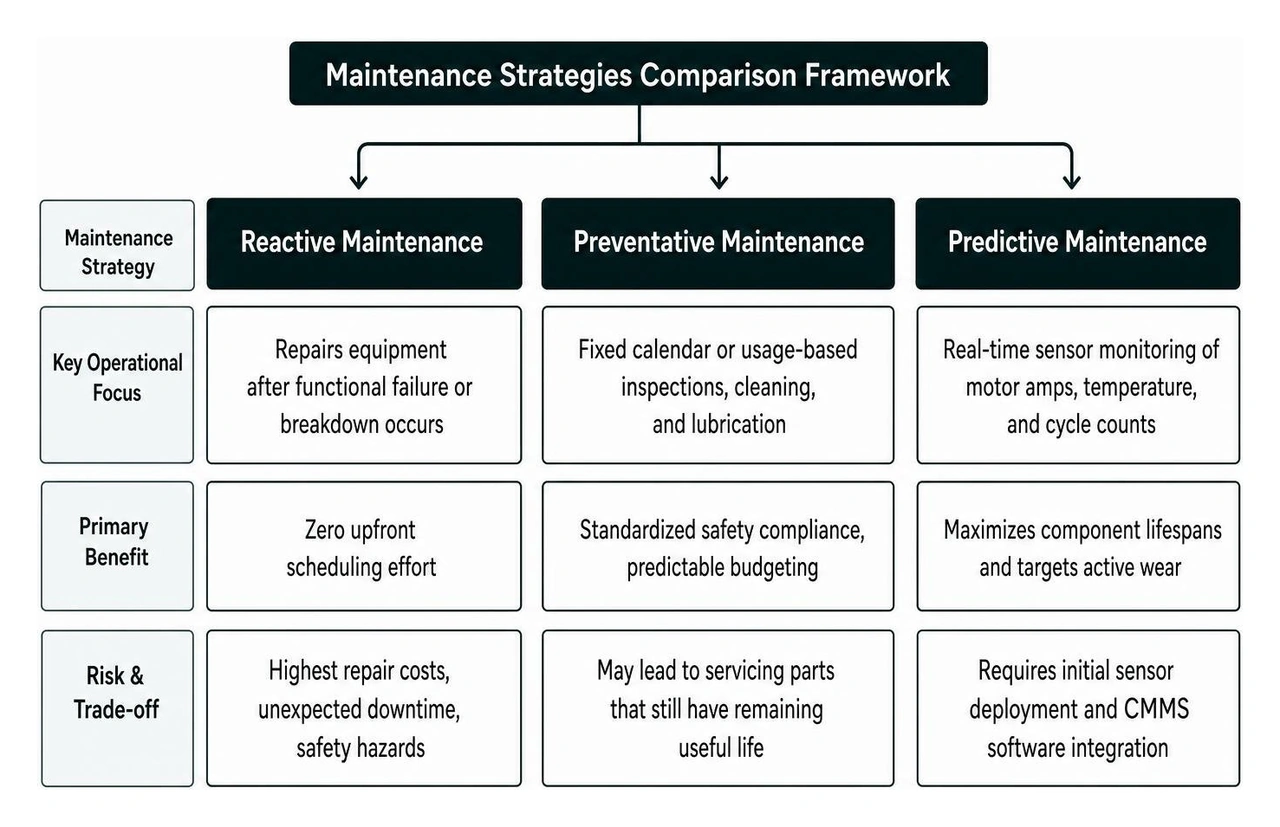
Historically, commercial fleets managed their tire programs reactively. A driver noticed a soft tire, or worse, experienced a blowout on a highway, prompting a costly emergency call. This traditional approach treated tires as disposable wear items, managed entirely in-house with basic shop tools.
Today, the industry is shifting rapidly toward structured, data-driven fleet tire service solutions. Commercial shops and fleet managers no longer wait for a failure. Instead, they utilize comprehensive outsourced programs and advanced commercial shop equipment to predict and prevent tire failures before they happen.
Comparing Traditional Tire Management vs. Managed Fleet Tire Service Solutions
| Feature | Traditional Tire Management | Managed Fleet Tire Service Solutions |
|---|---|---|
| Operational Model | Reactive (replace upon failure or visible wear) | Proactive (predictive scheduling and automated alerts) |
| Financial Structure | High upfront capital expenditure (CapEx) | Predictable operating expenditure (OpEx) / Subscription |
| Data Utilization | Manual tread depth and pressure gauge checks | Automated pressure, temperature, and wear tracking |
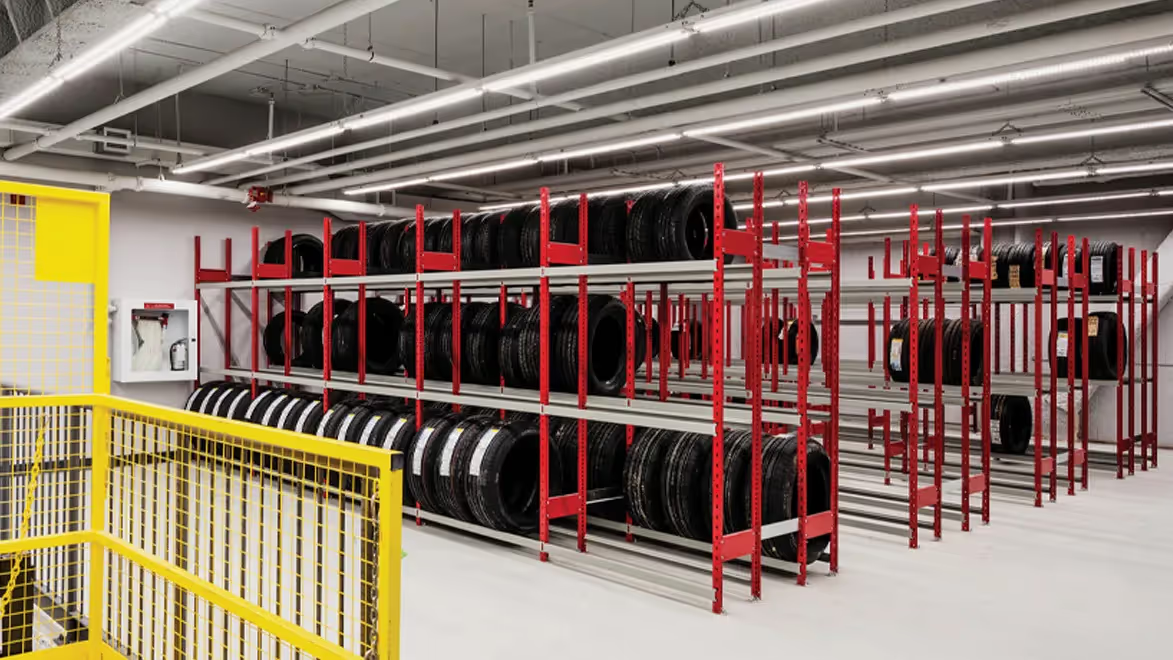
| Sourcing & Inventory | In-house stockpiling of multiple tire sizes | Just-in-time delivery and pooled asset management |
| Roadside Support | Local, uncoordinated towing or service calls | National 24/7 dispatch networks with pre-approved billing |
| Tire Lifecycle | Premature removal (up to 50% loss of usable tread) | Maximized casing life, retreading, and systematic recycling |
Outsourced tire management programs have completely redefined fleet logistics. Rather than purchasing assets outright, many fleets now opt for pay-per-mile or subscription-based models. A prime example is the shift toward Tires-as-a-service | Goodyear Truck Tires, which bundles premium tires, smart sensors, continuous remote monitoring, and proactive maintenance into a predictable monthly subscription.
Furthermore, national account programs like Fleet HQ | Goodyear Truck Tires and Conti360° Fleet Services | Commercial Tires & Retreads allow fleets to access standardized pricing, consistent service protocols, and emergency roadside assistance across massive regional networks. For commercial shops in regions like Charlotte, NC, Raleigh, NC, and Novi, MI, equipping service bays to support these high-tech, managed programs is no longer optional—it is a core business requirement.
Essential Heavy-Duty Equipment for Commercial Tire Shops
To capture B2B fleet accounts, commercial service shops must be outfitted with professional-grade shop equipment engineered for heavy-duty applications. Servicing multi-axle trucks, buses, and commercial trailers requires specialized machinery that can handle high volumes, massive tire dimensions, and intense physical demands while ensuring technician safety and shop productivity.
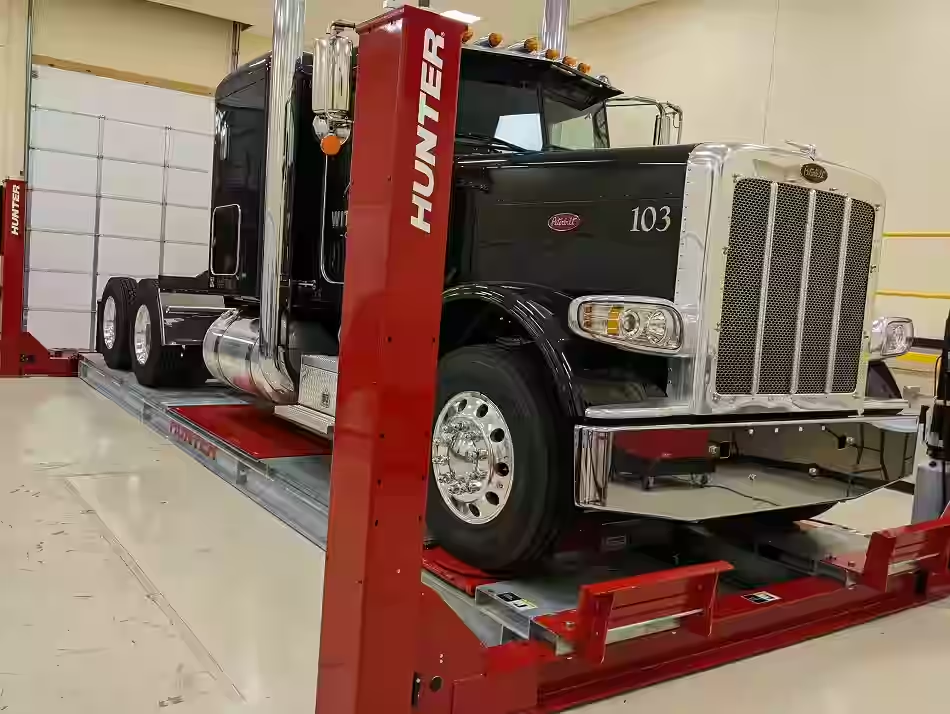
Outfitting Bays for Fleet Tire Service Solutions
Offering competitive fleet tire service solutions starts with the physical infrastructure of your service bays. Standard automotive lifts and light-duty tire changers simply cannot support the weight or dimensions of heavy-duty fleet assets.
- Professional Car Lift Installation: Commercial shops must install heavy-duty four-post lifts and alignment pit racks capable of lifting up to 35,000 lbs. These lifts must accommodate long wheelbases (often up to 300 inches) to service multi-axle transport trucks, buses, and utility vehicles. Pit racks are particularly efficient for high-volume fleet bays, allowing technicians to drive vehicles straight over the service area without crawling underneath, which drastically reduces service times.
- Heavy-Duty Tire Changers: Modern commercial tire changers must handle rim diameters ranging from 14 to 58 inches. Utilizing manual bars and sledgehammers to dismount heavy-duty tires is a safety liability and a major bottleneck. Modern automatic tire changers feature dual-disc bead breakers, hydraulic center-post clamping, and pneumatic assist arms (bead assist) to safely demount stiff, high-ply commercial tires without damaging the wheels or fatiguing the technician.
- Heavy-Duty Wheel Balancers: Unbalanced commercial wheels cause severe cab vibration, accelerated tread wear, and suspension damage. Shops should be equipped with heavy-duty wheel balancers featuring laser measurement systems that automatically input wheel dimensions and diagnose rim runout in seconds.
- Exhaust Extraction Systems: Because commercial vehicles must often run during diagnostic checks, active exhaust extraction systems are crucial. These systems hook directly to the vehicle's exhaust pipe, safely venting harmful diesel and combustion fumes out of the service bay to maintain OSHA compliance and protect technician health.
Advanced Diagnostics and Calibration Tools
As commercial vehicles grow more advanced, tire service is no longer just about rubber and steel; it is deeply integrated with vehicle electronics and driver-assist systems.
- Tire Pressure Monitoring Systems (TPMS) & Remote Diagnostics: Commercial fleets increasingly rely on intelligent tires embedded with sensors. Modern shop equipment must feature diagnostic tools that sync with these sensors to read real-time pressure, temperature, and treadwear data, instantly uploading the metrics to the fleet manager's dashboard.
- Wheel Runout Diagnostics & Laser Measurement: Advanced wheel balancers use non-contact laser technology to measure wheel runout. This allows technicians to identify bent rims or structural issues that would otherwise go unnoticed, preventing premature tire wear.
- ADAS Calibration: When a commercial truck undergoes a major wheel alignment, its Advanced Driver Assistance Systems (ADAS)—such as lane departure warning and collision avoidance systems—must be recalibrated. Outfitting alignment bays with ADAS calibration tools ensures that the vehicle's cameras and radar sensors align perfectly with the newly adjusted thrust line of the chassis.
Maximizing Fleet Uptime and Reducing Total Cost of Ownership
For fleet operators, every minute a vehicle sits idle in a bay is money lost. Tires represent one of the largest operating expenses for commercial fleets, second only to fuel. Implementing proactive fleet tire service solutions is the most effective way to drive down the total cost of ownership (TCO) and maximize uptime.

Proper tire maintenance directly impacts:
- Fuel Efficiency: Underinflated tires increase rolling resistance, forcing the engine to work harder. Keeping tires at optimal pressure can lead to a significant fuel consumption improvement.
- Tread Life & Casing Fatigue: Tires underinflated by just 10 PSI lose 7% to 15% of their usable tread life. Furthermore, underinflation causes excessive heat buildup, leading to accelerated casing fatigue. This ruins the casing, making it impossible to retread the tire and forcing the fleet to buy expensive new tires.
- Preventing Irregular Wear: Proper air pressure, precise toe alignment, and correct axle alignment can prevent up to 95% of irregular tire wear. This simple preventative step saves fleet operators hundreds of dollars per vehicle by avoiding premature tire removals, which can otherwise result in up to a 50% loss of usable tread.
The financial viability of this proactive approach is proven on a global scale. For instance, when Veolia France adopts Goodyear’s Tires-as-a-service for its entire fleet, it shifts the entire operational structure from a reactive purchasing model to a highly optimized, predictive maintenance subscription, drastically reducing roadside failures and optimizing fuel consumption.
Implementing In-House Fleet Tire Service Solutions
For large-scale fleet operators in our service areas—such as logistics hubs in Charlotte, NC, distribution networks in Raleigh, NC, and heavy-duty transport operators in Novi, MI—establishing an in-house commercial fleet service bay is often the most cost-effective solution.
By installing professional-grade tire changers, heavy-duty lifts, and precision alignment systems, fleets can execute scheduled maintenance within their own commercial facilities, avoiding the logistics of sending vehicles to third-party shops.
For fleets utilizing outsourced leasing models, such as Fleet Tire Leasing and Management | Michelin Fleet Solutions, having on-site commercial service bays allows third-party technicians to perform rapid scheduled inspections, wheel refurbishments, and tire rotations directly at the fleet’s primary operations base.
In emergency situations where vehicles cannot return to base, local operators can coordinate with specialized mobile networks, such as utilizing Mobile Tire Repair in and near Wade, NC - Find Truck Service to handle roadside emergencies.
For localized fleet operations, partnering with regional service centers like Fleet Service - Charlotte - Affordable Tire & Auto Care: or utilizing structured Novi, MI Fleet Management programs ensures that vehicles remain compliant, safe, and continuously operational.
Frequently Asked Questions about Fleet Tire Services
What equipment is required to offer commercial fleet tire services?
To service commercial fleets professionally, a shop must be equipped with heavy-duty machinery designed for large-scale vehicles. The baseline equipment includes:
- A heavy-duty tire changer (clamping up to 58-inch wheels) featuring pneumatic bead assist arms.
- A heavy-duty wheel balancer with automatic data entry and laser runout diagnostics.
- A heavy-duty alignment system (such as multi-axle alignment systems) to handle long-wheelbase trucks and trailers.
- Professional car lift installation of heavy-duty four-post lifts or alignment pit racks with at least a 35,000-lb capacity.
- An active exhaust extraction system to safely clear diesel fumes during indoor diagnostics.
How do fleet tire service programs reduce total cost of ownership (TCO)?
Fleet tire programs reduce TCO by transforming tire maintenance from reactive to proactive. They achieve this through:
- Fuel Consumption Improvement: Keeping tires at optimal inflation pressures reduces rolling resistance.
- Breakdown Reduction: Continuous monitoring and scheduled inspections catch slow leaks, structural damage, and tread wear before they cause roadside blowouts.
- Tread Life Extension: Regular rotations, correct inflation, and routine wheel alignments prevent irregular wear, ensuring the tire lasts for its full engineered lifespan.
- Casing Preservation: Preventing excessive heat buildup from underinflation preserves the tire casing, allowing it to be retreaded multiple times rather than replaced with a brand-new tire.
Why is professional alignment equipment critical for fleet maintenance?
Professional alignment equipment is critical because heavy-duty commercial vehicles are highly sensitive to misalignments across multiple axles. Misalignment causes tires to "drag" sideways down the highway, resulting in:
- Irregular Tire Wear: Severe toe or axle misalignment causes rapid, uneven wear (like feathering or cupping), which can ruin a tire in a fraction of its expected lifespan.
- Increased Fuel Burn: When axles are not parallel, the truck's engine must work harder to overcome the lateral drag, wasting fuel.
- Safety & Handling Issues: Proper alignment ensures the vehicle tracks straight, reducing driver fatigue and preventing dangerous pulling behaviors under heavy braking.
Conclusion
Managing a commercial fleet requires a relentless focus on minimizing downtime and controlling operational costs. Implementing professional fleet tire service solutions—whether through high-tech in-house tire bays or managed leasing programs—is one of the most impactful ways to keep your business moving forward.
At AutoTech Solutions, we specialize in helping commercial workshops and fleet operations optimize their service capabilities. We are a premier one-stop-shop for B2B automotive equipment sales, professional installation, emergency service, and preventative maintenance.
Our mission is simple: minimize your downtime with expert technical support and rapid repair response times. From high-capacity four-post lifts and alignment pit racks to heavy-duty tire changers, wheel balancers, and active exhaust extraction systems, we provide the industrial-grade tools your shop needs to service commercial fleets safely and efficiently.
We proudly serve commercial shops and fleet operations across Michigan to the Carolinas, with dedicated service coverage in:
- Novi, MI
- Charlotte, NC
- Raleigh, NC
- Wade, NC
Ready to upgrade your shop's capabilities and capture lucrative commercial fleet accounts? Explore AutoTech Solutions Equipment and Products today to discover how our professional shop systems and expert support can streamline your operations.