Heavy Duty Equipment Installation That Keeps Commercial Shops Productive
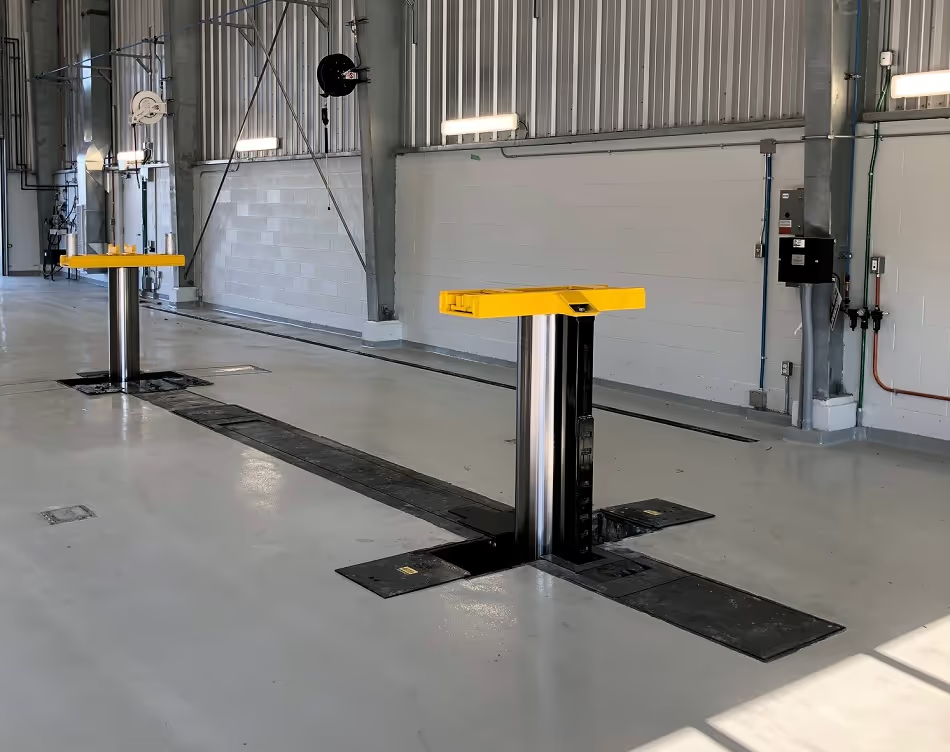
Heavy duty equipment installation for a commercial auto shop should be handled by qualified professionals who can assess the facility, position equipment accurately, connect required power and utilities, and verify safe operation before turnover.
For shop managers, the goal is simple: get essential systems online without creating downtime, safety risks, or compliance problems. That can include professional car lift installation, exhaust extraction systems, heavy-duty service equipment, fluid-delivery infrastructure, and other fixed shop tools.
A dependable installation starts with more than delivery day. It requires a clear plan for floor capacity, equipment layout, access routes, electrical supply, anchoring, safety controls, and final testing. Poor planning can disrupt technician workflow and make future maintenance harder.
AutoTech Solutions helps commercial facilities plan and install professional shop equipment with safety, uptime, and practical daily use in mind.
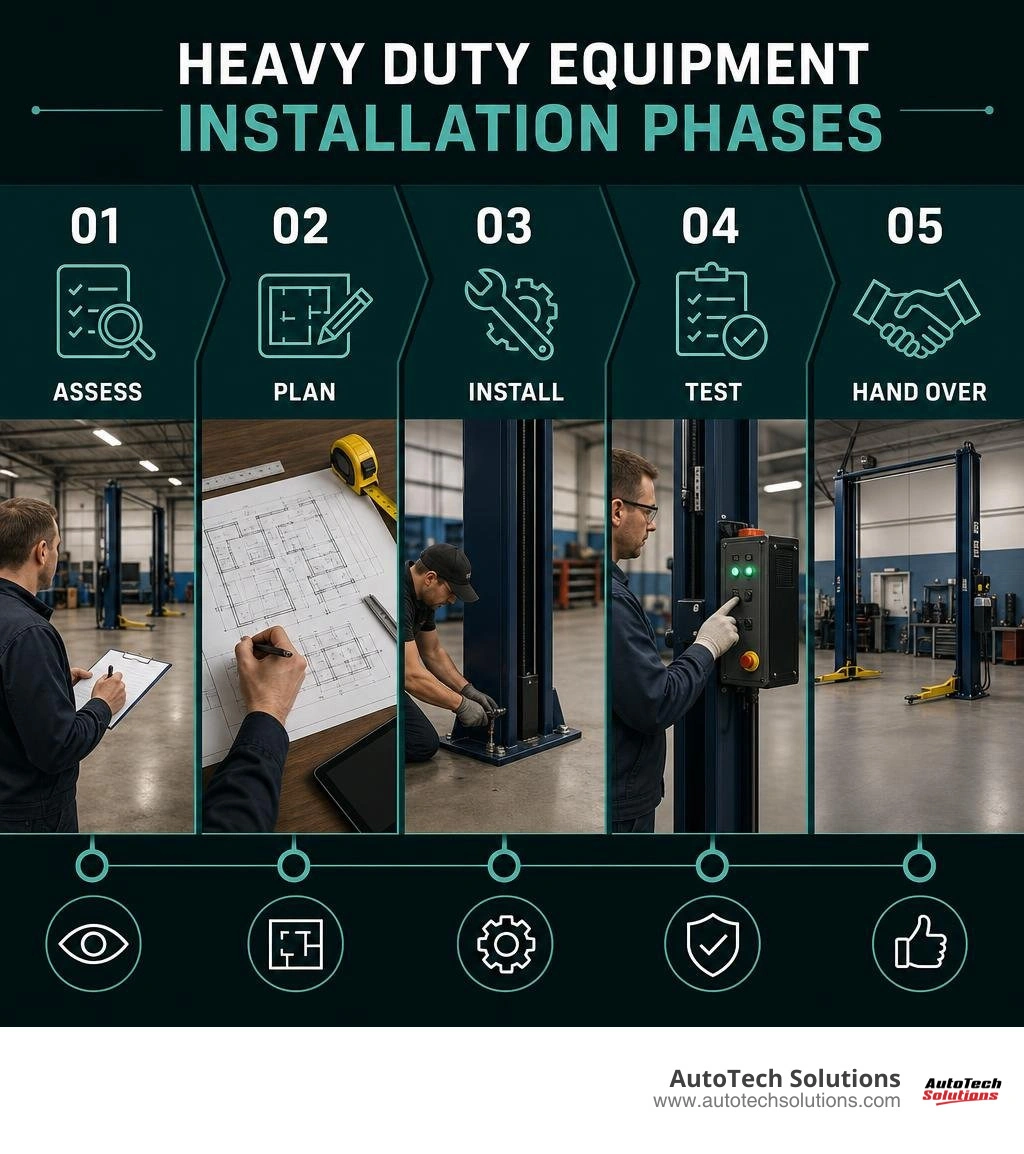
Important heavy duty equipment installation terms:
Comprehensive Heavy Duty Equipment Installation Protocols for Modern Commercial Shops
Setting up a heavy-duty commercial service center or expanding an active repair shop isn't just about dropping heavy machinery onto a concrete floor and plugging it in. Far from it! When you are placing multi-ton automotive lifts, heavy industrial fluid skids, or specialized wheel service machinery, heavy duty equipment installation demands structured protocols that protect your facility investment and technician safety.
At AutoTech Solutions, we view every installation through a comprehensive engineering and operational lens. We evaluate ground conditions, examine structural load capacities, analyze overhead clearance, and map out physical workflow traffic before a single piece of equipment arrives on site. Utilizing professional industrial contracting standards and expert regional logistics partners across our service footprints in Charlotte, NC, Raleigh, NC, Wade, NC, and Novi, MI ensures that every installation meets local building codes and rigorous industry benchmarks.
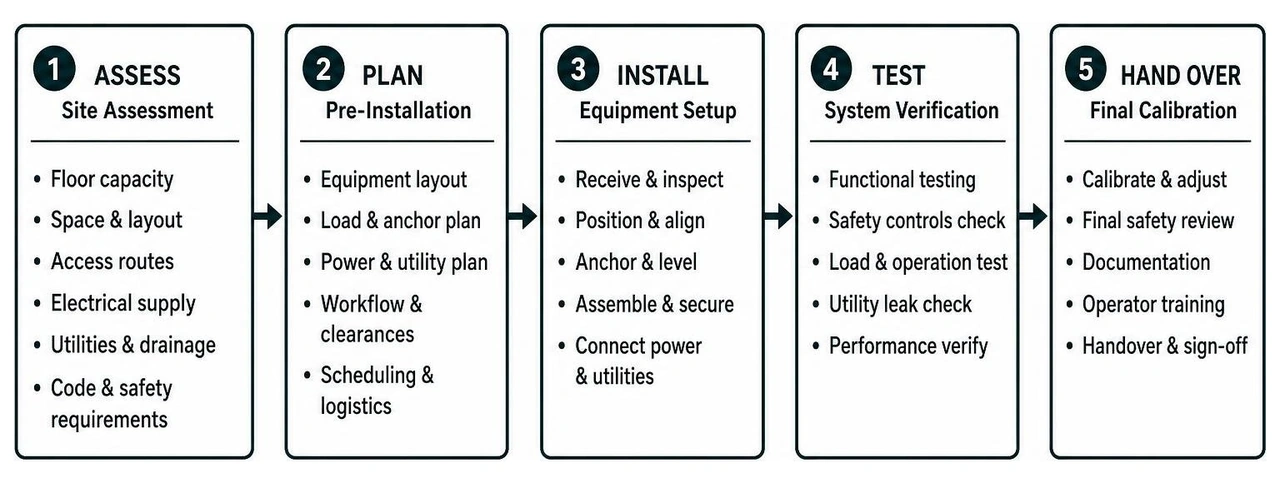
Safety Compliance and Regulatory Standards
Operating a modern commercial auto facility requires uncompromising adherence to workplace safety codes. During any machinery commissioning, regulatory frameworks set by OSHA (such as 29 CFR 1910 standards for general industry and powered equipment) govern how machinery must be anchored, guarded, and electrically protected. Internationally recognized machinery safety standards—such as Machinery Directive 2006/42/EC guidelines, EN 12999 specifications, and official CE marking practices—provide global engineering benchmarks for mechanical safety interlocks, structural reserve margins, and emergency stop systems.
When we install heavy-duty automotive machinery, safety compliance includes rigorous load testing and multi-point hazard isolation. We verify that all automatic mechanical lock pawls engage simultaneously, arm restraint systems hold under max capacity, and electronic travel limit switches halt motion prior to structural binding. Bureau of Labor Statistics data indicates that mobile heavy equipment technicians earned a median annual wage of $62,740 ($31.16 per hour), with the industry projecting steady employment growth through 2034. With roughly 21,700 annual technician job openings projected, shop managers must protect their skilled workforce by ensuring that installed shop equipment adheres strictly to structural safety margins.
Planning Site Foundations and Logistics for Heavy Duty Equipment Installation
A flawless machinery layout relies heavily on what lies underneath the shop floor. Heavy machinery demands verified concrete slab thickness, proper compressive strength (typically 3,000 to 4,000 PSI minimum), and adequate steel rebar reinforcement. Before anchoring high-capacity heavy-duty lifts, our team conducts core sampling or ultrasonic thickness checks to confirm that the slab can endure dynamic tipping moments and heavy point loads without cracking or punch-through failures.
Proper logistics planning ensures smooth equipment delivery without creating bay congestion or operational delays. Coordinating specialized transport for heavy components allows machinery to move directly from staging to designated bay locations. For complete facility upgrades, integrating early structural evaluations into your broader Facility Buildout Equipment Planning strategy guarantees that foundations, overhead clearance, and bay access routes align before equipment delivery day.
Technical Requirements: Hydraulics, Electrical, and Structural Integration
Integrating heavy-duty commercial equipment into your shop infrastructure involves a seamless blend of fluid dynamics, electrical capacity, and rigid mechanical fastening. Whether setting up high-volume fluid pumps, centralized air distribution, or heavy-duty post lifts, sub-standard integration leads to premature wear, energy inefficiency, and unexpected downtime.
Sizing Hydraulic Systems and Industrial Electrical Supply During Heavy Duty Equipment Installation
Hydraulic systems powering heavy commercial shop equipment require exact matching of pump displacement, operating pressure, reservoir capacity, and thermal heat dissipation. If hydraulic lines are undersized, fluid flow experiences excessive turbulence and pressure drops, creating friction heat that degrades hydraulic seals and degrades pump life.
| System Parameter | Sizing Consideration | Operational Impact |
|---|---|---|
| Pump Flow Rate (GPM) | Matched to cylinder velocity requirements | Dictates lift elevation speed and cycle times |
| Line Cross-Section | Sized to maintain laminar flow (<15 ft/sec) | Prevents hydraulic fluid overheating and pressure drop |
| Reservoir Volume | Sized to total circuit volume plus cooling margin | Ensures heat dissipation and prevents fluid aeration |
| Electrical Supply | Dedicated 3-phase circuits with thermal breakers | Prevents voltage drops during high-torque pump startup |
On the electrical side, heavy commercial tools demand clean, stable power. Running dedicated high-voltage lines with isolated ground protection prevents voltage drops when multi-horsepower motor pumps kick on under full load. Integrating modern radio remote control or pendant control systems also requires proper signal shielding and low-voltage control transformer wiring to ensure instantaneous operator control. For complex shop power upgrades, relying on certified professionals for your Electrical Equipment Installation guarantees compliance with the National Electrical Code (NEC) and eliminates fire risks.
Mechanical Outriggers, Subframes, and Tipping Stability Calculations
For heavy machinery, mobile column lifts, and specialized platform lifting systems, theoretical tipping stability calculations dictate how forces distribute across the floor. Engineers evaluate the standard stability coefficient ($K_s \ge 1.2$) to ensure the machine remains completely stable even under off-center loading or dynamic stopping forces.
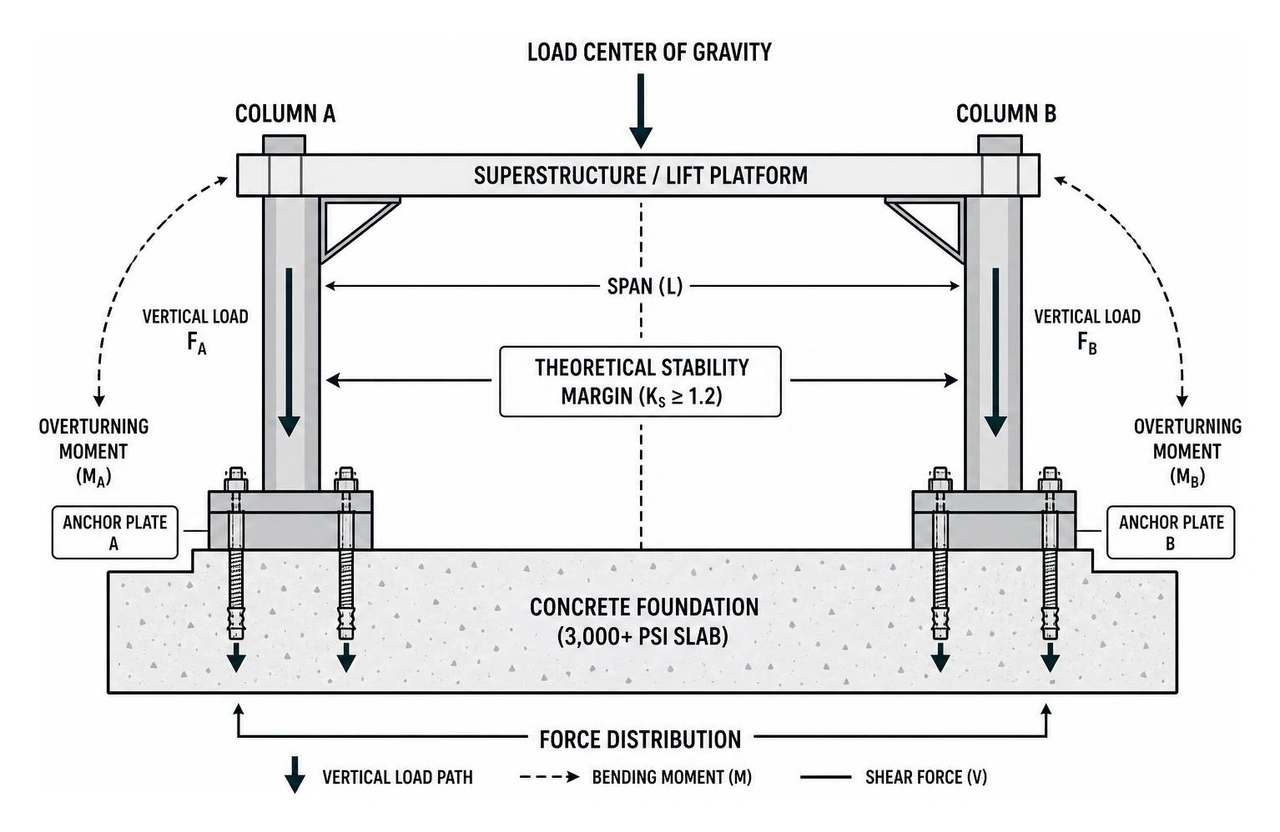
When mounting heavy overhead assemblies or base-mounted machinery, structural subframes and heavy-duty mechanical fasteners (such as wedge anchors or resin chemical anchors) must transfer bending moments and shear forces directly into structural concrete. Using certified mechanical fasteners with calculated torque values—rather than unapproved field alterations—preserves the structural integrity of both the equipment and the facility. For shop owners adding specialized vehicle lifts, scheduling a professional Car Lift Installation Service guarantees that structural baseplates and mechanical anchors are installed according to manufacturer specifications.
Best Practices for Heavy Lifting, Precision Alignment, and System Calibration
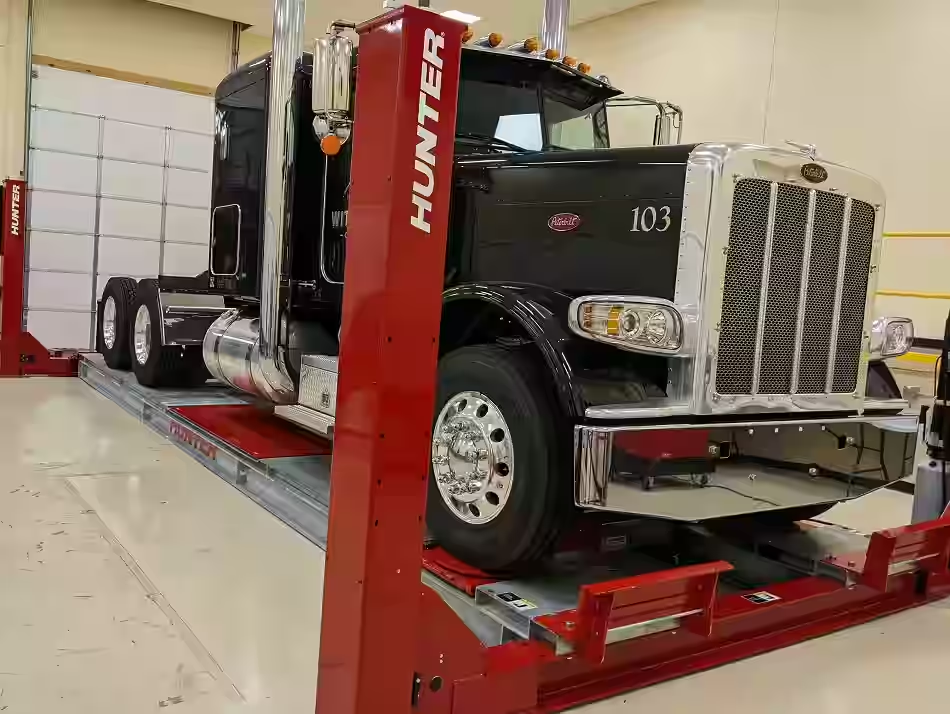
Positioning heavy shop machinery requires extreme precision. Dropping a multi-ton frame onto anchor bolts without verifying levelness leads to binding, uneven slide block wear, and eventual structural fatigue.
At AutoTech Solutions, our installation technicians follow strict field-verified steps during machinery setting:
- Multi-Jack Rigging & Hydraulic Positioning: We utilize multi-jack arrays, toe jacks, and engineered rigging hardware to move heavy modules into position without marring factory paint or stressing structural cross-members.
- Millimetre-Level Optical & Laser Alignment: Using precision optical levels and laser alignment tools, we ensure columns, tracks, and slide channels are plumb within millimetre tolerances across the entire rise.
- Precision Shim & Base Grouting: Heavy baseplates are shimmed using high-density steel spacers and grouted where necessary to eliminate hollow voids under anchor plates.
- Calibrated Anchor Bolt Torquing: Heavy-duty expansion and adhesive anchors are torqued using calibrated torque wrenches to exact foot-pound specifications established by structural engineers.
- Proof Load & Function Verification: Before turning equipment over to your team, we perform full-capacity proof load tests, verifying lock engagement, safety bypass switches, thermal overload relays, and fluid pressures under load.
During the mechanical assembly of shop infrastructure, installing proper electrical raceways and utility runs is equally critical. Having experienced technicians manage your Industrial Wiring Installation ensures that power feeds, control cables, and safety interlocks are cleanly routed in protective conduit, preventing mechanical pinch points and fluid exposure.
Equally important is relying on experienced local equipment support in your regional market. Facilities located around Michigan as well as operations across North Carolina benefit from dedicated local service and maintenance support in Novi, MI, Charlotte, NC, Raleigh, NC, and Wade, NC to maintain optimal uptime for all shop equipment.
Frequently Asked Questions About Commercial Shop Installations
How do safety standards impact heavy equipment installation in commercial auto shops?
Safety standards like OSHA regulations and Machinery Directive guidelines govern how heavy shop equipment must be installed, guarded, and operated. Compliance requires installing certified mechanical safety locks, emergency stop controls, clear hazard markings, and protective line covers. Adhering to these standards ensures your facility passes municipal building inspections, avoids costly regulatory fines, and protects technicians from workplace injuries.
What foundation preparations are required before positioning heavy shop equipment?
Foundation requirements depend on equipment weight and lifting capacity, but most commercial heavy-duty machinery requires a cured concrete slab between 4 to 6 inches thick (or up to 12+ inches for high-capacity heavy-duty lifts) rated at 3,000 to 4,000 PSI minimum. Concrete must be fully cured, structurally sound, free of major cracks, and reinforced with steel rebar or mesh. Installers verify slab depth and anchor embedment zones before drilling and torquing heavy anchor bolts.
How are hydraulic systems properly sized for heavy-duty shop machinery?
Hydraulic systems are sized by calculating the required lifting speed, total system load weight, and operating cylinder displacement. This determines the necessary pump flow rate in gallons per minute (GPM) and working pressure in PSI. System designers also calculate reservoir capacity and oil cooler sizing to ensure hydraulic fluid stays within normal operating temperature ranges during continuous commercial duty cycles.
Technical Installation Excellence Keeps Your Bays Profitable
Executing a seamless heavy duty equipment installation requires technical knowledge, specialized rigging tools, and an uncompromising commitment to safety standards. From initial ground condition checks to final proof-load testing, professional installation protects your equipment investment, extends machine service life, and ensures daily technician safety.
AutoTech Solutions provides end-to-end commercial equipment sales, installation, service, and preventative maintenance across Michigan and North Carolina. Whether you operate a commercial fleet maintenance garage, a heavy truck repair center, or a collision facility in Charlotte, Raleigh, Wade, or Novi, our goal is minimizing your downtime with expert technical support and fast service response.
Ready to upgrade your shop infrastructure with professional installation services? Explore our complete range of commercial garage lifts, air systems, fluid delivery skids, and shop infrastructure at Automotive Shop Products & Solutions or contact our technical team today to plan your next facility installation!