
Choosing Metal Fabrication Machines for a High-Output Shop
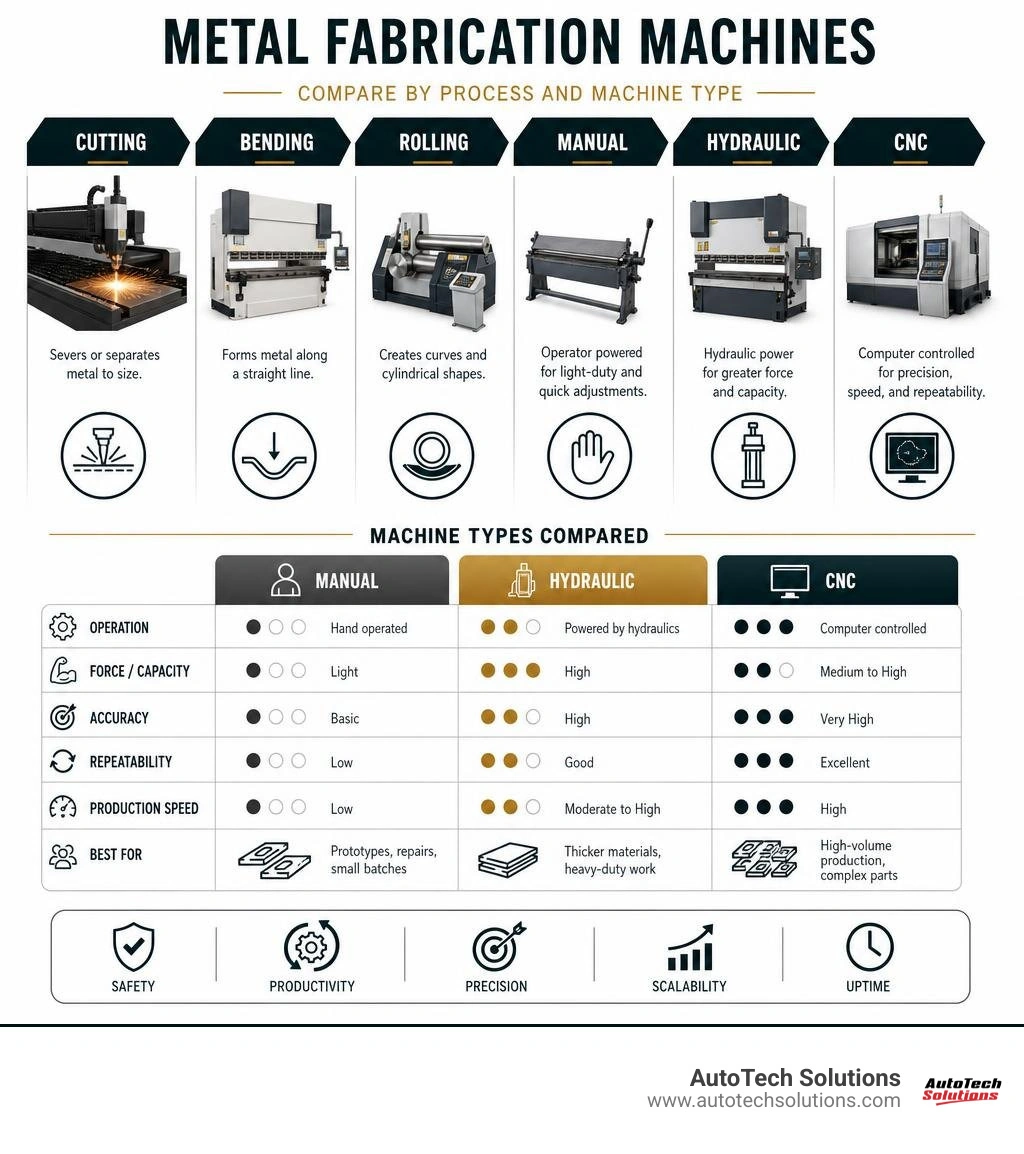
For commercial automotive, collision, and industrial facilities, the best metal fabrication machines depend on the work mix, material range, and production volume. A strong starting lineup usually includes:
- A CNC laser, plasma cutter, or industrial shear for cutting
- A hydraulic or CNC press brake for accurate bends
- A powered slip roll for curved sheet and cylindrical forms
- Material handling equipment, extraction, guarding, and controls that keep production safe and moving
The key comparison is simple: manual machines suit low-volume forming and quick adjustments; hydraulic machines deliver force for demanding work; CNC systems provide the repeatability, speed, and automation needed for higher throughput. Select capacity based on the widest material, maximum thickness, required bend or cut quality, available floor space, and the service support needed to prevent costly downtime.
Modern systems can also link nesting software, automatic loading, tool changes, monitoring, and safety interlocks. That reduces handling steps, improves repeatability, and helps managers plan labor and cycle times with more confidence.
AutoTech Solutions Staff will break down the machine categories and control options that help professional facilities scale without sacrificing safety or uptime.
Relevant articles related to metal fabrication machines:
Core Categories of Metal Fabrication Machines for Commercial Facilities
Scaling a commercial facility requires equipment engineered to handle continuous cycle times, maintain tight dimensional tolerances, and maximize blanking efficiency. When selecting capital equipment, facility managers must balance raw tonnage and bed size against workpiece flexibility and upstream workflow demands. Integrating the proper cutting systems, forming units, and structural profiling gear directly dictates product turnaround times and overall operating margins.
| Machine Category | Drive Mechanism | Best Operational Application | Primary Advantage | Typical Limitations |
|---|---|---|---|---|
| Manual Equipment | Mechanical leverage / Hand-crank | Prototyping, low-volume adjustments, maintenance | Low capital cost, zero electrical demand | High labor cost, operator fatigue, lower consistency |
| Hydraulic Equipment | Fluid pressure & proportional valves | Heavy-plate shearing, high-tonnage multi-gauge bending | Immense continuous force, robust overload protection | Slower cycle speeds, regular fluid maintenance required |
| CNC Automated Cells | Direct-drive servoelectrics / Multi-axis ballscrews | High-volume production, complex multi-step geometries | Unmatched cycle repeatability, automated tool changing | Higher upfront investment, requires programming workflows |

CNC Laser and Thermal Cutting Platforms
Thermal cutting forms the bedrock of modern sheet and structural metal preparation. High-speed solid-state fiber lasers dominate production floors because of their high photoelectric efficiency—often reaching 45% conversion rates compared to legacy gas resonators. These solid-state engines deliver beam densities capable of piercing and slicing through heavy structural steel, stainless steel, and non-ferrous plates with precise kerf control.
Advanced platforms utilize multi-gas manifolds to switch between assist gases dynamically. High-purity nitrogen is used to eliminate edge oxidation on stainless steel and aluminum, while industrial oxygen utilizes exothermic reactions to slice thick carbon steel. For production facilities targeting maximum throughput, high-output fiber laser systems operating at 12 kW to 40 kW allow operators to cut medium-gauge plates using shop-supplied, filtered high-pressure compressed air, substantially slashing consumable gas overhead. In facilities working with heavy structural structural beams, automated oxy-fuel and high-definition plasma coping systems process web and flange sections in a single setup.
Hydraulic Press Brakes and Precision Folders
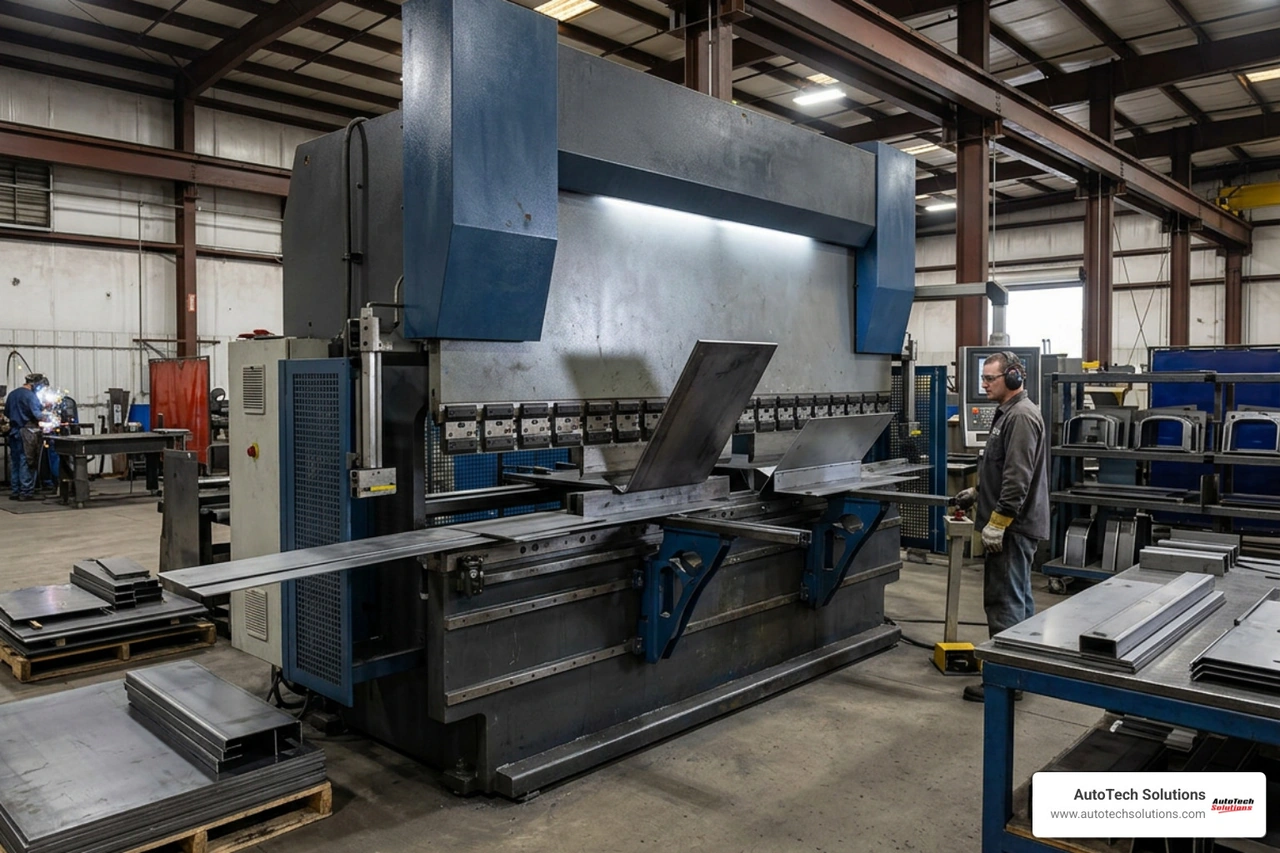
Forming structural profiles and intricate brackets requires tight angular repeatability. Hydraulic press brakes achieve this using synchronized dual-cylinder hydraulic circuits that regulate ram positioning down to micron-level tolerances. Operators can balance air bending—where the sheet contacts only the punch tip and die shoulders—against bottoming dies or coining methods, depending on springback tendencies and thickness.
Modern facilities handling high-mix runs invest in multi-axis CNC backgauges (X, R, Z1, Z2, and crowning axes) that automatically position stops between successive bends. Dynamic mechanical crowning systems compensate for natural machine bed deflection, eliminating the "canoe effect" and ensuring uniform angles across 10- to 14-foot bed lengths. For facilities handling extensive sheet forming alongside heavy frame adjustments, deploying commercial heavy-duty shop equipment ensures that hydraulic rams deliver unyielding tonnage without premature seal deterioration or frame deflection.
Industrial Shears and Powered Slip Rolls
For fast, straight-line blanking without thermal distortion or heat-affected zones, guillotine shears provide clean cuts across extensive sheet widths. Commercial hydraulic shears feature adjustable mechanical rake angles and programmable blade clearance systems. Setting the correct rake angle prevents material twisting and cambering on narrow drop-offs, while sharp four-edge reversible blades deliver high-volume throughput for basic rectangular blanks.
When workpieces call for conical or cylindrical geometries—such as commercial ventilation stacks, tank shells, or heavy structural equipment enclosures—powered slip rolls and three-roll plate forming machines take over. Modern powered slip rolls utilize hardened roll shafts driven by hydraulic motors or planetary gearboxes, complete with hydraulic drop-ends that allow swift removal of closed cylindrical shapes. In structural steel fabrication environments, combining rolling equipment with automated beam coping equipment streamlines cutting, coping, and profiling of heavy structural members before final assembly.
Drive Mechanisms and Control Architectures
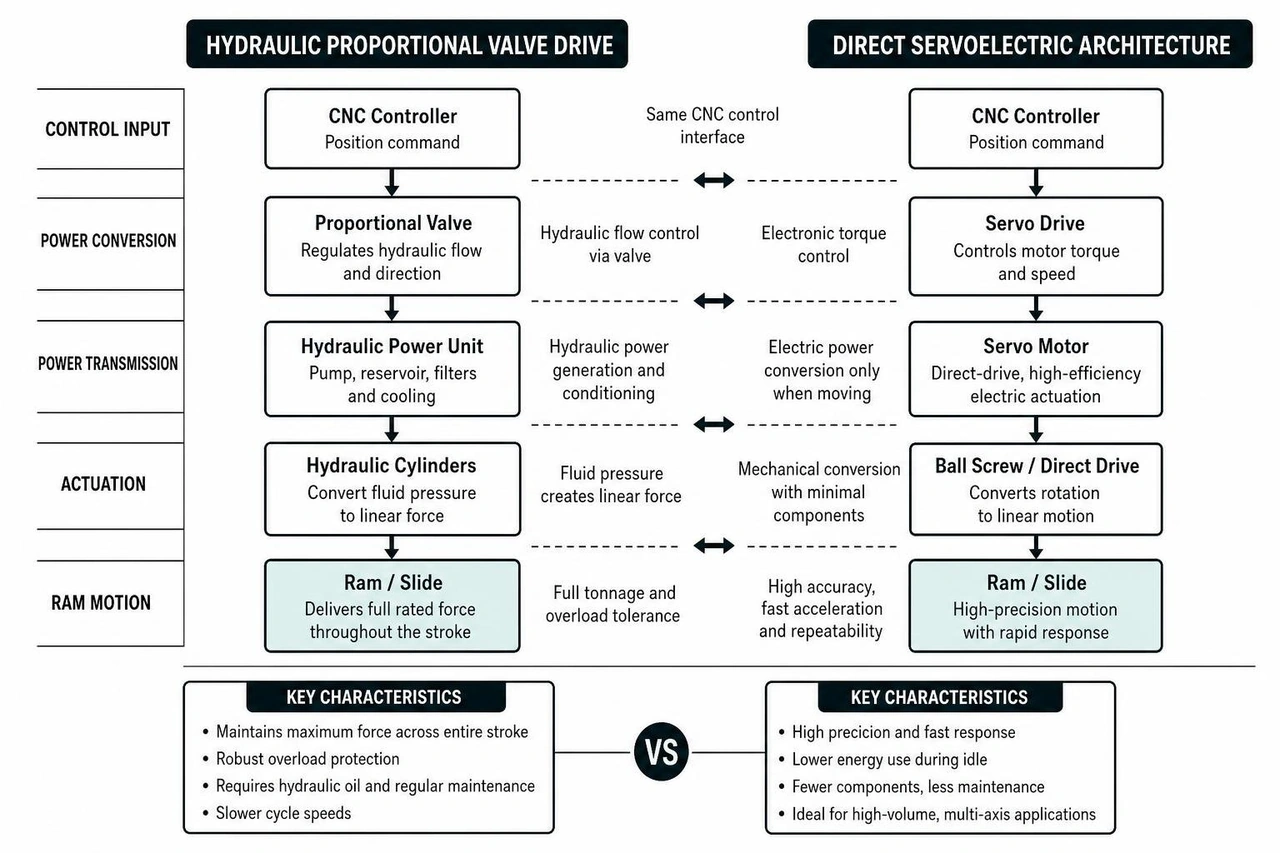
The underlying drive mechanism of a metal fabrication machine dictates its operating speed, mechanical rigidity, maintenance profile, and utility demands. Choosing between hydraulic, mechanical, and servoelectric platforms requires balancing power consumption with positional accuracy.
Evaluating Drive Systems in Metal Fabrication Machines
Mechanical flywheel drives deliver instantaneous punch impact for standard blanking presses, but they lack variable stroke control. Proportional hydraulic valves, conversely, allow precise stroke management throughout the entire travel path of a press brake or plate shear. The hydraulic approach maintains maximum rated tonnage across the entire stroke, offering unmatched protection against mechanical jamming on heavy plate.
Direct-drive servoelectric systems have reshaped the light-to-medium gauge forming sector. By eliminating hydraulic oil, pumps, valves, and fluid chillers, servoelectric drives consume electricity only during active ram movement, cutting idle energy consumption by up to 50%. These servoelectric actuators provide rapid acceleration curves, exceptionally tight ram positioning, and reduced mechanical wear, making them ideal for high-precision, multi-shift production schedules.
Integrating Automation and AI into Modern Metal Fabrication Machines
Automation technology has transformed standalone metal fabrication machines into integrated production cells. Automated material loading towers, vacuum-lift destackers, and robotic sheet handling arms transfer raw material directly onto laser shuttle tables or press brake beds without manual rigging.
Advanced CNC controls now feature real-time adaptive sensing. Optical cameras and contact lasers measure bend angles on the fly, signaling the CNC controller to adjust ram depth in milliseconds to overcome material springback variations. Offline CAD-to-part programming systems convert solid models into NC cutting and forming codes in seconds, optimizing tool setups and nesting density. Furthermore, integrated telemetry platforms provide remote diagnostic capabilities, constantly monitoring spindle vibration, hydraulic line pressures, and motor operating temperatures to alert shop managers before unexpected hardware failures cause unscheduled downtime.
Material Compatibility and Processing Capacities
Machine tonnage, cutting speeds, and tool selections vary drastically based on the mechanical properties and metallurgical structure of the raw material. Processing cold-rolled mild steel requires different operational parameters than handling work-hardening stainless steels or highly reflective non-ferrous alloys.
Structural carbon steels (such as A36 or 1018) provide predictable forming behavior but require careful tonnage calculations as sheet thickness scales. Stainless steel alloys (such as 304 and 316) exhibit high yield strength and severe springback, requiring up to 50% more bending tonnage per linear foot than mild steel, as well as specialized tooling to prevent galling.
Non-ferrous materials introduce unique physical challenges:
- Aluminum Alloys (5052, 6061): Require larger minimum bend radii to prevent outer-grain cracking along the bend line; cutting requires high-speed piercing controls to manage burr formation.
- Copper and Brass: Possess high thermal conductivity and optical reflectivity. Cutting these metals demands solid-state fiber lasers engineered with back-reflection isolators to prevent resonator damage.
- Tonnage Calculations: Fabricators must calculate tonnage-per-foot based on die opening width—standard practice dictates a V-die opening of 8 times material thickness for mild steel, expanding to 10 to 12 times for high-tensile materials to maintain mechanical integrity.
Equipment Maintenance, Safety Protocols, and Infrastructure
Operating high-tonnage forming systems and high-power thermal cutting cells requires strict adherence to machinery safety standards and comprehensive preventative maintenance routines. Because industrial fabrication tools operate under severe cyclic loading, minor mechanical looseness or electrical degradation can quickly compound into severe equipment failure.

Safety architecture begins with perimeter safeguarding. High-speed optical light curtains, laser-based active optical protection devices (AOPDs) mounted directly to press brake rams, and interlocked physical fencing protect machine operators from pinch points without impeding workflow ergonomics. Facilities should implement regular inspections of emergency stop circuits, hydraulic pressure relief valves, and automatic physical interlocks.
On the mechanical and electrical side, consistent upkeep safeguards production uptime:
- Hydraulic Fluid Management: Monitor hydraulic oil viscosity, filter elements, and fluid operating temperatures to prevent proportional valve scoring and seal degradation.
- Electrical Infrastructure: Ensure machine control enclosures remain free of conductive shop dust; execute systematic electrical machine maintenance to protect variable frequency drives, servo amplifiers, and PLC backplanes.
- Mechanical Systems: Regularly inspect linear guide rails, ball screws, drive belts, and backgauge alignments for backlash or irregular wear patterns.
- Motor Assemblies: Protect critical drive units through planned servicing, scheduling professional industrial motor repair at the first indication of bearing wear, winding insulation breakdown, or abnormal vibration harmonics.
Frequently Asked Questions About Commercial Fabrication Machinery
What is the difference between hydraulic and electric press brakes?
Hydraulic press brakes use fluid displacement driven by motor-driven pumps and proportional valves to move the upper ram, delivering immense tonnage suited for heavy structural plate across wide bed lengths. Electric press brakes utilize servomotors coupled to heavy-duty ball screws or heavy belt-pulley systems. Electric models offer higher stroke acceleration, lower energy draw during idle periods, tighter ram positioning repeatability, and zero hydraulic oil maintenance, though they are generally constrained to lower tonnage ratings than massive hydraulic systems.
What assist gases are required for high-power fiber laser cutting?
The primary assist gases used in fiber laser cutting are high-purity nitrogen, industrial oxygen, and filtered high-pressure compressed air:
- High-Purity Nitrogen (99.999%): Slices stainless steel, aluminum, and brass by mechanically blowing molten metal out of the kerf, resulting in a clean, oxide-free edge ready for immediate downstream powder coating or assembly.
- Industrial Oxygen: Applied to thick carbon steel, initiating an exothermic reaction that produces heat to accelerate cutting through heavy plate, though it leaves a thin oxide skin on the cut edge.
- High-Pressure Clean Compressed Air: Sourced from shop compressors equipped with multi-stage desiccant dryers and oil separators; serves as an economical assist gas for cutting thin-to-medium mild and stainless steel sheets where minor edge discoloration is acceptable.
How do modern automated systems reduce changeover times in fabrication shops?
Modern automated fabrication systems eliminate manual setup bottlenecks through integrated software and rapid tooling hardware:
- Automatic Tool Changers (ATCs): Swap punch and die segments on a press brake in less than a minute, eliminating physical operator handling and setup errors.
- Offline Nesting & Simulation: CAM packages generate toolpaths and verify clearance geometries before programs ever reach the machine control, maximizing material utilization up to 98% and removing trial-and-error scrap.
- Dual-Pallet Exchange Tables: Enable continuous fiber laser operation by swapping finished parts for a fresh sheet of raw material in under 45 seconds while the beam continues cutting inside the enclosure.
- Automated Vision & Thickness Sensors: Scan incoming material sheets for precise edge alignment, thickness verification, and sheet distortion, automatically adjusting machine parameters without manual zeroing.
Conclusion
Scaling a commercial fabrication or automotive facility requires selecting rugged machinery, engineering efficient shop floor layouts, and implementing structured preventative maintenance schedules. High-output operations depend on equipment that delivers day-in, day-out accuracy under rigorous production demands.
AutoTech Solutions supports commercial facilities across North Carolina and Michigan—with dedicated regional hubs in Charlotte, NC, Raleigh, NC, Wade, NC, and Novi, MI. We help operations maintain peak production capacity through equipment sales, professional car lift installation, shop infrastructure setup, and rapid-response diagnostics. Whether your facility needs machinery integration, electrical control diagnostics, or continuous preventative maintenance, our team delivers the technical expertise needed to minimize downtime and extend equipment life.
Maximize your commercial shop's efficiency and equipment reliability by scheduling professional service, repair, and equipment support with AutoTech Solutions today.