Maintenance Strategies: Reactive, Predictive, and Preventative Maintenance Lift Programs
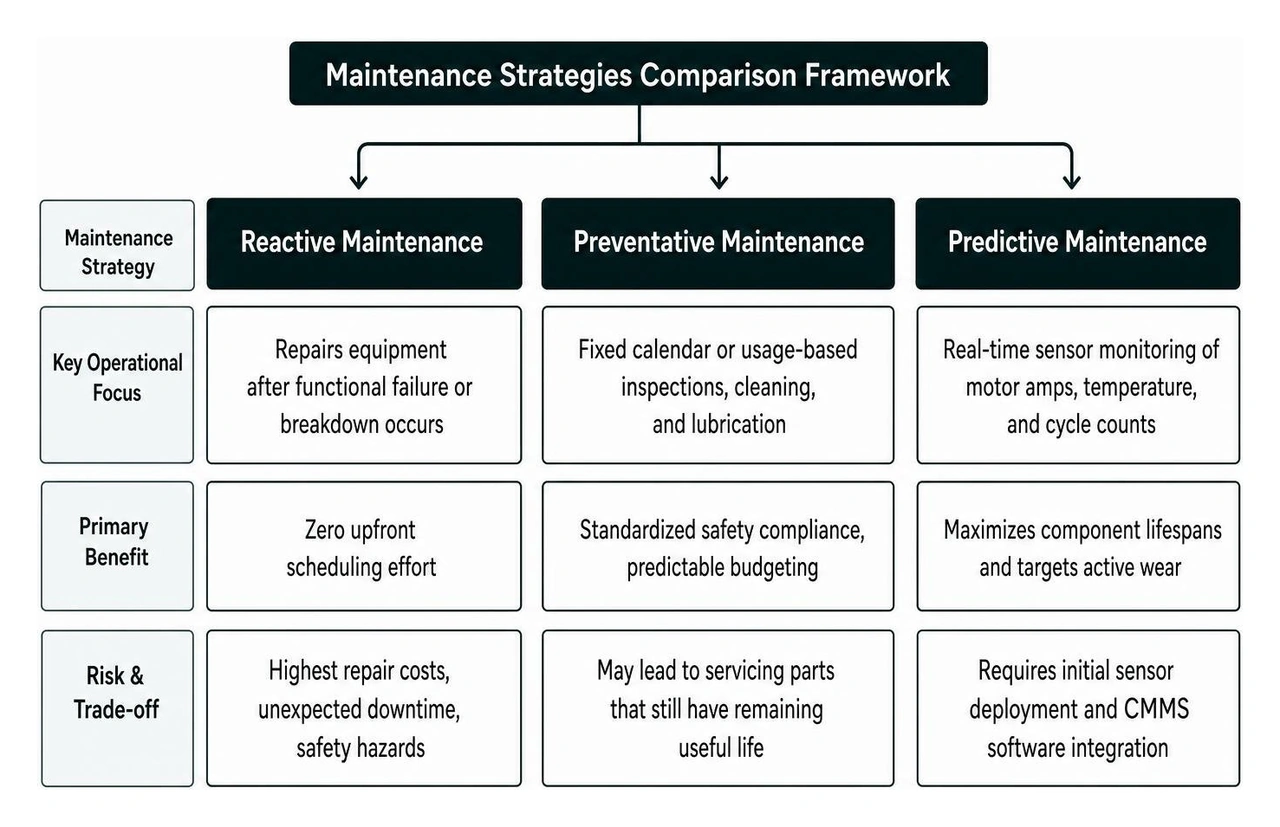
Establishing an effective preventative maintenance lift program requires an understanding of how different service models impact commercial shop operations. Facilities typically rely on one of three core approaches: reactive repairs, time-based preventative schedules, or condition-based predictive monitoring.
In a reactive strategy, service occurs only after a breakdown. This method leads to emergency service call-outs, delayed repair jobs, disrupted technician work schedules, and accelerated wear on related lift components. Conversely, time-based preventative maintenance establishes fixed calendar or hour-based service schedules to clean, adjust, lubricate, and inspect shop equipment before parts wear out. Predictive maintenance uses real-time telemetry to trigger maintenance based on operational wear data.
| Maintenance Strategy | Key Operational Focus | Primary Benefit | Risk & Trade-off |
|---|---|---|---|
| Reactive Maintenance | Repairs equipment after functional failure or breakdown occurs | Zero upfront scheduling effort | Highest repair costs, unexpected downtime, safety hazards |
| Preventative Maintenance | Fixed calendar or usage-based inspections, cleaning, and lubrication | Standardized safety compliance, predictable budgeting | May lead to servicing parts that still have remaining useful life |
| Predictive Maintenance | Real-time sensor monitoring of motor amps, temperature, and cycle counts | Maximizes component lifespans and targets active wear | Requires initial sensor deployment and CMMS software integration |
Transitioning away from run-to-failure habits is crucial for long-term downtime reduction lift repair and overall shop productivity.
Predictive vs Preventative Maintenance Lift Strategies
Preventative maintenance schedules rely on recurring time intervals (such as daily, monthly, or quarterly tasks) to perform routine mechanical adjustments and safety checks. While fixed-interval servicing prevents major mechanical breakdowns, predictive strategy introduces continuous monitoring tools.
Predictive systems utilize IoT (Internet of Things) hardware, thermal sensors, and motor load monitors to track real-time machine health:
- Motor Amp Draw Monitoring: Tracking motor current draw under load helps detect mechanical binding, pump wear, or electrical voltage drops before a thermal overload trips. An amp reading consistently exceeding 110% of the motor nameplate Full Load Amperage (FLA) signals an impending issue.
- Vibration and Thermal Sensors: Continuous vibration analysis highlights bearing wear in motor housings or pump assemblies, while thermographic sensors monitor high-voltage control panels for excessive heat accumulation.
- Pre-Breakdown Alerts: Real-time data streams feed directly into maintenance software, issuing immediate alerts when operating parameters deviate from baseline safety limits.
Incorporating condition-based insights into your broader predictive maintenance planning streamlines technician dispatch routes and eliminates unnecessary calendar-based component replacements.
Mitigating Financial and Operational Risk
Skipping regular maintenance on heavy commercial shop equipment introduces significant financial liability and workplace hazards. Research indicates that 73% of vehicle lift failures stem directly from skipped or undocumented preventive maintenance.
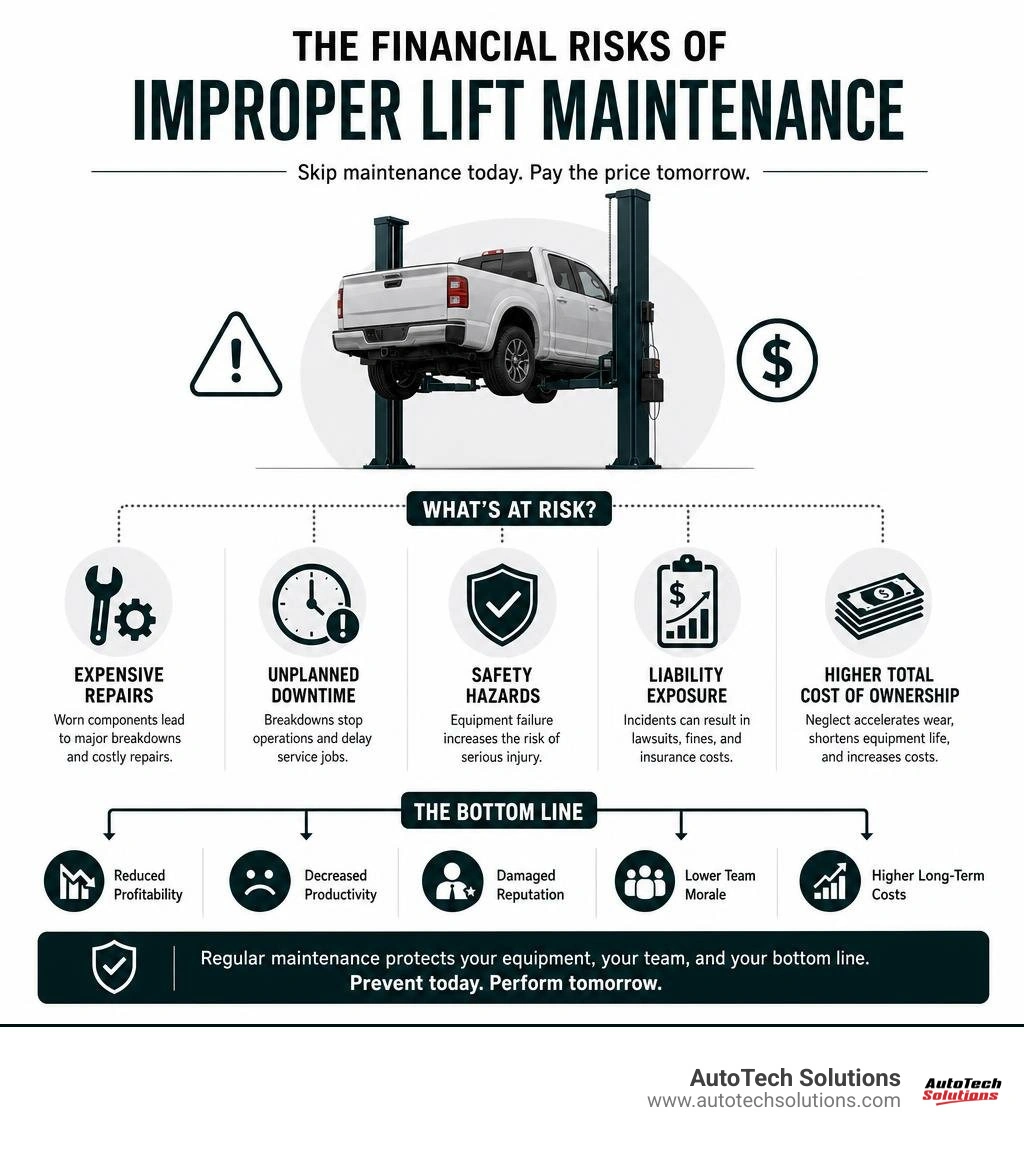
A single dropped vehicle incident caused by a worn equalizer cable, unanchored post, or bypassed mechanical safety lock creates an average of $48,000 in direct physical equipment damage, immediate facility downtime, and liability exposure. Furthermore, the average cost per OSHA recordable injury in commercial transportation and fleet maintenance facilities stands at $40,000 per incident.
Systematically inspecting safety latches, structural floor anchors, and hydraulic circuits isolates shop owners from catastrophic equipment failures while addressing the most common causes of automotive lift downtime.
Comprehensive Preventative Maintenance Lift Schedules by Frequency
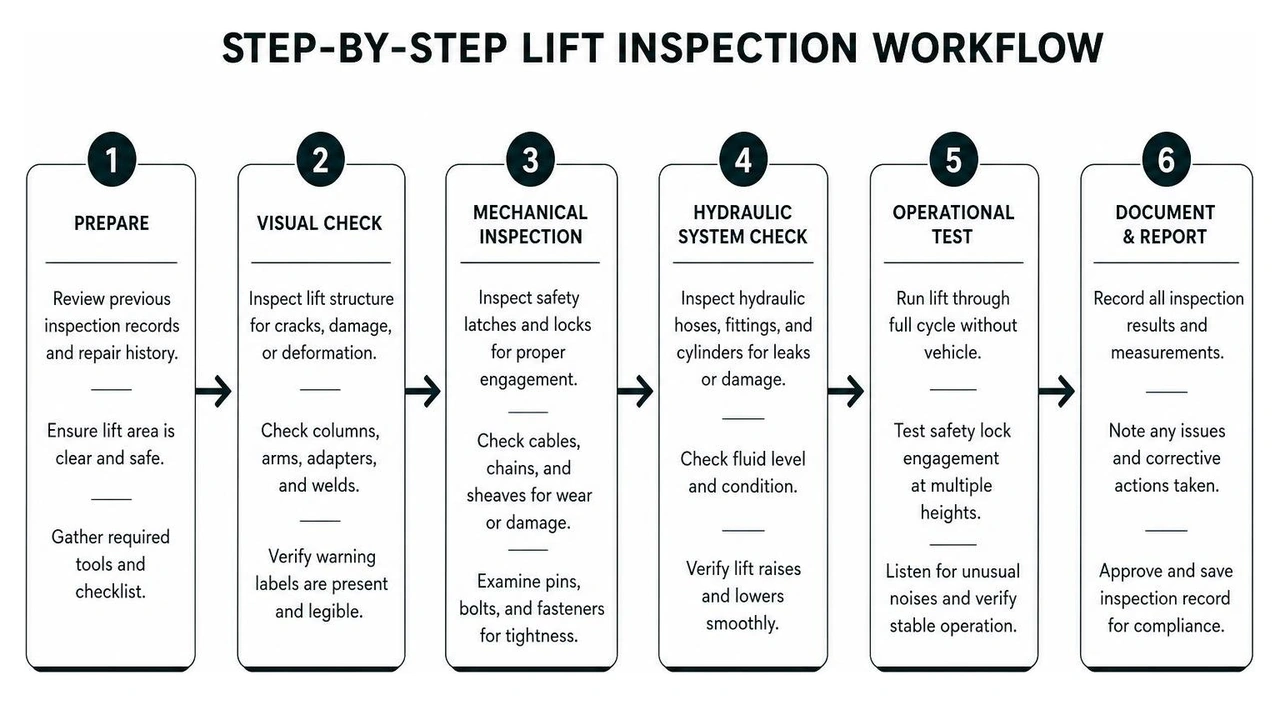
To ensure regulatory compliance and daily operational safety, commercial automotive centers must organize maintenance protocols into strict frequency buckets. Documenting every inspection in an organized log guarantees audit readiness under governing safety bodies. You can reference a complete Vehicle Lift PM Checklist to standardize shop procedures.
Daily and Weekly Preventative Maintenance Lift Routines
Daily pre-shift walkarounds and weekly mechanical checks should be performed by trained service operators before raising any vehicle:
Daily Pre-Shift Walkarounds:
- Safety Latch Engagement: Visually check that mechanical safety locks engage smoothly on both columns as the lift rises and drops into position.
- Hydraulic Leak Audits: Inspect floor areas around posts, power units, and hydraulic hose routing for visible fluid leaks or puddle buildup.
- Lift Pad and Adapter Checks: Confirm rubber contact pads are free of deep gouges, heavy oil saturation, or excessive wear (replace pads showing over 3mm of surface wear).
- Controls and Emergency Stops: Verify proper spring-back operation of deadman control switches and emergency shut-off buttons.
Weekly Operational Checks:
- Arm Restraint Locks: Inspect automatic gear-lock mechanisms on swing arms to ensure teeth mesh properly and prevent horizontal arm drift under load.
- Cable Tension & Equalization: Check steel equalizer cables on two-post units for slack or unequal tension across posts.
- Cleanliness of Tracks and Columns: Wipe dirt, metal shavings, and debris clear of carriage tracks, door gibs, and sliding surfaces.
Monthly, Quarterly, and Annual Compliance Inspections
Deeper structural, electrical, and safety testing requires recurring monthly, quarterly, and annual maintenance routines:
Monthly PM Tasks:
- Lubrication: Grease carriage sliders, hinge pins, sheaves, and lock mechanisms according to OEM grease specifications.
- Fluid Quality & Level: Check hydraulic oil levels inside reservoirs; look for fluid discoloration or foam.
- Anchor Bolt Checks: Verify tight floor anchors and check bolt torque settings according to manufacturer specifications.
Quarterly PM Tasks:
- Electrical & Control Audits: Inspect wiring harnesses, push-button control boxes, limit switches, and contactors for loose terminals or arc damage.
- NFPA 70B Compliance: Perform thermographic scans on electrical panels to identify loose connections or overheating components (investigate temperature increases greater than 15°C above ambient).
- Structural Integrity Audits: Check carriage joints, arm joints, and base plates for stress cracks or paint flaking.
Annual Certified Inspections:
- Safety Code Compliance: Schedule comprehensive inspections adhering to standard industry guidelines, such as ANSI/ALI ALOIM standards for automotive lifts or ASME A17.1 for vertical lifting devices.
- Qualified Inspector Audit: Have a Qualified Elevator Inspector (QEI) or certified lift inspector perform annual structural, hydraulic pressure, and full load-holding tests.
- Safety System Recertification: Verify velocity fuses, slack-cable shutoff switches, and platform leveling valves under maximum load capacity.
For facilities operating specialized overhead aerial or shop scissor platforms, review our dedicated lift inspection services guide 2026 and external manufacturer guidelines like this comprehensive Scissor Lift Maintenance Guide.
Critical Component Inspections Across Different Vehicle Lift Types

Vehicle lifts rely on critical mechanical, hydraulic, and structural assemblies that require targeted inspection metrics. Steel wire equalizer cables must be removed from service and replaced immediately if wear exceeds a 3% elongation limit or if severe necking and broken outer wire strands are detected. Similarly, floor anchor bolts must maintain specified torque standards; loose anchor bolts compromise carriage stability under load.
Maintenance Protocols for Two-Post and Four-Post Lifts
Two-post and four-post surface-mounted lifts require distinct component checks to maintain synchronization and vehicle stability:
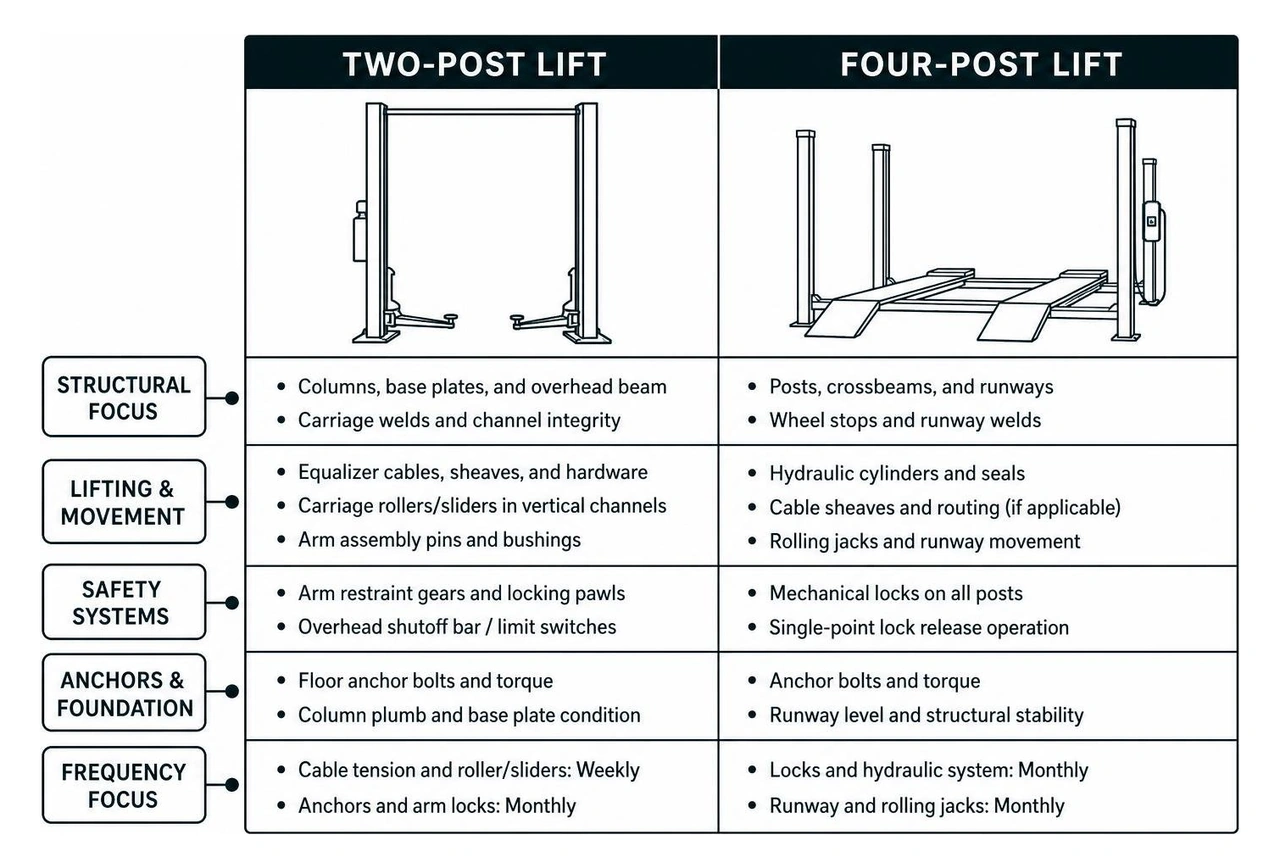
Two-Post Lift Inspections:
- Equalizer Cable Tensioning: Two-post symmetric and asymmetric lifts rely on dual equalizer cables running through overhead or floor-plate channels to ensure both carriages lift simultaneously. Inspect sheaves, wire rope clips, and threaded rod ends weekly.
- Carriage Rollers & Sliders: Check internal UHMW slide blocks or steel rollers inside vertical channels. Keep tracks clean and correctly lubricated to avoid binding.
- Floor Anchors: Inspect floor anchor concrete depth and torque tightness regularly, as two-post columns handle immense side-loading forces.
- Arm Restraint Gears: Ensure arm locking pawls drop completely into outer ring gears when the carriage rises off the ground.
- Learn more about resolving column imbalance and lock issues in our two post lift repair guide.
Four-Post Lift Inspections:
- Runway Alignment & Leveling: Four-post heavy-duty lifts require accurate horizontal plane alignment across both runways to preserve proper alignment rack calibration.
- Slack-Cable Safety Mechanisms: Check secondary slack-cable lock pawls inside each crossbeam. If cable tension drops, these spring-loaded safety locks must instantly engage column ladder rungs.
- Alignment Turning Radius Plates & Rolling Jacks: Inspect pneumatic/hydraulic rolling bridge jacks for cylinder leaks, and clean roller bearing tracks on alignment turn plates.
- Explore proper equipment selection and structural maintenance in our guide on 4 post vehicle lift applications.
Servicing Hydraulic, Scissor, and Specialty Heavy-Duty Lifts
Specialty lift configurations—such as ground-mounted scissor platforms, in-ground hydraulic posts, and mobile column units—demand unique fluid and mechanical protocols:
- Hydraulic System & ATF Quality: Check hydraulic reservoir conditions regularly. For systems running standard Dexron ATF, fluid turning pink or milky indicates water contamination entering through worn cylinder rod seals or unsealed reservoir covers. Contaminated fluid must be drained, flushed, and replaced immediately to prevent pump cavity corrosion.
- Scissor Lift Hinge Pins & Bushings: Mid-rise and full-rise scissor lifts utilize multiple scissor arm pivot points. Service technicians must systematically grease all pivot points across all grease fittings using high-pressure waterproof grease. Check velocity fuses in hydraulic cylinder ports to ensure immediate hydraulic lockdown in the event of hose rupture.
- Specialty Heavy Fleet Hoists: Heavy mobile column lifts and large in-ground drive-on hoists require precise electronic synchronization across columns. Inspect wireless/wired synchronization modules, battery charge banks, and heavy-duty screw drives according to OEM instructions.
Environmental Adaptations, Digital Tracking, and Spare Parts Management

Operating environments play a significant role in component longevity. High-volume automotive repair shops across Michigan and North Carolina contend with severe seasonal temperature fluctuations, humidity shifts, and constant concrete dust exposure.
Managing Environmental Factors in High-Volume Facilities
Environmental exposures accelerate wear across sensitive mechanical and electrical assemblies:
- Temperature Extremes: Winter freeze and summer heat cycles induce hydraulic oil viscosity changes. Low temperatures increase fluid drag on cold starts, placing stress on pump motors, while high temperatures accelerate seal erosion.
- Moisture Ingress & Humidity: Moisture buildup inside unheated bays causes condensation in electrical control boxes and hydraulic reservoirs, eroding terminal contactors and accelerating internal tank rust.
- Abrasive Shop Dust & Grit: Airborne concrete dust, brake dust, and metal shavings cling to oily equalizer cables and vertical slide tracks, forming an abrasive paste that grinds down sheaves, slide blocks, and rod seals.
Implementing daily sweeping protocols, keeping control cabinet gaskets tightly sealed, and wiping down exposed cylinder rods protects equipment investment across harsh weather shifts.
Digital CMMS Workflows, Documentation, and Spare Parts Inventory
Transitioning from paper checklist clipboards to digital CMMS (Computerized Maintenance Management System) platforms drastically improves facility tracking and audit readiness:
- Audit Readiness & Mandatory Photo Proof: Digital platforms require technicians to log numerical measurements (such as cable elongation metrics or line voltage) and attach timestamped photos of critical safety locks. This eliminates skipped checks and creates verifiable compliance records for safety auditors.
- MTTR & Downtime Reduction: Shops leveraging digital workflows experience up to a 40% reduction in Mean Time to Repair (MTTR) by utilizing instantly accessible repair histories and photo proof. In high-volume operations—such as a 12-bay maintenance shop operating 18 vehicle lifts—digitizing PM routines and scheduling auto-PM work orders can reduce unplanned equipment downtime by up to 38%.
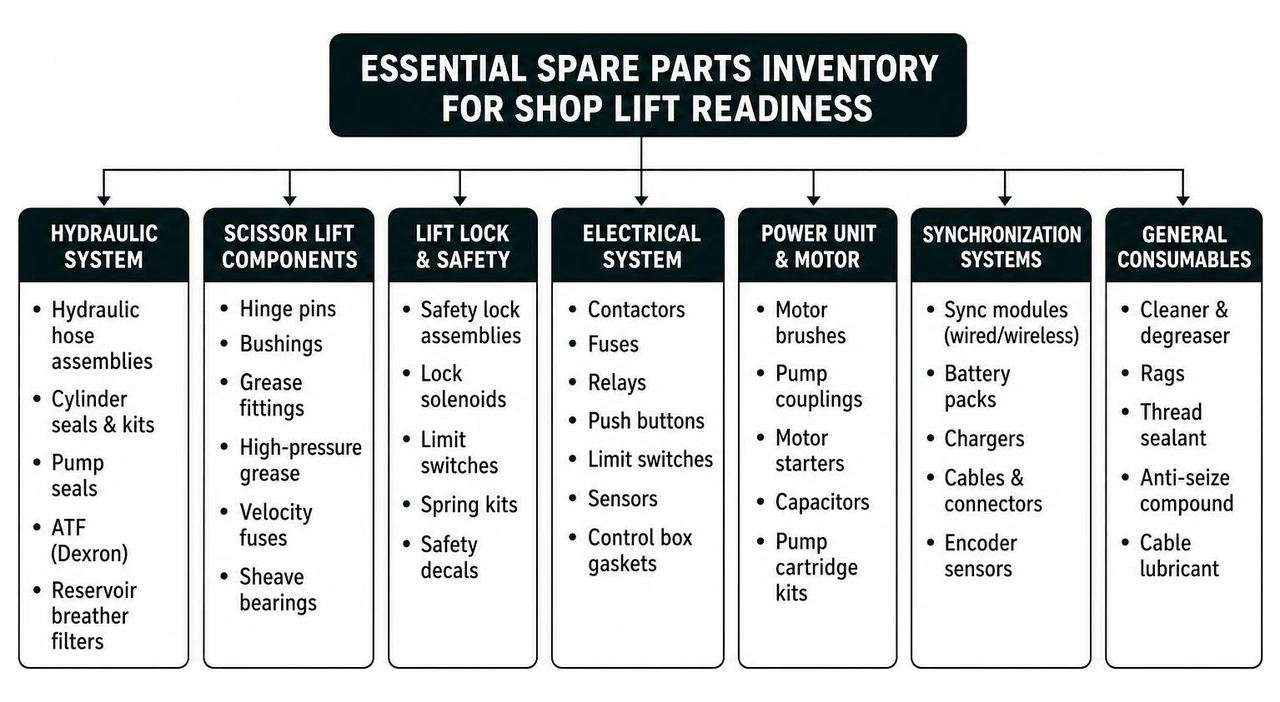
- On-Site Spare Parts Management: To maintain maximum bay uptime, shops should store key consumable lift replacement components on site:
Discover how to streamline asset tracking across multi-bay facilities in our preventative maintenance systems guide 2026.
Frequently Asked Questions About Car Lift Maintenance
What are the most common causes of automotive lift failure?
The most common causes include skipped preventative maintenance schedules, unlubricated sliding blocks, steel equalizer cable elongation or strand breakage, contaminated hydraulic fluid, worn arm rubber contact pads, and loose floor anchor bolts. Addressing these areas during daily and monthly checks prevents most unexpected bay breakdowns.
How often should vehicle lifts undergo certified inspections?
Commercial vehicle lifts should undergo daily pre-shift operator walkarounds, monthly lubrication and fluid audits, quarterly electrical and structural inspections, and a comprehensive annual certified inspection conducted by a qualified lift technician in compliance with ANSI/ALI ALOIM standards.
What spare parts should commercial service centers keep on site?
Commercial service centers should maintain a dedicated inventory of critical failure-prone components, including rubber vehicle arm adapter pads, replacement hydraulic hoses, safety latch springs, control panel fuses, extra door gibs, and sheave assemblies. Keeping these items in stock minimizes bay downtime when service is required.
Conclusion
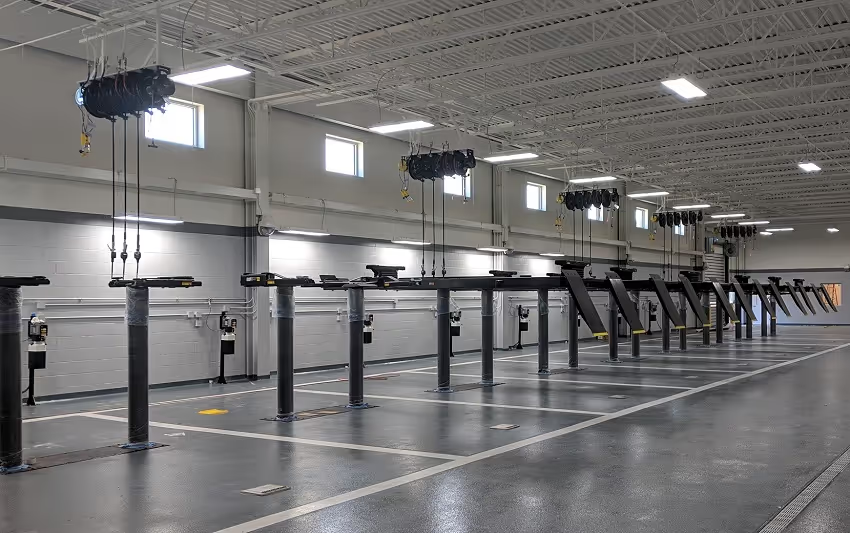
A disciplined preventative maintenance lift strategy is essential for protecting technician safety, preventing expensive downtime, and maximizing equipment return on investment across commercial service bays. By combining structured daily walkarounds with detailed monthly servicing, annual certified inspections, and digital asset tracking, shop managers ensure every lift operates at peak performance.
AutoTech Solutions provides complete automotive equipment sales, professional installation, scheduled preventative maintenance programs, and fast emergency repair support across Michigan and North Carolina. Whether you operate a fleet repair facility in Novi, MI, or manage a busy collision center in Charlotte, Raleigh, or Wade, NC, our team helps keep your bays running efficiently.
Contact AutoTech Solutions today to schedule expert lift inspections, establish custom preventative maintenance schedules, or explore full facility upgrades. Learn more about our complete commercial services by visiting our Installations, Upfits & Facility Buildouts page.