Choosing a 20 Ton Car Jack for a Commercial Fleet Bay
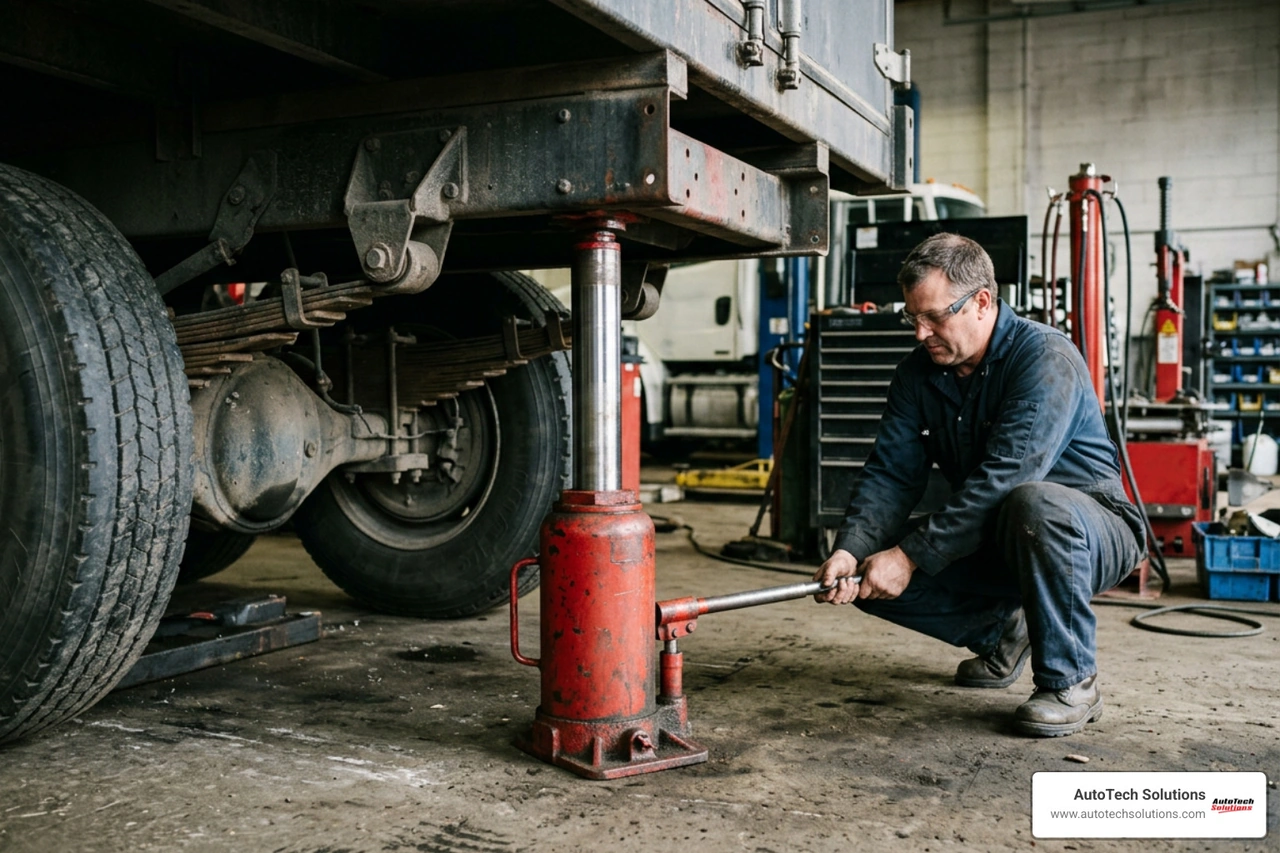
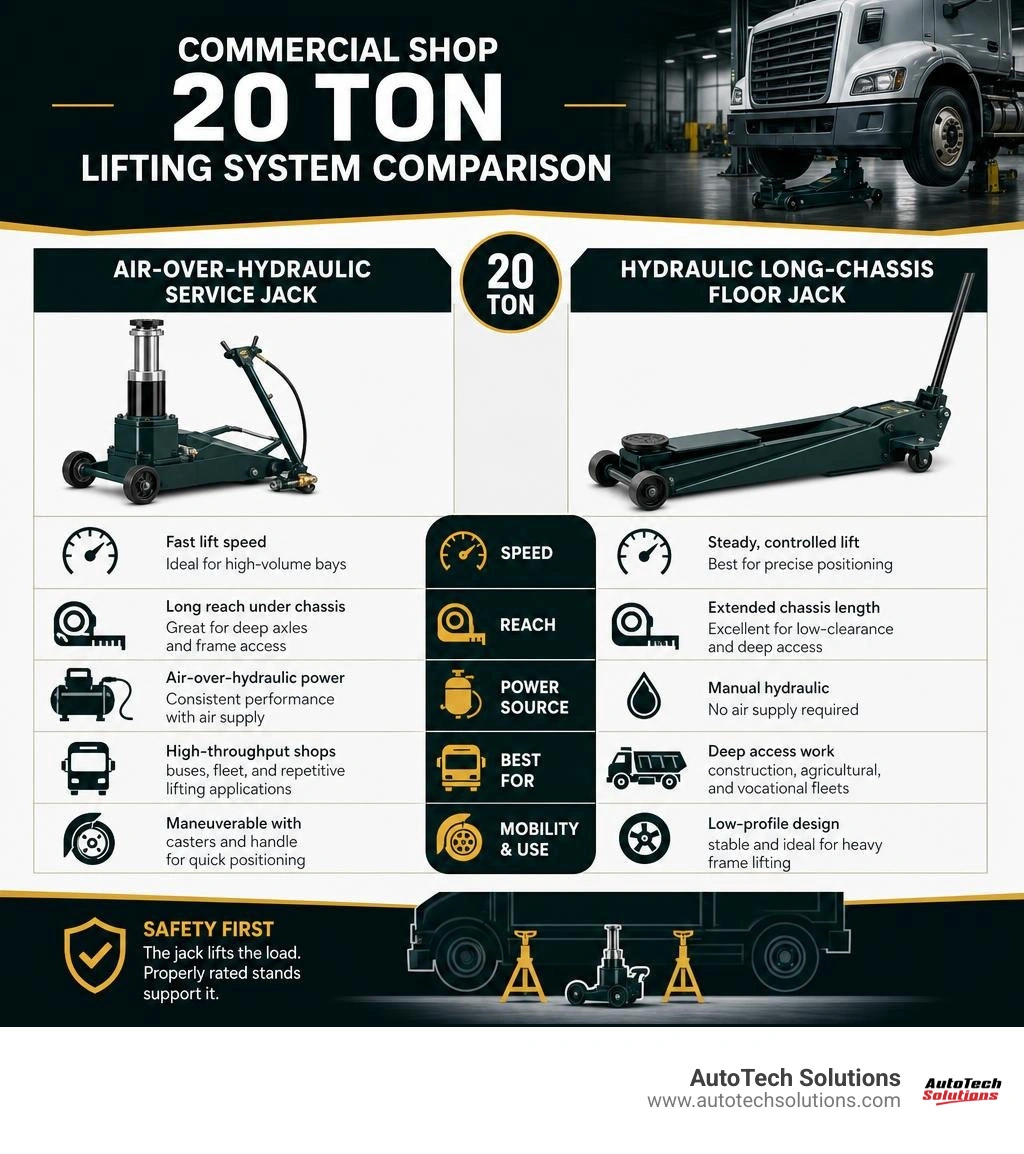
For commercial trucks, buses, and vocational rigs, the right 20 ton car jack is a professional-grade service jack with a 40,000 lb working capacity, adequate frame reach, and a lifting range that matches the fleet's chassis clearances. Choose an air-over-hydraulic model when repeat lifts and technician speed matter; choose a long-chassis hydraulic floor jack when deep axle or frame access is the priority.
The capacity rating is only the starting point. A productive fleet bay also needs a stable steel chassis, controlled lowering, overload bypass protection, and compliance with applicable ASME PASE safety requirements. For work beneath a raised vehicle, the jack lifts the load; properly rated mechanical stands support it.
Long-reach 20-ton service jacks can access lifting points far under commercial chassis. Some heavy-duty designs reach more than 110 inches while lifting from roughly 7.5 to 23.8 inches, making them suited to transit, construction, agricultural, and Class 7-8 fleet service environments.
AutoTech Solutions Staff will compare the key commercial 20-ton lifting-system options, specifications, and maintenance needs next.
Primary Types of 20 Ton Car Jack Systems for Commercial Fleet Bays
Managing high-volume commercial bays requires lifting gear designed to maximize bay throughput and minimize technician fatigue. In heavy-duty repair environments, moving multi-ton commercial vehicle axles, municipal buses, and heavy vocational equipment quickly demands industrial-grade chassis construction and integrated hydraulic power. When selecting heavy equipment for commercial service facilities, shop managers evaluate systems based on duty cycles, chassis length, maneuverability, and power sources.
The primary commercial configurations center on long-chassis air-over-hydraulic service jacks and heavy-duty mechanical hydraulic long-frame units. Both configurations deliver the required 40,000-lb (or up to 44,092-lb) capacity, but their operational mechanics impact shop workflows differently. When looking for reliable air-hydraulic floor jack options, shops must balance speed with access reach across different vehicle categories.
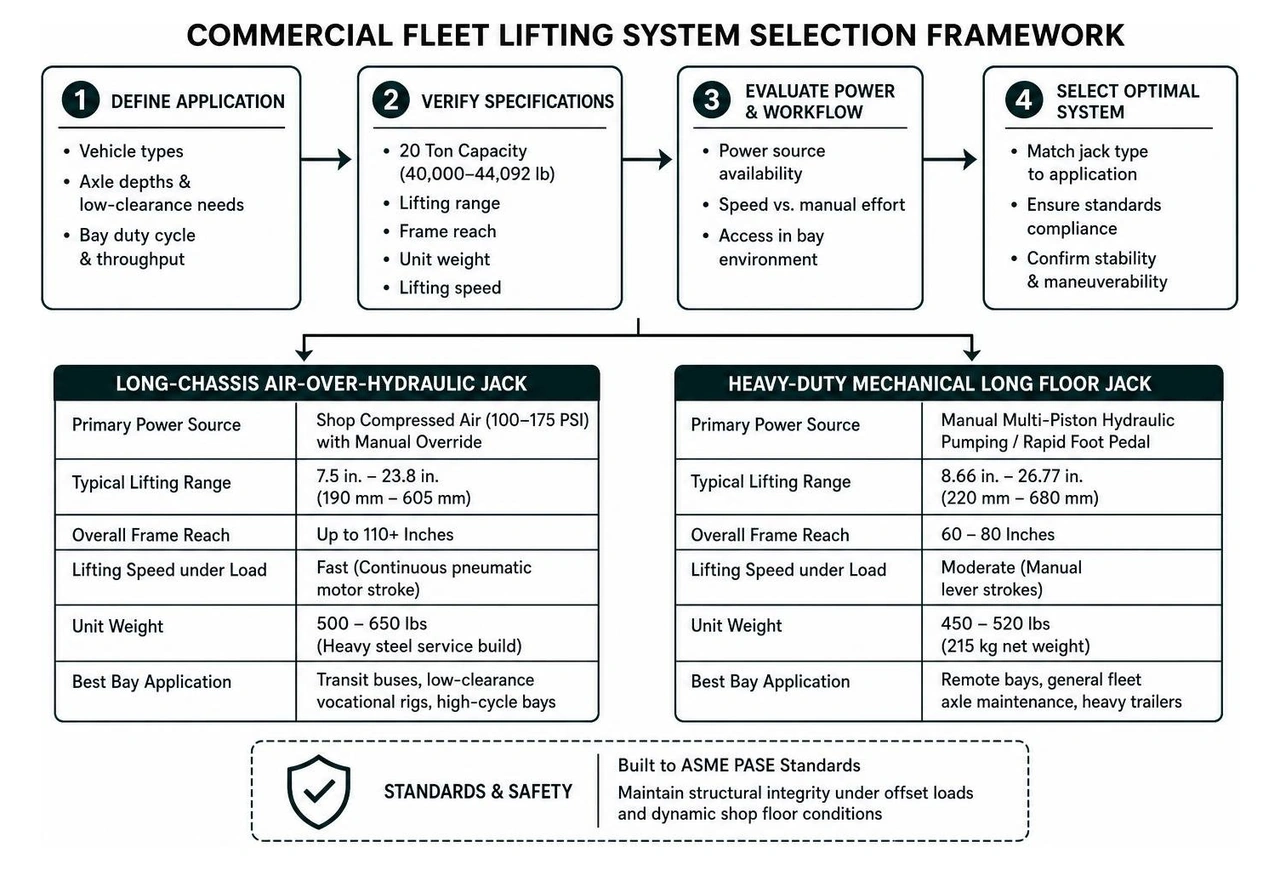
| Specification / Feature | Long-Chassis Air-Over-Hydraulic Jack | Heavy-Duty Mechanical Long Floor Jack |
|---|---|---|
| Primary Power Source | Shop Compressed Air (100–175 PSI) with Manual Override | Manual Multi-Piston Hydraulic Pumping / Rapid Foot Pedal |
| Typical Lifting Range | 7.5 in. – 23.8 in. (190 mm – 605 mm) | 8.66 in. – 26.77 in. (220 mm – 680 mm) |
| Overall Frame Reach | Up to 110+ Inches | 60 – 80 Inches |
| Lifting Speed under Load | Fast (Continuous pneumatic motor stroke) | Moderate (Manual lever strokes) |
| Unit Weight | 500 – 650 lbs (Heavy steel service build) | 450 – 520 lbs (215 kg net weight) |
| Best Bay Application | Transit buses, low-clearance vocational rigs, high-cycle bays | Remote bays, general fleet axle maintenance, heavy trailers |
Air-Over-Hydraulic Long-Chassis 20 Ton Car Jack Designs
Air-over-hydraulic systems combine standard commercial shop pneumatic lines with high-pressure internal hydraulic circuits. Operating reliably within an air pressure window of 100 to 175 PSI, these units use an integrated pneumatic motor to pump hydraulic fluid directly into the primary power cylinder. This design eliminates manual physical exertion during repetitive lifting cycles on Class 7 and Class 8 commercial trucks.
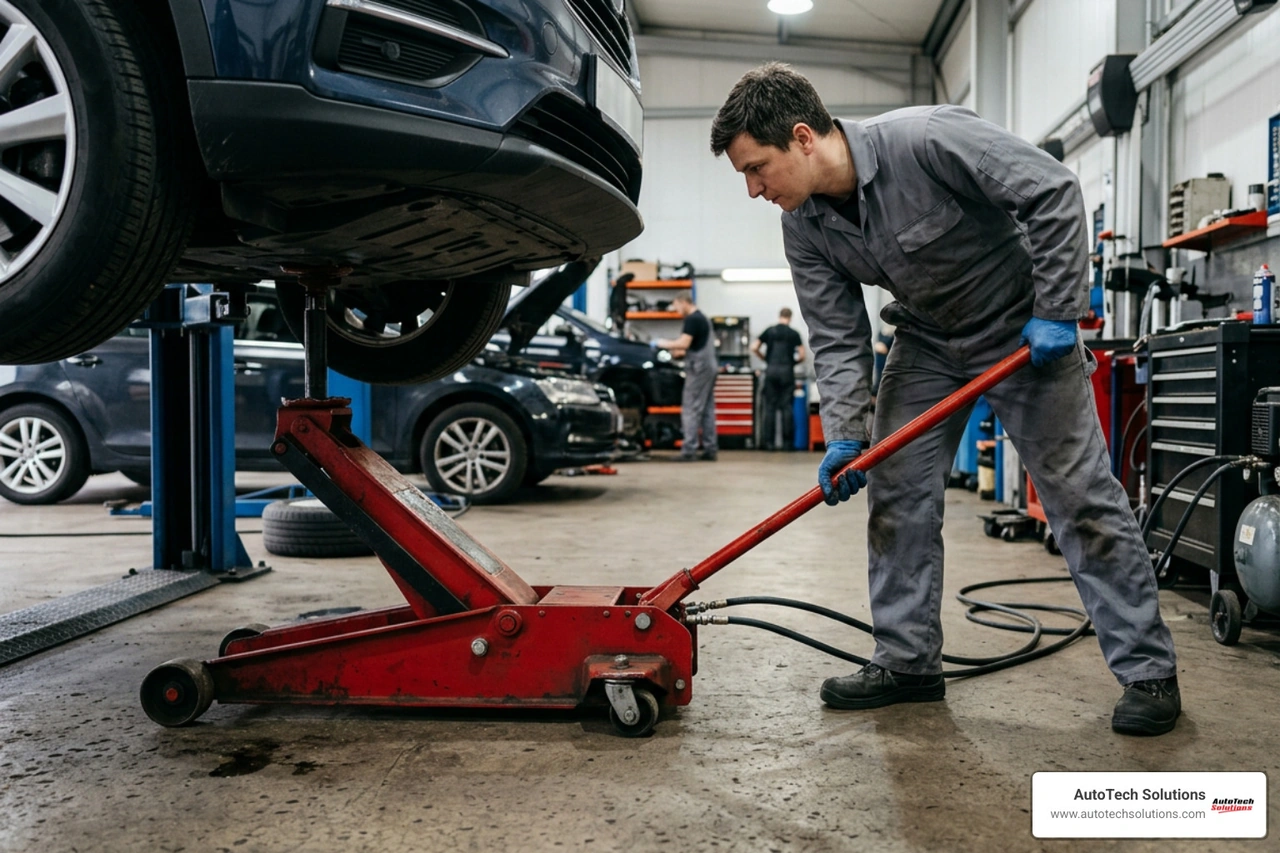
High-grade commercial models incorporate dual-mode actuation. If an air line is disconnected or unavailable in a secondary staging area, technicians can switch immediately to a manual pump handle without dropping hydraulic line pressure. Furthermore, precision handle-mounted pneumatic throttles and quick-advance foot pedals allow rapid positioning against pickup points before full hydraulic pressure is applied.
Heavy-Duty Mechanical and Pneumatic Service Jack Configurations
For dedicated structural stability, heavy-duty service jacks utilize heavy-gauge steel side plates and reinforced base geometry. Many commercial units weigh between 450 and 640 lbs, relying on specialized 6-caster wheel arrays—typically featuring four fixed front roller wheels and two mid-body swivel casters—to distribute weight evenly across commercial shop concrete slabs.
Fleet managers frequently pair these robust heavy duty jacks with auxiliary shop equipment like heavy duty car ramps to create versatile, high-throughput service bays capable of handling everything from municipal delivery fleets to agricultural tractors.
Essential Specifications: Reach, Frame Clearance, and ASME PASE Standards
Selecting commercial lifting equipment requires reviewing technical dimensions, structural materials, and certified load tolerances. A unit rated for 20 metric tons (40,000 to 44,092 lbs) must maintain structural rigidity under offset loads and dynamic shop floor conditions. Fleet bay managers must ensure that every service jack features reinforced side plates and welded steel chassis assemblies capable of resisting chassis twist when operating on uneven shop concrete slabs.
Selecting the Proper 20 Ton Car Jack for Deep-Set Axles and Clearances
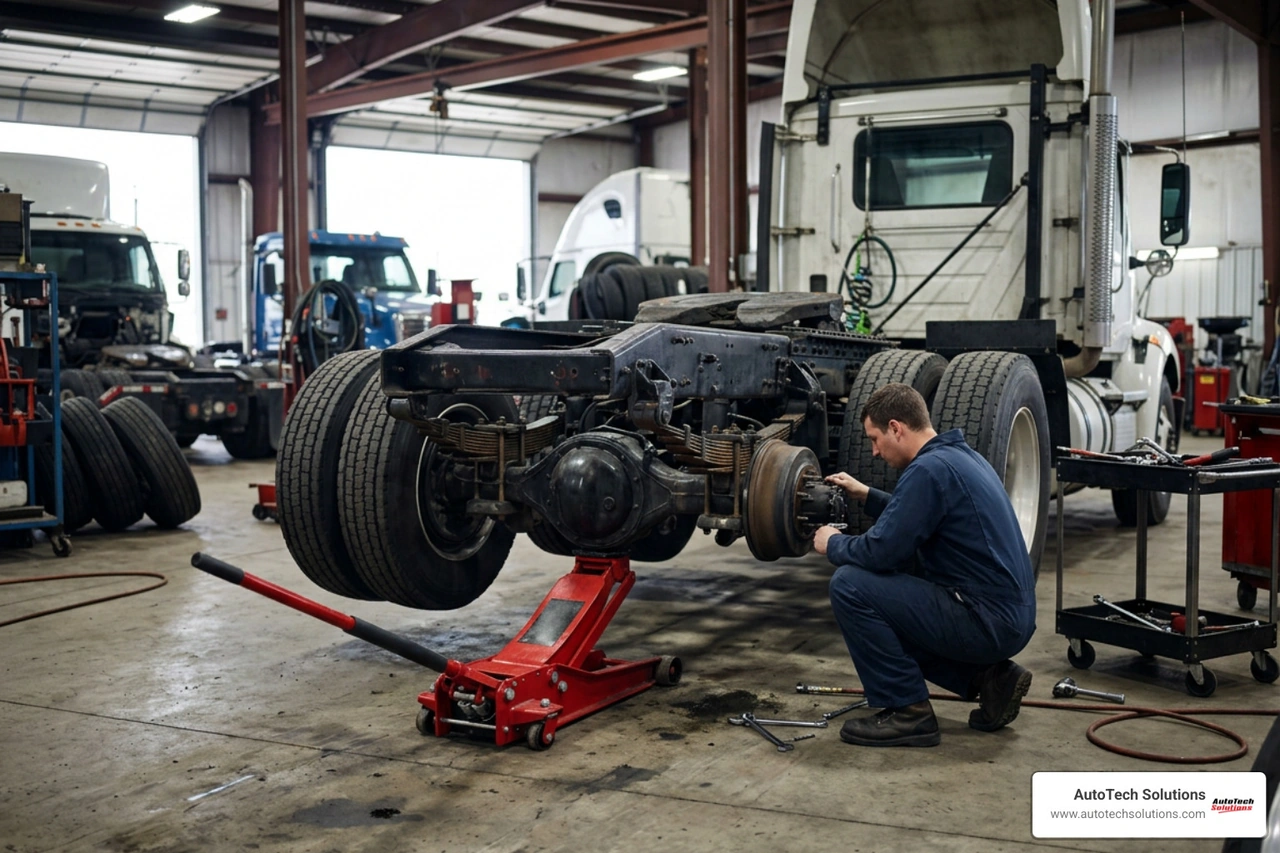
Vocational trucks, mass transit buses, and multi-axle trailers often have deep overhangs that prevent standard-length shop jacks from reaching internal crossmembers or axle differential points. Commercial long-reach designs solve this by extending the physical chassis reach beyond 100 inches (with select units reaching 110.4 inches) while keeping the frame profile under 10.5 inches high. This low, extended frame profile ensures technicians can clear low aerodynamic side skirts, fuel tanks, and battery boxes without damaging vehicle bodywork.
Key clearance parameters to verify include:
- Minimum Low-Profile Height: Must clear collapsed suspensions or flat-tire axle drops (typically 7.0 to 8.8 inches / 170 mm to 225 mm).
- Maximum Lift Extension: Must reach sufficient heights (up to 23.8 to 26.8 inches / 605 mm to 680 mm) to unload suspensions and allow commercial wheel removal.
- Saddle Crown Diameter: Heavy steel saddles (measuring 4.5 to 6.5 inches across) provide solid contact with round axle tubes and heavy-duty leaf spring perches.
- Handle Positioning Angle: Multi-position locking handles allow technicians to position, pump, and lock the jack in tight bay spaces without interfering with surrounding bay equipment.
Build Quality, Overload Bypass Valves, and Certified Ratings
Commercial shop safety demands strict adherence to ASME PASE (Portable Automotive Service Equipment) manufacturing and testing standards. Certified commercial units are proof-tested to 150% of their rated working capacity to verify weld integrity and structural stability under maximum hydraulic pressure.
High-performance service jacks utilize:
- Calibrated Overload Bypass Valves: Automatically divert hydraulic fluid back to the reservoir if an operator attempts to lift loads beyond 40,000 lbs, preventing catastrophic structural fatigue.
- Ram Over-Extension Limiters: Internal hydraulic bypass ports that prevent the main ram from exceeding its maximum engineered stroke.
- Chromium-Plated Piston Rods: Polished, hard-chrome cylinders that resist corrosion and withstand high duty cycles (rated up to 10,000 lift cycles in high-throughput fleet environments).
- Controlled Lowering Metering Valves: Release mechanisms engineered to prevent sudden descent, ensuring controlled, smooth lowering even under maximum rated capacity.
Commercial Shop Maintenance Protocols for Heavy Lifting Equipment
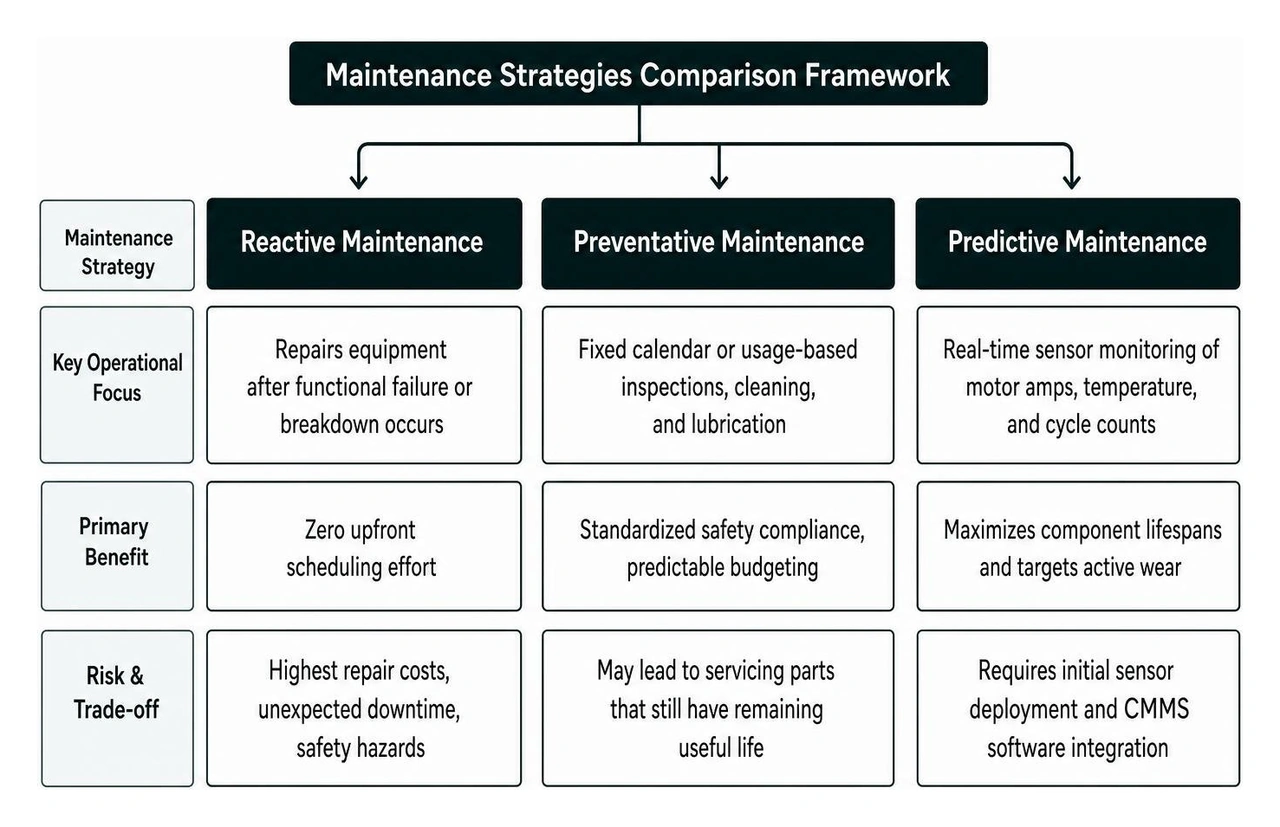
To maintain equipment longevity and protect technicians, commercial facilities follow rigorous preventative maintenance protocols for all heavy hydraulic lifting gear. Establishing a structured daily inspection checklist and monthly servicing schedule prevents premature seal degradation and unexpected hydraulic line pressure drops in busy shop bays.
- Hydraulic Fluid Management: Maintain fluid levels using high-grade ISO hydraulic oil formulated for multi-temperature performance (rated from -13°F to 140°F). Low fluid levels cause the main ram to stall before reaching maximum height, while overfilling can create reservoir cavitation.
- Air Purging (Bleeding): Trapped air in the hydraulic circuit causes spongy lifting, slow ram retraction, or failure to raise under no-load conditions. Purge the system by opening the release valve, removing the reservoir fill plug, and cycling the pump handle rapidly several times before resealing.
- Wiper Seal and Gasket Inspections: Routinely inspect the main cylinder base joints, return valve needles, and pump pistons for weeping oil. Industrial wiper seals and external dust boots must be maintained to prevent shop floor grit from contaminating internal hydraulic valves and scratching polished piston rods.
- Chassis and Wheel Lubrication: Commercial service jacks feature heavy-duty steel front rollers and rear swivel casters equipped with grease fittings. Apply high-pressure lithium grease every 90 days to maintain effortless positioning across textured shop floors.
- Mechanical Lock and Fastener Verification: Check all frame cross-bolts, handle linkage pins, and return springs regularly to ensure mechanical structural integrity during continuous high-tonnage lifting cycles.
Frequently Asked Questions About Commercial Fleet Lifting Gear
What Air Pressure Is Required for Pneumatic 20-Ton Shop Jacks?
Most commercial air-over-hydraulic service jacks require a shop compressed air line providing between 100 and 175 PSI (typically operating at an optimal standard around 110–120 PSI or 8.27 Bar) with a standard 1/4-inch NPT or 3/8-inch airline connection to achieve their full lifting speed.
How Does ASME PASE Compliance Impact Fleet Safety and Equipment Longevity?
ASME PASE (such as the PASE-2019 standard) certifies that the lifting equipment has undergone structural overload testing, dynamic stability evaluations, and valve reliability verifications. Compliance ensures equipment will not experience sudden structural failure under rated capacity, reducing commercial shop liability and protecting service technicians.
What Are the Key Preventative Maintenance Steps for Heavy Hydraulic Rams?
Standard preventative maintenance includes monthly checks of hydraulic reservoir levels, periodic air bleeding, visual inspections for cylinder scoring or oil leaks along the base seals, greasing caster bearings, and wiping down the hard-chrome piston rod to prevent abrasive particle accumulation.
Conclusion
Equipping a professional commercial repair facility with reliable, high-capacity lifting equipment is essential for shop safety, bay efficiency, and minimizing downtime. AutoTech Solutions provides automotive equipment sales, professional car lift installation, field service, and comprehensive preventative maintenance for commercial truck shops, collision facilities, and fleet service centers across Michigan and the Carolinas.
Explore our full commercial lineup of commercial car air jacks and professional lifting infrastructure to keep your commercial fleet bays operating at peak performance.