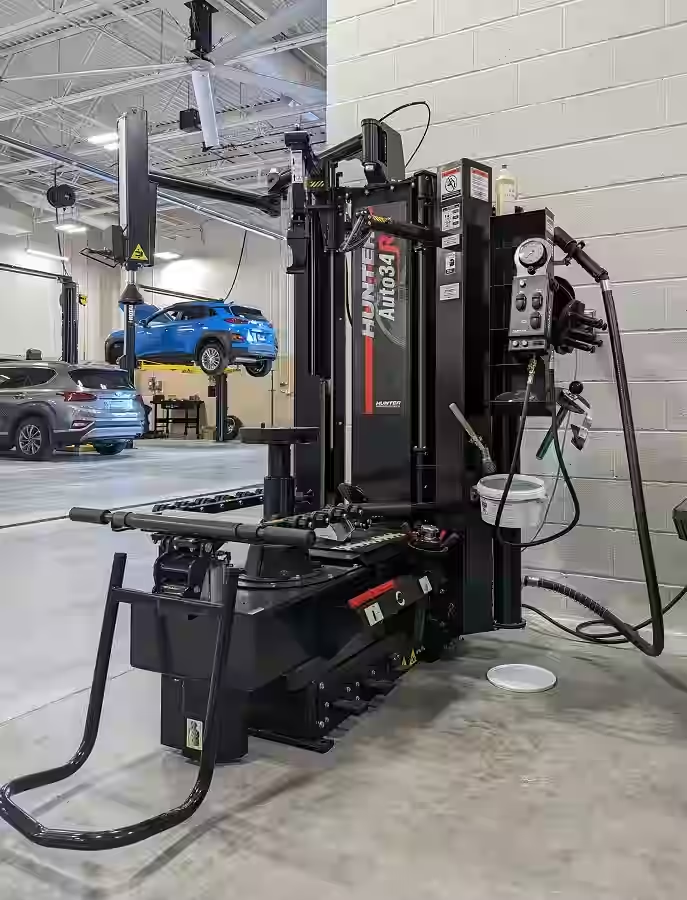
How to Size an Air Compressor for a Tire Changer
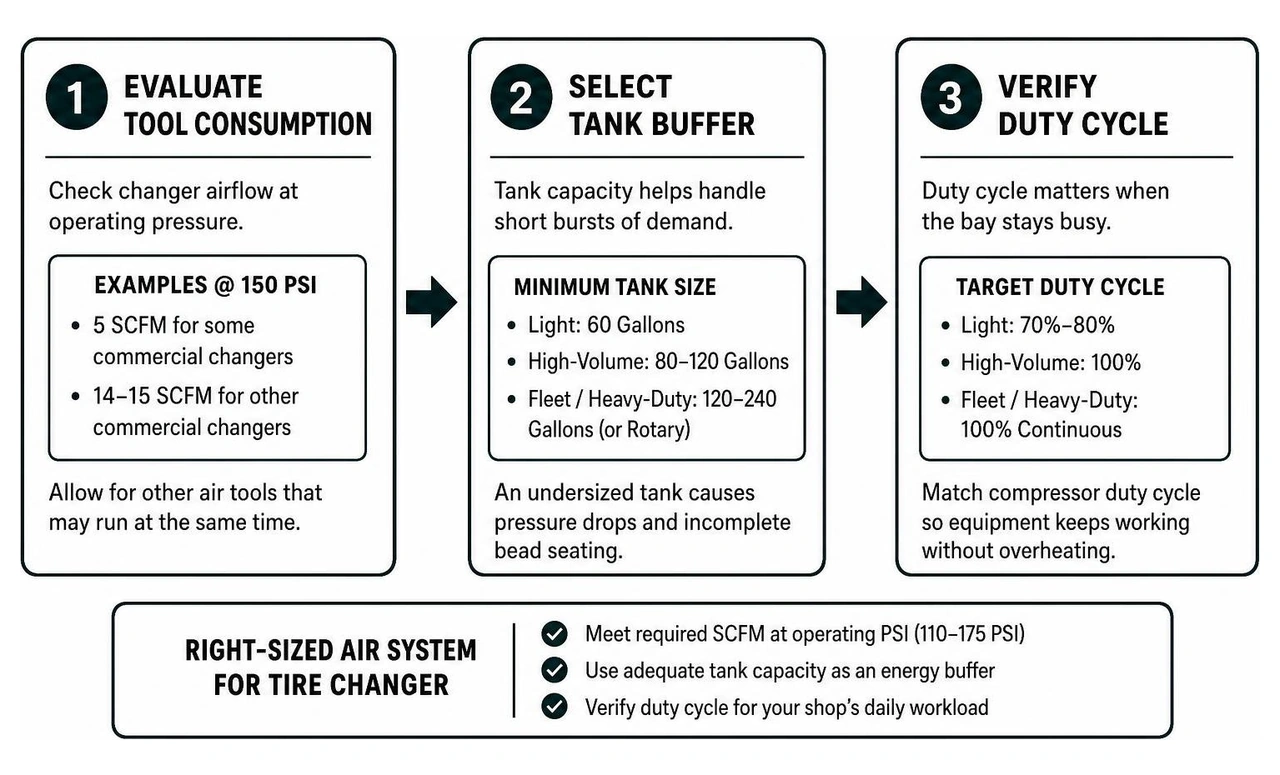
To choose an air compressor for tire changer systems, check the changer's required airflow at its operating pressure, not just the compressor's maximum PSI. Some commercial changers need about 5 SCFM at 150 PSI; others need 14-15 SCFM at 150 PSI. Use your model's specifications, then allow for other air tools that may run at the same time.
Tank capacity helps handle short bursts of demand, while duty cycle matters when the bay stays busy. We're AutoTech Solutions Staff, and we help commercial shops size air systems to keep their equipment working.

Key Specifications for an Air Compressor for Tire Changer Systems
Choosing the right compressor requires balancing four key engineering metrics: Standard Cubic Feet per Minute (SCFM), operating pressure (PSI), duty cycle, and receiver tank capacity. Overlooking any single metric leads to sluggish bead breakers, incomplete clamping cycles, or premature pump failure in demanding bay environments.
For a complete breakdown of shop pneumatic design, consult our complete compressed air guide for 2026. When evaluating heavy-duty automated changers, verify technical specifications such as the Revolution Series Tire Changer Specification 7082-T to confirm exact inlet tolerances and connection requirements.
| Shop Volume Category | Daily Wheel Volume | Recommended Airflow @ 150 PSI | Minimum Tank Size | Target Duty Cycle |
|---|---|---|---|---|
| Light Commercial / General Repair | 5–15 assemblies | 5–10 SCFM | 60 Gallons | 70%–80% |
| High-Volume Tire Service Center | 20–60 assemblies | 15–25 SCFM | 80–120 Gallons | 100% |
| Commercial Fleet / Heavy-Duty Bay | 60+ assemblies | 30–45+ SCFM | 120–240 Gallons (or Rotary) | 100% Continuous |
Calculating CFM and Operating Pressure Requirements
Pneumatic tire changers rely on pressurized air to drive mechanical operations:
- Tabletop Clamping Jaws: Pneumatic pistons lock rims securely in place without slippage during high-torque mounting.
- Bead Breaker Shovels: Large pneumatic cylinders exert thousands of pounds of force to unseat stubborn, low-profile, or run-flat tire beads.
- Articulating Helper Arms: Pneumatic assist arms hold stiff sidewalls down inside the rim drop center during mounting cycles.
- Integrated Bead Seating Jets: High-volume air bursts blast through tabletop nozzles to seat tire beads rapidly against wheel rims.
Commercial tire changers generally operate within a working range of 110 to 175 PSI. For example, classic swing-arm machines require a modest 5 SCFM at 150 PSI powered by a 2 HP motor, whereas modern high-production leverless and center-clamp models demand 14 to 15 SCFM at 150 PSI, typically requiring at least a 5 HP or 7.5 HP industrial compressor to sustain continuous operation.
If your compressor delivers rated CFM only at 90 PSI, its output will drop significantly at the 150 PSI required by commercial bead breakers. Compressors lose roughly 30% to 40% of their volumetric delivery rate when compressing air from 90 PSI up to 150–175 PSI. Always check manufacturer pump output curves at actual working pressure rather than relying on nominal displacement ratings.
Receiver Tank Capacity and Duty Cycle Demands
Receiver tanks serve as essential energy storage buffers. Inflating a high-volume commercial tire or firing an integrated bead-seating blast consumes air faster than standard compressor pumps generate in real time.
An undersized receiver tank causes immediate line pressure drops, leading to incomplete bead seating and stalling helper arms mid-stroke. For dedicated commercial service bays, an 80-gallon vertical tank is the baseline industry standard, while multi-bay facilities benefit from 120-gallon or dual-tank configurations to cushion sudden pneumatic spikes.
Duty cycle measures the proportion of time a compressor can run within a given timeframe without overheating or breaking down pump lubricant. A reciprocating compressor with an 80% duty cycle can run for roughly 45 minutes and requires 10 to 15 minutes of cool-down time. For high-volume tire service bays running continuous mounting cycles throughout peak business hours, we specify heavy-duty two-stage reciprocating pumps or rotary screw systems rated for a 100% continuous duty cycle.
Commercial Shop Setup and Air Delivery Architecture
A high-output air compressor cannot perform if the downstream distribution network restricts flow. Installing an undersized air line or restrictive quick-connect couplers chokes pneumatic tools right at the machine connection, dropping pressure right when the technician activates the foot pedal.
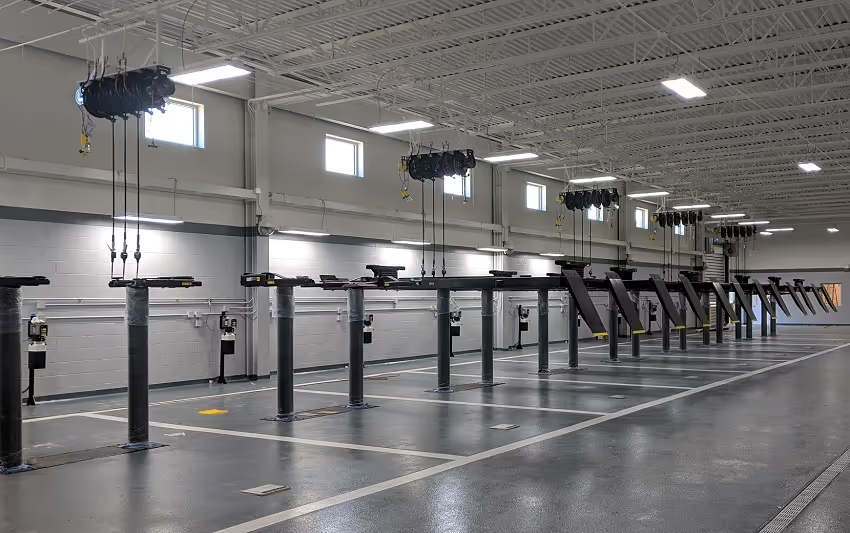
To prevent pressure loss across your bays, install a dedicated automotive compressed air ring main layout. A continuous closed-loop distribution header balances pressure across all service bays, eliminating line starvation when multiple technicians run impact wrenches while a tire machine cycles.
Choosing a Stationary Air Compressor for a Tire Changer in Commercial Bays
When planning commercial facility upgrades, select between two main compressor architectures based on volume and growth expectations:
- Two-Stage Reciprocating Compressors: Industrial two-stage units (ranging from 5 to 15 HP, delivering 15 to 45+ CFM at up to 175 PSIG) use cast-iron cylinders and splash- or pressure-lubricated pumps. They deliver reliable high-pressure air for medium- to high-volume commercial bays and handle variable duty cycles effectively.
- Rotary Screw Compressors: For massive fleet maintenance centers running 3 or more tire changers simultaneously alongside exhaust extraction systems and continuous shop air tools, rotary screw units offer 100% duty cycles, ultra-quiet operation below 70 dBA, and steady line pressure with minimal pulsation.
Pipe sizing also plays a major role in delivery efficiency. Main distribution headers should use at least 3/4-inch to 1-inch modular aluminum or copper piping, with dedicated 1/2-inch drop lines running to each tire changer station. High-flow industrial couplers (such as 3/8-inch or 1/2-inch Milton V-style or European safety fittings) eliminate the restrictive bottlenecks common with standard 1/4-inch automotive fittings.
For safe installation, proper electrical wiring, and vibration-dampened anchoring, schedule a professional shop compressor installation.
Equipping Mobile Service Rigs with an Air Compressor for Tire Changer Work
Mobile tire operations require compact, high-output pneumatic power mounted directly on service vehicles to support roadside tire replacements and fleet service calls.
- Gasoline-Driven Two-Stage Compressors: Equipped with electric-start commercial engines and 30-gallon horizontal tanks, delivering 15–25 CFM at 175 PSI to operate full-size tire changers and heavy-duty impact tools.
- Hydraulic-Drive Air Systems: Integrated directly into vehicle PTO hydraulics to deliver industrial pneumatic capacity without a separate engine footprint, saving valuable truck bed payload capacity and reducing service rig noise levels.
Air Quality, Safety Systems, and Shop Maintenance
Commercial tire changers feature precision pneumatic valves, composite drive cylinders, and directional foot pedals that degrade quickly if exposed to moisture and dirty oil.

Protect your equipment investment by scheduling routine preventative shop compressor maintenance to test check valves, inspect safety systems, and change pump oil.
Clean Air Delivery and Moisture Filtration
Piston compressors produce significant heat, causing water vapor to condense inside shop distribution lines. Unfiltered water washes away factory cylinder grease, rusts steel valves, and ruins bead-blast solenoids.
Install a comprehensive automotive air compressor filtration system with three core stages:
- Particulate/Coalescing Filters: Remove solid rust scale, dust, and bulk liquid down to 5 microns.
- Refrigerated Air Dryers: Lower compressed air dew points to eliminate moisture condensation before it enters tire changer valves.
- Filter-Regulator-Lubricator (FRL) Units: Placed within 10 feet of the tire changer drop line to regulate terminal pressure (110–140 PSI) and meter micro-mists of pneumatic tool oil into the drive cylinders.
Essential Safety Controls and System Protection
Commercial compressed air systems store immense potential energy. Every professional compressor installation requires strict safety safeguards:
- ASME-Certified Pressure Relief Valves: Automatically discharge line pressure if primary pressure switches fail.
- Thermal Overload Cut-Off Switches: Prevent motor windings from burning out during prolonged duty periods.
- Automatic Tank Drains: Electric timed or zero-air-loss pneumatic drains purge corrosive water buildup from receiver tanks daily.
- Vibration Dampening Pads: Thick elastomeric floor mounts isolate pump vibrations, protecting shop concrete foundations from fatigue cracking.
Frequently Asked Questions About Sizing Tire Changer Compressors
What size air compressor is required to run a commercial tire changer?
Most standard commercial tire changers require a minimum 5 HP two-stage air compressor delivering 14 to 15 SCFM at 150 PSI paired with an 80-gallon tank. While compact entry-level changers can operate on 5 SCFM, dedicated high-volume bays demand higher delivery rates to sustain rapid bead seating and assist-arm operation.
Can a single air compressor supply both tire changers and shop impact wrenches?
Yes, provided the compressor is sized for aggregate CFM demand. A 1/2-inch commercial impact wrench consumes 4 to 6 CFM under intermittent load, while a tire changer demands 5 to 15 CFM during active cycling. Ensure your compressor output exceeds total simultaneous tool draw, and use a closed-loop air distribution header to eliminate localized pressure drops.
Why does my tire changer bead breaker lose power during continuous operation?
Loss of bead-breaking force is caused by dynamic pressure drop. Common culprits include:
- A compressor pump that cannot recover to the 140+ PSI cutoff threshold during sustained work.
- Undersized drop lines (e.g., 1/4-inch hose or restrictive quick disconnects instead of dedicated 1/2-inch lines).
- Saturated inline filter elements creating severe pneumatic restriction.
Conclusion
Choosing the right air compressor for tire changer operations ensures your shop maintains maximum throughput, avoids costly bay bottlenecks, and keeps pneumatic equipment running smoothly. Matching CFM delivery at 150 PSI, choosing an appropriate tank buffer, and implementing a clean air delivery network are the keys to long-term shop reliability.
AutoTech Solutions specializes in complete commercial shop equipment sales, system design, certified car lift installation, and preventative maintenance across Michigan and the Carolinas, with local service hubs in Charlotte, NC, Raleigh, NC, Wade, NC, and Novi, MI.
Ready to upgrade your shop pneumatic infrastructure or equip a new tire bay? Explore commercial tire shop equipment and installation services with AutoTech Solutions today.