Why Your Shop Can't Afford to Ignore Compressed Air Systems
Air compressor repair and maintenance for automotive shops is one of the most overlooked factors separating high-performing service bays from ones that bleed money through downtime, rework, and broken tools.
Here's a quick answer if you need it fast:
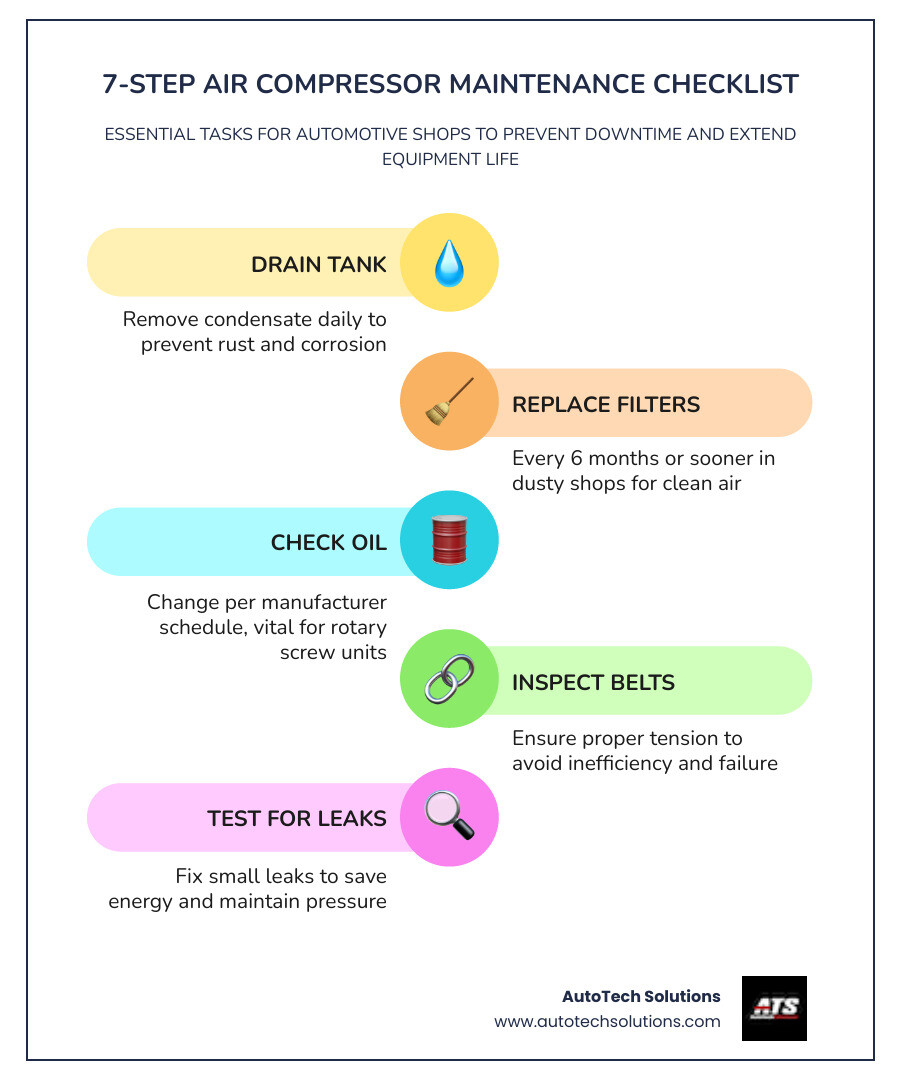
Key air compressor maintenance tasks for automotive shops:
- Drain the tank - Remove condensate regularly to prevent corrosion
- Replace air filters - Every 6 months, or sooner in dusty environments
- Check and change oil - Per manufacturer schedule; critical for rotary screw units
- Inspect belts and tension - Loose belts cause inefficiency and premature failure
- Check for air leaks - Even small leaks waste significant energy and drop system pressure
- Test condensate drains and safety valves - Ensure dryers and pressure relief systems work correctly
- Schedule professional inspections - Every 6 months for compressors, annually for dryers
Think about what runs on compressed air in your shop. Impact wrenches. Spray guns. Tire inflation. Lifts. Pneumatic ratchets. Nearly every productive task in a busy bay depends on a steady, clean air supply.
When that system fails, everything stops.
Compressed air problems rarely announce themselves dramatically. More often, pressure quietly drops, moisture creeps into lines, tools start underperforming, and paint jobs develop defects that send expensive work back to the booth. By the time the compressor finally quits, the damage to productivity and profitability is already done.
For shop managers and owners running established automotive, collision, or industrial facilities, the stakes are real. Technician downtime is expensive. Unplanned repairs cost far more than scheduled maintenance. And a compressor failure during peak hours isn't just an inconvenience — it's lost revenue and frustrated customers.
This guide covers everything you need to keep your compressed air system running reliably: from spotting early warning signs and understanding piston versus rotary screw compressors, to building a preventative maintenance schedule and knowing when repair no longer makes sense.
Understanding Air Compressor Repair and Maintenance for Automotive Shops
At AutoTech Solutions, we’ve seen it all—from small leaks that cost hundreds in monthly energy bills to catastrophic tank failures that could have been prevented with a simple five-minute check. In the high-demand environments of Michigan and the Carolinas, a shop's air compressor is its heartbeat. If the heart stops, the shop stops.
Effective air compressor repair and maintenance for automotive shops isn't just about fixing things when they break; it's about system reliability. When we handle Automotive Equipment Repair, we focus on the "root cause" rather than just the symptoms. A compressor that keeps tripping a breaker might have an electrical issue, but it could also be struggling against a clogged intake filter or a failing internal valve.
The goal is to transition from "reactive" repairs—which usually happen at 2:00 PM on your busiest Tuesday—to proactive, preventative care. This approach lowers your total operational costs by extending the lifespan of your equipment (which should ideally last 10–15 years) and ensuring your tools perform at peak efficiency. Furthermore, a properly planned Air Compressor Installation ensures that the system is sized correctly for your specific piping and ventilation needs from day one.
Common Air Compressor Problems and Symptoms
Identifying trouble early requires a "senses-on" approach. Your technicians are your first line of defense. They should be trained to look for these common symptoms:
- Pressure Drops: If an impact wrench that usually zips lugs off is suddenly struggling, you likely have a pressure drop. This is often caused by air leaks in the lines, clogged filters, or a failing pressure regulator.
- Unusual Noises: Screeching usually points to a loose belt. Clunking or knocking often indicates internal mechanical wear, such as a loose connecting rod or a failing bearing.
- Excessive Vibration: If the unit is "walking" across the floor or vibrating more than usual, it could mean misaligned drives, mounting degradation, or internal component imbalance.
- Oil Leaks: For oil-lubricated models, spots on the floor are a red flag. Oil in the air lines is even worse, as it can ruin paint jobs and gum up pneumatic tools.
- Frequent Motor Cycling: Also known as "short cycling," this happens when the compressor turns on and off too frequently. It’s a sign of air leaks, a faulty pressure switch, or a tank that is too small for the demand.
Early Warning Signs Your System Needs Professional Attention
Don't wait for the "check engine light" of a total shutdown. Watch for these subtle warning signs that suggest you need Service, Repair, and Equipment Support:
- Rising Energy Bills: If your utility costs are climbing but your shop volume is the same, your compressor is likely working harder (and longer) to compensate for leaks or internal inefficiency.
- Moisture in the Lines: If you see water spitting out of your air blowers, your dryer or condensate drains are failing. Moisture is the enemy of automotive craftsmanship, leading to tool corrosion and paint "fish-eyes."
- Slow Recovery Time: Time how long it takes for your tank to reach full pressure from a dead stop. If that time is increasing, your pump is losing efficiency.
- Overheating: If the compressor feels excessively hot or smells like burning oil, the cooling system is likely clogged or the lubricant has broken down.

Piston vs. Rotary Screw: Choosing and Sizing for Your Shop
Choosing the right technology is the foundation of a reliable air system. In the automotive world, we primarily see two types: Piston (Reciprocating) and Rotary Screw.
| Feature | Piston (Reciprocating) | Rotary Screw |
|---|---|---|
| Duty Cycle | Intermittent (approx. 60-70%) | Continuous (100%) |
| Noise Level | High (like a motorcycle) | Low (like a dishwasher) |
| Initial Cost | Lower | Higher |
| Maintenance | Simple but frequent | Specialized |
| Best For | General repair, tire shops | Collision centers, high-volume bays |
Piston compressors are the traditional workhorse. They are great for shops where air use is "bursty"—like using an impact wrench for a few minutes and then letting the compressor rest. However, they generate a lot of heat and noise.
Rotary screw compressors, like the Quincy models we often recommend, are designed for 24/7 operation. They are significantly quieter and often come as "all-in-one" units with integrated dryers and filters. For a deeper dive into equipment types, check out our Automotive Shop Equipment Complete Guide or our section on Heavy Duty Shop Equipment.
Sizing Your Air Compressor Repair and Maintenance for Automotive Shops
The biggest mistake we see is shops buying a compressor based on Horsepower (HP) rather than Airflow (CFM). Horsepower is what you pay for; CFM is what you use.
To size your system correctly:
- Calculate Total CFM: Add up the CFM requirements of every tool that might run at the same time.
- Factor in Duty Cycle: If you need 20 CFM and buy a 20 CFM piston compressor, you’ll burn it out because it needs "rest" time. You would need a larger piston unit or a 20 CFM rotary screw.
- Plan for Growth: If you plan to add another bay or a paint booth next year, size your compressor for that future demand now. Proper Automotive Equipment Installation and Service ensures your piping can also handle this increased flow.
Reducing Noise in Busy Automotive Environments
A loud shop isn't just annoying; it's a safety hazard. It hinders communication between technicians and increases fatigue.
- Sound Enclosures: Many modern rotary screw compressors come with "whisper-quiet" cabinets.
- Vibration Pads: Installing the unit on rubber vibration-isolation pads can drastically reduce the "hum" that travels through the shop floor.
- Remote Intake: Plumb the air intake to the outside of the building. This provides cooler air (which is more efficient) and keeps the "gasping" sound of the intake out of the bay.
- Relocation: If possible, house the compressor in a dedicated utility room with sound-dampening insulation.
The Critical Role of Clean, Dry Air in Automotive Applications
In a collision shop, air quality is just as important as air pressure. Compressed air naturally creates moisture as it cools. If that moisture reaches your spray gun, it can ruin a $5,000 paint job in seconds.
Clean, dry air is essential for:
- Paint Quality: Preventing bubbles, craters, and adhesion issues.
- Tool Longevity: Preventing internal rust in expensive pneumatic tools.
- Plasma Cutting: Ensuring clean, precise cuts without dross.
- Tire Inflation: Moisture inside a tire can cause pressure fluctuations and rim corrosion.
Maintaining Filtration and Lubrication for Longevity
Think of your compressor's oil and filters like you do a customer's engine.
- Oil Sampling: For large industrial units, we perform fluid sampling to detect internal wear before a part fails.
- Filter Replacement: Clogged intake filters make the motor work harder, increasing energy use. Line filters (particulate and coalescing) must be swapped regularly to keep oil and dirt out of your air stream.
- Aftercoolers: These heat exchangers are the first step in moisture removal. If the fins are clogged with dust, the air stays hot, and your dryer has to work twice as hard.
Impact of Moisture on Tool Performance and Painting
To achieve "instrument-grade" air, you need more than just a tank.
- Refrigerated Dryers: These cool the air to about 35-40°F, causing moisture to condense and drop out. They are the standard for most general repair shops.
- Desiccant Dryers: These use chemical beads to "soak up" moisture, achieving extremely low dew points. These are often required for high-end paint booths.
- Automatic Drains: Don't rely on a technician to remember to drain the tank every night. Electronic auto-drains ensure water is purged consistently, preventing tank rust.
Implementing a Preventative Maintenance Program
The secret to 99.9% uptime is a formal Preventative Maintenance Program. At AutoTech Solutions, we provide structured plans for shops from Novi, Michigan, down to Raleigh, North Carolina.
A good program reduces energy costs, minimizes emergency downtime, and—most importantly—keeps your staff safe.
Routine Air Compressor Repair and Maintenance for Automotive Shops Tasks
While we recommend professional service every six months, your team can handle daily and weekly "health checks":
- Daily: Drain the tank (if not automated) and check oil levels.
- Weekly: Inspect for leaks (listen for hissing) and wipe down the unit to prevent overheating.
- Monthly: Check belt tension and inspect the safety relief valve.
- Semi-Annually (Professional): This is where we come in. We perform voltage and amp checks, grease the motor bearings, tighten all electrical connections, and conduct a full system performance audit.
Safety Risks Associated with Neglected Systems
Neglecting a compressor isn't just a budget risk; it's a safety risk.
- Tank Failure: A rusted tank can literally explode under pressure. This is why regular draining and internal inspections are non-negotiable.
- Electrical Hazards: Loose wiring or worn motor insulation can lead to shop fires.
- High-Pressure Leaks: A pinhole leak in a hose can cause "injection injuries" if a technician's hand passes over it.
- Compliance: OSHA and local North Carolina or Michigan inspectors look for properly anchored tanks and functional safety valves.
Repair vs. Replace: Maximizing Your Equipment Lifespan
Eventually, every machine reaches the end of the road. Most industrial compressors have a lifespan of 10–15 years. But how do you know when to stop pouring money into an old unit?
Consider replacement if:
- Repair Costs Exceed 50% of New Value: If you’re facing a major airend rebuild and the motor is also old, a new, more efficient unit is usually the better ROI.
- Frequent Breakdowns: If you are calling us for emergency repairs every three months, the "hidden cost" of downtime is likely higher than a new monthly equipment payment.
- Inability to Meet Demand: If your shop has grown and the compressor is running 100% of the time just to keep up, it will eventually overheat and fail.
- Energy Efficiency: Modern rotary screw models with Variable Speed Drive (VSD) can be up to 35% more efficient than older fixed-speed units. The energy savings alone can often pay for the new machine within a few years.
For more guidance on equipment lifecycle, refer to our Automotive Shop Equipment Complete Guide.
Frequently Asked Questions about Automotive Air Systems
How often should my shop's air compressor receive professional service?
For most busy automotive shops, we recommend a professional "deep dive" every 6 months. This includes oil and filter changes, belt adjustments, and electrical safety testing. Air dryers should be serviced annually to ensure the refrigerant levels and drains are functioning.
What are the costs of ignoring compressor maintenance versus regular service?
Ignoring maintenance is a "pay now or pay much more later" scenario. A standard preventative maintenance visit might cost a few hundred dollars. An emergency weekend repair, plus the cost of five technicians sitting idle for four hours, can easily run into the thousands. Additionally, neglected systems use significantly more electricity.
Can a rotary screw compressor really eliminate 80% of air treatment costs?
Yes! Integrated rotary screw models often include the compressor, dryer, and dual filtration on a single tank ("Total Air System"). This eliminates the need for separate piping, separate electrical installs, and separate floor space, reducing the initial setup and long-term maintenance costs of air treatment by up to 80%.
Conclusion
Your air compressor is the silent partner in your shop's success. By prioritizing air compressor repair and maintenance for automotive shops, you aren't just checking a box—you're protecting your technicians' productivity and your shop's reputation for quality.
From our locations in Charlotte, Raleigh, and Wade, NC, to our team in Novi, MI, AutoTech Solutions is your one-stop-shop for everything compressed air. Whether you need an emergency repair (with our average 1h 24m response time), a new system installation, or a worry-free preventative maintenance plan, we are here to keep your shop's wind in its sails.
Don't wait for the hissing to stop. Service, Repair, and Equipment Support is just a call away. Let's ensure your shop stays powered, productive, and profitable.