
Why Your Auto Body Repair Machine Is the Engine Behind Every Profitable Collision Shop
An auto body repair machine is the central piece of equipment that makes structural collision repair possible in a professional shop. For shop operators evaluating equipment, here's what you need to know:
What is an auto body repair machine?
- A frame bench or repair rack that holds collision structures securely during structural repairs
- Uses hydraulic pulling towers (typically up to 10 tons of force) to straighten bent or twisted frames back to factory dimensions
- Often includes a built-in lift (commonly 3-ton capacity) for technician access during disassembly and assembly
- Paired with measuring systems (laser, electronic, or mechanical) to verify accuracy at every stage
Main types available:
- Frame racks and platform benches
- Scissor lift systems
- Tilt deck and drive-on platforms
- Combined frame/lift systems (like the Autorobot B15 design)
- Heavy-duty racks for commercial fleet and truck repair operations
Typical cost range (as of 2026): $9,995 for entry-level systems up to $30,000+ for professional-grade machines, with heavy-duty truck systems exceeding $100,000.
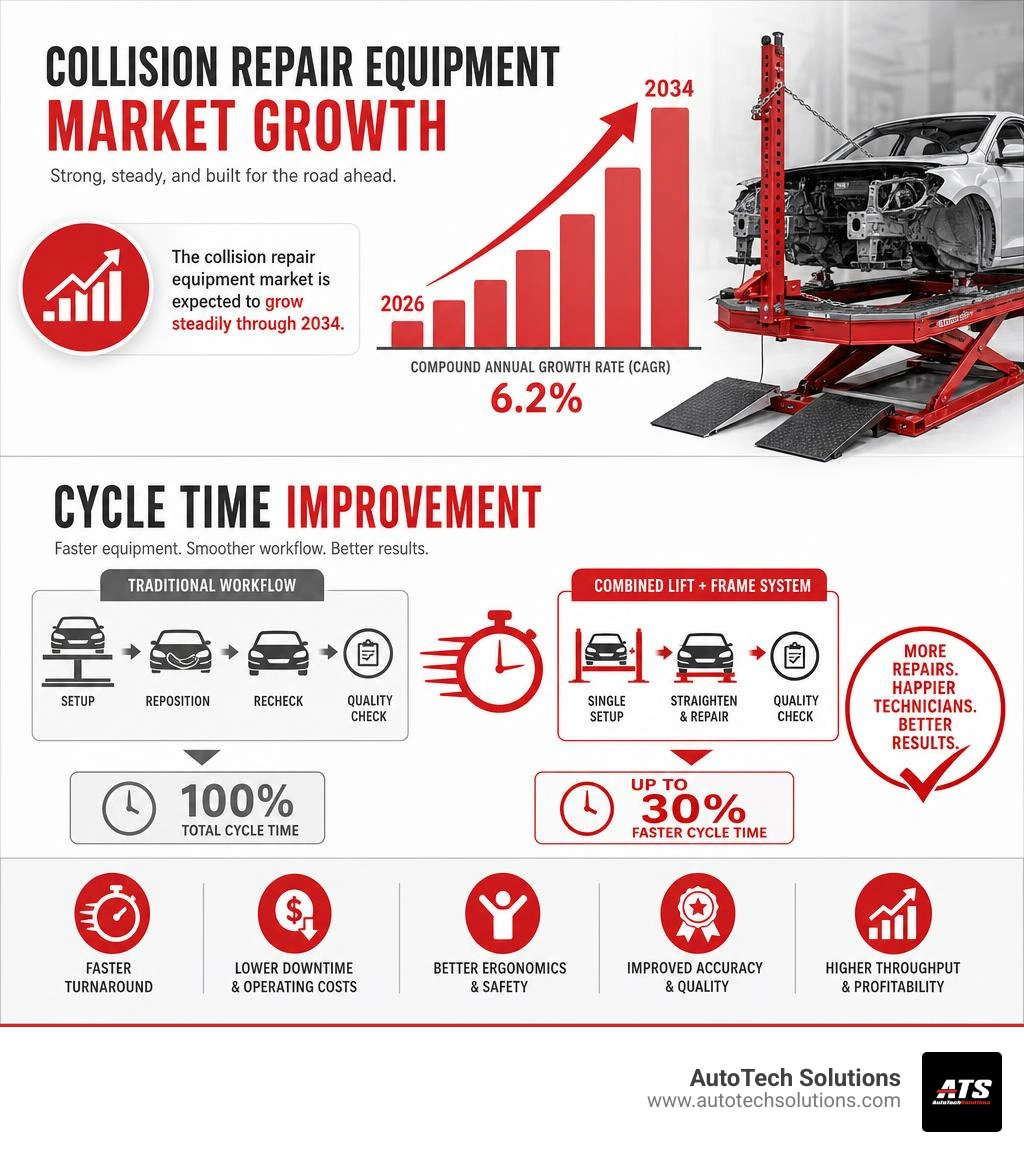
For shop managers and collision center operators, the stakes around this equipment are high. The global collision repair equipment market was valued at roughly $1.8 billion in 2023 and is on track to reach $2.7 billion by 2030. Frame straightening and alignment equipment alone accounts for about 22% of all collision repair equipment sales in North America.
More importantly: shops using advanced frame machines report 18–25% shorter repair cycle times compared to traditional methods. That directly affects throughput, labor efficiency, and revenue per bay.
Yet many shops are still running undersized or mismatched equipment — or haven't fully integrated measuring systems to document repairs accurately. Over 65% of U.S. collision facilities now use computerized measuring systems alongside frame machines, but that also means a significant share are still leaving accuracy and documentation gaps on the table.
This guide covers everything a professional shop decision-maker needs — from understanding how these machines work, to choosing the right specs, to operating safely and getting measurable ROI.
Auto body repair machine vocab to learn:
What an auto body repair machine is and how it works
An auto body repair machine is shop infrastructure designed to hold a damaged structure in a fixed, repeatable position while technicians apply controlled force and verify dimensions. You may hear it called a frame bench, frame rack, repair rack, chassis bench, or structural repair platform.
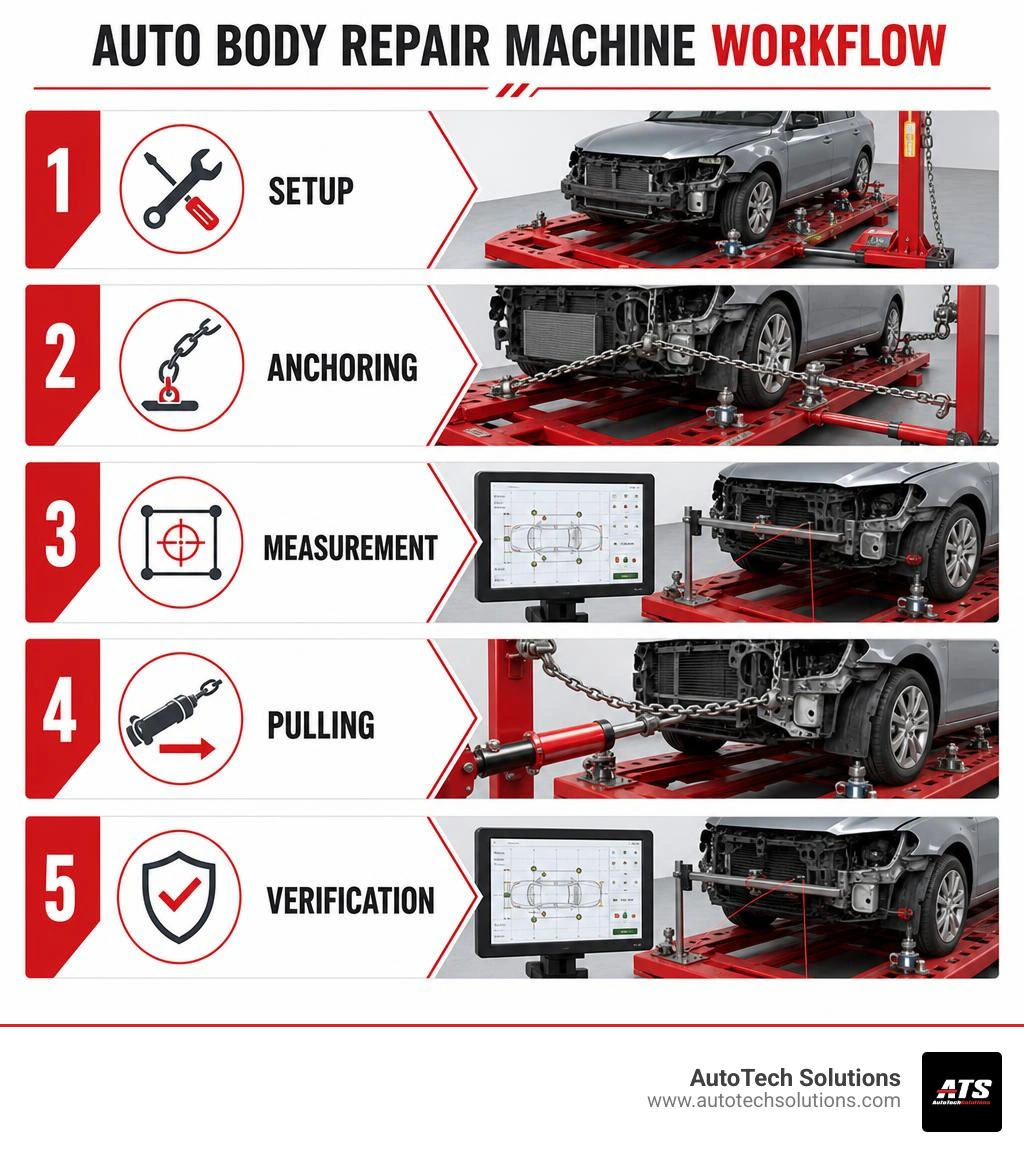
The basic process is simple:
- The structure is positioned on the machine.
- Anchoring equipment secures it to the platform.
- A measuring system records the starting condition.
- Hydraulic towers apply pulling force in the correct direction.
- Technicians remeasure after each controlled correction.
- The final result is documented against repair data or factory reference dimensions.
The key phrase is "controlled force." A professional machine is not just about pulling hard. It is about pulling predictably, safely, and measurably. That is what separates a production repair bay from a "let's see what happens" science project. We like science, but not when it is happening under load in a busy shop.
For a deeper look at the structural repair side of the process, see our guide to automotive frame repair fundamentals.
Core components inside an auto body repair machine

Most professional systems include a combination of the following:
- Platform or deck rack: The rigid base that supports the work area.
- Pull towers: Movable hydraulic towers that apply force from different angles.
- Hydraulic pump and cylinders: The power system behind the pulling operation.
- Clamps and anchoring hardware: Secure the structure so force goes where it should.
- Chains, hooks, and adapters: Connect the pull point to the tower.
- Anchor pots or floor anchors: Used in certain floor-based pulling systems.
- Lift or scissor mechanism: Raises the working height on machines with lifting capability.
- Remote controls: Let technicians adjust lift height or pulling functions more efficiently.
- 360-degree pulling access: Allows towers to work around the platform instead of forcing awkward bay setups.
- Measuring bridge or electronic measuring system: Verifies whether the repair is moving in the right direction.
- Tool carts and storage: Keep clamps, chains, adapters, and measurement accessories organized.
The best machines feel boring in the best possible way: stable, repeatable, and easy to set up. When equipment is awkward, technicians lose minutes. When equipment is unstable, shops risk accuracy and safety.
Step-by-step repair workflow for professional shops
A strong workflow turns the machine into a production system:
- Damage analysis: Identify whether structural correction is required and plan the setup.
- Machine setup: Confirm capacity, platform position, tower placement, and tooling.
- Secure anchoring: Lock the structure to the bench using approved anchoring points and hardware.
- Baseline measurement: Capture pre-pull measurements before force is applied.
- Controlled pulling: Apply hydraulic force in planned increments.
- Incremental verification: Stop, measure, document, and adjust the pull strategy.
- Quality control: Confirm final dimensions and review repair documentation.
- Bay handoff: Move the job to the next process with clean documentation and minimal rework risk.
This workflow protects cycle time because it reduces guessing. Guessing is expensive. It hides inside rework, technician delays, and jobs that sit in the bay while everyone waits for "one more check."
Why computerized measuring systems matter
Computerized measuring systems are now a major part of structural repair. Industry data shows that more than 65% of U.S. collision repair facilities use computerized measuring systems integrated with frame machines for structural work.
Common measuring options include:
- Electronic measuring systems: Fast, data-driven, and documentation-friendly.
- Laser measuring systems: Useful for precision layout and verification.
- Mechanical gauges: Reliable and simple, often used as part of specific workflows.
The biggest advantages are:
- Pre-pull baseline documentation
- Faster confirmation of movement during correction
- Post-repair verification
- Repeatable results across technicians
- Better documentation for shop records and repair file review
A frame machine without measurement is like a tape measure with no numbers. It may look useful, but the confidence level is not where a professional shop needs it to be.
Main types of professional auto body repair machines and when to use each
Not every shop needs the same machine. The right choice depends on repair volume, available floor space, technician workflow, and the type of structural work the shop performs.
| Machine type | Best fit | Strengths | Watch-outs |
|---|---|---|---|
| Frame rack/platform bench | High-volume structural repair | Stable platform, multiple pulling angles, strong anchoring | Requires dedicated bay space |
| Repair bench | Precision structural work | Accurate setup, excellent measurement integration | May require more setup discipline |
| Scissor lift system | Quick access and ergonomic work height | Efficient loading, good bay flexibility | Capacity and deck size must match workload |
| Tilt deck | Shops needing easier loading | Convenient entry and exit | Check tower access and platform rigidity |
| Floor anchor system | Flexible pulling in open bays | Lower equipment footprint, adaptable layouts | Floor integrity and anchor layout are critical |
| Medium/heavy-duty rack | Larger commercial work | Higher capacity and longer decks | Higher cost, more floor space, more installation planning |
Frame racks, benches, and platform systems
Frame racks and platform benches are the backbone of many collision centers. They provide a fixed surface for anchoring and pulling, with deck lengths often selected around the shop's repair mix. Common professional systems may support work areas around 18 feet, while larger systems extend much farther for commercial applications.
When comparing platforms, consider:
- Deck length and width
- Working height
- Pull tower range
- 180-degree versus 360-degree access
- Ceiling clearance
- Floor condition
- Lift access
- Quick repair bay versus heavy repair bay layout
The goal is to avoid bottlenecks. A machine that is too small slows setup. A machine that is oversized for the bay creates traffic problems. A machine that does not match your repair mix becomes a very expensive workbench, and not even a fun one.
For related tooling considerations, see our guide to auto collision repair tools.
Specialty body repair machines beyond frame equipment
An auto body repair machine category can also include equipment beyond the main frame platform. Modern shops often need specialized systems for fastening, measuring, panel handling, and material-specific repair processes.
Examples include:
- Punch and rivet systems
- Dent repair stations
- Panel stands and handling carts
- Measuring carts
- Fastening tools
- Clamp and chain packages
- Dedicated tool boards and storage systems
For example, hydraulic punch-and-rivet equipment can reach force levels around 100 kN, or about 10 tons, depending on the system. That type of capability matters when working with modern high-strength materials and controlled fastening processes. One technical benchmark is this universal punch-and-rivet equipment specification.
Shops should also treat downstream areas as part of the same production ecosystem. Supplies, staging, and finish-area organization all affect throughput. See our guide to auto body paint shop supplies for more on shop readiness.
Matching machine type to shop volume
Before buying, ask practical production questions:
- How many structural jobs do we process per week?
- How often does the machine sit idle?
- Do technicians share one machine across too many bays?
- Is labor availability limiting throughput?
- Do we need faster loading and unloading?
- Is our floor condition ready for the equipment?
- Do we have the right air and electrical supply?
- Are we planning expansion in the next 3 to 5 years?
A lower-volume shop may prioritize flexibility and cost control. A high-volume collision center may need multiple systems, faster setup, integrated measuring, and strong service support. The right answer is not always "buy the biggest." The right answer is "buy the machine your workflow can keep busy."
Choosing the right auto body repair machine: specs that protect uptime

Specs are not just numbers on a brochure. They determine what the machine can safely handle, how fast technicians can work, and how often your shop will need service support.
Key categories include:
- Pulling capacity
- Lift capacity
- Deck dimensions
- Power requirements
- Air requirements
- Hydraulic pressure
- Tower travel
- Pulling radius
- Clamp package
- Measuring compatibility
- Warranty terms
- Replacement parts availability
- Installation requirements
- Training support
Key specifications for an auto body repair machine purchase
Here are the specs we recommend reviewing before purchase:
- Pulling force: Many professional systems advertise 10-ton pulling capability, often listed as 100 kN.
- Lift capacity: A 3-ton lift is commonly listed around 3,000 kg or 6,600 lb.
- Hydraulic pressure: Some systems operate around 70 MPa, or roughly 10,000 PSI.
- Air supply: Many pneumatic or air-over-hydraulic systems require 100-120 PSI, though exact requirements vary.
- Electrical supply: Some machines require 220V power.
- Loading capacity: Certain bench systems list capacities around 7,700 lb.
- Deck length: Around 18 feet is common for many professional collision applications.
- Pull radius: 360-degree pulling improves access and reduces awkward repositioning.
- Tower count: Two towers may improve productivity when multiple pull directions are needed.
- Clamp package: Do not treat clamps as an afterthought. Poor anchoring ruins good equipment.
Also confirm the installed footprint, not just the machine dimensions. The machine may fit the bay, but technicians still need room to move, load equipment, position towers, and work safely.
How to compare manufacturers without brand bias
We recommend comparing manufacturers by measurable criteria, not marketing volume. Loud brochures do not straighten anything.
Look at:
- Platform rigidity and fabrication quality
- Hydraulic reliability
- Control layout and ease of use
- Tower movement and locking design
- Measuring system compatibility
- Installation support
- Warranty terms
- Replacement parts availability
- Training resources
- Distributor and service network
- Calibration and documentation support
For combination lift/frame systems, published technical specifications can be useful benchmarks. For example, this lift/frame combination specification shows the type of data buyers should review, including lift capacity, pulling force, lift height, lifting time, maximum working length, floor-space needs, and machine weight.
The lesson is not to buy by name alone. Buy by fit, uptime support, and documented capability.
Budget, ROI, and shop fit
As of 2026, professional frame equipment commonly ranges from about $9,995 for entry-level systems to $30,000+ for higher-capability professional systems. Heavy-duty truck systems can exceed $100,000.
That sounds like a lot until you compare it to the cost of bottlenecks.
ROI factors include:
- 18-25% reported reduction in repair cycle time with advanced frame machines
- Higher technician productivity
- Less repositioning between bays
- Better measurement documentation
- Reduced rework
- Faster quality control
- Better bay utilization
- Lower downtime when service support is reliable
The cheapest machine is not always the lowest-cost machine. If it slows setup, lacks parts support, or sits down waiting on service, the "savings" can disappear quickly.
10-ton pulling, 3-ton lifting, and combined frame/lift systems
A combined frame/lift system brings structural correction and lifting into one work area. For many shops, that is where the productivity gains get interesting.
Instead of moving the job from analysis to lift to frame machine and back again, the team can perform more steps in one setup. Fewer transfers means fewer delays, fewer alignment checks, and less bay congestion.
How a 10-ton auto body repair machine differs from lighter-duty models
A 10-ton auto body repair machine is typically designed for heavier structural correction than lighter-duty equipment. It may be rated around 100 kN of pulling force, depending on the system.
The differences often include:
- Stronger tower construction
- Higher-rated chains and hardware
- More rigid platform design
- Better anchoring capacity
- More robust hydraulic components
- Improved pressure control
- Greater ability to perform multi-angle pulls
- Higher technician training expectations
More force is not automatically better. A 10-ton system must be paired with proper anchoring, correct tooling, trained technicians, and verified procedures. Pulling capacity is only useful when the entire system can safely manage the load.
How the 3-ton lift function works inside the machine
A 3-ton lift function is commonly rated around 3,000 kg, or about 6,600 lb. In a combined machine, the lift may use a scissor mechanism, ramp platform, or integrated lifting structure to raise the work area.
Published benchmarks for this category include:
- 3,000 kg or 6,600 lb lift capacity
- Lift height around 1.5 m or 4.92 ft
- Lift time around 31 seconds on certain systems
- Remote-controlled hydraulics
- Mechanical locks for safe working height
- Multi-angle access around the platform
In practical shop terms, the lift function helps technicians work at a better height for damage analysis, disassembly, measuring, correction, and assembly access. It also improves ergonomics. Happy backs make happier technicians. Happier technicians tend to stay productive.
Benefits of combining frame straightening with lifting
The biggest benefit is workflow continuity.
A combined machine can help with:
- Single setup from analysis through correction
- Less repositioning
- Faster teardown and reassembly access
- Better under-platform clearance
- Reduced equipment duplication
- Improved floor-space usage
- Less waiting for a separate lift bay
- Faster quality-control checks
- Better technician ergonomics
For shops with limited space in Charlotte, Raleigh, Wade, or Novi facilities, bay consolidation can be especially valuable. If one machine can do the work of two separate pieces of equipment for the right repair mix, it may improve both capital efficiency and throughput.
Operating safely while improving repair accuracy and cycle time
A frame machine is powerful equipment. It deserves a safety program, not a sticky note that says "be careful."
Daily safety checks should include:
- Confirm machine capacity for the job
- Inspect clamps, chains, hooks, and adapters
- Check anchoring before applying force
- Look for hydraulic leaks
- Verify lift locks and safety stops
- Confirm towers are locked before pulling
- Keep hands clear of pinch points
- Monitor pressure limits
- Keep the work area clear
- Use required PPE
- Stop work if anything shifts unexpectedly
- Record issues in the inspection log
For a broader uptime plan, see our guide to collision center equipment maintenance.
Safety considerations for auto body repair machines
The most important safety considerations are:
- Load limits: Never exceed rated lifting, loading, or pulling capacity.
- Anchor verification: Confirm anchoring before every pull.
- Chain inspection: Remove damaged chains or hooks from service.
- Hydraulic leaks: Treat leaks as downtime risks and safety hazards.
- Pinch points: Keep technicians clear of towers, ramps, locks, and moving mechanisms.
- Guarded controls: Prevent accidental activation where possible.
- Lockout/tagout: Use proper lockout procedures during service.
- Floor integrity: Confirm the floor can support the machine and any anchor requirements.
- Emergency stop: Make sure technicians know where it is and that it works.
- Pressure monitoring: Stay within manufacturer limits.
- No overloading: If the job exceeds the machine, the answer is not "just a little more."
Safety also depends on layout. Crowded bays increase risk. Poor lighting increases mistakes. Tool clutter slows response time. A clean frame bay is not about looking fancy for a tour; it helps technicians work safely and accurately.
Maintenance and calibration requirements
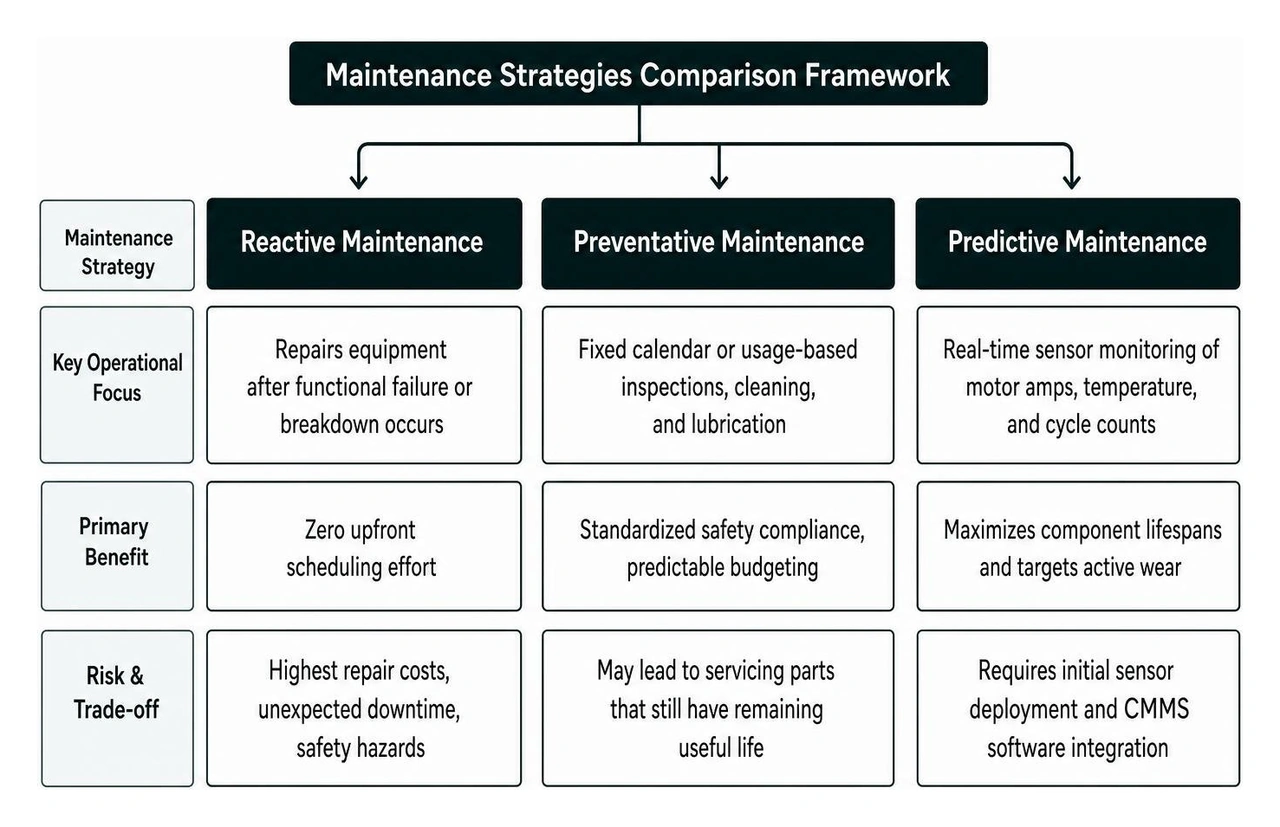
Preventive maintenance keeps the machine available when production needs it. A maintenance plan should cover:
- Hydraulic fluid level and condition
- Hoses and fittings
- Cylinders and seals
- Tower rollers and tracks
- Fasteners and locking points
- Control switches and remotes
- Lift locks and mechanical stops
- Deck level and platform condition
- Clamp wear
- Chain condition
- Measuring system calibration
- Documentation and inspection logs
Measuring equipment deserves special attention. If the frame machine is strong but the measuring system is out of calibration, the shop can still lose time to inaccurate verification.
AutoTech Solutions supports shops with equipment service, installation, and preventative maintenance because uptime is not an accident. It is a plan.
Training practices that raise throughput
Training is where shops turn equipment into profit.
Good training should include:
- Manufacturer operating procedures
- Shop-specific standard operating procedures
- Safe anchoring practices
- Hydraulic pressure awareness
- Measuring system use
- Documentation requirements
- Quality-control checkpoints
- Setup repeatability
- Safety refreshers
- Cross-training between technicians
Industry-recognized training practices, including I-CAR and ASE-aligned skill development, help create consistency. The more repeatable the setup, the faster the bay moves.
For more on professional tool readiness and equipment planning, see our guide to professional body tools.
Conclusion: Turn an auto body repair machine into a shop productivity system
An auto body repair machine is not just a frame rack. It is a production system that affects cycle time, technician efficiency, documentation quality, safety, and bay profitability.
The best results come from matching the machine to your real shop needs:
- Repair volume
- Bay layout
- Floor condition
- Air and electrical supply
- Pulling and lifting requirements
- Measuring integration
- Technician training
- Preventive maintenance
- Service response
AutoTech Solutions helps professional light, heavy, and collision shops plan, install, service, and maintain the equipment that keeps production moving. With support across Michigan to the Carolinas, including Novi, Charlotte, Raleigh, and Wade, we focus on minimizing downtime with expert equipment support and fast repair response.
If your current setup is slowing cycle time, limiting structural repair capacity, or creating service headaches, it may be time to look at the entire system - not just the machine.
Learn more about our service repair and equipment support, or contact AutoTech Solutions to assess your shop's equipment plan before the next bottleneck parks itself in your frame bay.