The Right Auto Mechanic Shop Equipment Keeps Your Bays Running and Revenue Flowing
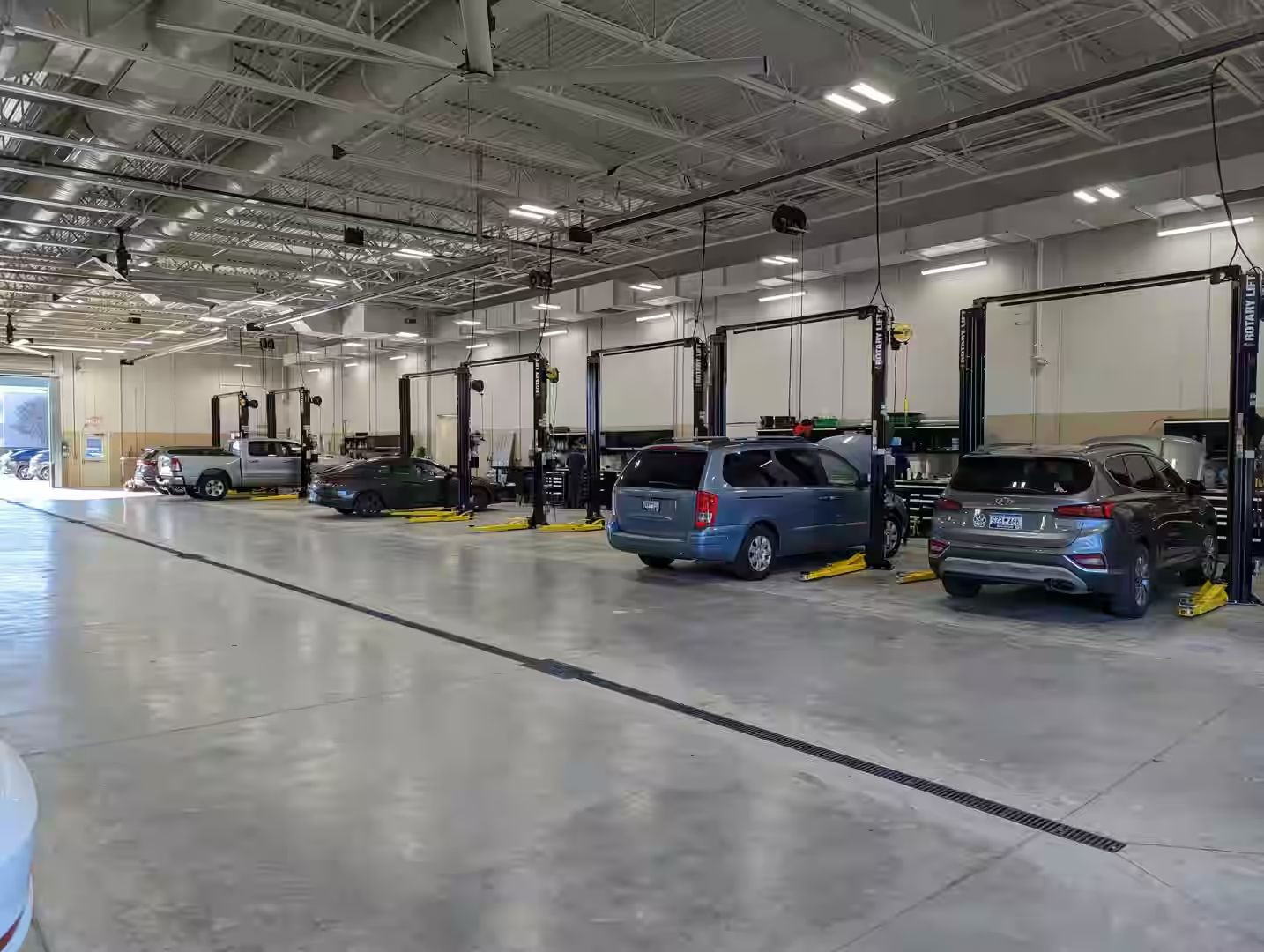
Auto mechanic shop equipment is the backbone of every productive commercial service facility — and choosing the right gear directly impacts technician efficiency, service throughput, and your bottom line.
Here are the essential categories every professional shop needs:
| Equipment Category | Examples |
|---|---|
| Vehicle Lifting Systems | Hydraulic lifts, scissor lifts, rolling bridge jacks, transmission jacks |
| Diagnostic Tools | Scan tablets, bi-directional scan tools, J2534 pass-thru devices |
| Tire Service Equipment | Tire changers, wheel balancers, combo packages |
| Fluid Management Systems | Oil drains, fluid evacuators, brake and coolant flush stations |
| Bay Infrastructure | Shop presses, workbenches, tear-down tables, exhaust extractors |
Getting this mix right isn't just about buying tools. It's about building a system where every bay is safe, every technician is productive, and equipment downtime is minimized.
The difference between a shop that struggles and one that thrives often comes down to infrastructure decisions made before the first vehicle rolls in. The wrong equipment — undersized lifts, slow diagnostic tools, inadequate fluid systems — creates bottlenecks that compound daily.
This guide breaks down every major equipment category, what to look for, and how to match the right specs to your shop's volume and workflow.
The team at AutoTech Solutions has put together this comprehensive resource to help shop owners and facility managers make confident, cost-effective equipment decisions — so let's get into it.

Auto mechanic shop equipment terms you need:
Essential Categories of Commercial Auto Mechanic Shop Equipment
Outfitting a high-volume service shop requires balancing durability, bay dimensions, and labor efficiency. Modern commercial facilities cannot rely on residential-grade gear; professional automotive service requires industrial auto mechanic shop equipment built to sustain continuous operation under demanding conditions. From high-capacity vehicle lifts to advanced diagnostic centers, equipping your facility with the proper tools drives overall productivity and safety across all service bays. For a deeper dive into garage layouts, explore our automotive shop equipment complete guide.

Heavy Lifting Systems and Bay Support Infrastructure
Vehicle lifts are the structural heart of any commercial service bay. Choosing the right lifting system depends on the types of repairs your facility performs most frequently, ceiling clearances, and floor loading specs.
- Two-Post and Four-Post Lifts: Two-post lifts offer unrestricted wheel access for brake, suspension, and driveline maintenance, while four-post lifts provide rapid vehicle drive-on capability and superior stability for wheel alignment and heavy fleet inspections.
- Mid-Rise and Scissor Lifts: Space-saving mid-rise scissor lifts (such as 9,000 lb capacity models) provide an ideal solution for detailing, tire operations, and quick-lube services where ceiling height is limited or clear bay floors are required.
- Rolling Bridge Jacks & High Stands: Rolling bridge jacks (rated at 5,000 lbs or higher) allow technicians to elevate wheels off four-post runways for brake work. To secure raised loads safely, high jack stands and 1-ton to 2-ton tripod stands stabilize heavy vehicles during undercarriage work.
- Transmission Jacks: Heavy-duty driveline removal demands specialized hydraulic support. Telescoping transmission jacks with capacities ranging from 1,000 lbs (1/2 ton) up to 3,000 lbs (1.5 tons) provide precise angle adjustments and stable platform controls needed when dropping commercial transmissions and transaxles.
Choosing certified lifting machinery backed by heavy-gauge steel columns and dual hydraulic cylinders protects technicians while keeping revenue-generating bays open. Investing in professional car lift installation ensures precise concrete anchoring, ANSI/ALI ALCTV safety compliance, and maximum longevity for high-volume service bays. View our catalog of auto garage tools equipment to match lift capacity with your shop's primary vehicle mix.
Advanced Vehicle Diagnostics and Electrical Testing Tools
Modern commercial service bays handle complex vehicle electronics, multiplexed networks, and OEM secure gateways. Rapid, accurate diagnostic scan tools are essential to keep repair jobs moving smoothly from intake to sign-off.
High-performance scan tablets — such as the ADS 625X Diagnostic Scan Tool | Bosch Diagnostics — give technicians enterprise-level testing power. Equipped with open Android operating systems, 10-inch high-definition displays, and up to 14 hours of continuous battery life, these tools integrate full-system color wiring diagrams and OEM repair databases directly into the bay workflow.
Diagnostic capabilities essential for commercial repair facilities include:
- Rapid All-Systems Scanning: Advanced software updates (like ADS X Version 7.0) boost scan speeds up to 4x faster across Asian and European models, completing full fault code (DTC) pre-scans in under 40 seconds on average.
- OEM Secure Gateway (SGW) Access: Authorized bi-directional access to bypass security gateways on Chrysler, FCA/Stellantis, Ford, Nissan, Hyundai, Kia, Honda, Subaru, and Volvo models.
- Bi-Directional Actuation & Reflash: Bi-directional test controls allow technicians to actuate solenoids, pumps, and valves directly from the tablet, while J2534 pass-thru functionality enables factory ECU flash programming using OEM software subscriptions.
Fast pre-repair scanning documents pre-existing issues instantly, protecting your shop's reputation while helping advisors generate precise, complete work orders before work begins.
Tire Service Equipment: Changers, Balancers, and Integrated Combos
Tire service represents one of the highest-margin, continuous revenue streams for commercial auto facilities, dealership service centers, and fleet operators. Commercial tire changers and precision wheel balancers ensure fast turnarounds, flawless tire installations, and long equipment service life. Shop owners considering fleet expansions can evaluate setup options through our automotive equipment sales guide 2026.
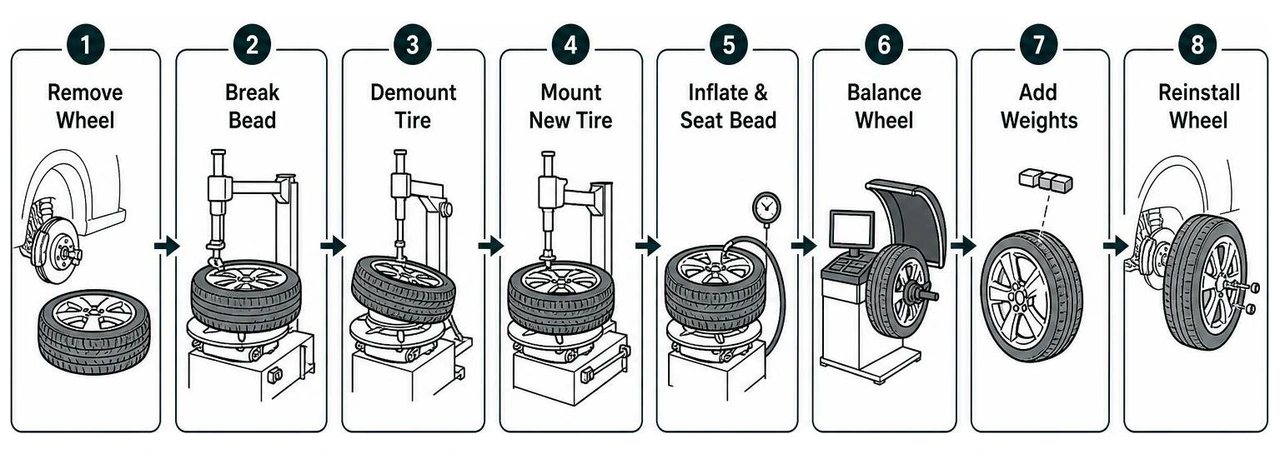
Evaluating Features in Commercial Auto Mechanic Shop Equipment for Tire Demounting
When choosing a commercial tire changer, equipment managers must evaluate wheel clamping capacity, bead breaking force, and helper arm accessories to handle tough modern tires without scratching alloy rims.
- Clamping Ranges: Professional tire changers feature internal clamping capabilities up to 28 or 29 inches and external clamping ranges from 10 to 27 inches, accommodating passenger cars, low-profile performance wheels, and light truck assemblies up to 43 inches in total outer diameter.
- Bead Breaker Systems: Powerful pneumatic bead breakers delivering over 6,600 lbs (30,000 N) of force pop stubborn beads off rims effortlessly. Advanced systems, such as the patented PO system on the Tilt-back tyre changer machine SX228 Pro Duo LNL | Giuliano , automatically retract the bead breaker shovel after penetration to eliminate blade jamming.
- Leverless (Lever-No Lever) Technology & Assist Arms: Dual pneumatic assist arms apply targeted pressure points on stiff run-flat and low-profile sidewalls. Leverless demounting heads eliminate manual pry bars, preventing rim damage and reducing physical strain on technicians.
High-Volume Wheel Balancers and Precision Alignment Machines
Dynamic tire balancing requires high-precision sensor arrays and rapid cycle times to eliminate ride-quality vibrations caused by imbalance or radial run-out.
- Speed and Cycle Times: Commercial automated balancers feature cycle times under 4.5 to 8 seconds. High-end automated systems utilize QuickBal technology to reduce overall cycle time by 30% while incorporating non-contact optical scanning and Smart Sonar for automatic rim width measurement.
- Laser-Spot Positioning: Laser line positioning targeting the 6 o'clock or 12 o'clock positions removes guesswork when sticking adhesive weights onto alloy rims.
- Balancing Accuracy: Precision digital units feature microprocessors delivering balancing accuracy down to ±1 gram (0.035 oz) at 180–210 RPM spin speeds.
For small to mid-sized repair shops or regional service centers (such as commercial facilities operating in Raleigh, NC or servicing fleets near Novi, MI), bundled equipment combos present an attractive investment. High-performance tire changer and wheel balancer bundles combine 110V/120V single-phase convenience, reduced floor space usage, and lower initial capital outlay compared to buying separate standalone machines.
Fluid Management, Evacuation, and Shop Environmental Systems
Managing waste oil, coolant, brake fluid, and engine exhaust fumes safely is essential for regulatory compliance, shop cleanliness, and technician health. Professional fluid transfer equipment converts messy liquid changes into clean, standardized bay procedures. Explore options for consumable fluids and hardware in bulk via our auto repair shop supplies wholesale resource.
Fluid Drain Pans, Evacuators, and Flush Stations
Commercial oil drains and fluid flushing units keep floors free of slip hazards and speed up routine maintenance jobs:
- Upright Portable & Air-Evac Oil Drains: Heavy-duty oil drains (available in 18 to 20-gallon steel or poly capacities) feature height-adjustable funnels with up to 60% larger catch areas to capture oil without splashing. Air-evac models allow technicians to pressurized the reservoir to discharge spent oil directly into waste bulk storage tanks.
- Low-Profile Truck Drains: Servicing buses, delivery vans, and heavy transport vehicles requires low-profile rolling drains (17 to 26-gallon capacities) that slide under low-clearance chassis without needing a vehicle lift.
- Fluid Extractors & Automated Flush Systems: Pneumatic fluid evacuators (featuring transparent sight bowls for fluid inspection) suck fluids directly through dipstick tubes. Single-operator fluid exchangers — such as brake fluid pressure flushers, vacuum coolant changers, and transmission fluid exchangers — reduce flush service times while maintaining sealed, spill-free fluid transfer.
Exhaust Extraction Systems and Bay Ventilation Infrastructure
Running engines inside closed service bays introduces hazardous carbon monoxide and toxic fumes into the shop atmosphere. Installing dedicated exhaust management infrastructure protects technician respiratory health and satisfies workplace air quality standards.
Where fixed overhead ducting is impractical, portable vehicle exhaust extraction systems (powered by 110V 0.75 HP motors) provide a flexible, mobile solution. Equipped with high-temperature flexible hoses and heat-resistant rubber nozzles that clamp directly over vehicle tailpipes, these units discharge fumes safely outside through side doors or wall ports.
Heavy-Duty Bay Infrastructure: Presses, Workbenches, and Safety Support
A well-equipped commercial service bay requires durable infrastructure gear designed to withstand heavy impact, press fits, and teardowns day after day. Selecting long-lasting shop furniture and hydraulic press equipment maximizes workstation ergonomics and floor space safety across high-volume commercial service bays.
| Investment Factor | Manual / Basic Shop Machinery | Automated / Premium Commercial Machinery |
|---|---|---|
| Initial Capital Expenditure | Lower initial cost; ideal for low-volume bays | Higher upfront investment; rapid ROI via labor savings |
| Workflow & Cycle Speed | Manual measurements; higher operator labor per job | Automated scanning, sonar detection, and rapid cycle times |
| Precision & Error Reduction | Relies on technician manual input and calculations | High-precision sensors, automated digital readouts |
| Durability & Duty Cycle | Standard duty cycles; periodic component wear | Heavy-duty steel structures, patented components, extended warranties |
| Technician Fatigue | Higher physical effort required during operation | Assisted pneumatic lift arms, ergonomic touchscreens, wheel lifters |
Ergonomic Workstations, Tear Down Tables, and Surface Storage
To keep rebuilds organized and prevent oil from dripping onto shop floors, heavy workstations are designed with fluid management in mind:
- Heavy-Duty Workbenches & Tool Cabinets: Heavy steel workbenches equipped with lockable tool drawers provide stable work surfaces capable of holding heavy assemblies like engine blocks and cylinder heads.
- Tear-Down Tables with Integrated Parts Washers: Specialty steel tear-down tables feature sloped tops leading into central drain basins. Paired with 3.5-gallon solvent parts washers, fluid flows straight into collection buckets during component teardowns rather than pooling on workbench tops.
- Heavy Parts Handling & Engine Supports: Engine support bars (rated for 1,000+ lbs) hold engine assemblies securely when subframes or transmission mounts are removed. Jumbo car dollies (rated up to 1,500 lbs per dolly) allow non-running or disassembled vehicles to be moved across service bays effortlessly.
- Hydraulic Shop Presses: Industrial 20-ton two-stage hydraulic shop presses handle bearing replacements, bushing press-fits, gear removals, and metal bending smoothly and safely.
Preventive Maintenance and Sizing Specifications for Auto Mechanic Shop Equipment
Investing in top-tier auto mechanic shop equipment is only half the equation; routine preventative maintenance and correct utility installation ensure equipment longevity and operating safety.
- Electrical Infrastructure: Verify power requirements prior to installation. While small tire changers and scan docks run on 120V single-phase outlets, heavy two-post lifts, large air compressors, and high-volume tire equipment may require 220V single-phase or three-phase power connections.
- Compressed Air Systems: Pneumatic tools and tire bead breakers require clean, dry compressed air operating reliably between 116 and 145 PSI (0.8–1.0 MPa). Installing dedicated Filter-Regulator-Lubricator (FRL) units directly on air lines removes moisture and adds oil lubrication to prolong internal pneumatic valves and cylinder life.
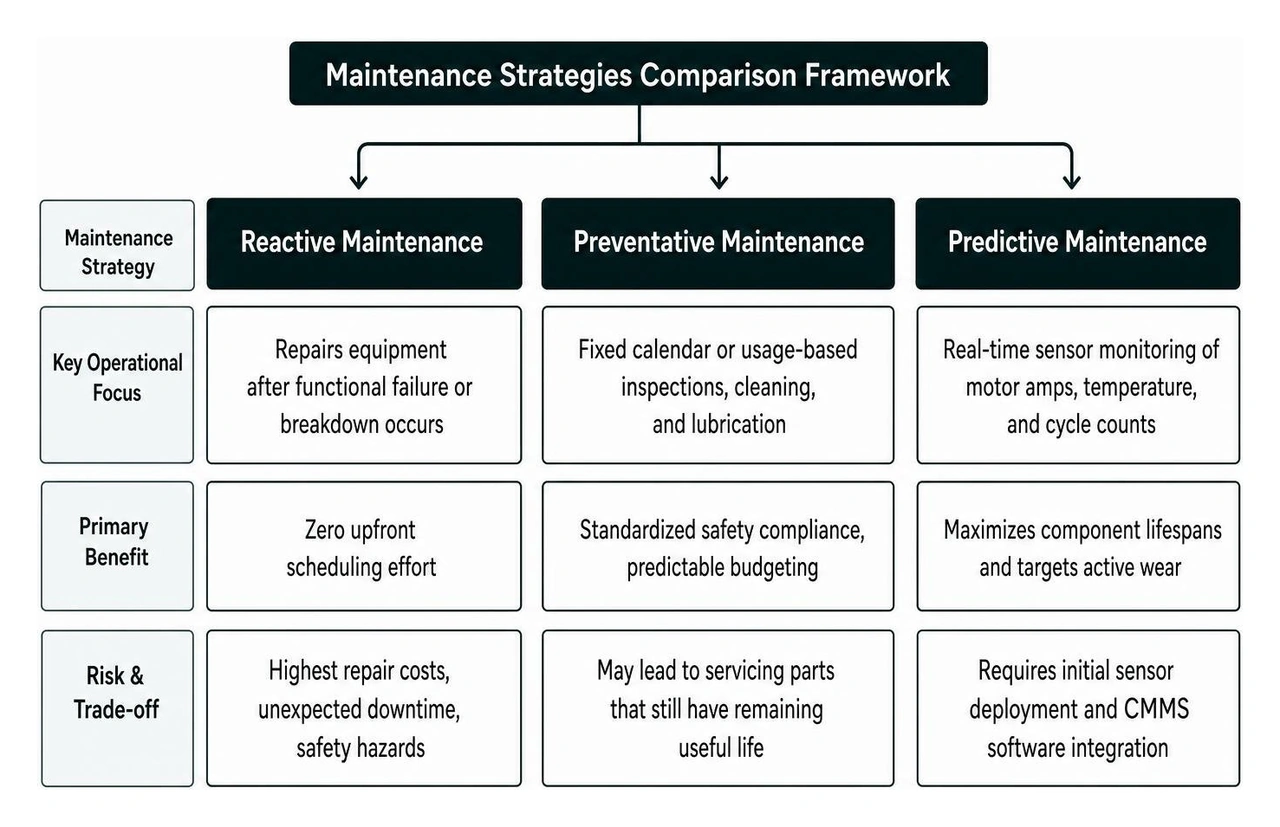
- Preventative Maintenance Routines: Daily checks should include inspecting hydraulic lift cables, checking fluid levels in reservoir tanks, bleeding air line moisture traps, and wiping down turntable clamping jaws. Monthly schedules should involve checking torque on anchor bolts, lubricating guide posts, and verifying wheel balancer shaft calibration.
For detailed maintenance schedules, troubleshooting steps, and emergency field services, refer to our automotive shop equipment repair guide.
Frequently Asked Questions About Commercial Shop Equipment
What essential machinery is required to outfit a commercial service bay?
A standard commercial repair bay requires a reliable vehicle lift (two-post, four-post, or mid-rise scissor lift), high-capacity hydraulic jacks (transmission jacks and tripod stands), an advanced diagnostic scan tool with bi-directional capabilities, an upright or low-profile fluid drain pan, a heavy-duty workbench or tear-down table, and access to compressed air line hookups.
How do integrated tire changer and balancer combos improve shop ROI?
Bundled equipment combos lower initial equipment acquisition costs compared to purchasing separate standalone machines. They save valuable shop floor space and allow service bays to perform complete tire mounting, demounting, dynamic balancing, and weight placement in a single streamlined workspace, increasing labor efficiency and bay turnover.
What power supply and air pressure levels do heavy shop tools require?
Most compact or portable equipment operates on standard 120V single-phase power, while heavy-duty commercial vehicle lifts and industrial equipment often require 220V single-phase or three-phase electrical circuits. Pneumatic shop equipment — such as tire changers, bead breakers, and fluid evacuators — requires dry compressed air supplies regulated between 116 and 145 PSI (0.8–1.0 MPa).
Conclusion
Outfitting your facility with the right auto mechanic shop equipment lays the groundwork for high bay throughput, technician safety, and long-term business growth. From precision diagnostics to heavy vehicle lifts and automated tire changers, investing in commercial-grade infrastructure minimizes bay bottlenecks and delivers reliable performance job after job.
At AutoTech Solutions, we specialize in comprehensive equipment sales, professional car lift installation, bay layout design, and fast preventative maintenance support across our locations in Charlotte, NC, Raleigh, NC, Wade, NC, and Novi, MI. Whether you operate a general automotive repair facility, fleet maintenance garage, or high-volume tire center, our team provides technical guidance and equipment backup to keep your shop running at full capacity.
Ready to upgrade your service bays or schedule equipment maintenance? Visit AutoTech Solutions Equipment Support to consult with our garage machinery specialists today.