Why Professional Automotive Lift Installation Matters for Your Shop

Automotive lift installation near me connects you with local experts who ensure your equipment is safe, code-compliant, and warranty-protected from day one.
Quick Answer: Finding Local Automotive Lift Installation Services
- Verify ALI certification - Only work with installers who follow industry safety standards
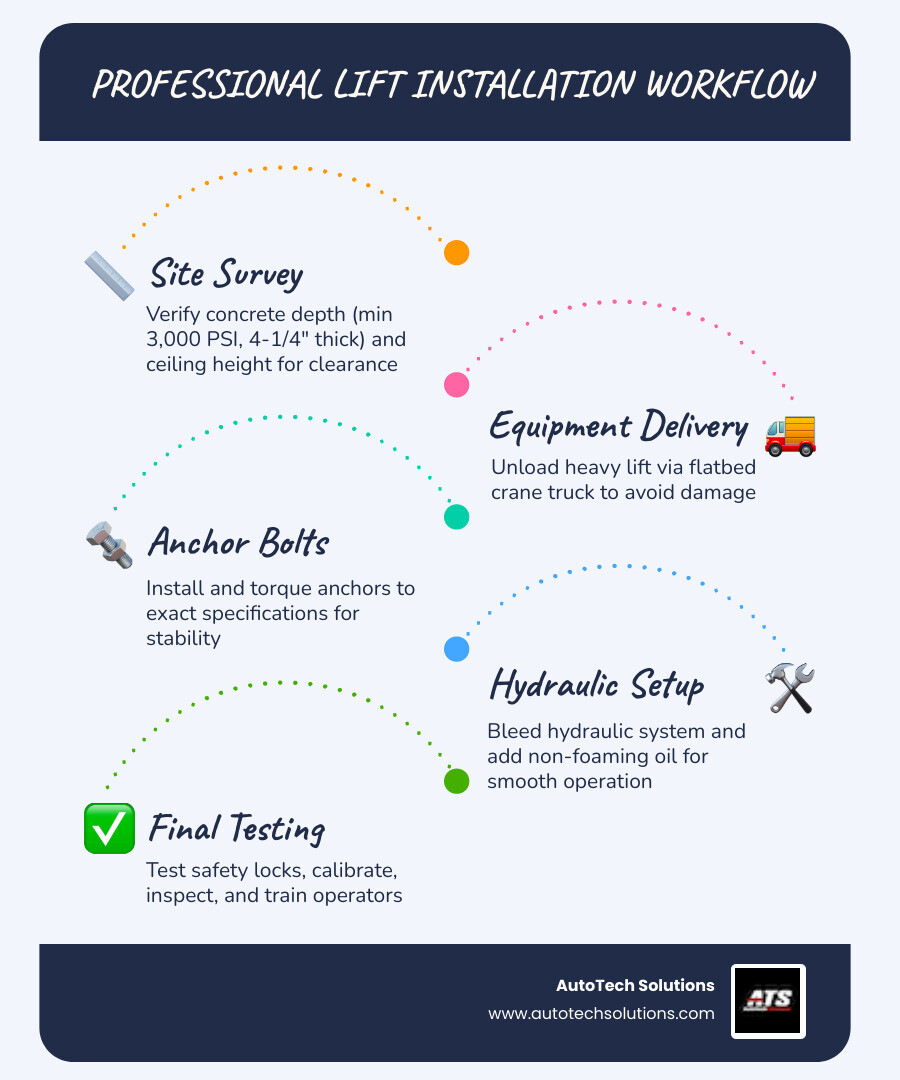
- Check concrete requirements - Your floor needs 3,000 PSI minimum and 4-1/4" to 8" thickness depending on lift capacity
- Get detailed quotes - Professional installation ranges from $595 for basic 2-post lifts to $1,650+ for heavy-duty models
- Confirm what's excluded - Electrical work, air supply lines, hydraulic fluid, and equipment unloading typically cost extra
- Schedule annual inspections - ALI-certified inspections keep your lift compliant and maximize equipment lifespan
Installing an automotive lift isn't like assembling furniture. One installation company with over 40 years of experience reports they're rated number one in customer satisfaction surveys specifically because their factory-trained technicians pay attention to details that matter—anchor torque, hydraulic bleeding, and safety lock synchronization.
The difference between a professional installation and a DIY attempt shows up immediately in warranty coverage. Factory-authorized installers protect your investment while ensuring full manufacturer warranty. They also bring specialized knowledge about concrete specifications, building codes, and equipment that weighs thousands of pounds.
Your facility's productivity depends on equipment that works reliably. Downtime costs money. That's why experienced shops choose installers who combine technical expertise with fast response times for both installation and ongoing maintenance needs.
Critical Site Requirements for Automotive Lift Installation Near Me
Before you even unwrap your new lift, your facility must meet specific physical criteria. At AutoTech Solutions, we’ve seen shops in Charlotte and Raleigh get excited about a purchase only to realize their ceiling is three inches too short or their concrete is too thin.

The most common mistake is assuming "concrete is concrete." In reality, the foundation is the only thing standing between a 10,000-pound truck and your shop floor. Professional installers will perform a site survey to measure ceiling height, check for overhead obstructions (like heater vents or garage door openers), and verify that your bay width allows for proper vehicle door opening and technician movement. For more information on how we handle these logistics, check out our installation and upfit services.
Concrete Specifications and Foundation Integrity
The "backbone" of any automotive lift installation near me is the concrete. You cannot install a heavy-duty lift on asphalt or a cracked residential driveway. Industry standards generally require a minimum of 3,000 PSI (pounds per square inch) concrete. However, the thickness requirements scale dramatically with the lift’s capacity:
| Lift Capacity | Minimum Concrete Thickness | Minimum PSI |
|---|---|---|
| 7,000 – 10,000 lbs (2-Post) | 4-1/4" | 3,000 |
| 12,000 lbs (2-Post) | 6-1/2" | 3,000 |
| 15,000 – 18,000 lbs (2-Post) | 8" | 3,000 |
| 12,000 – 18,000 lbs (4-Post) | 4-1/4" | 2,500 |
Beyond thickness, we must inspect for "post-tension" slabs. If you drill into a post-tension cable, you could compromise the entire building's structural integrity—not to mention the safety risk to the installer. We also look for expansion seams and cracks; anchors must be placed a specific distance away from any edge or seam to prevent the concrete from "spalling" or breaking under the lateral load of a 2-post lift. To ensure your shop meets the highest benchmarks, you can learn more about industry safety standards through the Automotive Lift Institute (ALI).
Space and Ceiling Height Considerations
Ceiling height is often the "silent killer" of lift dreams. A standard clearfloor 2-post lift often requires at least 12 to 14 feet of clearance. If you have a low ceiling, you might need a "floorplate" model, where the hydraulic lines run across the floor under a metal cover.
You also need to consider:
- Overall Height: Does the top of the lift clear the rafters?
- Vehicle Clearance: When the lift is at full height, will the roof of a tall SUV hit the ceiling?
- Symmetric vs. Asymmetric: Symmetric lifts center the car between the posts, while asymmetric lifts angle the posts and use different arm lengths to allow the car doors to open wider.
At AutoTech Solutions, we help you navigate these choices to find the perfect fit for your specific bay dimensions. You can view our full range of lift products to see which models match your space.
Professional Installation Costs and Exclusions
One of the most frequent questions we hear is, "How much is this going to cost?" While it’s tempting to look for the cheapest labor, you are paying for the precision that keeps your technicians safe.
Professional installation pricing is usually tiered based on the weight and complexity of the lift. Heavier lifts require more manpower, larger anchors, and more time for leveling. Furthermore, if your equipment is down, you aren't making money. That is why we emphasize service and repair support to keep your shop running long after the initial install.
Factors Affecting Automotive Lift Installation Near Me Pricing
When searching for automotive lift installation near me, you’ll find that prices vary by region and lift type. Based on industry data, here is what you can generally expect for labor:
- Two-Post Lifts (9k–10k lbs): $595.00 – $850.00
- Two-Post Lifts (12k–18k lbs): $895.00 – $1,050.00
- Four-Post Lifts (9k lbs): $595.00 – $850.00
- Four-Post Lifts (14k–27k lbs): $750.00 – $1,350.00
- Scissor Alignment Lifts: $1,250.00 – $1,500.00
Factors that can drive these prices up include difficult site accessibility (e.g., a basement or a tight corner) and whether the installer needs to provide specialized unloading equipment. To see the level of engineering that goes into these machines, you can watch how professional lifts are engineered.
Services Typically Not Included in Quotes
It is a common "gotcha" in the industry: the installation quote often covers only the physical assembly and anchoring of the lift. At AutoTech Solutions, we believe in transparency. In most cases, the following are handled separately:
- Electrical Wiring: Most lifts require a 220V single-phase circuit. This must be performed by a licensed electrician to meet local building codes.
- Air Supply Lines: If you are installing a 4-post lift with pneumatic locks, you’ll need air lines run to the lift.
- Hydraulic Fluid: Due to DOT hazardous material laws, hydraulic fluid is rarely shipped with the lift. You’ll need to purchase 10-weight non-foaming hydraulic oil or Dexron-III ATF separately.
- Unloading: Lifts arrive on long flatbed trailers. If you don't have a forklift capable of handling 3,000+ lbs, you may need to pay for a "roll-off" or crane service.
For a comprehensive look at what a "turn-key" package looks like, visit our detailed installation and upfit services page.
Why Professional Installation Outperforms DIY
We get it—the DIY spirit is strong in the automotive world. But when you’re standing under a 6,000-pound vehicle, "close enough" isn't good enough. Professional installation is about liability reduction and precision.
A professional installer doesn't just bolt the lift down; they use high-grade shims to ensure the posts are perfectly plumb. If a 2-post lift is even slightly out of alignment, the carriages will bind, causing premature wear on the expensive poly-sliders and potentially leads to a catastrophic failure. We dive deeper into this in our article on the importance of professional automotive lift installation.
Ensuring Safety with Certified Automotive Lift Installation Near Me
Safety isn't a single step; it’s a checklist. Our technicians at AutoTech Solutions focus on:
- Anchor Torque: Ensuring every bolt is torqued to the manufacturer’s exact foot-pound specifications.
- Synchronization: Adjusting the cables so that both sides of the lift rise and click into the safety locks at the exact same time.
- Hydraulic Bleeding: Removing air from the lines to prevent "spongy" operation or uneven lifting.
- Weight Testing: Confirming the lift holds its rated capacity without deflection.
Post-Installation Maintenance and Compliance
Once the lift is up, the clock starts on its maintenance lifecycle. In a busy shop in Novi or Wade, a lift might go up and down twenty times a day. That’s hundreds of cycles a month.
Regular maintenance isn't just a "good idea"—it’s often a legal requirement for commercial shops. This includes lubricating the columns, checking cable tension, and inspecting hydraulic hoses for leaks. AutoTech Solutions provides ongoing equipment support to handle these tasks so you can focus on fixing cars.
The Importance of Annual ALI Inspections
The Automotive Lift Institute (ALI) recommends—and many insurance providers require—that every lift be inspected annually by a qualified inspector. These "ALI 360" inspections look for:
- Structural cracks in welds.
- Fraying or "bird-caging" of synchronization cables.
- Proper operation of safety locks and overhead shut-off bars.
- Compliance with OSHA and local safety workshops.
By catching a frayed cable during an inspection, you avoid a week of downtime (and a potential injury) later. Explore our service offerings to see how we can help you stay compliant.
Frequently Asked Questions about Car Lift Installation
Does my lift come with anchor bolts and hydraulic fluid?
Most reputable brands ship with the necessary concrete anchors. However, they almost never include hydraulic fluid. This is due to DOT regulations regarding the shipping of flammable or hazardous liquids. You will typically need 3 to 5 gallons of 10-weight, non-foaming hydraulic oil per lift.
Can I install a lift on a cracked or sloped floor?
Small slopes can often be managed with professional shimming. However, if the concrete has major structural cracks or is "soft" (spalling), it is unsafe to anchor a lift. You should never install a lift over an expansion joint. If you’re unsure, an architect or a professional from AutoTech Solutions can perform a "slab test" to verify thickness and PSI.
What electrical and air requirements are needed?
Most standard 2-post and 4-post lifts require a 208-230V single-phase power supply. For heavy-duty 4-post alignment lifts, you will also need an air supply of approximately 115 PSI at 15 CFM to operate the pneumatic safety locks and rolling jacks.
Conclusion
Choosing the right partner for automotive lift installation near me is the most important decision you’ll make for your shop’s safety and efficiency. At AutoTech Solutions, we pride ourselves on being a one-stop-shop that understands the unique needs of light, heavy, and collision shops.
From our locations in Charlotte, Raleigh, and Wade, NC, all the way up to Novi, MI, we are dedicated to minimizing your downtime. Whether you need a brand-new installation, a facility buildout, or an emergency repair, our expert support and fast response times ensure your shop stays productive. Don't leave your safety to chance—schedule your professional installation today and experience the AutoTech Solutions difference.