Commercial Garage Equipment That Improves Shop Throughput
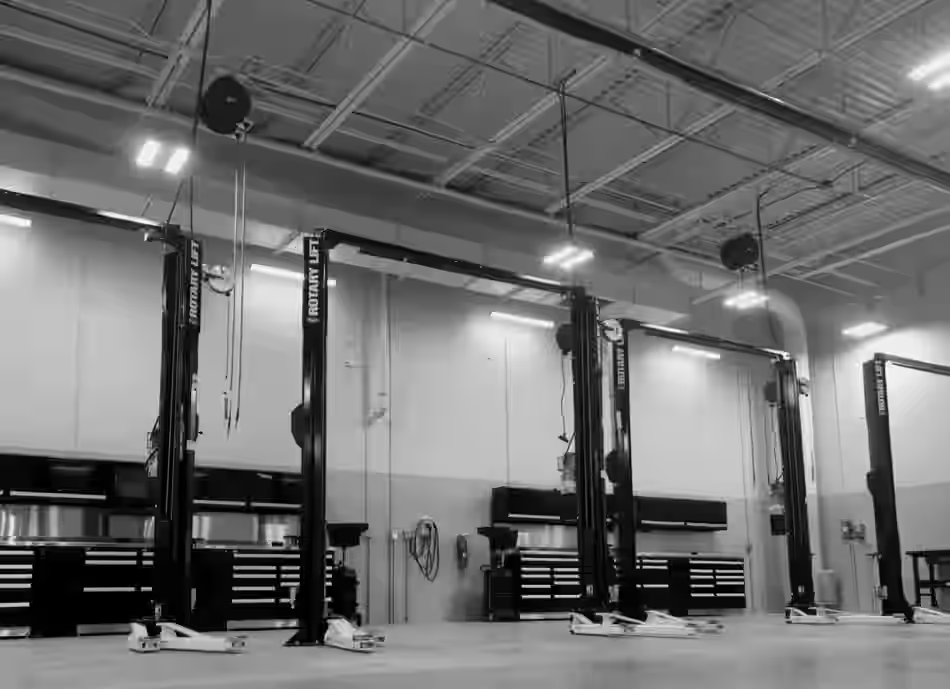
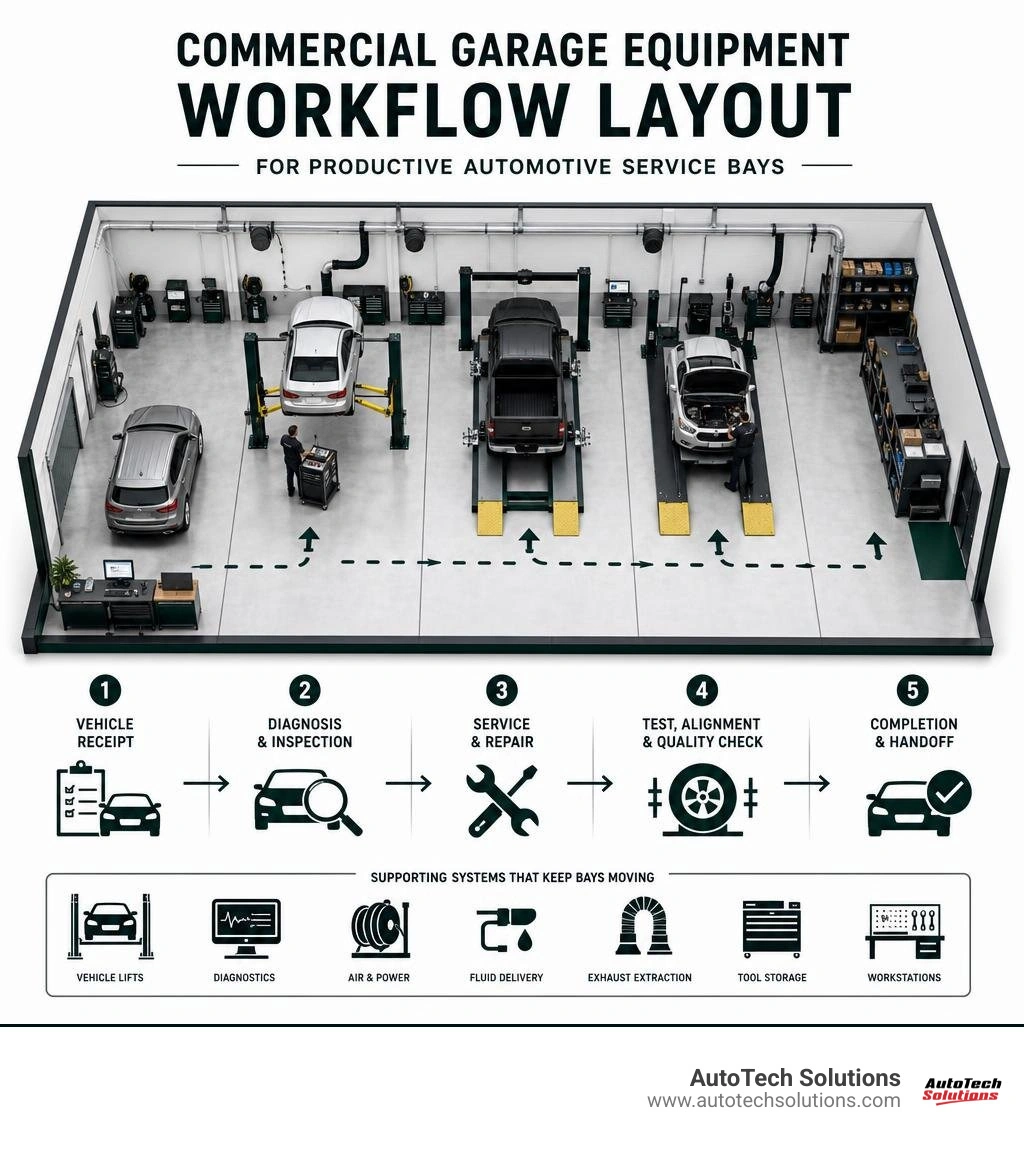
To outfit a professional automotive facility, start with commercial garage equipment matched to your heaviest service demand, bay layout, utility capacity, and daily workflow. A productive equipment plan typically includes certified vehicle lifts, diagnostic systems, compressed-air and fluid-delivery infrastructure, exhaust extraction, durable workstations, and organized tool storage.
The goal is not simply to fill bays. It is to reduce setup time, keep technicians moving, protect uptime, and give the shop capacity to handle the work it accepts. Fast-rise lifts, rolling bridge jacks, alignment-ready runways, and well-placed air and power connections can turn a single-purpose bay into a more flexible service station.
For fleet, collision, and high-volume maintenance operations, equipment decisions also affect compliance, installation costs, preventive maintenance needs, and long-term return on investment. This guide compares the core systems that support safer, faster, more reliable shop operations.
Prepared by AutoTech Solutions Staff, with practical guidance for planning, installing, and maintaining professional service-bay equipment.
Essential Commercial Garage Equipment Categories for Modern Service Bays
Equipping a modern high-volume service facility requires a cohesive strategy that connects structural utility systems to front-line service assets. When bay architecture integrates smoothly with overhead systems and heavy machinery, technicians spend less time hunting for resources and more time turning wrenches. Our comprehensive Automotive Shop Equipment Complete Guide explores how balancing primary lifting systems with supporting shop infrastructure drives sustained profitability.
Modern service facilities rely on five foundational equipment categories:
- Primary Vehicle Lifting Systems: Two-post, four-post, and heavy-duty in-ground lifts that establish the core capability of each bay.
- Dedicated Exhaust Extraction: Centralized tubing, high-temperature hose reels, and source-capture blowers that pull carbon monoxide and particulate matter directly from tailpipes to ensure code compliance.
- Overhead Fluid and Power Delivery: Retractable reels delivering fresh motor oils, transmission fluids, coolants, compressed air, and electricity directly over the engine bay.
- Heavy-Duty Mobile Shop Equipment: Industrial underhoist support stands, heavy-capacity transmission jacks, mobile oil drains, and low-profile floor jacks rated for continuous commercial cycles.
- Integrated Diagnostic and Wheel Service Equipment: Advanced alignment racks, wheel balancers, heavy tire changers, and diagnostic scanning consoles integrated directly into the bay workflow.
Heavy-Duty Commercial Garage Equipment for Fleet and Truck Service
Fleet maintenance shops and municipal garages manage extreme vehicle mass, elongated wheelbases, and unpredictable axle distributions. Servicing utility trucks, buses, and commercial chassis requires specialized Heavy Duty Shop Equipment capable of supporting severe working loads without deflection or structural strain.
When selecting machinery for severe-duty cycles, lifting systems such as the BendPak HDS-27 Heavy-Duty Four-Post Lift - 5175162 demonstrate the engineering required for continuous fleet operations. Rated for 27,000 lbs (13,500 lbs per axle), this class of machinery utilizes dual-hub cable sheaves, 1/2-inch aircraft-grade galvanized cables, large 12" x 12" structural base plates, and internal grease nipples for automated lubrication across critical wear points. Accommodating extended chassis lengths prevents structural overhang hazards and ensures that technicians can navigate beneath the entire drivetrain safely.

Shop Infrastructure and Overhead Fluid Management
A common bottleneck in commercial garages is physical congestion caused by portable oil caddies, loose hoses, and trailing electrical cords. Implementing centralized fluid delivery systems frees up valuable floor space and prevents costly slip-and-fall incidents.
Strategic Shop Design and Consulting positions overhead reel banks at central structural columns or ceiling trusses between bay pairs. These reels supply high-pressure grease, multiple oil viscosities, coolant, washer fluid, and compressed air right where the technician stands. Combining these supply reels with dedicated bulk-oil containment, air-operated diaphragm pumps, and sealed fluid evacuation systems ensures that routine fluid services occur rapidly without fluid loss or cross-contamination.
Selecting Commercial Vehicle Lifts: Two-Post, Four-Post, and In-Ground Systems
Choosing the right lift design directly dictates bay turnaround times and the scope of work your technicians can execute. Every design offers specific mechanical trade-offs between unobstructed underbody access, drive-on speed, and physical footprint. Proper Commercial Garage Equipment Planning ensures you select the correct lift architecture for your service mix.
| Lift Category | Standard Capacity Range | Ideal Application | Setup Speed | Underbody Access Level |
|---|---|---|---|---|
| Two-Post Symmetric / Asymmetric | 9,000 – 18,000 lbs | General repair, brakes, suspension, powertrain drops | Moderate (Requires arm spotting) | Maximum (Complete wheels-free access) |
| Four-Post Runway | 9,000 – 40,000+ lbs | Quick lube, inspections, wheel alignments, heavy fleet | Fast (Drive-on, immediate lift) | Moderate (Runways present; requires rolling jacks) |
| In-Ground Piston / Scissor | 10,000 – 140,000 lbs | Quick service, fleet maintenance, severe-duty municipal | Fast to Moderate | High to Maximum (Clean floor profile when lowered) |
Evaluating Capacity, Rise Time, and Footprint
Selecting commercial lifts requires careful evaluation of rise speeds, total rise height, and clear bay clearances. High-throughput facilities benefit significantly from advanced power units that cut rise cycles down from 60–75 seconds to under 35 seconds. Over thousands of annual service orders, shaving 40 seconds per lift cycle directly expands billable bay capacity.
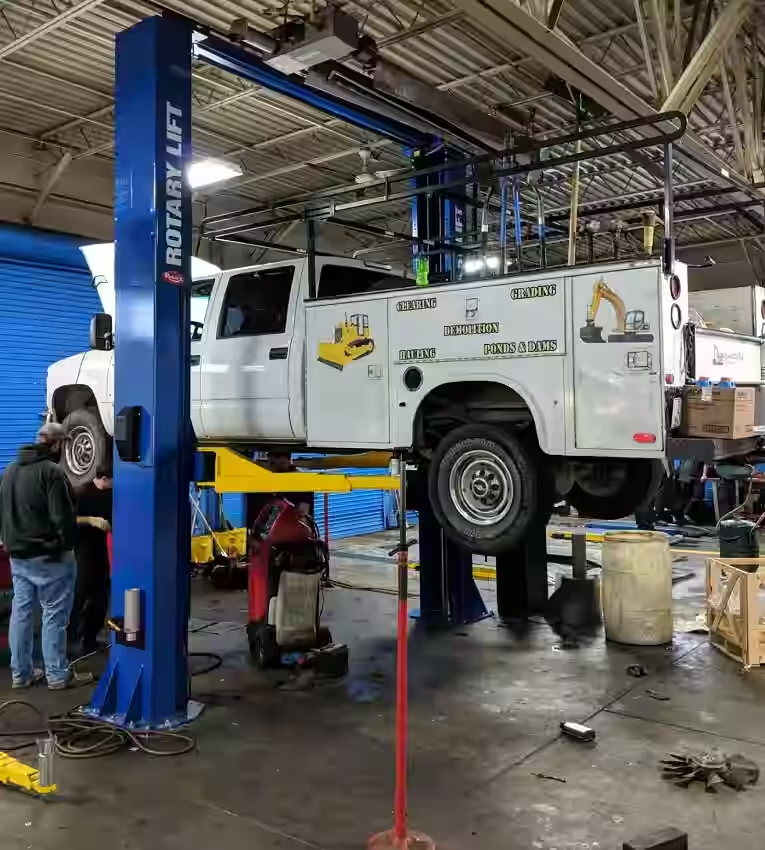
Runway length and overhead rise clearances must also align with high-roof commercial vans and utility vehicles. Versatile standard-duty systems like the BendPak HD-9XW Four-Post Lift - 5175863 provide an 82-inch rise height and extra-wide clearances to accommodate taller commercial vans and light-duty trucks while maintaining an approachable shop footprint.
Critical Safety Certifications and ANSI/ALI Standards
Commercial garage safety hinges on verified structural engineering. Never install uncertified lifting systems in a commercial environment. The primary benchmark for lift safety in North America is ANSI/ALI ALCTV-2011 (Automotive Lift Construction, Testing, and Validation), certified through the Automotive Lift Institute (ALI) and independent testing bodies such as ETL.
Critical safety features to look for on commercial-grade hoists include:
- Mechanical Multi-Position Safety Locks: Gravity-engaged or spring-loaded mechanical locks on every column that hold the load mechanically, independent of hydraulic pressure.
- Slack-Cable Safety Latches: Secondary backup lock systems that instantly arrest runway movement if primary cable tension is lost.
- Hydraulic Velocity Fuses / Flow Restrictors: Integrated valving that limits descent speeds to a controlled crawl even in the event of a catastrophic hydraulic hose rupture.
- Pneumatic or Industrial Lock Releases: Single-point push-button air releases that disengage column locks simultaneously, eliminating manual multi-column release procedures.
Facility Integration and Commercial Garage Equipment Installation Requirements
The performance and safety of heavy machinery depend directly on the structural slab and utility infrastructure beneath it. Reviewing our Equipment Installation Guide 2026 prior to pouring concrete or mounting equipment prevents expensive structural retrofits and project delays.
Concrete Slab Integrity and Foundation Engineering
Commercial vehicle hoists transfer intense dynamic and static loads into narrow concrete footprints. Two-post lifts generate massive tensile pull-out forces on the rear anchors and high compression forces on the front edge of the base plate.
Key concrete specifications for commercial lift installations include:
- Compressive Strength: Minimum 3,000 PSI cured concrete for light-duty lifts (up to 10,000 lbs), increasing to 4,000–5,000 PSI for high-tonnage four-post and heavy two-post systems.
- Slab Thickness: Minimum 4 to 4.5 inches for standard commercial lifts, with heavy-duty commercial lifts requiring 6 to 8 inches or dedicated reinforced concrete footers.
- Edge Distance and Anchor Embedment: Heavy-duty mechanical wedge anchors require core-drilled holes set away from expansion seams and slab edges to prevent cracking or anchor failure under load.
High-Volume Pneumatic and Electrical Specifications
Commercial service equipment places steady demands on facility air and power delivery networks. Heavy four-post pneumatic safety locks, tire equipment, and air tools require a clean, dry, high-volume air supply:
- Pneumatic Infrastructure: Main trunk air lines should maintain 90–125 PSI, with dedicated Filter-Regulator-Lubricator (FRL) units at each bay drop to capture condensation and protect pneumatic valves. Lifts with air-lock releases typically require a clean air feed of at least 30 to 60 PSI at 3 to 5 CFM.
- Electrical Capacity: Standard light commercial lifts operate on 208–230V single-phase power, while heavy fleet systems and continuous-duty rotary screw compressors demand 208–460V 3-phase circuits. Dedicated breakers prevent nuisance tripping during initial motor startup torque spikes.
Maximizing Productivity with Commercial Lift Accessories and Storage
Equipping a bay with a base lift is only the starting point. Integrating purposeful accessories and high-durability storage systems transforms a basic hoist into a comprehensive service center, drastically lowering overall cycle time per vehicle. Investing in structured Preventative Maintenance Programs ensures these critical mechanical and pneumatic accessories remain in peak operating condition.
Rolling Bridge Jacks and Wheel Alignment Packages
While four-post lifts offer rapid drive-on positioning, performing brake, tire, suspension, and hub maintenance requires getting the wheels off the runways. Pneumatic/hydraulic rolling bridge jacks ride inside the lift runway channels, allowing technicians to raise the front, rear, or entire vehicle off the runways safely without transferring the chassis to a separate two-post bay.
For shops expanding into high-margin wheel service, outfitting four-post runway lifts with integrated slip plates, front turnplate pockets, and precision runway leveling kits creates a dedicated alignment bay. Adding laser spotting kits ensures technicians center long-wheelbase vehicles on the runways on the very first try, eliminating awkward repositioning.
Industrial Tool Storage and High-Capacity Workstations
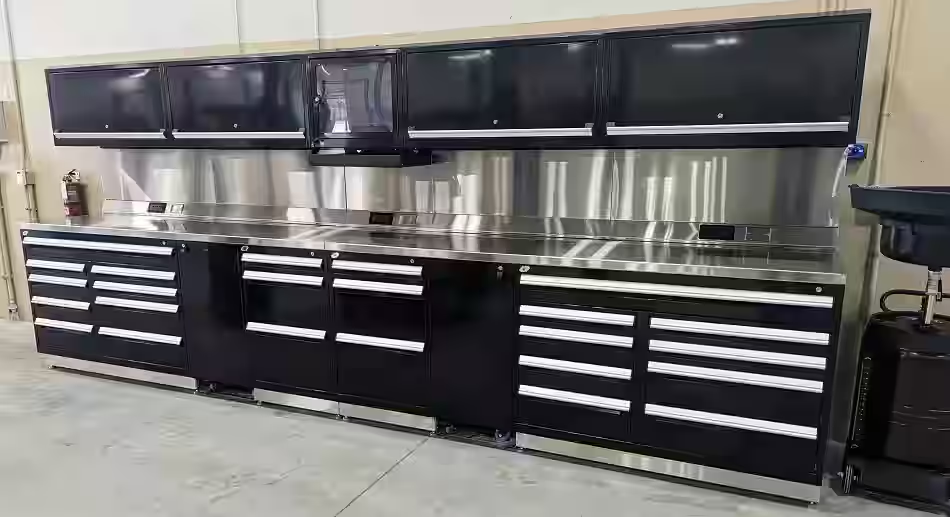
Consumer-grade toolboxes quickly buckle, bind, and fail when exposed to the daily punishment of a multi-shift commercial auto facility. Professional facilities require industrial steel workstations built for continuous commercial abuse.
Key differences in commercial-grade shop cabinetry include:
- Heavy-Gauge Welded Steel: Cabinets fabricated from 14- to 18-gauge welded steel chassis that resist structural racking under massive tool payloads.
- High-Capacity Ball-Bearing Drawer Slides: Heavy-duty slides rated for 200 to 450 lbs per drawer, equipped with full-extension hardware and positive latching mechanisms.
- Chemical-Resistant Work Surfaces: Thick stainless steel, heavy-gauge steel with durable powder coatings, or impact-resistant butcher block tops that withstand heavy impacts, solvents, and oil saturation.
- Mobile Work Tables and Support Stands: Heavy-gauge rolling tool tables rated for 100+ lbs allow technicians to keep active hardware, specialty tools, and fluids directly beside the vehicle wheel wells, eliminating wasted steps across the bay.
Frequently Asked Questions About Commercial Garage Equipment
How thick must shop concrete be to install heavy-duty commercial lifts?
Standard automotive lifts (up to 10,000–12,000 lbs capacity) generally require a minimum 4-inch to 4.5-inch continuous slab of 3,000 PSI cured concrete. Heavy-duty commercial lifts (ranging from 15,000 to 40,000+ lbs capacity) require a 6-inch to 8-inch reinforced concrete slab rated at 4,000 PSI or deeper engineered concrete footers to support the high column anchor tension and floor loading.
What is the return on investment for fast-rise commercial lift systems?
Fast-rise lift systems equipped with high-output motors or specialized hydraulic systems can reduce full rise times from 65–75 seconds down to approximately 35 seconds. In a busy shop servicing 15 to 20 vehicles per bay daily, saving 60 to 80 seconds per complete cycle adds up to dozens of recovered labor hours annually per technician. This extra time translates into increased billable hours and faster vehicle turnaround times.
How often should commercial garage lifts undergo safety inspections?
Commercial garage lifts must receive a comprehensive annual inspection by a certified automotive lift inspector in accordance with ANSI/ALI ALOIM (Standard for Automotive Lifts – Operation, Inspection, and Maintenance) guidelines. Technicians should also perform daily pre-operational visual checks on safety locks, cables, hydraulic hoses, and anchor bolts, complemented by monthly internal preventative maintenance reviews.
Conclusion
Outfitting an automotive service facility with high-performance commercial garage equipment is a strategic investment in daily workflow, technician safety, and shop capacity. Matching lift capacities, overhead fluid systems, and durable shop storage to your actual service volume minimizes operational bottlenecks and maximizes bay revenue.
At AutoTech Solutions, we deliver end-to-end equipment sales, turnkey installation, preventive maintenance, and rapid repair support across Michigan to the Carolinas. Whether you are expanding a dealer service department, upgrading a fleet maintenance shop, or planning a complete facility buildout, our factory-trained specialists ensure your equipment operates at peak performance with minimal downtime.
Explore our comprehensive Installations Upfits Facility Buildouts services to discover how we can engineer, equip, and support your commercial service bays for maximum throughput.