Why Your Commercial Garage Needs Certified Venting
Securing the right exhaust extraction system approvals is the single most important step to keeping your commercial garage safe, compliant, and open for business.
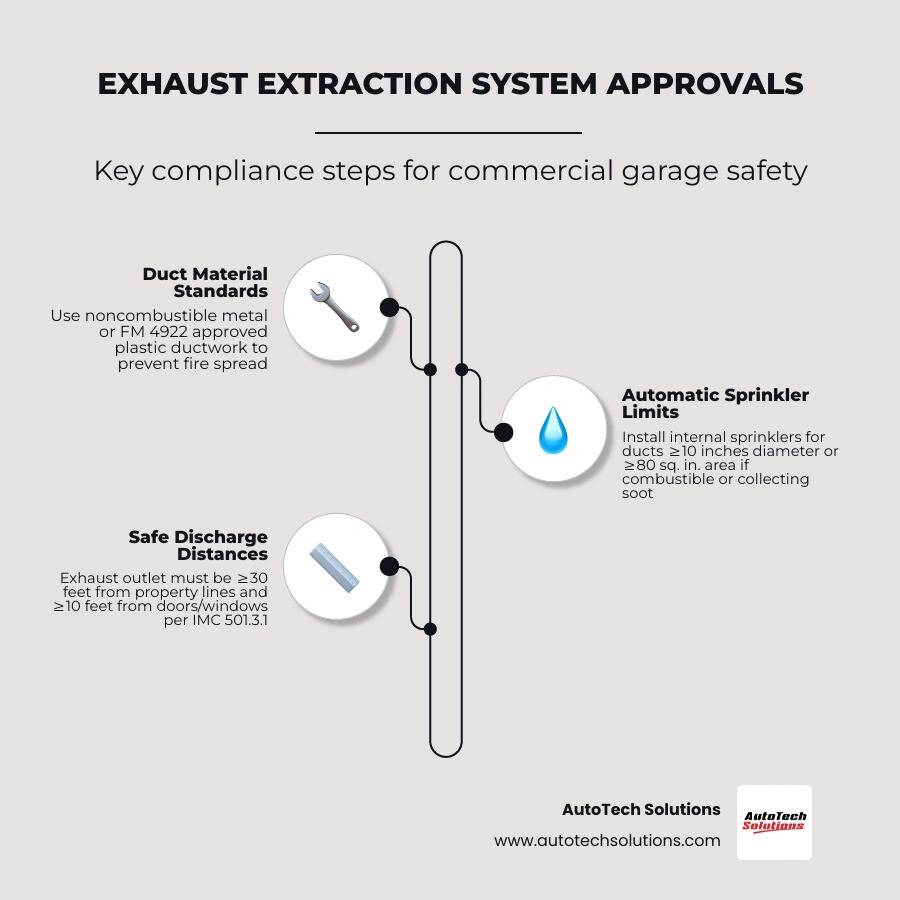
To help you secure these approvals quickly, here is a checklist of the core safety and code requirements your system must meet:
- Duct Material Standards: Use noncombustible metal or FM 4922 approved plastic ductwork to prevent the rapid spread of fire.
- Automatic Sprinkler Limits: If your ducts are made of combustible materials or collect soot, you must install internal sprinklers if the duct diameter is 10 inches or larger (or has a cross-sectional area of 80 sq. in. or more).
- Safe Discharge Distances: Your exhaust outlet must discharge at least 30 feet away from property lines and 10 feet away from any door or window.
- Local Mechanical Codes: Your system must comply with Chapter 5 of the International Mechanical Code (IMC) for hazardous exhaust.
Running a busy commercial service department or fleet shop is a major challenge. The last thing you need is a surprise inspection that shuts down your bays.
Vehicle tailpipe emissions contain toxic soot and diesel fumes. Over time, these build up inside your ductwork as sticky, highly flammable deposits. If a fire starts, unapproved ductwork can fail in minutes, putting your technicians and your entire business at risk.
The garage exhaust extraction system market is expanding rapidly, with a projected CAGR of 8.4% from 2026 to 2033. Because of this growth, local code officials are looking much closer at shop ventilation systems.
We are the AutoTech Solutions Staff, and we designed this guide to help you understand the engineering rules and fire codes needed to pass your inspections with flying colors.
Fire and Safety Hazards in Garage Exhaust Systems

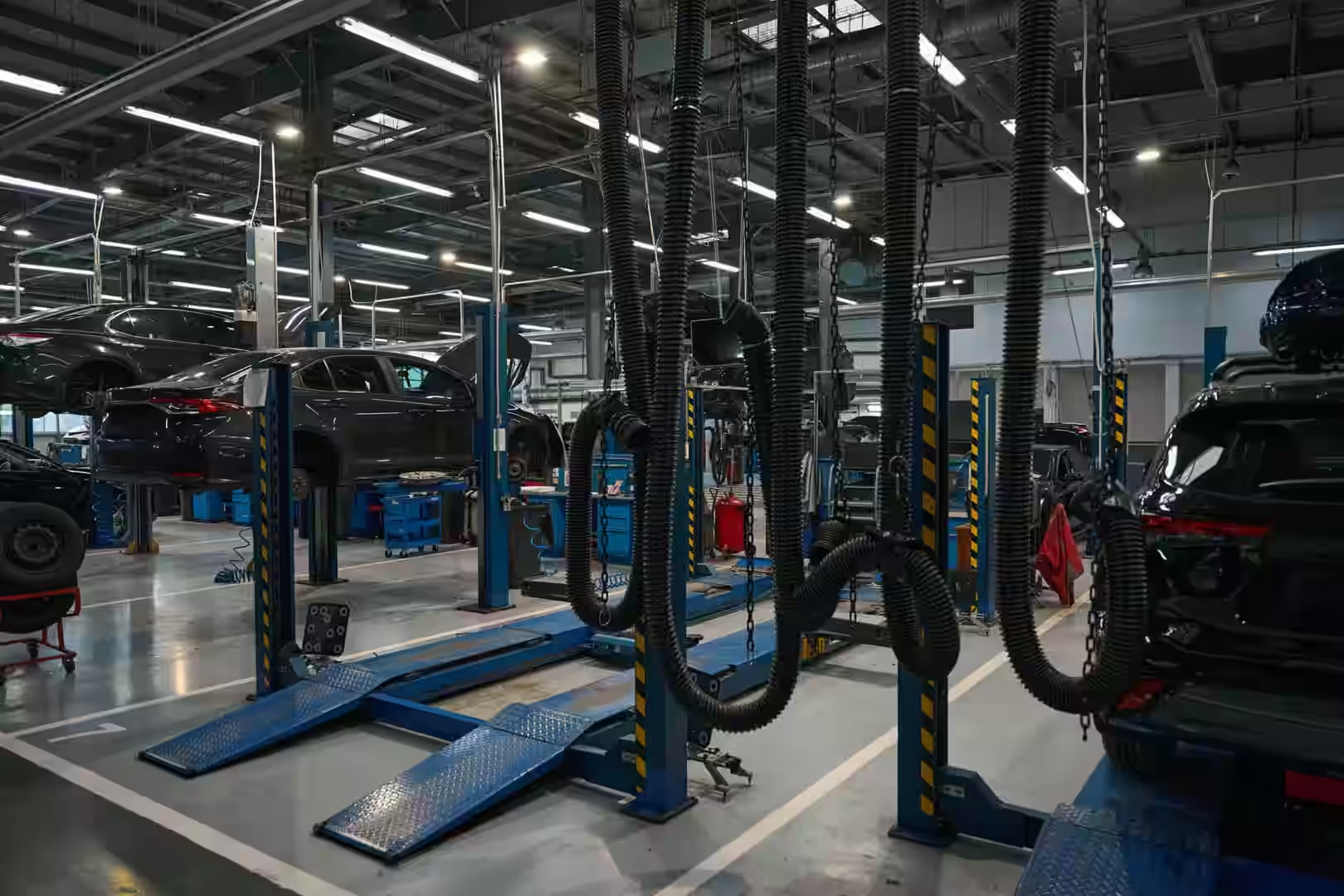
When you look up at the ceiling of a busy commercial repair shop, you see a complex network of ducts, hoses, and blowers. It looks like a simple air-moving setup, but it is actually a critical piece of safety infrastructure.
Without proper engineering, your exhaust system can quickly turn from a safety asset into a major fire hazard. The primary dangers stem from the materials used to build the ductwork and the highly combustible materials that collect inside them.
The Role of Material Selection in Exhaust Extraction System Approvals
Historically, commercial facilities relied on heavy, noncombustible metal ductwork. Over the years, many operations transitioned to lighter, corrosion-resistant plastic options like polypropylene, polyvinyl chloride (PVC), and Fiberglass Reinforced Plastic (FRP).
While these materials handle corrosive fumes beautifully, unapproved plastics present a major fire risk. If a fire starts inside or outside the duct, unapproved plastics melt, collapse, and feed the flames, spreading toxic smoke throughout your facility.
To prevent this, structural approvals require high-performance materials. For high-pressure engine and turbine applications, pre-fabricated stainless steel systems like Models PS/IPS are the industry standard. These double-wall systems feature specialized ceramic or dense fiber insulation that keeps the outer skin temperature low and easily handles extreme thermal expansion.
Understanding Combustible Deposits and Ductwork Fire Risks
The air moving through your shop's extraction system is not clean. It is loaded with unburned hydrocarbons, sulfur oxides, fine carbon soot, and diesel exhaust particulates.
As these hot vapors cool inside the ductwork, they condense and cling to the inner walls. Over time, they form a sticky, highly flammable layer of organic soot.
If a vehicle backfires or a technician introduces an ignition source near an extraction nozzle, sparks can be sucked directly into the ductwork. If the soot layer inside is thicker than 1/16 of an inch (1.5 mm), it can ignite instantly.
Once a fire starts inside a duct, the draft created by the exhaust fan acts like a blast furnace, rapidly raising temperatures past the failure point of unapproved duct materials.
Key Standards and Exhaust Extraction System Approvals
To secure exhaust extraction system approvals from local building inspectors and fire marshals, your ventilation design must comply with several strict national and international standards. These rules are designed to prevent duct failure and stop fires from traveling through your building.
FM 4922 vs. ASTM E-84 Testing Standards
One of the most common mistakes shop owners make is assuming a material is safe because it has a low flame-spread rating under ASTM E-84.
The truth is, a plastic duct can pass the standard ASTM E-84 horizontal tunnel test with a perfect score of 25, yet completely fail a real-world vertical fire test. This is why FM Global created FM Approval Standard 4922 (Approval Standard for Fume Exhaust Ducts or Fume and Smoke Exhaust Ducts).
FM 4922 is a much tougher standard. It tests ductwork in both horizontal and vertical configurations under intense fire exposure. To receive FM 4922 approval:
- The duct must limit fire spread on both its interior and exterior surfaces.
- The duct must maintain its structural integrity during a fire, preventing a collapse that would dump smoke and flames into the shop.
- The approval typically covers duct diameters up to 60 inches (1.5 meters).
For advanced smoke and heat extraction systems, European benchmarks like those set by the Construction products for smoke control and extraction | DIBt - Deutsches Institut für Bautechnik also highlight the importance of certified 90-minute fire-resistant barriers to keep escape routes clear.
International Mechanical Code (IMC) Chapter 5 Compliance
In locations like Novi, MI, and across the Carolinas in Charlotte, Raleigh, and Wade, NC, local building officials enforce Chapter 5 of the International Mechanical Code (IMC).
The IMC classifies vehicle exhaust as a "hazardous exhaust" system. This means your shop's extraction system must remain completely independent of all other building ventilation systems. You cannot route tailpipe emissions through your standard HVAC ducts.
Additionally, the equipment you install must carry recognized commercial listings. For example, commercial extraction hoods must comply with the strict UL 710 testing standard, similar to the requirements outlined in CERTIFICATE OF APPROVAL # 5946.
These certifications ensure that the metal thickness, joint welds, and clearance to combustible materials (typically 18 inches for uninsulated systems) meet strict structural safety margins.
Automatic Fire Protection and Sprinkler Requirements
If your exhaust system uses combustible duct materials or carries air that leaves flammable deposits, you may be required to install an internal fire suppression system. This is one of the most heavily scrutinized areas during any commercial building inspection.
When Are Internal Sprinklers Mandatory?
Both NFPA 13 and FM Global Data Sheet 7-78 outline clear size and material thresholds that trigger the need for internal automatic sprinklers or water spray nozzles:
- Size Threshold: Any ductwork with a cross-sectional area of 80 square inches or more (which translates to a round duct diameter of 10 inches or larger) requires internal protection.
- Material and Contents: This rule applies if the ductwork is constructed of combustible materials (like non-FM approved plastics) or if the exhaust contains combustible deposits (like vehicle soot and grease) thicker than 1/16 of an inch.
By choosing noncombustible metal or FM 4922 Approved ductwork, you can often avoid the high cost and complexity of installing internal sprinklers in areas without heavy soot buildup.
| Duct Material | Duct Diameter / Area | Combustible Deposits Present? | Internal Sprinklers Required? |
|---|---|---|---|
| Standard Metal | Under 10" (<80 sq. in.) | No | No |
| Standard Metal | 10" or Larger (≥80 sq. in.) | Yes (>1/16" thick) | Yes |
| Unapproved Plastic | Any Size | Yes or No | Yes |
| FM 4922 Approved Plastic | Up to 60" | No | No |
Preventing Duct Collapse During Sprinkler Activation
If your system requires internal sprinklers, the physical design of the ductwork must change to handle the water.
Water is incredibly heavy. If a sprinkler head activates inside a lightweight plastic duct, the weight of the standing water will quickly cause the duct to collapse, ripping down your ceiling supports and dumping water and fire into your shop.
To prevent this, you must install a dedicated duct drainage system. This requires:
- Installing low-point drains designed to handle the full flow capacity of your sprinkler system.
- Designing all horizontal duct runs with a minimum 4% slope (1/2 inch of drop per foot of run) leading toward the drains.
- Using linear heat detection lines installed within 3 feet upstream of the water spray nozzles to ensure rapid, targeted activation.
Design and Installation of Modern Vehicle Extraction Systems
Modern automotive and fleet service shops require highly efficient source-capture systems to keep technicians safe.
Integrating these systems into your shop design requires careful planning to balance daily productivity with strict building and fire codes.
Integrating Source Capture with Building Codes
An effective exhaust system installation must capture fumes directly at the tailpipe before they can disperse into the shop air.
Today's shops rely on several advanced configurations, including:
- Touchless Extraction Arms: These arms hover near the tailpipe without actually touching the vehicle, eliminating the need for hot nozzle adapters and preventing damage to delicate exhaust tips.
- Spring-Recoil and Motorized Hose Reels: These systems keep hoses stored neatly overhead when not in use, keeping your shop floor clear of tripping hazards.
- Sliding Suction Rails: Ideal for multi-bay setups, these rails allow a single extraction drop to slide easily between different work bays.
During the facility buildout equipment planning phase, you must calculate the precise volumetric flow rate (CFM) required for your specific mix of vehicles.
Under-sizing your blowers will cause fumes to escape into the shop, while over-sizing them wastes energy and creates negative air pressure issues.
- Passenger Cars & Light Trucks: 250 to 300 CFM per bay.
- Medium-Duty Trucks: 300 to 350 CFM per bay.
- Heavy Diesel Trucks (up to 500 HP): 450 to 500 CFM per bay.
- Heavy Diesel Engines (over 600 HP): 600 to 650 CFM per bay.
Outdoor Discharge and Exhaust Extraction System Approvals
Once the fumes are captured and moved through your ductwork, they must be discharged safely outside.
The International Mechanical Code (IMC Section 501.3.1) mandates strict termination distances to prevent toxic fumes from being pulled back into the building:
- Property Lines: Exhaust outlets conveying flammable or toxic vapors must terminate at least 30 feet from all property lines.
- Building Openings: Outlets must be located at least 10 feet away from operable doors, windows, and mechanical air intakes.
- Termination Protection: Outdoor outlets must be protected with corrosion-resistant screens or louvers. The openings in these screens must be between 1/4 inch and 1/2 inch to keep out debris and pests without restricting airflow.
Your rooftop exhaust fans must also be tough enough to handle local weather extremes.
Whether you are dealing with high winds in coastal Carolinas or winter storms in Michigan, your rooftop equipment must meet strict structural standards.
Many local building departments look for certified engineering benchmarks, such as those verified in a NOTICE OF ACCEPTANCE (NOA) or the structural wind-load approvals granted to systems like the 24101102 Air Syst Comp dba PennBarry.
These certifications prove the fan housing and its mounting curbs can withstand extreme physical forces without tearing off your roof.
Frequently Asked Questions about Exhaust Extraction System Approvals
What is the minimum discharge distance for hazardous exhaust outlets?
Per IMC Section 501.3.1, exhaust outlets carrying hazardous, flammable, or toxic vapors must terminate at least 30 feet from all property lines and at least 10 feet from any operable building openings, such as doors, windows, or fresh air intakes.
When does ductwork require internal automatic sprinkler protection?
Internal automatic sprinklers or water spray nozzles are required if the ductwork has a cross-sectional area of 80 square inches or more (or a diameter of 10 inches or larger) and either contains combustible deposits (like soot) thicker than 1/16 of an inch or is made of combustible materials (such as non-FM approved plastics).
What is the difference between Fume Exhaust and Fume and Smoke Exhaust approvals?
Under FM Approval Standard 4922, "Fume Exhaust" ducts are approved to convey corrosive fumes but may collapse under high heat to isolate a fire.
"Fume and Smoke Exhaust" ducts are designed to maintain their structural integrity and shape during a fire, allowing the exhaust system to continue pulling smoke and heat out of the building to keep escape routes clear.
Conclusion
Securing your exhaust extraction system approvals does not have to be a stressful, confusing process.
By selecting the right certified materials, planning your duct layout to meet IMC Chapter 5, and matching your CFM rates to your actual shop needs, you can build a ventilation system that is safe, efficient, and fully compliant.
At AutoTech Solutions, we specialize in helping commercial garages, fleet maintenance facilities, and collision centers design, install, and maintain code-compliant shop infrastructure.
From initial shop design and consulting to professional equipment sales, professional car lift installation, and ongoing preventative maintenance programs, we are your single source for keeping your shop running smoothly.
Whether you are operating in Novi, MI, or throughout the Carolinas in Charlotte, Raleigh, or Wade, NC, our expert team is ready to minimize your downtime and ensure your shop passes every inspection.
Need help planning your next ventilation upgrade or securing system approvals? Contact us today for expert service repair and equipment support.