Why Exhaust System Installation Matters for Your Auto Shop

Exhaust system installation in a professional auto shop is one of the most critical infrastructure decisions a facility manager will make. Get it right, and your technicians work in a clean, safe environment. Get it wrong, and you're looking at health risks, compliance violations, and costly downtime.
Here's a quick overview of what a professional shop exhaust extraction installation involves:
- Plan your system - assess bay count, vehicle types, and airflow requirements
- Choose the right system type - above-ground, in-ground, hose reel, rail, or telescopic drop
- Install extraction hardware - mount fans, route ducting, seal joints, and connect hose assemblies
- Test and calibrate - verify airflow, check for leaks, and balance static pressure
- Maintain regularly - replace filters every six months, inspect hoses, lubricate motors
The stakes are high. The World Health Organization classifies diesel exhaust fumes as a Group 1 known carcinogen. Every minute your technicians breathe unfiltered shop air is a liability - for their health and your business.
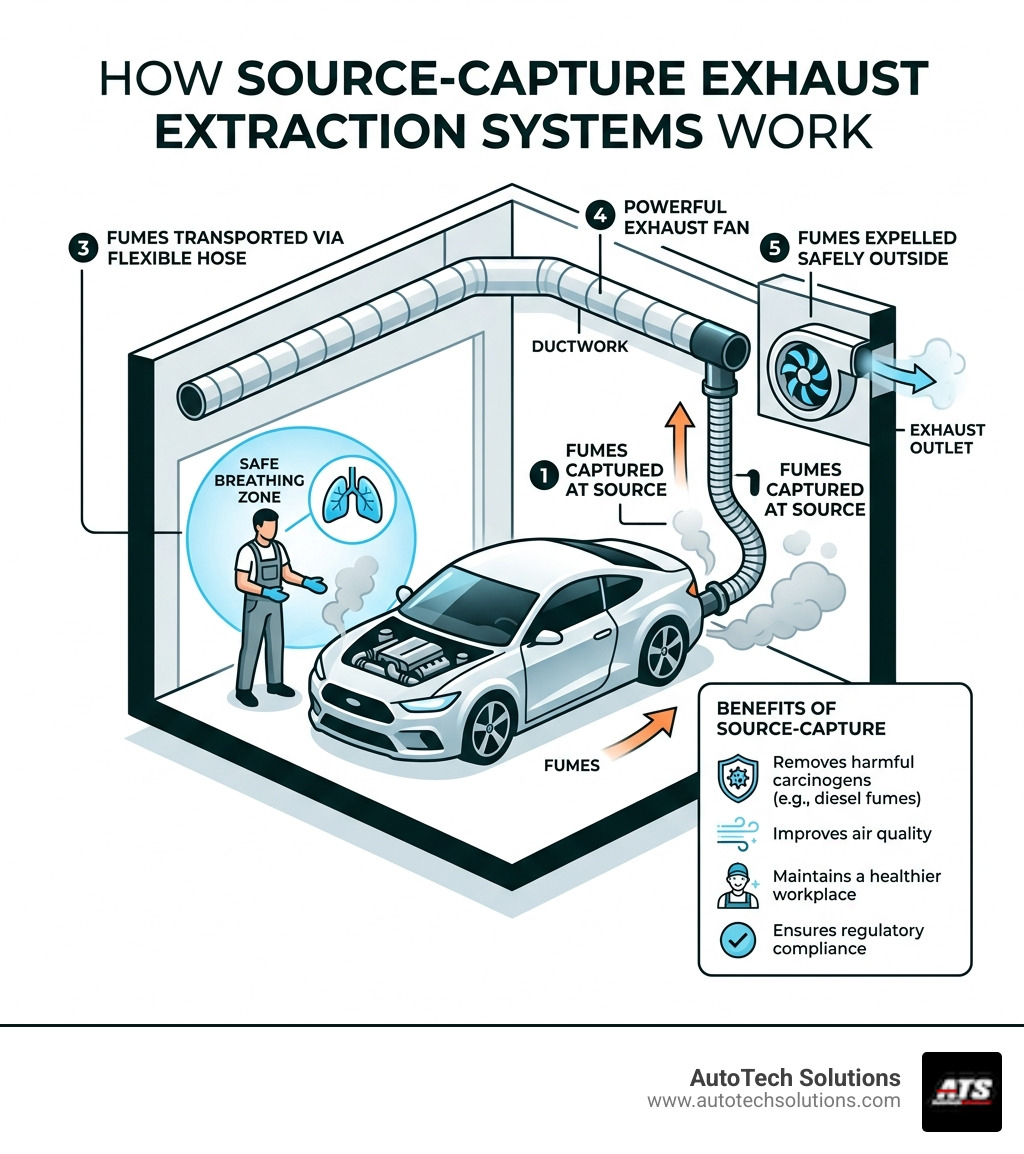
A well-designed source-capture exhaust extraction system removes fumes at the point of emission, before they spread through your facility. That means healthier staff, better compliance, and a shop that runs efficiently day after day.
This guide walks you through everything AutoTech Solutions recommends for a professional-grade exhaust extraction installation - from initial planning to long-term maintenance.
Key terms for Exhaust system installation:
Planning Your Professional Exhaust System Installation

Before a single bolt is turned, a successful Exhaust system installation requires a comprehensive blueprint. We look at a shop as a living organism; the extraction system is its respiratory tract. If the "lungs" (the fans) aren't sized to the "airways" (the ducting), the system will fail to protect your team.
Proper planning starts with a detailed facility layout. We must account for the number of service bays, the height of the ceilings, and the specific types of engines being serviced. A shop handling heavy-duty diesel trucks requires significantly higher CFM (cubic feet per minute) than a light-duty passenger car dealership.
At AutoTech Solutions, we specialize in Installations, Upfits & Facility Buildouts, ensuring that the extraction system doesn't just exist but thrives within your specific workflow. We analyze the "source capture" points—where the hose meets the tailpipe—to ensure the geometry allows for a 100% seal, preventing toxic gases like carbon monoxide and nitrogen oxides from escaping into the workspace.
Selecting the Right Exhaust System Installation for Your Shop
There is no "one size fits all" when it comes to extraction. Depending on your shop's architecture and service volume, we generally categorize systems into several types:
- Above-Ground Systems: These are the most common for existing facility retrofits. They utilize overhead ducting and drops.
- In-Ground Systems: Ideal for new construction, these systems keep the shop floor clean by routing fumes through PVC or galvanized piping beneath the concrete slab.
- Hose Reels: These can be manual, spring-loaded, or motorized. They allow the hose to be retracted when not in use, keeping the floor clear of trip hazards.
- Telescopic Drops: Perfect for high-ceiling facilities where a standard hose would be too heavy or cumbersome.
- Rail Systems: These allow a single extraction point to slide along a track, servicing multiple bays with one hose assembly. This is a highly efficient way to manage Services in a high-volume shop.
Assessing Structural and Airflow Requirements
The "heart" of your Exhaust system installation is the centrifugal fan. To choose the right one, we must calculate the total static pressure of the system. Every foot of ducting, every elbow, and every foot of hose adds resistance. If the fan isn't powerful enough to overcome this resistance, the fumes will simply linger in the hose.
Furthermore, we must consider the roof or wall penetration. Industrial fans are heavy and produce significant vibration. We often coordinate this with other major utility installs, such as Air Compressor Installation, to ensure that the building's electrical and structural integrity can support multiple heavy-duty systems. Duct diameters must be sized correctly—too small and the air becomes turbulent and noisy; too large and the velocity drops too low to carry particulates.
Essential Tools and Safety for Facility Infrastructure
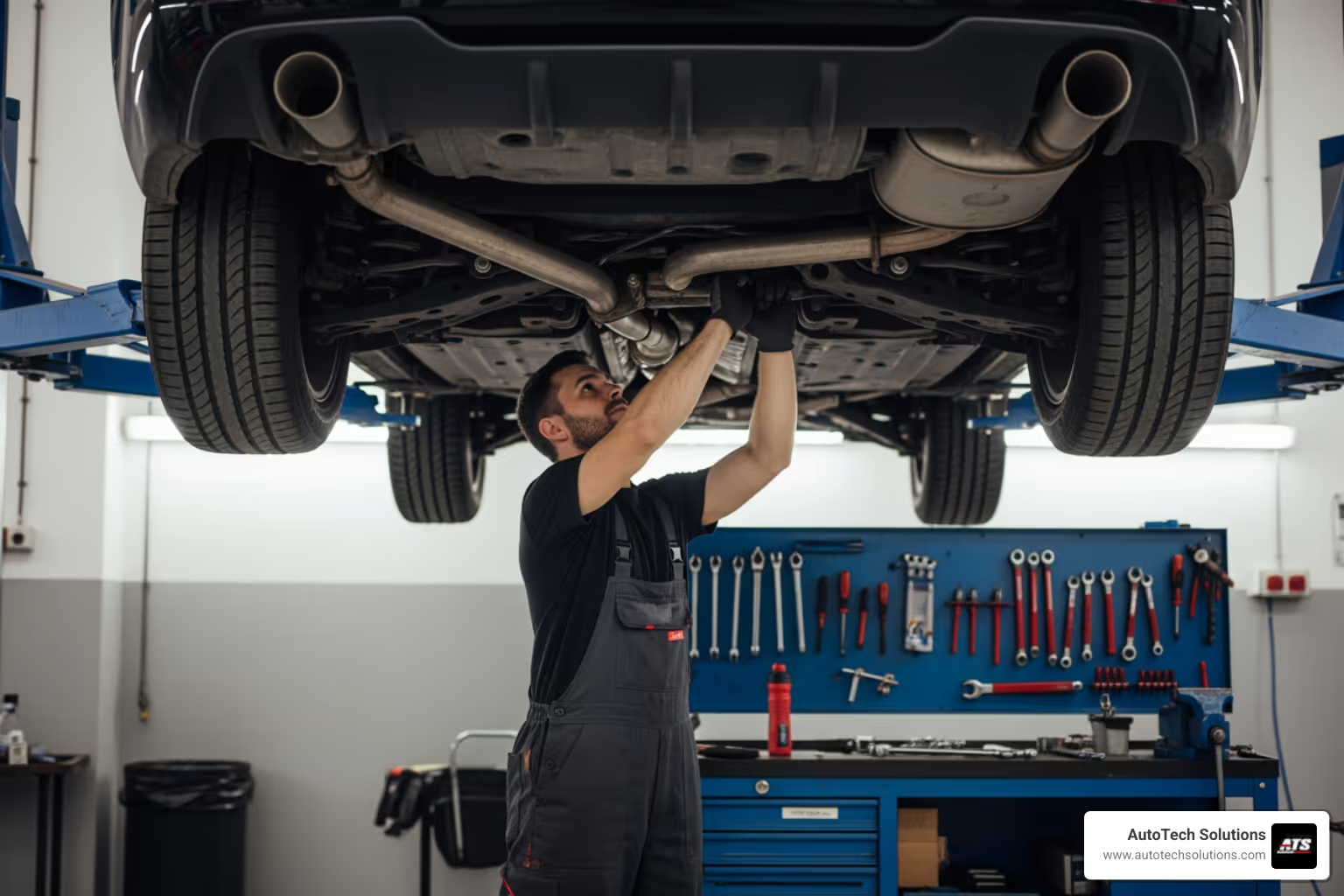
Installing a professional extraction system isn't a DIY weekend project. It requires heavy-duty equipment and a keen eye for industrial safety. We use laser levels to ensure ducting has the proper pitch and alignment, and high-torque wrenches to secure mounting brackets that must hold hundreds of pounds of dynamic force.
When we perform an Automotive Lift Installation, we often work in tandem with the exhaust team to ensure that the extraction drops don't interfere with the lift's range of motion. Precision is everything.
Safety Protocols During Exhaust System Installation
Safety isn't just a suggestion; it’s a regulatory requirement. Our installation teams follow strict OSHA compliance protocols, particularly regarding fall protection when working on lifts or scaffolding to reach overhead ductwork.
We also prioritize electrical safety. Industrial fans often require 208-230V or 460V three-phase power. Ensuring these are wired correctly and integrated with control panels—perhaps including remote start options for technicians—is a core part of the process. This level of technical integration is similar to the precision needed in an ADAS Equipment Installation Complete Guide, where sensors and electronics must communicate perfectly.
Required Materials for Industrial Extraction
The materials used in a professional Exhaust system installation must be able to withstand extreme environments. Exhaust gases can reach temperatures over 1,000 degrees Fahrenheit at the manifold, though they cool as they travel.
- Galvanized Ducting: Resists corrosion from the moisture and chemicals found in exhaust.
- High-Temperature Hoses: These aren't your standard shop vac hoses. They are often wire-reinforced and rated for 600°F to 1000°F.
- Rubber Isolators: These are critical for mounting fans and ducting to prevent vibrations from rattling the entire building.
- Heavy-Duty Anchors: When mounting a motorized hose reel, we use anchors capable of handling several hundred pounds of pull-out force.
Whether we are performing a Car Hoist Installation or an exhaust build, we use only industrial-grade hardware designed to last for decades, not years.
Step-by-Step Guide to Installing Exhaust Extraction Systems
The physical installation of the system is a choreographed process. We start from the discharge point (the fan and roof stack) and work our way back to the service bays.
- Mounting the Fan: The fan is typically located on the roof or an exterior wall to minimize noise inside the shop. It must be mounted on vibration-dampening curbs.
- Running the Main Trunk: Large-diameter galvanized ducting is hung from the ceiling joists using heavy-duty straps.
- Installing the Drops: This is where the hose reels or telescopic drops are attached to the trunk line. Each connection must be sealed with industrial-grade duct sealant to prevent leaks.
- Connecting the Source Capture: The final step is attaching the high-temperature hoses and the specific tailpipe adapters designed for the vehicles your shop services.
Proper Alignment and Component Integration
Alignment is about more than just looking good; it's about efficiency. Ductwork should have a slight pitch to prevent moisture (from condensation) from pooling in low spots, which can lead to premature corrosion.
We follow a similar logic to our Automotive Lift Installation Guide: every component must have adequate clearance. For exhaust systems, we look for 1/4" to 1/2" clearance for metal-to-metal contacts to allow for thermal expansion. Non-metal heat-sensitive components need even more—usually 2" to 3" of breathing room.
Final Calibration and Exhaust System Installation Testing
Once the hardware is up, the "balancing" begins. We use anemometers to measure the airflow at each drop. In a multi-bay shop, we must ensure that the bay furthest from the fan still has enough suction to capture 100% of the fumes.
We also check for leaks using a simple but effective method: soapy water or smoke emitters. Any hiss or bubble indicates a loss of suction and a potential entry point for fumes into the shop.
| Bay Type | Required Airflow (CFM) | Typical Hose Diameter |
|---|---|---|
| Light Duty (Cars) | 300 - 400 CFM | 4" |
| Medium Duty (Trucks) | 500 - 600 CFM | 5" |
| Heavy Duty (Diesel) | 700 - 1000+ CFM | 6" or 8" |
Maintaining Shop Infrastructure for Peak Performance
An Exhaust system installation is an investment that requires protection. Without regular maintenance, fans lose efficiency, hoses crack, and filters (if your system uses them) clog, leading to higher energy bills and poor air quality.
Regular inspections should include checking the fan blades for soot buildup, which can unbalance the motor and lead to bearing failure. We also look at the hoses for "pinching" or internal collapses that restrict airflow. This proactive approach is exactly how we handle a Downdraft Paint Booth Installation—prevention is always cheaper than repair.
Neutralizing Stress on Facility Components
Thermal expansion is a major factor in shop infrastructure. As hot exhaust passes through the system, the metal ducting expands. If the hangers are too rigid, the ducting can buckle or pull away from the wall. We use "neutralizing" techniques, ensuring that isolators are equally loaded and angled slightly forward when the system is cold, so they move into a straight vertical position as the system heats up.
This attention to dynamic force management ensures that your Services are never interrupted by a catastrophic equipment failure.
Frequently Asked Questions about Shop Exhaust Systems
How often should extraction system filters be replaced?
If your system utilizes a filtration unit (common in urban areas with strict emission codes), filters should generally be replaced every six months. However, if you run a high-volume diesel shop, you may need to check them every three months. A clogged filter increases static pressure, forcing the fan to work harder and reducing the suction at the tailpipe.
What are the clearance requirements for overhead ducting?
For safety and longevity, maintain at least 1/4" to 1/2" of clearance for any metal-to-metal contact points to account for vibration and heat expansion. For non-metal or heat-sensitive components (like plastic conduits or fire sprinkler lines), a minimum of 2" to 3" of clearance is required.
How do I calculate the fan capacity needed for a multi-bay shop?
Calculation involves adding the required CFM for each bay that will be used simultaneously and then adding the "static pressure loss" for the total length of the ductwork and hoses. It’s a complex math problem that involves air density and friction coefficients—which is why AutoTech Solutions handles these calculations for our clients to ensure the system is neither underpowered nor wastefully oversized.
Conclusion
A professional Exhaust system installation is the backbone of a safe, productive automotive shop. From the Carolinas to Michigan, AutoTech Solutions is dedicated to ensuring your facility stays compliant and your technicians stay healthy. We don't just sell equipment; we provide the expert support and preventative maintenance necessary to minimize downtime and keep your bays turning.
Whether you are building a new facility in Raleigh or upgrading a shop in Novi, our team is ready to design and install a system that meets the highest industrial standards. Don't let harmful fumes compromise your business.
For expert assistance with your facility's infrastructure, visit our Service Repair and Equipment Support page and let us help you build a better shop today.