Why Heavy Duty Diagnostic Tools Are Essential for Fleet Operations

Heavy duty diagnostic is the process of reading, interpreting, and clearing fault codes from commercial trucks, semi-trucks, and other large vehicles using specialized scan tools that go far beyond what a standard car scanner can do.
Here's a quick breakdown of what that means in practice:
- What it covers: Engines, transmissions, braking systems, DPF (Diesel Particulate Filter), and more
- Who uses it: Fleet managers, shop owners, and diesel technicians
- Why it matters: A truck sitting idle costs money — fast, accurate diagnosis gets it back on the road
- Key protocols used: J1939 and J1708 (the communication languages of heavy-duty trucks)
- Tools required: Purpose-built HD scanners or rugged diagnostic laptops — not standard OBD2 readers
With over 360 heavy duty truck scanner products available on the market, the options can feel overwhelming. And the stakes are high. When a Class 8 truck goes down, every hour of downtime hits your bottom line hard.
The good news? The right diagnostic tool — matched to your truck brands and engine types — can dramatically cut repair time and keep your fleet moving.
Glossary for heavy duty diagnostic:
Understanding the Heavy Duty Diagnostic Process
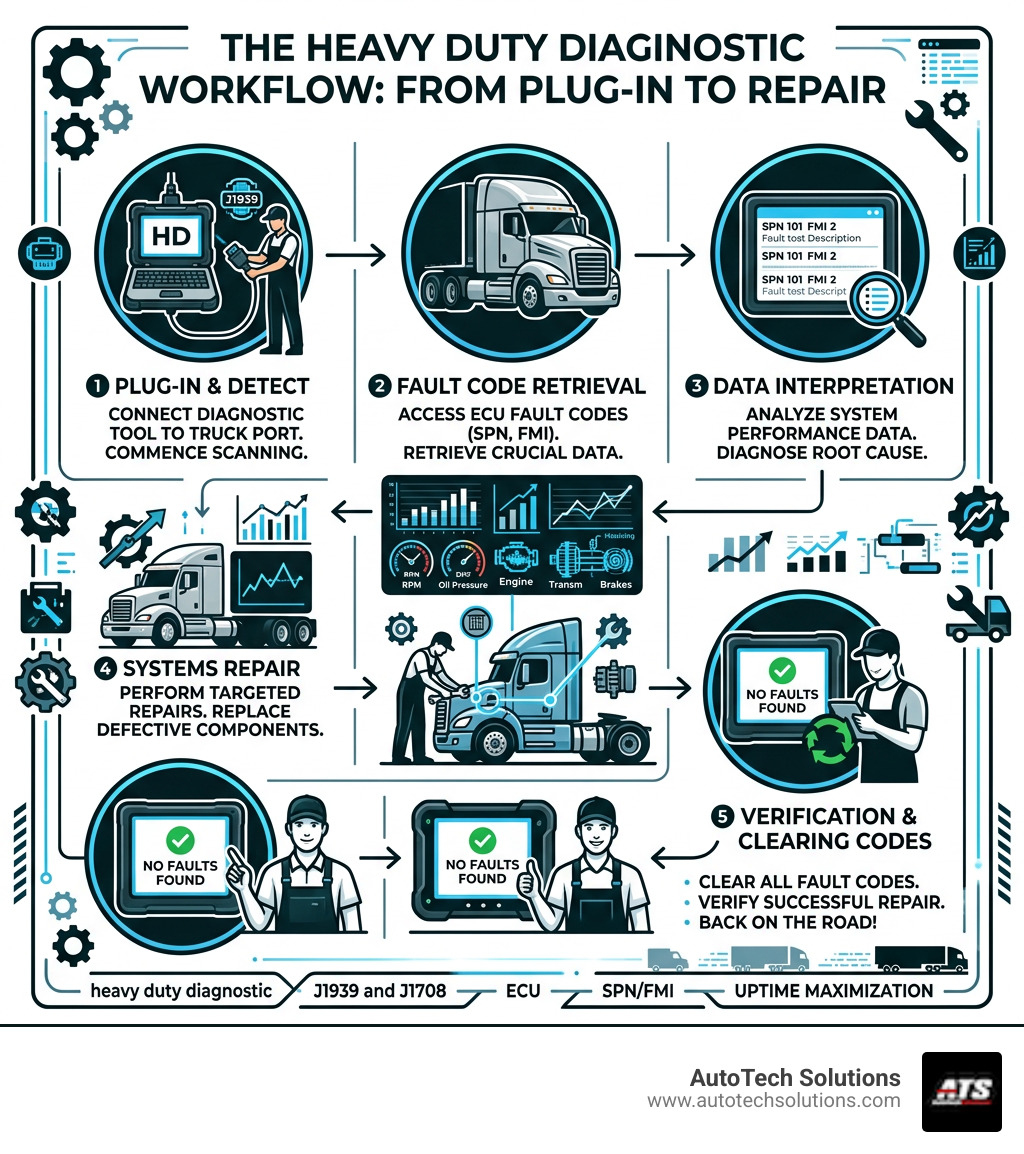
When a modern semi-truck hits the road, it isn't just a feat of mechanical engineering; it’s a rolling supercomputer. Every time a driver sees a "Check Engine" light or feels a stutter in the transmission, the vehicle's internal brain—the Electronic Control Unit (ECU)—is logging a specific story. The heavy duty diagnostic process is how we translate that story into a repair plan.

The process begins with communication. Unlike passenger cars that primarily use a single standard, heavy-duty vehicles rely on robust industrial protocols. The most common are J1939 (the modern standard for high-speed CAN bus communication) and J1708 (an older, slower, but still widely used protocol). A professional heavy-duty truck scan tool must be able to "speak" these languages fluently to extract data from the engine, transmission, and braking systems.
Once the tool is plugged in, it performs a system health monitor check. It doesn't just look for active faults; it looks at "pending" codes and historical data. This allows technicians to see if a sensor is failing intermittently before it leaves a driver stranded on the side of the I-95. Clearing a fault code is the final step, but only after the underlying mechanical issue has been addressed. Without this deep-dive capability, shops are simply guessing, which leads to "parts cannon" repairs and unnecessary expenses.
Heavy Duty Diagnostic vs. Standard OBD2
We often get asked if a $50 scanner from a big-box store will work on a Freightliner. The short answer is: No. While light-duty vehicles (cars and pickups) use the standard 16-pin OBD2 port, heavy-duty trucks operate on an entirely different scale.
First, there is the physical connection. Heavy-duty trucks typically use 6-pin or 9-pin Deutsch connectors. If you try to force a standard car scanner into a semi-truck, you’ll quickly realize the round pegs don't fit the trapezoidal holes. Furthermore, the voltage requirements are different. Most cars operate on a 12V system, whereas heavy-duty trucks often utilize 24V systems for starting and charging. Using an unrated tool can result in fried internal circuits.
The complexity of the data bus is also significantly higher in commercial vehicles. A standard car might have a few dozen modules; a modern Class 8 truck can have over 100 OEM-specific vehicle systems communicating simultaneously. To manage this, you need more info about heavy duty shop equipment that is designed to handle high-speed data traffic without crashing or providing "unknown code" errors.
Advanced Functions in Heavy Duty Diagnostic Systems
A basic code reader tells you what is wrong. An advanced heavy duty diagnostic tool tells you how to fix it and allows you to test the fix. This is where bidirectional control comes into play.
Bidirectional control allows the technician to send commands to the truck. For example, if you suspect a fuel injector is failing, you can perform an injector cutout test. The scanner tells the ECU to stop firing a specific injector; if the engine's RPM doesn't drop, you've found your dead cylinder. Other advanced functions include:
- Parameter Changes: Adjusting idle speeds or PTO settings.
- Speed Limit Adjustment: Essential for fleet safety and insurance compliance.
- Calibration: Re-aligning sensors after a component replacement.
Having a high-quality heavy duty diagnostic tool means you can perform these "dealer-level" tasks in your own shop, saving you the time and massive expense of towing a truck to a dealership just to have a computer setting toggled.
Essential Features for Professional Fleet Maintenance
Choosing between a handheld code reader and a full-scale diagnostic laptop is a major decision for any shop owner. Handhelds are great for quick triage in the parking lot, but for deep repair work, a laptop-based system is often the gold standard.
| Feature | Entry-Level Code Reader | Professional Diagnostic Laptop |
|---|---|---|
| Connection | Wired 6/9-pin | Wireless/Bluetooth VCI |
| System Coverage | Engine/ABS only | Full System (Body, Chassis, Trans) |
| DPF Regen | Rare/Limited | Full Forced Regeneration |
| ECU Coding | No | Yes |
| Bi-Directional | No | Yes |
| Updates | Limited | Lifetime/Subscription-based |
One of the most critical features for any modern diesel shop is the ability to handle the aftertreatment system. DPF regeneration (Diesel Particulate Filter) is a frequent headache. When a truck's filter becomes clogged with soot and the vehicle can't perform an "automatic" regen while driving, it enters a "derate" mode, cutting power to protect the engine. A professional tool allows for a forced regen, where the scanner commands the truck to park and high-idle to burn off the soot, potentially saving a $5,000 filter replacement.
Furthermore, professional-grade systems offer deep braking system analysis (ABS/EBS) and transmission diagnostics. At AutoTech Solutions, we believe that having these capabilities in-house is the best way to learn more about our specialized services and how we help shops maintain their own equipment to the highest standards.
Compatibility Across Major Engine Manufacturers
In heavy-duty trucking, "one size fits all" is a myth. A single fleet might have a Freightliner with a Detroit Diesel engine, a Peterbilt with a Paccar MX-13, and a specialized rig running a Cummins ISX. Your heavy duty diagnostic strategy must account for this variety.
Top-tier scanners provide integrated support for:
- Cummins: Deep access to Insite-level data, including calibrations and trip information.
- Detroit Diesel: Comprehensive coverage for DD13, DD15, and DD16 engines, including proprietary fault codes.
- Paccar: Specialized communication with engine and body controllers found in Kenworth and Peterbilt.
- Caterpillar: Support for legacy yellow engines (J1708) and modern electronics (J1939).
- Volvo/Mack: Integration with the specific V-MAC systems and proprietary protocols used by these manufacturers.
Many modern tools also offer 2-in-1 functionality. This means the same tool used for a Class 8 semi can also plug into a light-duty Ford F-250 or a Chevy Silverado delivery van using standard OBD2 protocols. This versatility is a game-changer for mixed-fleet operators. Interestingly, the industry is also moving toward sustainability; several popular scanners are now certified by the Global Recycled Standard, containing at least 50% recycled material in their housings, proving that ruggedness and environmental responsibility can go hand-in-hand.
Choosing the Right Diagnostic Hardware for Your Shop
The software is the brain, but the hardware is the body. In a shop environment—where grease, drops, and extreme temperatures are the norm—a standard consumer laptop won't last a week. This is why many professionals opt for ruggedized laptops like the Panasonic Toughbook.
Toughbooks are built to MIL-STD-810G and IP65 standards, meaning they are water-resistant, dust-proof, and can survive a drop onto a concrete shop floor. When configuring these units, look for SSD (Solid State Drive) performance. An SSD-equipped diagnostic laptop can boot up in under 10 seconds, which is 10X faster than traditional hard drives. This speed is vital when you have a line of trucks waiting for a quick scan.
When buying, consider the update model. Some brands offer lifetime free updates, which is excellent for long-term cost control. Others use a subscription model that provides ongoing OEM-level coverage and "SureTrack" expert information to help guide your repairs. Beyond the engine, don't forget the electrical system. Tools like the Bosch BAT 155 are specialized for advanced battery and electrical system testing, ensuring the truck's "muscles" are as healthy as its "brain." At AutoTech Solutions, we specialize in more info about automotive equipment installation and service, ensuring your diagnostic hardware is set up correctly from day one.
Frequently Asked Questions about Truck Diagnostics
What is DPF regeneration and why is it critical?
The Diesel Particulate Filter (DPF) catches soot from the exhaust. Over time, this soot accumulates. DPF regeneration is the process of burning that soot into ash. If the soot builds up too much, the engine will "derate," significantly limiting your speed and power to prevent engine damage. A forced regeneration via a heavy duty diagnostic tool is often the only way to clear a heavily loaded filter and keep the truck compliant with emission standards without replacing expensive components.
Do professional scanners require monthly subscription fees?
It depends on the brand. Many consumer-grade scanners (like the ANCEL or NEXAS models) offer lifetime free updates with no subscription fees. However, professional, dealer-level tools (like Bosch ESI[truck] or other industry-leading diagnostic platforms) often require an annual licensing agreement. These fees pay for the constant development required to keep up with new truck models and complex OEM-level coverage.
Can one tool diagnose both my semi-truck and my pickup?
Yes! Many modern scanners are "2-in-1" tools. They come with adapters for the 6-pin and 9-pin heavy-duty ports while also supporting the 16-pin OBD2 port found in light-duty cars and trucks. This allows a shop to use a single tool for everything from a Honda Civic to a Caterpillar excavator.
Conclusion
At AutoTech Solutions, we know that in heavy-duty trucking, time is the most valuable commodity. Whether you are operating out of Novi, MI, or managing a fleet in Charlotte or Raleigh, NC, our mission is to minimize your downtime. By investing in the right heavy duty diagnostic equipment and ensuring it is properly serviced and maintained, you can stop reacting to breakdowns and start predicting them.
From expert technical support to fast repair responses across our service area—spanning from Michigan down to the Carolinas—we are your partners in preventative maintenance. Don't let a "tantrum" from your truck's ECU derail your schedule. Explore our full range of professional products today and keep your fleet on the road where it belongs.