
Why Planning Maintenance Preventive Is the Smartest Move Your Shop Can Make
Planning maintenance preventive is one of the highest-leverage decisions a shop operator can make — and most facilities are still doing it wrong.
Here's a quick answer if you need it fast:
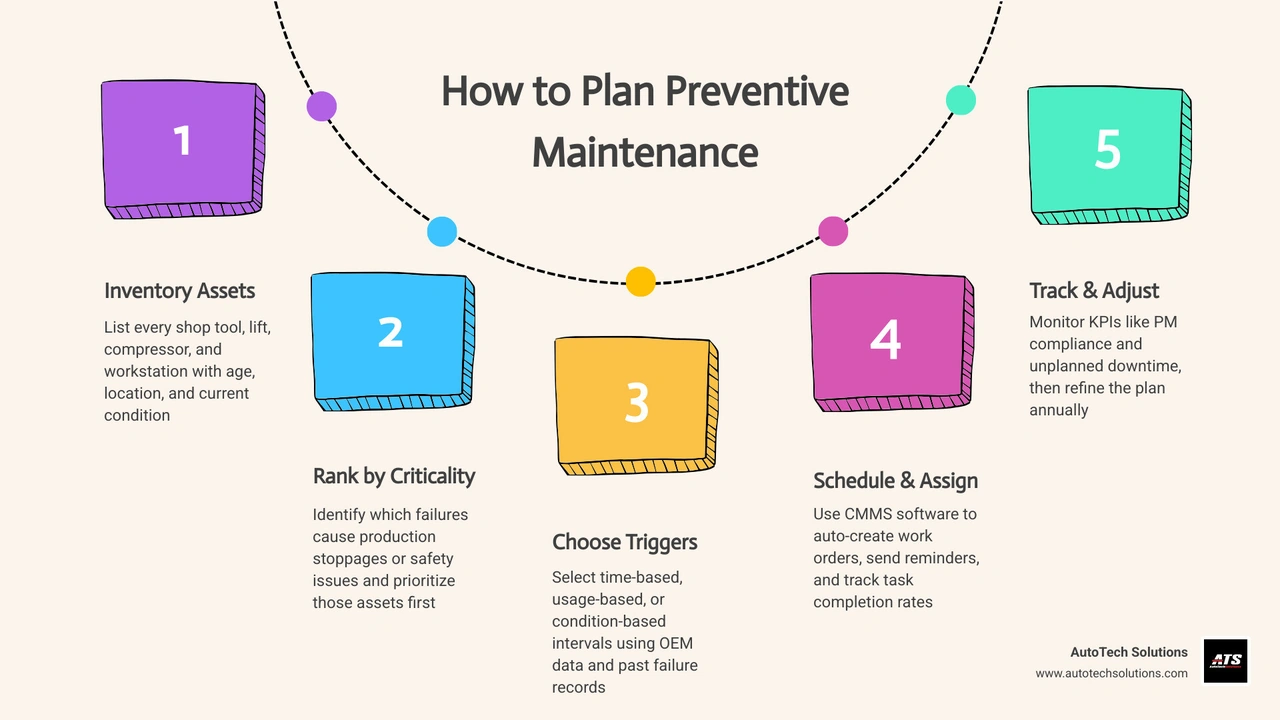
How to plan preventive maintenance for your shop:
- Build a complete asset inventory — every piece of equipment, its age, location, and condition
- Rank assets by criticality — what fails first, what costs the most, what stops production
- Choose your maintenance triggers — time-based, usage-based, or condition-based
- Set task frequencies and procedures — using OEM guidelines and your own failure history
- Schedule and assign work — using software to automate reminders and track completion
- Train your team — so tasks get done right, every time
- Track your KPIs — PM compliance rate, unplanned downtime, cost per asset
- Review and adjust — at least once a year, based on real data
The reality is brutal: unplanned downtime costs industrial manufacturers an average of $125,000 per hour. And across the industry, that adds up to $50 billion in losses every year. For automotive service facilities — where a single down lift or failed compressor can idle multiple technicians — those numbers hit close to home.
The good news? Organizations that shift to proactive maintenance see 52.7% less unplanned downtime than their reactive peers. And every $1 invested in preventive care saves an estimated $4 to $5 in future repair costs.
This guide walks you through exactly how to build a maintenance plan that protects your equipment, your team, and your bottom line.
Similar topics to planning maintenance preventive:
The Business Case for Planning Maintenance Preventive
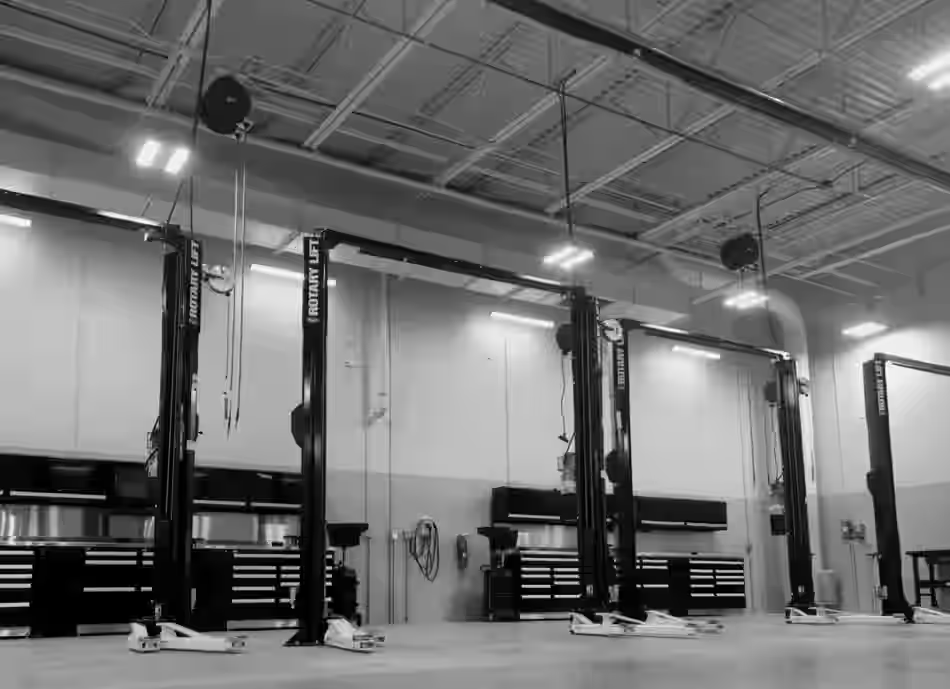
In the high-stakes world of automotive service, equipment isn't just a tool; it's the engine of your revenue. When a heavy-duty lift goes out of commission or an exhaust extraction system fails, the clock starts ticking on your profits. At AutoTech Solutions, we’ve seen how planning maintenance preventive transforms a chaotic "firefighting" shop into a streamlined, reliability-first powerhouse.
The financial data for May 2026 is clear: manufacturers and service centers face a staggering average downtime cost of $125,000 per hour. While your shop might not be a massive factory, the principle remains the same. If a bay is down, you aren't just losing the cost of the repair; you're losing the labor hours, the customer trust, and the opportunity cost of every vehicle you could have serviced.
Adopting a robust strategy can increase equipment life by 20% to 40% and achieve overall savings of 30% to 40% compared to reactive "run-to-failure" models. For a deeper dive into the fundamentals, check out this Preventive Maintenance: A Complete Guide or explore our own Preventative Maintenance Service Guide.
Understanding the ROI of Proactive Care
We like to talk about the 1:5 ratio. For every $1 we spend on planning maintenance preventive today, we save roughly $5 in future emergency repairs, expedited shipping for parts, and lost productivity. It’s the difference between a $400 quarterly service on a compressor and a $30,000 emergency replacement when that same compressor seizes during your busiest week of the year.
Beyond the raw dollars, there is the matter of safety and compliance. In Michigan and the Carolinas, regulatory audits and insurance requirements are becoming stricter. A documented maintenance plan isn't just a "nice-to-have"; it's your proof of due diligence. Our Preventative Maintenance Systems Guide 2026 outlines how digital tracking ensures you never miss a critical safety check, keeping your technicians safe and your shop compliant with OSHA and ANSI standards.
Shifting from Reactive to Reliability-First Culture
Many shop managers believe that equipment fails because it gets "old." However, research shows that only 11% of failures are strictly age-related. The other 89% occur randomly or are triggered by external factors like improper usage or lack of lubrication. This is often illustrated by the "bathtub curve" — where equipment is most likely to fail either right after installation (infant mortality) or at the very end of its service life.
By shifting to a reliability-first culture, we stop waiting for things to break. We acknowledge that assets are saved from failure every 17 minutes across the industry thanks to proactive intervention. This shift in mindset stabilizes your operations, allowing your team to focus on serving customers rather than wondering which piece of equipment will let them down next.
Core Strategies: From Time-Based to Predictive Models

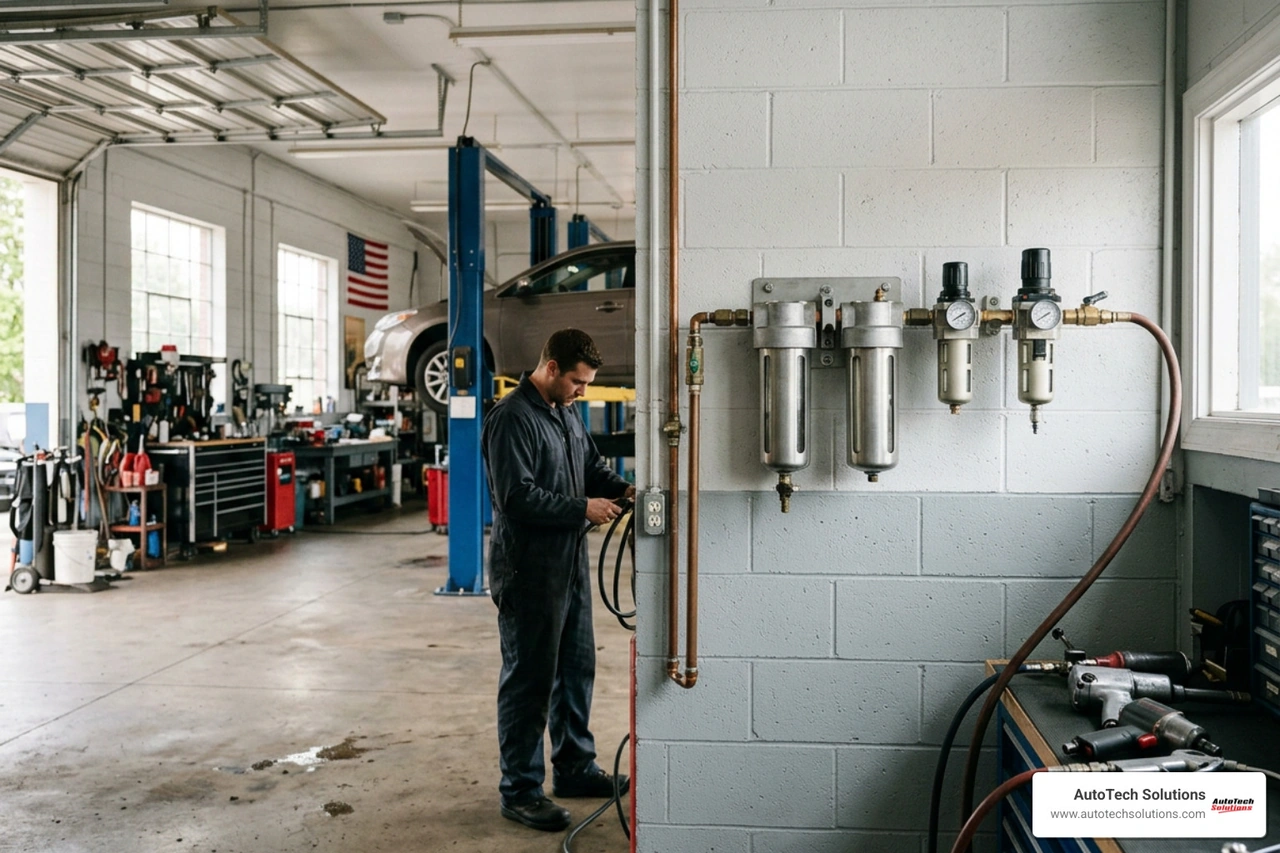
Not all equipment is created equal, and neither should be your maintenance approach. When planning maintenance preventive, we categorize tasks based on what triggers the work. For instance, an air compressor requires a different rhythm than a tire changer or a lubrication system. You can find specific tips in our Air Compressor Preventative Maintenance Guide to see how these triggers apply in practice.
At AutoTech Solutions, we act as a Preventative Maintenance and Repair Provider for Automotive Equipment, helping you decide which of the following models fits each asset in your facility.
Time-Based vs. Usage-Based Triggers
- Time-Based (Calendar) Maintenance: This is the most common form. It involves tasks performed at set intervals, such as inspecting your shop’s exhaust extraction system every six months or checking lift anchors annually. It’s simple to schedule but can sometimes lead to "over-maintenance" if the equipment hasn't been used much.
- Usage-Based (Meter) Maintenance: This triggers work based on actual "wear and tear." Think of it like an oil change for a shop vehicle or servicing a forklift every 200 operating hours. For government-run fleets or large dealer groups, these Preventative Maintenance Schedules | NC DOA are often the gold standard for balancing cost and reliability.
Advanced Condition-Based and Prescriptive Maintenance
As we move further into 2026, many shops are adopting "Condition-Based Maintenance" (CBM). Instead of guessing when a motor might fail, we use IoT sensors to monitor vibration, heat, or noise levels. If a lift motor starts running 10 degrees hotter than normal, the system alerts us before it burns out.
The most advanced version is "Prescriptive Maintenance," which uses AI to not only tell you that something is going to break but also suggests the specific fix and the best time to perform it to minimize impact on your shop's workflow.
8 Essential Steps for Planning Maintenance Preventive
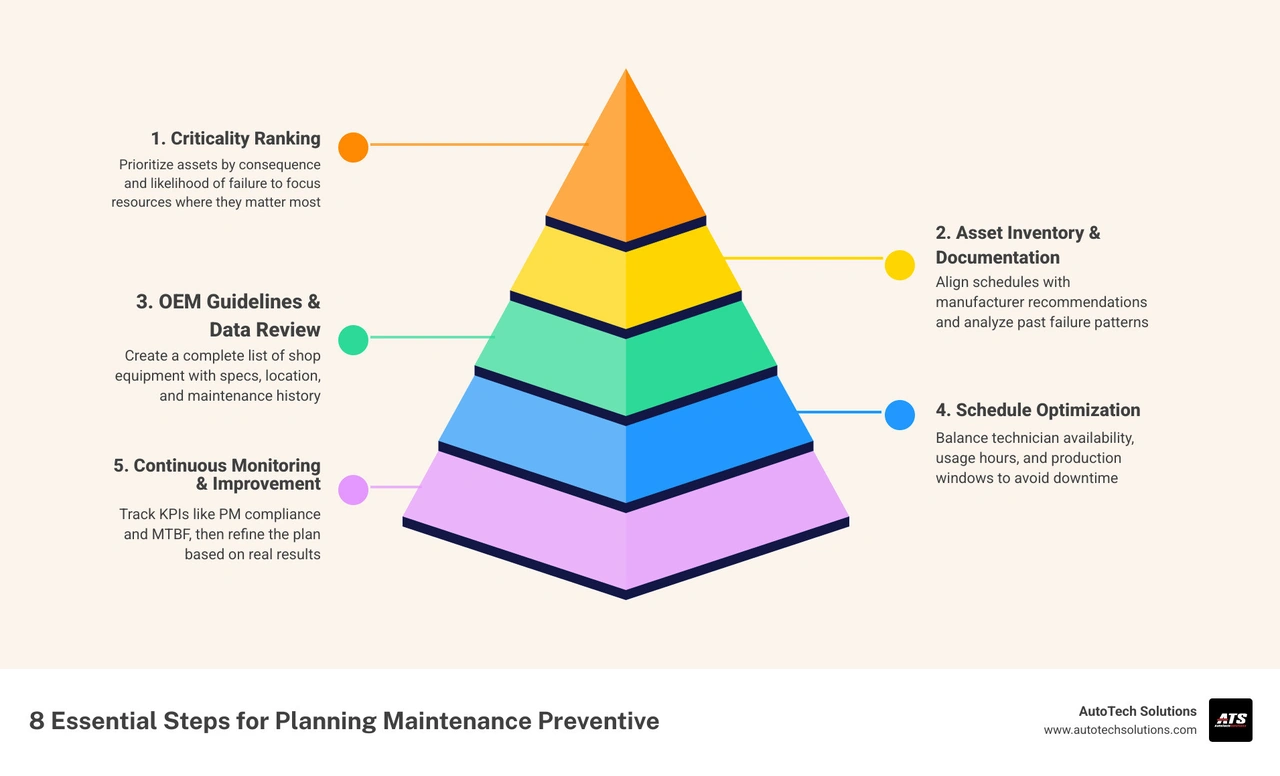
Creating a plan from scratch can feel overwhelming, but it’s really about breaking the shop down into manageable pieces. Whether you are managing a single location in Novi, MI, or a dozen across Charlotte and Raleigh, NC, the framework remains the same. For a technical deep dive into these structured plans, you might find the Assisted-Driven Design of Customized Maintenance Plans for Industrial Plants useful, or see how we simplify it with our PMS Planned Maintenance System.
Criticality Ranking for Planning Maintenance Preventive
You can’t do everything at once. We use a formula: Criticality = Consequence × Likelihood.
- Tier 1 (High Criticality): If this breaks, the shop stops. (e.g., Main air compressor, primary heavy-duty lifts).
- Tier 2 (Medium Criticality): This causes a headache and slows us down, but we can work around it for a day. (e.g., Individual oil reels, tire balancers).
- Tier 3 (Low Criticality): We can run these until they fail without much impact. (e.g., Shop vacuums, non-essential lighting).
By ranking your assets, you ensure your limited budget and time are spent where they matter most.
Optimizing Schedules for Planning Maintenance Preventive
Once you know what is important, you have to decide when to touch it. We start with the Original Equipment Manufacturer (OEM) guidelines as a baseline. However, a lift in a high-volume Charlotte shop running 12 hours a day needs more frequent care than one in a lower-volume facility. We help our clients with Automotive Shop Equipment Maintenance Across Multiple Locations by adjusting these frequencies based on real-world usage data and historical failure patterns.
Leveraging Technology: CMMS and EAM Integration
If your maintenance plan is living on a paper calendar in the back office, it’s likely being ignored. Modern planning maintenance preventive requires digital tools. A Computerized Maintenance Management System (CMMS) or Enterprise Asset Management (EAM) platform acts as the "brain" of your shop. For larger organizations, Centralized Equipment Service Coordination for Dealer Groups is the only way to maintain visibility across multiple sites.
Benefits of Digital Maintenance Management
Digital systems offer several game-changing advantages:
- Automation: Work orders are generated automatically based on time or meter readings.
- Accountability: You can see exactly who completed a task and when, including photo evidence of the work.
- Inventory Integration: The system can automatically reserve the filters or belts needed for a PM task, so you aren't stuck waiting for parts.
- Compliance: You can instantly pull up an audit trail for an inspector.
Microsoft’s guide on how to Schedule maintenance plans - Supply Chain Management | Dynamics 365 | Microsoft Learn shows how these enterprise-level tools handle complex scheduling logic, ensuring nothing falls through the cracks.
Data-Driven Decision Making in 2026
By mid-2026, the best shops aren't just following a schedule; they are analyzing data. If your CMMS shows that a specific brand of lift in your Raleigh location is requiring 30% more repairs than the ones in your Charlotte shop, you can investigate why. Is it a training issue? A regional power surge problem? Or just a "lemon" asset? This level of insight allows you to allocate resources where they will actually move the needle on profitability.
Measuring Success: KPIs for Your Maintenance Plan
How do you know if your plan is working? You need to track Key Performance Indicators (KPIs). At AutoTech Solutions, we help our partners set up Equipment Maintenance Reporting for Dealer Groups so they can see their ROI in black and white.
| Metric | Reactive Shop (Average) | World-Class Shop (Target) |
|---|---|---|
| PM Compliance Rate | 55% - 65% | 90% + |
| Planned vs. Unplanned Work | 30/70 | 80/20 |
| Downtime Reductions | Baseline | 50% - 75% Improvement |
| Asset Life Extension | Standard | 20% - 40% Increase |
Tracking the Planned vs. Unplanned Work Ratio
The "80/20 rule" is our target. We want 80% of your maintenance activities to be planned and only 20% to be emergency repairs. If your shop is currently at 50/50, you are still in "firefighting" mode. Shifting this ratio drastically improves labor productivity because technicians aren't standing around waiting for a lift to be fixed. Our Slugpreventative Maintenance Programs Dealerships Guide provides a roadmap for dealerships looking to make this transition.
Analyzing Total Cost of Ownership (TCO)
Finally, we look at the Total Cost of Ownership. This includes the purchase price, energy consumption, repair costs, and eventual disposal. Well-maintained equipment runs more efficiently, consuming less electricity and requiring fewer expensive parts over its lifetime. Protecting your margins in 2026 means looking beyond the initial sticker price and focusing on the long-term cost of keeping that asset running.
Frequently Asked Questions about Maintenance Planning
What is the difference between preventive and predictive maintenance?
Preventive maintenance is done on a schedule (like changing your oil every 5,000 miles), regardless of the current condition. Predictive maintenance uses sensors and data to tell you exactly when a part is about to fail, so you only fix it when necessary.
How often should automotive shop equipment be inspected?
It depends on the asset and its usage. High-use items like lifts should have a basic safety check daily and a professional, ALI-certified inspection annually. Air compressors typically need service every 3 to 6 months depending on the shop's air demand.
Can a CMMS really reduce my shop's operating costs?
Yes. By automating schedules, tracking parts, and reducing emergency repair fees, most shops see a return on their software investment within 60 to 90 days. It eliminates the "hidden costs" of lost labor and missed appointments.
Conclusion
At AutoTech Solutions, we believe that a well-oiled shop is a profitable shop. From Michigan to the Carolinas, we provide the expert support, high-quality equipment, and the strategic planning needed to keep your bays full and your technicians productive. Don't wait for the next breakdown to think about your equipment.
Ready to stop fixing and start planning? More info about Preventative Maintenance Programs is just a click away. Let us help you build a strategy that turns your maintenance from a headache into a competitive advantage.