
Why Equipment Downtime Can Sink Your Shop's Profitability
How to reduce equipment downtime in an automotive shop starts with understanding that every idle minute costs money. The research is clear: downtime can cost fleets between $448 and $760 per day per truck, and a single hour of unplanned downtime can drain thousands of dollars from your bottom line.
Quick Answer: 5 Essential Strategies to Reduce Equipment Downtime
- Implement preventive maintenance programs with scheduled inspections and regular servicing
- Use real-time monitoring tools like OEE software to track equipment performance and catch issues early
- Invest in advanced diagnostic equipment to cut diagnostic time by 30-40%
- Optimize parts inventory with automated reorder alerts and strong supplier relationships
- Train technicians thoroughly on equipment operation and standardized diagnostic procedures
In automotive environments, a stopped lift or broken diagnostic machine doesn't just halt one repair—it creates a domino effect. Technicians stand idle. Customers wait longer. Revenue evaporates.
The good news? Most downtime is preventable.
Studies show that inefficiencies in repair planning practices result in a loss of 39 million man-days (equivalent to $1.5 billion in lost productivity) annually. Yet shops that shift from reactive "firefighting" maintenance to proactive strategies see dramatic improvements. One precision shop boosted productivity by 20% and saved $1.5 million simply by identifying their primary downtime culprits through better monitoring.
This guide breaks down proven strategies to keep your equipment running, your technicians productive, and your customers satisfied. We'll cover everything from predictive maintenance to inventory optimization—practical steps you can implement starting today.

The Financial Impact of Unplanned Downtime
When a piece of equipment fails, the immediate reaction is often to look at the repair bill. But at AutoTech Solutions, we know that the invoice for the parts and labor is just the tip of the iceberg. To truly understand how to reduce equipment downtime in an automotive shop, we first have to look at the True Downtime Cost (TDC).
The Hidden Costs of a "Quiet" Shop
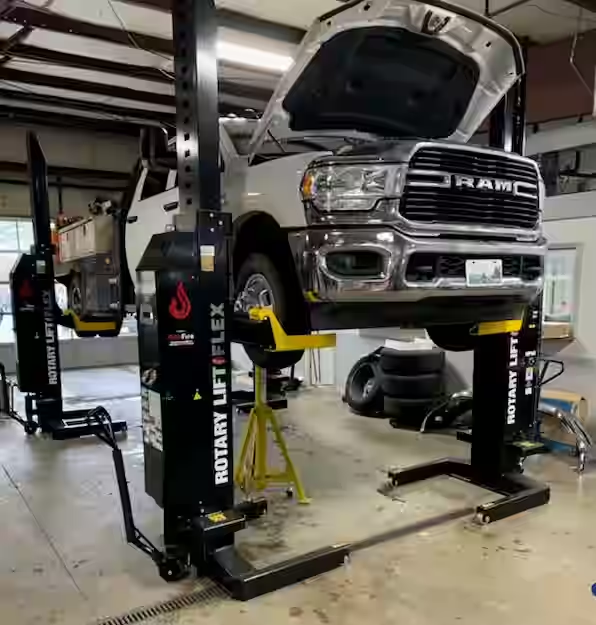
When a lift goes down in Charlotte or a paint booth fails in Novi, the silence is deafening. Here is what is actually happening to your money:
- Idle Labor: You are still paying your technicians their hourly rate or salary, but they have no way to complete the jobs on their boards.
- Lost Throughput: If your shop typically processes 10 cars a day and a equipment failure drops that to 7, you’ve lost 30% of your daily revenue.
- Managerial Overhead: Every hour a manager spends on the phone with repair techs or shuffling schedules to accommodate a broken machine is an hour not spent growing the business.
- Customer Dissatisfaction: In the age of instant reviews, a delay caused by "broken equipment" sounds like an excuse to a customer. They may not come back, and they might tell their friends.
Measuring What Matters: MTTR and MTBF
To get a handle on your shop's health, we recommend tracking two critical metrics:
- Mean Time To Repair (MTTR): This is the average time it takes to get a machine back up and running after it fails. If your MTTR is high, your "firefighting" skills need work.
- Mean Time Between Failures (MTBF): This measures the average time a piece of equipment operates between breakdowns. A low MTBF means your equipment is unreliable or your maintenance is insufficient.
By focusing on these numbers, we can move away from guessing and start making data-driven decisions that protect your profit margins.
How to Reduce Equipment Downtime in an Automotive Shop Through Proactive Maintenance
Most shops operate on a "break-fix" model. Something breaks; they fix it. This is known as reactive maintenance, and according to NIST research, it costs 5 to 7 times more than planned maintenance.
At AutoTech Solutions, we advocate for Preventative Maintenance Programs that stop failures before they start.
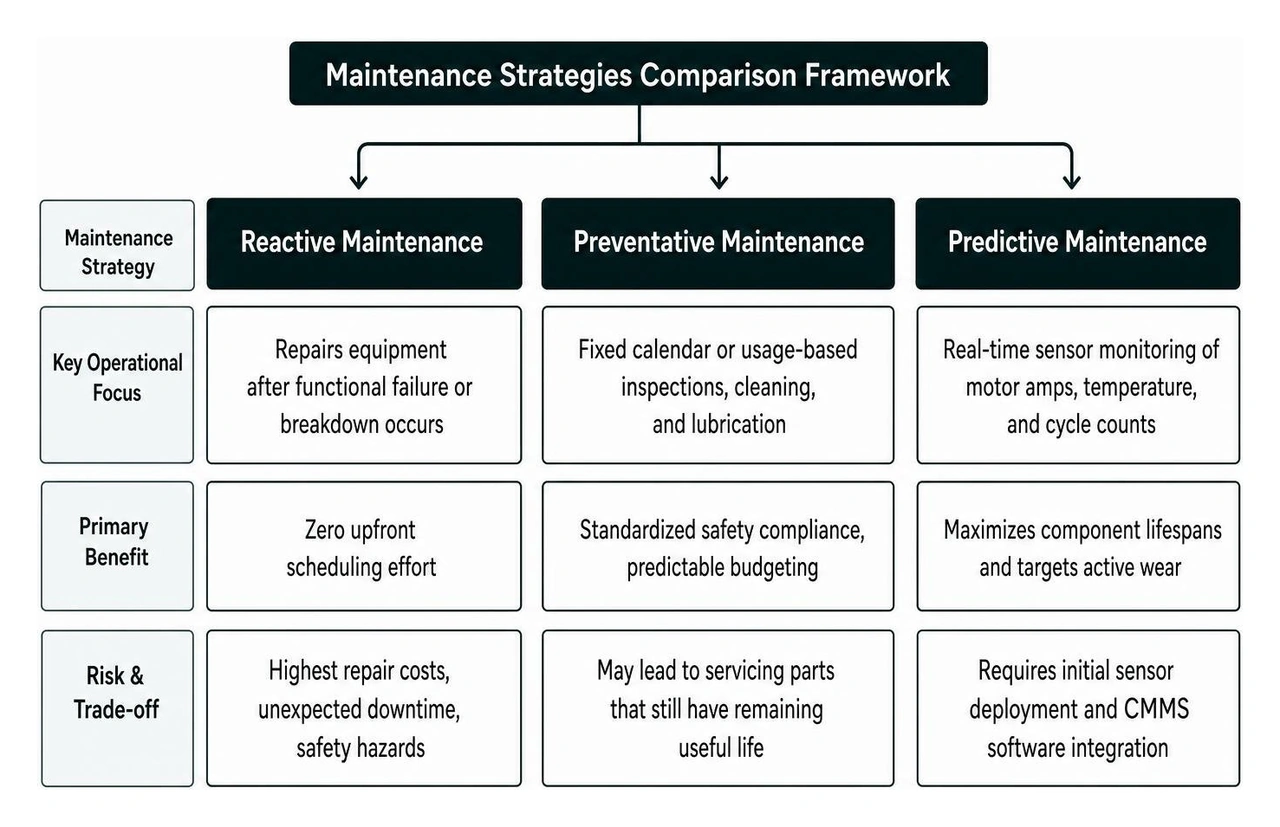
The Three Tiers of Maintenance Strategy
Understanding the difference between maintenance styles is key to long-term success.
| Maintenance Type | Approach | Cost Impact |
|---|---|---|
| Reactive | "If it ain't broke, don't fix it." | Highest (emergency repairs, lost revenue). |
| Preventative | Scheduled inspections based on time/usage. | Moderate (planned costs, high ROI). |
| Predictive | Using data/sensors to predict failure. | Lowest (repairs only when truly needed). |
For a detailed look at these differences, check out A Guide for Preventive vs. Corrective Maintenance.
The Power of Predictive Maintenance and IoT
We are entering an era where your equipment can talk to you. By using IoT (Internet of Things) sensors, we can monitor the "vital signs" of your heavy-duty lifts or compressors. For example, a sensor might detect a slight increase in vibration or heat in a motor. This allows us to schedule a repair before the motor seizes, turning a potential three-day shutdown into a 30-minute belt replacement.
Leveraging Advanced Diagnostics to Reduce Equipment Downtime in an Automotive Shop
Modern vehicles are computers on wheels, and the equipment used to fix them is just as complex. If your technicians are using outdated tools, they are spending hours on "guesswork" diagnostics.
Investing in Automotive Equipment Repair and high-level diagnostic tools can cut your diagnostic time by 30-40%. When we provide OEM-specific tools and standardized diagnostic checklists, we eliminate the "tribal knowledge" trap where only "Old Bob" knows how to fix the alignment machine.
Standardization is key. We look to the International Society of Automation (ISA) for frameworks on vibration and thermography. When your team knows exactly what "normal" looks and sounds like, they can spot "abnormal" instantly.
Using Real-Time Monitoring to Reduce Equipment Downtime in an Automotive Shop
To maximize uptime, you need to see what’s happening in your shop in real-time. This is where Nulogy Smart Factory concepts and OEE (Overall Equipment Effectiveness) software come into play.
OEE is a simple but powerful formula: Availability x Performance x Quality.
- Availability: Is the machine running when it's supposed to be?
- Performance: Is it running at its top speed?
- Quality: Is the work it produces correct the first time?
By using automated tracking, we can see if a specific lift in your Raleigh shop is constantly underperforming compared to the others. This visibility allows us to address the root cause—perhaps a hydraulic leak or a training issue—before it becomes a total failure.
Streamlining Diagnostics and Technician Workflows
Sometimes, the equipment is fine, but the process is broken. Inefficiencies in how we assign tasks can lead to massive amounts of wasted time.
The S.T.O.P. Protocol for Rapid Triage
When a machine fails, we recommend the S.T.O.P. protocol to reduce your MTTR:
- S - Secure the Scene: Ensure safety first. Lock out and tag out (LOTO) the equipment.
- T - Think and Talk: Interview the operator. What did they hear, smell, or see right before the failure? Sensory clues can eliminate 50% of potential causes.
- O - Observe: Look at the "as-is" state. Is a breaker tripped? Is a hose disconnected?
- P - Plan: Use a diagnostic path rather than just grabbing a wrench and guessing.
Skill-Based Task Assignment
Not every technician is an expert on every piece of equipment. At AutoTech Solutions, we’ve seen that shops using skill-based assignment—like sending a specialist to handle a complex Paint Booth Repair Service—complete repairs significantly faster.
Solving the Root Cause
If you keep replacing the same fuse on a tire changer, you aren't fixing the problem; you're treating a symptom. We use the "5 Whys" method to get to the bottom of things.
- Why did the machine stop? The fuse blew.
- Why did the fuse blow? The motor overloaded.
- Why did the motor overload? The bearings were dry.
- Why were the bearings dry? They weren't on the maintenance checklist.
- Why weren't they on the checklist? The manual was lost.
By finding the root cause, you ensure that the failure never happens again. For more on this, see these 5 steps to solve root causes.
Optimizing Inventory and Parts Procurement
A technician can be the fastest in the world, but they can't fix a car without parts. Statistics show that 42% of repair plans contain at least one single-use part that is often forgotten during the initial order.
Smarter Parts Management
To avoid the "waiting for parts" bottleneck, we recommend:
- Inventory Management Software: Use a system that tracks what you use most. If you are in Charlotte and you service a lot of Ford F-150s, you should never be out of common filters or brake pads.
- Automated Reorder Alerts: Set "par levels." When your stock of a critical item hits a certain number, the system should automatically order more.
- Supplier Relationships: Don't rely on just one vendor. We help shops build relationships with multiple suppliers across Michigan and the Carolinas to ensure fast access to parts, even during supply chain hiccups.
Speeding Up the "Paperwork"
Downtime isn't just about the physical repair; it's about the administrative time. Using digital payment systems and real-time invoicing allows you to close out jobs the moment the wrench is put away. This clears the bay faster for the next vehicle.
For more "quick wins," check out this guide on Quick Wins to Cut Heavy-Duty Downtime. You can also learn about Creating a Maintenance Checklist to Reduce Vehicle Downtime to keep your fleet customers happy.
Frequently Asked Questions about Reducing Shop Downtime
What are the most common causes of equipment downtime?
The most common culprits include:
- Lack of Preventative Maintenance: Skipping oil changes for compressors or failing to lubricate lift chains.
- Operator Error: Inexperienced staff using equipment outside of its intended parameters (like overloading a 2-post lift).
- Wear and Tear: Natural degradation of components like belts, hoses, and seals that aren't replaced on schedule.
- Environmental Factors: Dust, heat, and humidity, especially in collision centers, can wreak havoc on sensitive electronics.
How does OEE help improve equipment uptime?
OEE (Overall Equipment Effectiveness) provides a "score" for your equipment. If your score is low, it tells you exactly where the problem lies. Is the machine breaking down (Availability)? Is it running too slowly (Performance)? Or is it producing faulty work (Quality)? By identifying the specific weakness, you can target your resources effectively rather than wasting time on the wrong "fix."
What metrics should my shop track to measure performance?
Beyond MTTR and MTBF, we recommend tracking:
- Downtime Percentage: The amount of time equipment is down vs. its scheduled operating time.
- First-Time Fix Rate: How often a repair is completed correctly without needing a "re-do."
- Preventative Maintenance Compliance: The percentage of scheduled maintenance tasks completed on time.
Conclusion
At AutoTech Solutions, our mission is simple: we keep your shop moving. Whether you need an Automotive Lift Installation in Novi or a complete Shop Design and Consulting project in Charlotte, we focus on maximizing your uptime.
We provide comprehensive Collision Center Solutions and Installations Upfits Facility Buildouts across Michigan and the Carolinas. By combining expert support, fast repair response times, and proactive maintenance programs, we help you transition from the stress of "firefighting" to the efficiency of a high-performance shop.
Don't let unplanned downtime drain your profits. More info about Service Repair and Equipment Support is just a click away. Let’s work together to ensure your equipment is an asset, not a liability.