
Why Every Auto Shop Needs a PMS Planned Maintenance System
A pms planned maintenance system is a software-based approach that helps maintenance teams schedule, assign, track, and document recurring upkeep tasks for equipment and machinery — before problems occur.
Quick answer for auto shop owners and managers:
- What it is: A structured system to plan and record maintenance on shop equipment (lifts, paint booths, ADAS tools, compressors, etc.)
- Why it matters: Prevents unexpected breakdowns, reduces repair costs, and keeps your bays productive
- Core benefit: Shops using a PMS can cut operational costs by 15-20% and reduce unplanned downtime by up to 25%
- Who uses it: Auto service shops, collision centers, fleet facilities, and industrial operations of all sizes
- How it works: Tasks are scheduled by time, usage, or equipment condition — then assigned, completed, and logged automatically
Running an auto shop means your equipment is your business. A lift that fails mid-job, a paint booth that goes offline, or a diagnostic tool that needs emergency repair doesn't just cost money — it costs you bays, technician hours, and customer trust.
That's where a planned maintenance system comes in. Instead of waiting for something to break, a PMS keeps you ahead of the problem. It replaces the guesswork of "when did we last service that lift?" with a clear, organized schedule that runs automatically in the background.
According to industry data, 88% of real-estate and facility operations had already adopted planned preventive maintenance by 2021 — and the automotive service industry is catching up fast. For established shops managing multiple pieces of high-value equipment, a PMS isn't a luxury. It's how you protect your investment and keep revenue flowing.
Understanding the Role of a pms planned maintenance system in Modern Auto Shops
At its heart, a pms planned maintenance system is a proactive strategy. In the "old days," maintenance was often reactive—meaning we fixed things only when they smoked, squeaked, or snapped. But in a modern B2B environment, whether you are running a heavy-duty truck shop in Novi, MI, or a high-volume collision center in Charlotte, NC, reactive maintenance is a recipe for financial bleeding.
A PMS serves as the "brain" of your shop's technical operations. It is a technical system designed to help us plan, execute, and document maintenance at intervals that comply with both manufacturer requirements and safety standards. Think of it as a digital insurance policy for your most expensive assets. By moving away from "firefighting" and toward a structured plan, we ensure that every piece of equipment—from the smallest torque wrench to the largest four-post lift—is operating at peak efficiency.
The importance of these systems is perhaps best seen in the maritime industry, where the Planned Maintenance System is actually mandated by the International Safety Management (ISM) Code. While the automotive world doesn't always have the same strict international mandates as a container ship, the logic remains identical: if the equipment fails, the mission stops. For an auto shop, that "mission" is getting cars back to customers on time.
Implementing preventative maintenance programs through a PMS allows us to protect our assets by catching minor wear-and-tear before it turns into a catastrophic failure. It’s the difference between a $50 seal replacement today and a $5,000 cylinder overhaul next month.
Core Components and Features of an Effective PMS
If you’re looking to implement a pms planned maintenance system, you shouldn't just settle for a digital calendar. A truly effective system needs several "moving parts" to be useful for a busy shop manager.
The first core component is a comprehensive Equipment Database. This is a centralized repository of every asset in your shop. It should include the make, model, serial number, installation date, and—most importantly—the manufacturer’s recommended service intervals. Without this data, your PMS is just a fancy to-do list.
Next is Work Order Management. This feature allows us to create, assign, and track maintenance tasks. When a lift is due for its 6-month inspection, the system automatically generates a work order and assigns it to a technician or an external service provider like AutoTech Solutions. Once the work is done, the technician logs the completion, and the system updates the asset’s history.
Finally, we have Inventory Control and MRO (Maintenance, Repair, and Operations) Management. There is nothing more frustrating than scheduling a compressor service only to realize you don't have the right filters in stock. A high-quality PMS tracks your spare parts inventory, alerting you when stock is low so you can order parts before the maintenance date arrives.
For those managing shop equipment maintenance across multiple locations, such as a fleet owner with shops in both Raleigh and Wade, NC, these features are essential for maintaining a standardized level of safety and performance across the entire organization.
Core Features of a pms planned maintenance system
Beyond the basics, modern systems offer specialized features that take maintenance from "good" to "exceptional."
- Meter Readings: Instead of just servicing equipment every six months (time-based), a PMS can track usage. For example, a paint booth’s filters might need changing after a certain number of hours of operation. Meter readings allow for "usage-based" maintenance, which is far more accurate.
- KPI Dashboards: These provide a high-level view of your shop's health. You can see your "Mean Time Between Failures" (MTBF) or your "Schedule Compliance" rate. If you see that 30% of your scheduled maintenance is being deferred, you know you have a bottleneck that needs addressing.
- Automated Alerts: No one has time to check a dashboard every hour. Automated email or SMS alerts ensure that critical tasks—like a safety inspection on a collision frame machine—never fall through the cracks.
This is especially vital for collision center equipment maintenance, where the precision of the equipment directly impacts the safety of the repaired vehicle.
Advanced Connectivity in a pms planned maintenance system
We are currently living in the era of "Smart Shops." The integration of the Internet of Things (IoT) has transformed the pms planned maintenance system from a passive record-keeper into an active participant.
Through IoT integration, sensors can be placed directly on critical machinery. These sensors monitor vibration, temperature, and fluid levels in real-time. If a motor in your car wash or a pump in your fluid management system starts running hot, the PMS receives an alert immediately—often before a human technician would even notice a problem.
Cloud-based access is another game-changer. Whether you are at the shop in Novi or at home in Charlotte, you can log in to see the status of your equipment. This connectivity is particularly important for ADAS calibration equipment maintenance. ADAS tools require frequent software updates and precise physical calibration; a connected PMS ensures these high-tech assets are always ready for the next job.
Maintenance Strategies: From Preventive to Predictive
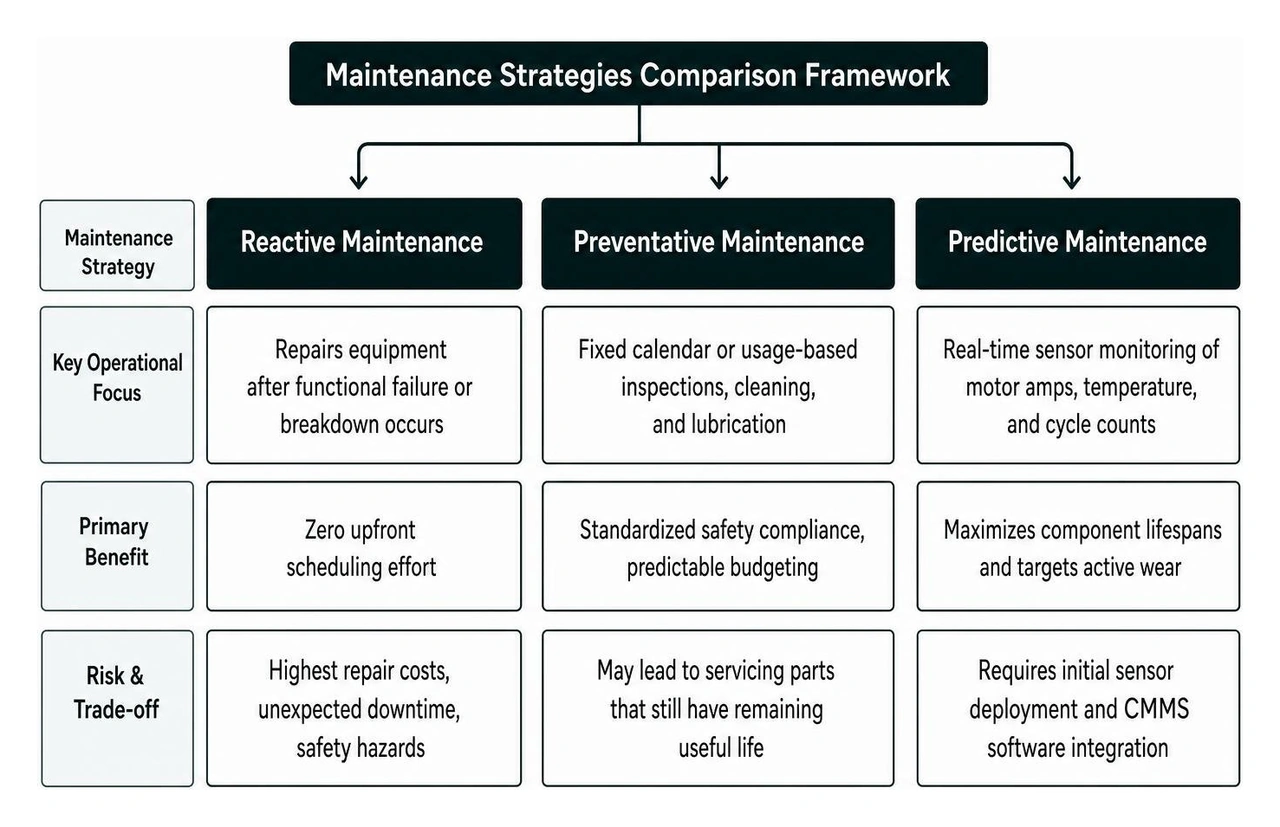
Not all maintenance is created equal. A robust pms planned maintenance system supports several different strategies, and the best shops use a mix of all three.
- Preventive Maintenance (Time-Based): This is the most common strategy. It’s like performing a scheduled inspection on a heavy-duty lift every six months. You perform the task at set intervals (weekly, monthly, annually) regardless of the equipment’s apparent condition. It’s simple to schedule but can sometimes lead to "over-maintenance."
- Usage-Based Maintenance: This is a step up in efficiency. Maintenance is triggered by actual work performed—such as the number of cycles on a lift or the hours of run-time on an air compressor.
- Predictive Maintenance (Condition-Based): This is the gold standard. By evaluating maintenance strategies for asset management, we can move toward a model where data tells us exactly when a part is going to fail. For instance, analyzing the oil in a heavy-duty hydraulic system can reveal microscopic metal shavings that signal a pump failure is imminent.
By using these strategies, we can significantly reduce the need for emergency automotive equipment repair, keeping your technicians focused on billable work rather than fixing their own tools.
The Business Case for PMS: Efficiency and Cost Reduction
If you’re wondering if a pms planned maintenance system is worth the investment, the numbers speak for themselves. In the maritime and industrial sectors, implementing a PMS has been shown to cut operational costs by 15-20% and reduce major repair expenses by a staggering 25-30%.
In the auto shop environment, the "cost" of a breakdown isn't just the repair bill. It’s the lost revenue from a bay that sits empty for three days while you wait for a part. It’s the cost of paying a technician to stand around because their lift is tagged out.
| Feature | Reactive Maintenance | Planned Maintenance (PMS) |
|---|---|---|
| Cost | High (Emergency rates, shipping) | Lower (Scheduled, bulk parts) |
| Downtime | Unpredictable & Long | Scheduled & Minimal |
| Equipment Life | Shortened by neglect | Maximized |
| Safety Risk | High (Unexpected failures) | Low (Regular inspections) |
| Staff Stress | High ("Firefighting" mode) | Low (Organized workflow) |
Implementing predictive maintenance through a PMS can reduce downtime by up to 25%. When you consider that common causes of automotive lift downtime—like worn cables or leaking seals—are easily detectable through regular checks, the business case becomes undeniable.
Overcoming Common Implementation Challenges
Switching to a pms planned maintenance system isn't as simple as flipping a switch. There are hurdles, but they are easily cleared with the right approach.
The biggest challenge is often Data Migration. If your shop has been around for 20 years, you likely have a mountain of paper records or "tribal knowledge" stored in your head technician's brain. Getting that data into a digital format takes time. We recommend starting with your most critical assets—the ones that would stop production if they broke—and building out from there.
Staff Training and User Adoption are also critical. If your technicians find the software difficult to use, they won't log their work. Choose a system with a user-friendly mobile app so they can update work orders right from the bay.
Finally, you need a breakdown response plan for critical shop equipment. Even with the best PMS, things can still go wrong. Knowing exactly who to call—and having a partner like AutoTech Solutions who can respond quickly across Michigan and the Carolinas—is the final piece of the puzzle.
Frequently Asked Questions about Planned Maintenance Systems
How does a PMS reduce equipment downtime?
A PMS reduces downtime by shifting maintenance from "unplanned" to "planned." Instead of a lift failing on a busy Tuesday morning, the system flags a worn component during a scheduled Monday evening inspection. According to a report by Plant Engineering, around 9% of equipment downtime results from a lack of time for maintenance. By carving out dedicated slots for upkeep, we avoid those "surprise" failures. This is particularly true for automotive paint booth maintenance, where regular fan and filter checks prevent the entire booth from shutting down during a spray cycle.
Is a PMS necessary for small collision shops?
Absolutely. In fact, smaller shops often feel the sting of a breakdown even more than large ones. If you only have two paint booths and one goes down, you've lost 50% of your capacity. A PMS helps small shops manage their cash flow by predicting when expensive repairs will be needed, rather than being hit with a massive, unexpected bill. It also ensures you stay in compliance with safety regulations, which is vital for liability protection. For example, following paint booth repair tips and logging them in a PMS provides a paper trail that proves you are maintaining a safe work environment.
What is the difference between a PMS and a CMMS?
While the terms are often used interchangeably, there is a slight difference. A pms planned maintenance system focuses specifically on the planning and scheduling of recurring tasks. A CMMS (Computerized Maintenance Management System) is often broader, encompassing everything from facility management to energy tracking and even human resources for the maintenance team. For most auto shops, the functionality they need is found in a robust PMS that offers service repair and equipment support features.
Conclusion
In the competitive landscape of the modern automotive industry, you can't afford to be reactive. Whether you are operating in the bustling hubs of Charlotte and Raleigh, NC, the quiet service centers of Wade, or the industrial corridors of Novi, MI, your equipment is the engine that drives your profit.
A pms planned maintenance system is more than just software; it's a commitment to operational excellence. It’s about knowing that when your technicians walk into the shop on Monday morning, every lift will rise, every compressor will hum, and every diagnostic tool will be ready to work.
At AutoTech Solutions, we specialize in helping shops minimize downtime. We don't just sell equipment; we provide the expert support, fast repair response, and preventative maintenance programs needed to keep your business moving. Don't wait for the next breakdown to start thinking about maintenance. Let us help you build a system that works as hard as you do.