Why Every Commercial Shop Needs Professional Lift Inspection Services
Lift inspection services are formal safety evaluations of automotive lifting equipment, carried out by qualified inspectors to verify that lifts meet current safety standards and are safe to operate.
Here's what you need to know at a glance:
- Who needs them: Any commercial automotive shop, dealership, or service facility operating vehicle lifts
- How often: At least once per year, per ANSI/ALI ALOIM:2020 standards
- Who performs them: ALI-certified inspectors or licensed elevator/lift inspectors (varies by region)
- What's covered: Structural, mechanical, hydraulic, electrical systems — up to 120 inspection points
- Why it matters: OSHA compliance, liability protection, technician safety, and insurance requirements
A lift is one of the most-used — and most dangerous — pieces of equipment in any commercial shop. Technicians trust it with their lives every single day. Yet it's easy to overlook routine inspections when the focus is on throughput, productivity, and keeping bays full.
The reality is simple: an uninspected lift is an unverified lift. And in a professional shop environment, that's a liability no manager should accept.
Annual inspections aren't just a best practice — in the U.S. and Canada, ANSI standards require dealerships, service stations, and educational facilities to have automotive lifts inspected every year. Health and safety officials actively check for proof of these inspections during site visits.
This guide covers everything shop owners and facility managers need to know — from what inspections include, to how often they're required, to choosing the right inspection partner.
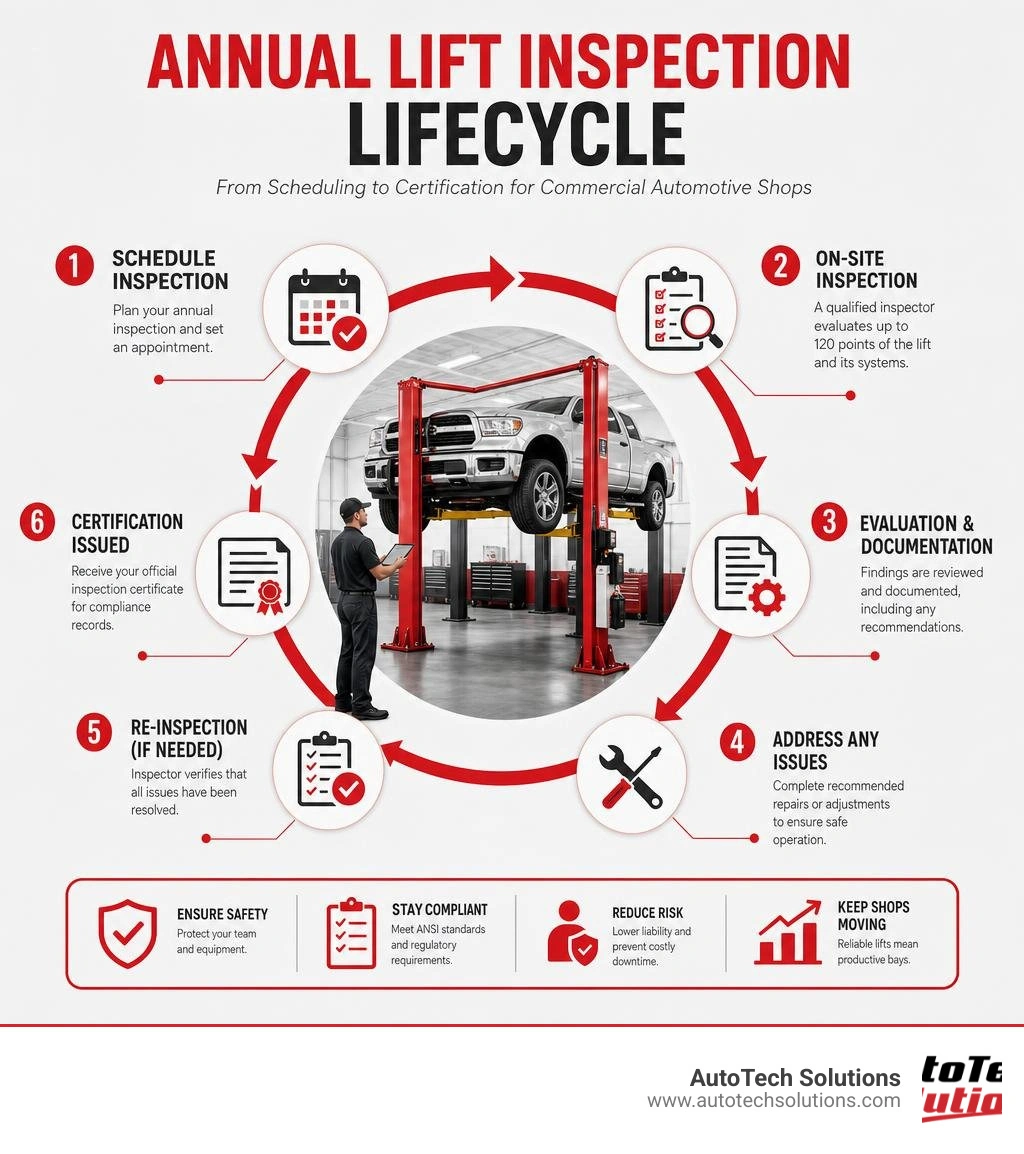
Lift inspection services terms to know:
Why Professional Lift Inspection Services Are Essential for Commercial Shops
Operating a busy commercial garage in Novi, Michigan, or across Charlotte, Raleigh, and Wade, North Carolina, requires a constant focus on safety and efficiency. Your heavy-duty and light-duty lifts are the backbone of your operations. However, because they are used repeatedly day in and day out, components naturally wear down.
Without professional lift inspection services, minor issues like hairline structural cracks, slowly leaking hydraulic cylinders, or stretched cables can go completely unnoticed until a catastrophic failure occurs. Routine Car Lift Maintenance keeps your equipment running, but a certified inspection is the only way to officially guarantee that your machinery complies with national and state laws.
Standardizing Safety with Certified Lift Inspection Services
In the automotive industry, the Gold Standard for lift safety is established by the Automotive Lift Institute (ALI). The ANSI/ALI ALOIM:2020 standard ("Safety Requirements for Operation, Inspection and Maintenance") mandates that all vehicle lifts, regardless of age, manufacturer, or model, must be inspected at least annually by a qualified lift inspector.
To ensure your shop meets these rigorous requirements, we utilize ALI Certified Lift Inspectors. A standard, certified inspection is not a quick visual walk-around. Depending on the lift type, it involves up to a 120-point inspection covering every structural, mechanical, hydraulic, pneumatic, and electrical component.
By choosing a provider that offers Check360 Certified Lift Inspections — the only lift inspection program backed and audited by ALI — you receive an official safety label for each passing lift. This label provides clear proof of compliance to anyone walking through your shop floor, from your technicians to insurance auditors.
Legal and Insurance Requirements for Shop Owners
As a commercial shop owner or facility manager, you are legally considered the "duty holder" or the primary employer responsible for workplace safety. Under OSHA regulations (and state-specific bodies like MIOSHA in Michigan), employers are legally obligated to provide a safe working environment free from recognized hazards. Failing to produce documented proof of annual lift inspections during an OSHA visit can result in severe financial penalties, mandatory shop shutdowns, and massive legal liabilities if an accident occurs.
Beyond federal and state laws, your commercial liability insurance policy likely contains clauses requiring you to maintain all shop equipment according to manufacturer specifications and industry standards. If an uninspected lift fails, your insurance provider may deny your claim, leaving your business fully exposed to devastating out-of-pocket costs.
Furthermore, keeping up with your scheduled inspections is one of the most effective ways to lower your insurance premiums. Proactive compliance demonstrates to underwriters that you run a low-risk facility. It also plays a massive role in how you manage your fleet; understanding the condition of your machinery is key to learning How to Reduce Equipment Downtime in an Automotive Shop.
Equipment Covered and Inspection Frequency
Commercial shops utilize a wide variety of lifting systems to handle everything from compact fleet cars to heavy-duty transit buses and commercial trucks. Professional lift inspection services must be tailored to the specific mechanical design of each lift type.
| Lift Type | Primary Commercial Use Case | Key Inspection Focus Areas | Required Frequency |
|---|---|---|---|
| Two-Post Lifts | Light-to-medium vehicles, quick service, brake and suspension work | Equalizer cables, arm synchronization, arm restraints, concrete anchor bolts | At least annually (ANSI/ALI) |
| Four-Post Lifts | Wheel alignment, heavy-duty trucks, long-term storage, quick lube | Sheaves, pulleys, runways, mechanical lock ladders, slack-cable devices | At least annually (ANSI/ALI) |
| Scissor Lifts | Alignment bays, collision repair, space-saving service bays | Hinge pins, hydraulic synchronization, pneumatic safety lock releases | At least annually (ANSI/ALI) |
| Mobile Column Lifts | Heavy-duty commercial fleets, transit buses, agricultural vehicles | Wireless communication, battery charge systems, carriage guiding rollers | At least annually (ANSI/ALI) |
Determining Your Inspection Schedule
While the national standard is a minimum of one inspection every 12 months, your actual schedule should be determined by your shop's specific volume and regional regulations. High-volume dealerships, multi-shift fleet maintenance centers, and collision shops operating heavy-duty equipment often schedule bi-annual or quarterly inspections to stay ahead of wear and tear.
Depending on where your business is located, you must also adhere to specific state-level directives:
- Michigan Shops: Must comply with MIOSHA regulations. Utilizing certified services ensures your shop meets the specific requirements outlined under Annual MIOSHA Vehicle Lift Inspections.
- North Carolina Shops: Must follow the guidelines monitored by the North Carolina Department of Labor. You can learn more about state-specific industrial equipment regulations directly via the Elevator | NC DOL - NC Department of Labor portal.
Understanding LOLER vs PUWER Standards
If your business operates internationally or handles compliance for global logistics partners, you might hear the terms LOLER (Lifting Operations and Lifting Equipment Regulations) and PUWER (Provision and Use of Work Equipment Regulations).
While these are UK-specific statutory instruments, understanding their core differences helps clarify why North American standards (like OSHA and ANSI) are structured the way they are:
- LOLER focuses strictly on the equipment used for lifting and lowering loads (or people). It mandates regular "thorough examinations" by a competent, independent person every 6 months for passenger-carrying lifts and every 12 months for goods-only lifts.
- PUWER applies more broadly to all work equipment (including hand tools, machinery, and assembly lines) used in the workplace, ensuring that the equipment is suitable for its intended use, regularly maintained, and operated safely.
In the United States, OSHA and ANSI integrate these concepts. ANSI/ALI ALOIM:2020 acts similarly to LOLER by focusing deeply on the mechanical safety of the lift itself, while general OSHA workplace safety mandates mimic PUWER by regulating how your technicians load, operate, and maintain that equipment daily.
What to Expect During a Professional Lift Inspection
When you book lift inspection services with AutoTech Solutions, we schedule our visit to minimize disruption to your service bays. We know that empty bays mean lost revenue, so our certified inspectors work efficiently while maintaining absolute technical precision.
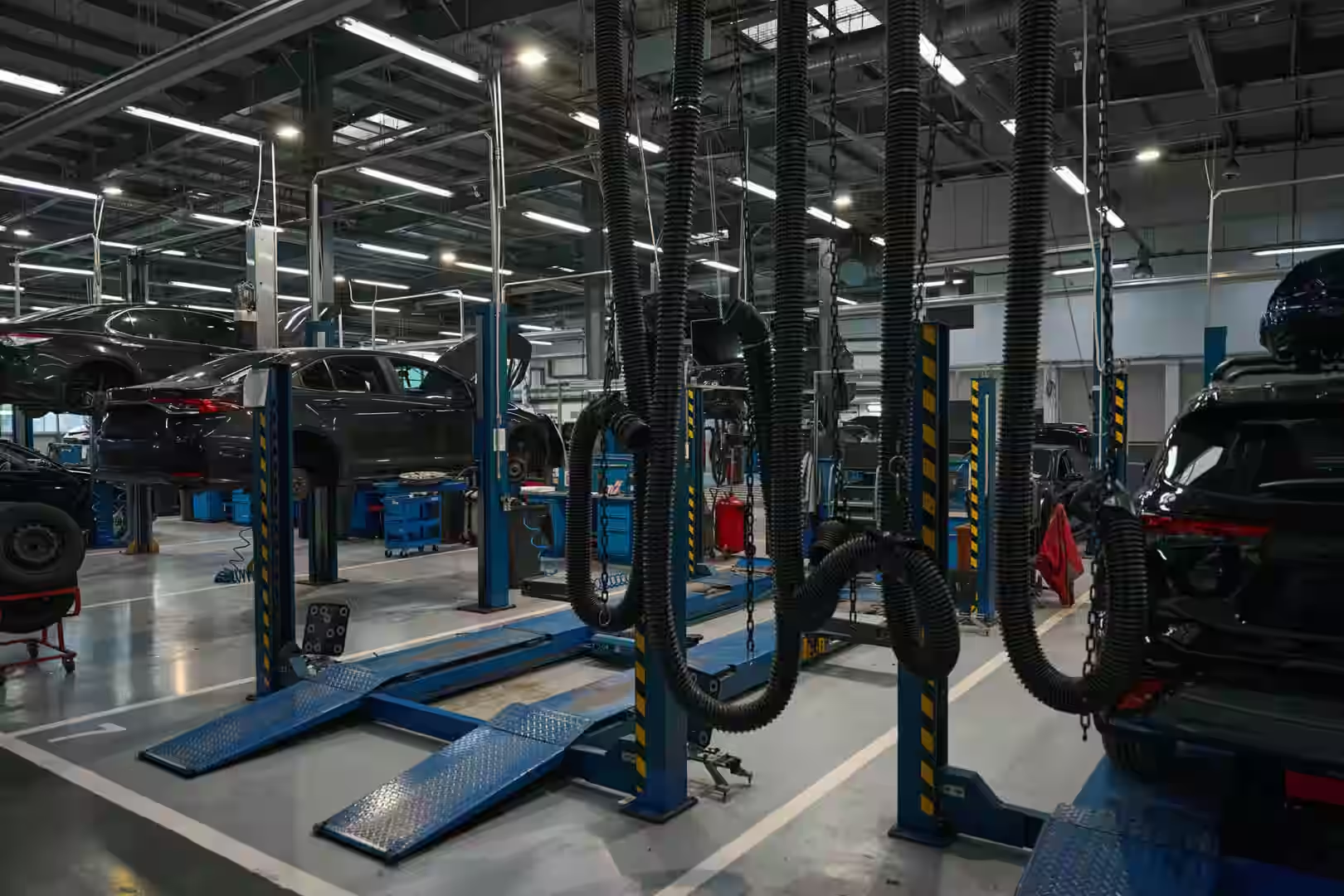
During the inspection, the inspector will examine every square inch of the machine, checking structural welds, looking for signs of concrete stress around the floor anchors, testing electrical controls, checking hydraulic fluid levels, and verifying that all safety mechanisms engage perfectly.
The 120-Point Inspection Checklist
A comprehensive lift inspection leaves nothing to chance. The inspector will systematically work through a detailed checklist, which includes:
- Cables and Chains: Checking for fraying, master link wear, correct tension, and proper lubrication.
- Safety Locks: Verifying that mechanical safety latches engage and disengage smoothly on both columns.
- Pneumatic / Hydraulic Systems: Checking hoses for dry rot, inspecting cylinders for fluid leaks, and testing the integrity of the hydraulic power unit.
- Lowering Speed: Ensuring the lift descends at a safe, controlled speed according to manufacturer standards.
- Capacity Plates and Labels: Verifying that lift capacity warnings, safety placards, and operating instructions are present and completely legible.
If any of these components are found to be worn or damaged, the inspector will note them immediately. To understand how these components are repaired or replaced, consult our comprehensive Auto Lift Repair Guide 2026.
Understanding the Inspection Report and Severity Classifications
Once the physical examination is complete, you will receive a detailed, multi-page inspection report. To make the findings easy to digest, deficiencies are classified by severity:
- Critical (Immediate Action Required): The lift has a defect that poses an immediate safety hazard (e.g., a cracked load-bearing weld or a broken safety latch). The lift must be locked out and tagged out immediately. It cannot return to service until repairs are completed.
- Major (Repair Soon): A component is showing significant wear (e.g., stretched equalizer cables) but does not pose an immediate danger. This must be scheduled for repair quickly to avoid a critical shutdown.
- Minor (Monitor): Small issues that do not affect safety but should be addressed during routine maintenance (e.g., slightly worn rubber arm pads or missing cosmetic covers).
Lifts that pass the inspection are awarded a serialized, color-coded pass sticker that is applied directly to the lift column, showing safety inspectors and technicians that the machine is certified for another calendar year.
Selecting a Qualified Inspection Partner
Your lifts are complex, high-capacity machines. You should never trust their safety certification to an unaccredited general handyman or an uncertified technician. To protect your business, your employees, and your bottom line, you must partner with an accredited inspection provider.
For a deeper look into professional lift setup and engineering standards, read our Car Lift Installers Complete Guide.
Choosing the Right Provider for Your Lift Inspection Services
When searching for lift inspection services, always verify that the provider employs certified inspectors who are registered with the Automotive Lift Institute. You can verify inspector credentials directly through the official AutoTech Solutions, LLC - Automotive Lift Institute directory listing.
A reputable provider should also offer:
- Digital-First Reporting: Providing clear, photo-documented reports that you can easily access, store, and share with insurance auditors.
- Safety Policy Consulting: Helping you build operator training logs and daily pre-use checklist sheets to keep your shop compliant year-round.
- Comprehensive Fleet Tracking: Keeping track of your annual inspection dates across multiple shop locations and automatically reminding you when your next service is due, helping you avoid the Common Causes of Automotive Lift Downtime.
If you operate in Michigan, you can also leverage specialized Elevator Inspection Services | Novi, MI to ensure complete alignment with both municipal and state-level safety codes.
Avoiding Conflicts of Interest in Inspections and Repairs
One of the biggest pitfalls commercial shop owners face is using an inspection provider that uses safety inspections as a high-pressure sales tactic to sell expensive, unnecessary repairs.
At AutoTech Solutions, we believe in complete transparency and unbiased reporting. While we provide expert repair services, our inspections are conducted strictly according to ANSI/ALI standards. If we identify a defect, we provide a detailed, itemized quote based on real mechanical data. You are never forced into an immediate purchase, and we work closely with your facility’s budget to schedule repairs logically.
In the event of an unexpected lift failure after-hours, we also offer rapid-response After Hours Automotive Lift Repair to get your bays back up and running safely.
Frequently Asked Questions about Lift Inspections
How often do commercial automotive lifts need to be inspected?
According to ANSI/ALI ALOIM:2020 standards, all commercial vehicle lifts must be inspected by a qualified lift inspector at least once every 12 months. If your shop operates multiple shifts or handles exceptionally heavy commercial fleets, you should consider bi-annual inspections to ensure continuous safety.
What happens if a lift fails its safety inspection?
If an inspector identifies a critical safety defect, the lift will be classified as "failed" and must be immediately taken out of service. The inspector will assist you in applying a lockout/tagout device to prevent accidental use. The lift cannot be used until the specific components are repaired or replaced by a qualified technician. For detailed insights on repairing two-post systems, check out our guide on Two Post Lift Repair.
Can our shop technicians perform our annual lift inspections?
No. While your shop technicians should perform daily pre-use visual checks (checking for fluid puddles, testing controls), they are not legally qualified to perform the official annual safety inspection. OSHA and ANSI standards require that annual inspections be performed by a "qualified person" who has been formally trained, tested, and certified (such as an ALI Certified Lift Inspector). Self-inspecting your lifts does not satisfy legal, state, or insurance compliance requirements.
Conclusion
At AutoTech Solutions, we are dedicated to keeping your commercial shop running safely, efficiently, and fully compliant. We serve as your trusted, one-stop B2B partner for automotive equipment sales, professional installation, preventative maintenance, and certified inspection services across Michigan and the Carolinas.
By keeping your equipment certified, you protect your technicians, lower your liability risks, and eliminate the costly downtime associated with unexpected equipment failures.
Don't wait for an unexpected OSHA audit or an equipment breakdown to check the safety of your bays. Schedule professional lift inspection and repair services with AutoTech Solutions today and keep your business moving forward safely.