When Your Shop's Auto Repair Air System Is the Backbone of Every Bay
If your shop's auto repair air system isn't performing, neither are your technicians. Here's a quick overview of what professional shops need to keep operations running at full capacity:
Quick Reference: Auto Repair Air System Essentials for Commercial Shops
| System | Purpose | Key Concern |
|---|---|---|
| Shop compressed air (rotary screw compressor) | Powers pneumatic tools across all bays | Pressure drop, duty cycle, CFM output |
| Refrigerated air dryer | Removes moisture from compressed air lines | Condensation damage to tools and lines |
| A/C recovery and recharge machine | Recovers, evacuates, and recharges vehicle refrigerants | EPA Section 609 compliance, refrigerant type |
| Piping and distribution network | Delivers clean, dry air to every drop point | Ring main design, pipe material selection |
| Preventative maintenance program | Keeps every component above running reliably | Unplanned downtime, emergency repair cost |
Every one of these systems is interconnected. A single weak link — a moisture-saturated air line, an undersized compressor, or an out-of-compliance A/C machine — can stall productivity across your entire facility.
And in a busy commercial shop, downtime doesn't just slow things down. It costs real money.
This guide is written by the AutoTech Solutions team — specialists in commercial automotive shop equipment, infrastructure, and professional-grade tool systems — to help shop managers and facility operators make smarter decisions about every layer of their air system.
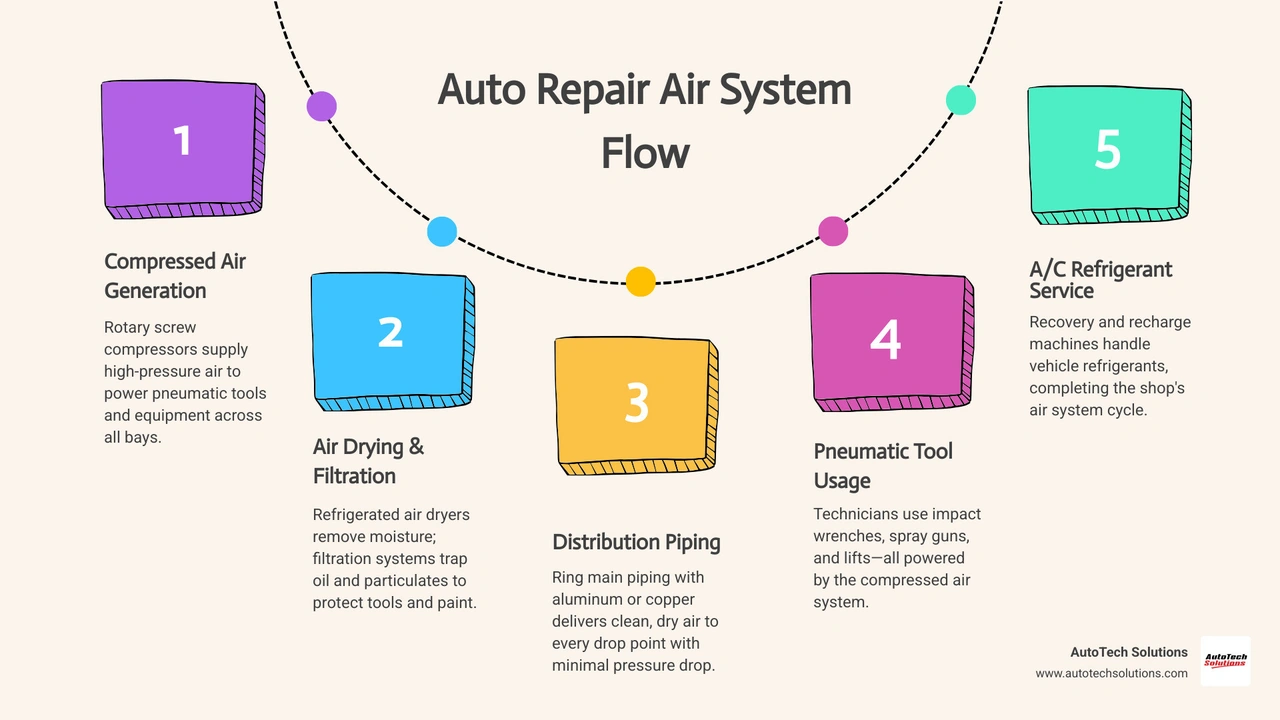
Designing a High-Performance Auto Repair Air System for Commercial Shops
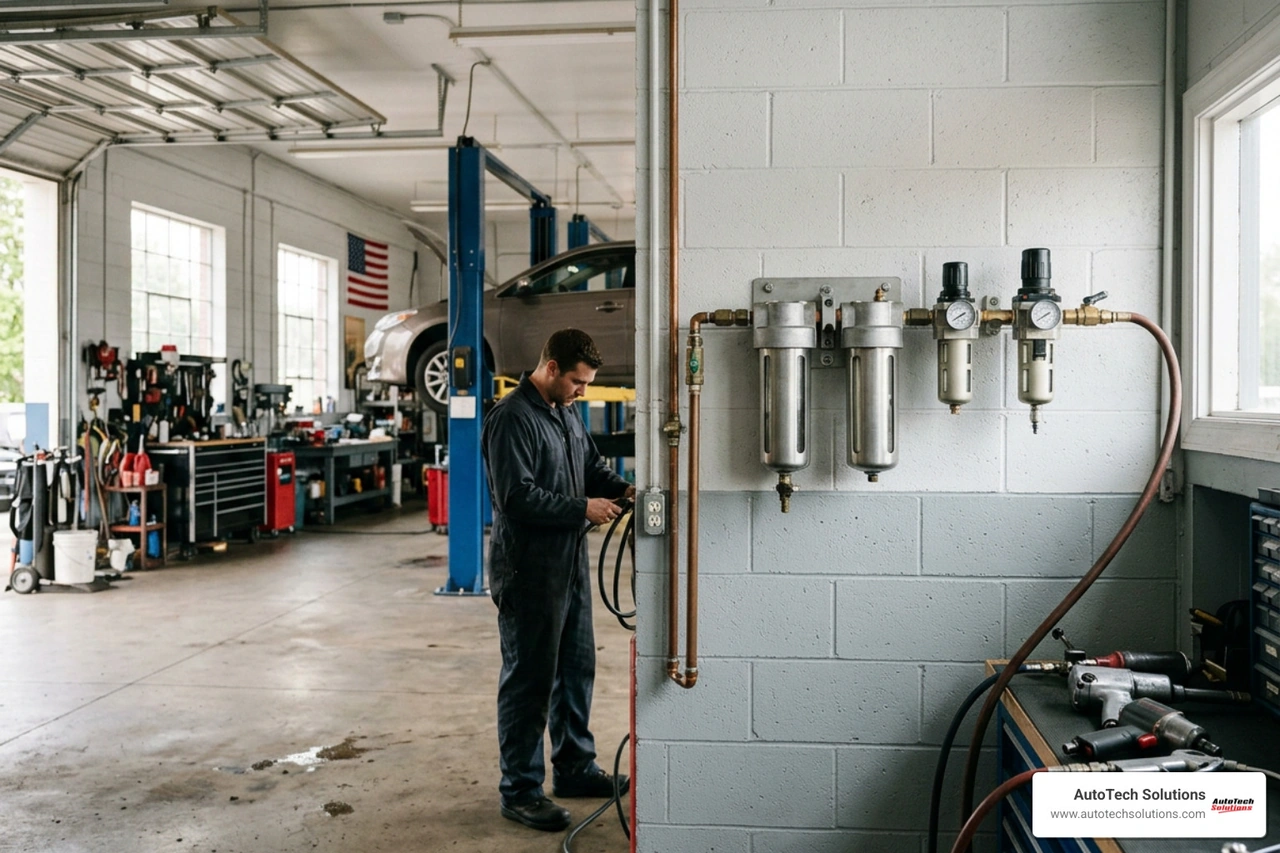
For any busy commercial repair, collision, or heavy-duty fleet facility, the compressed air infrastructure is just as critical as the electrical grid. A poorly designed system results in pressure drops, ruined paint finishes, and premature wear on expensive pneumatic tools. When we plan a commercial auto repair air system, we look at the facility's total CFM (Cubic Feet per Minute) demand, peak usage times, and the physical layout of the shop.
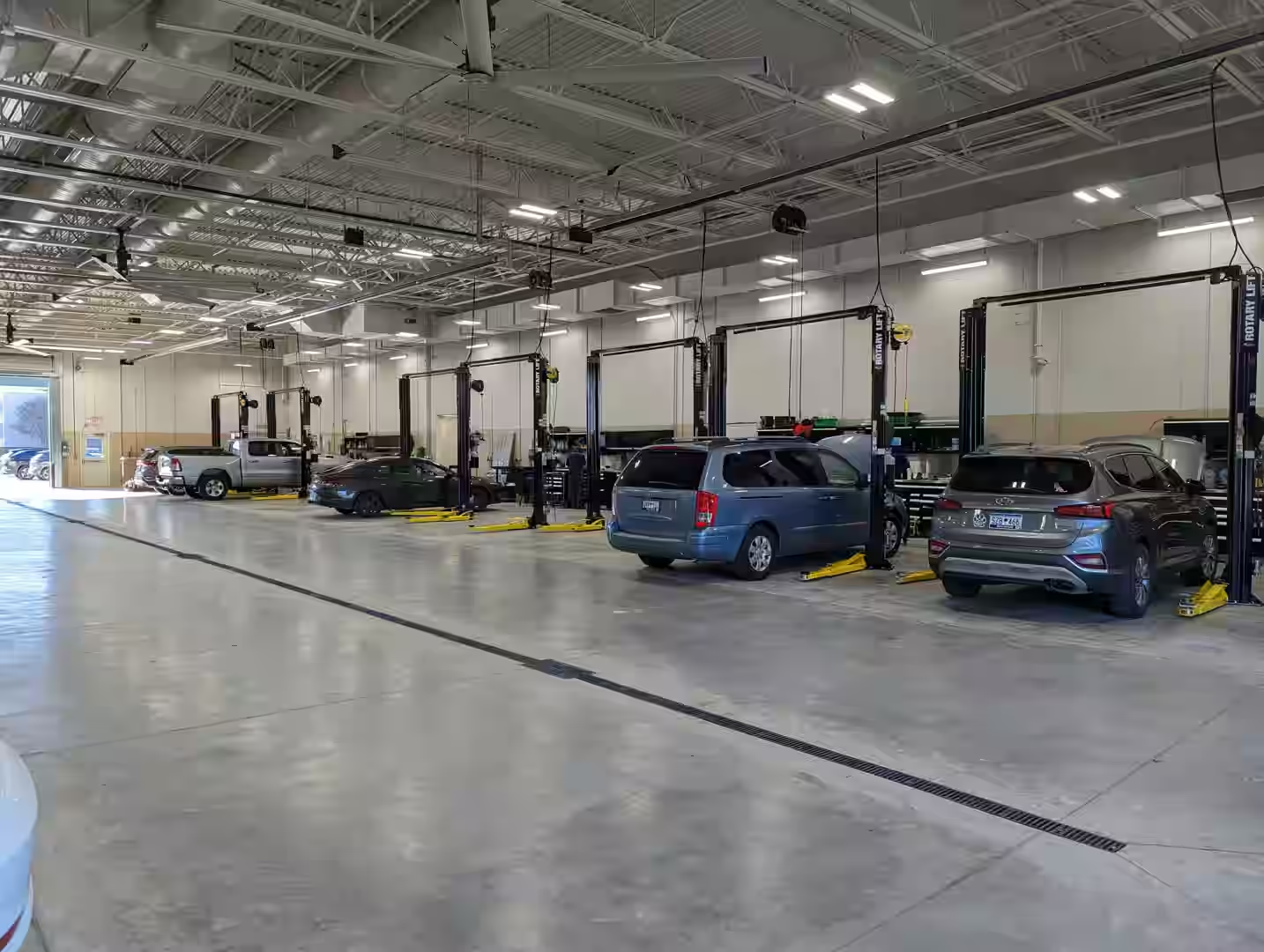
A high-performing shop system must deliver consistent, clean, dry air to every single workstation without forcing the compressor to run continuously at its absolute thermal limits. Proper system design balances the compressor output with adequate storage capacity and efficient distribution. To achieve this, proper planning during the installation phase is paramount. For a comprehensive look at how to set up your shop's system from the ground up, refer to our guide on Air Compressor Installation for Automotive Shops.
Essential Components of a Shop-Level Auto Repair Air System
To build a reliable commercial air system, you cannot rely on consumer-grade hardware. Commercial facilities require robust, industrial-grade components designed to operate under heavy workloads:
- Rotary Screw Compressors: Unlike piston compressors that require cool-down periods, rotary screw compressors are designed for a 100% duty cycle. They provide a continuous, pulsation-free supply of air, making them ideal for busy shops running multiple pneumatic lifts, impact guns, and sanders simultaneously.
- Refrigerated Air Dryers: Compressed air naturally generates heat and moisture. A refrigerated air dryer cools the compressed air, condensing and separating water vapor before it can travel downstream. This prevents internal pipe corrosion and protects sensitive pneumatic tools.
- Receiver Tanks: These tanks act as a buffer to store pressurized air, reducing compressor cycling and handling sudden spikes in air demand.
- Filtration Systems: Multi-stage filtration is required to remove particulate matter and oil aerosols. This is especially critical in collision shops, where even microscopic oil droplets can ruin a vehicle's paint finish.
When choosing premium equipment built for the demanding environment of commercial automotive bays, we highly recommend exploring Quincy Compressor Solutions to find high-efficiency, durable systems.
Preventative Maintenance for Your Auto Repair Air System
A commercial air system is a major investment, and neglecting it is a fast track to expensive, unplanned shop downtime. Implementing a structured preventative maintenance schedule ensures your pneumatic infrastructure remains efficient and safe.
Daily maintenance should start with draining condensation from the receiver tanks and filter bowls. Moisture buildup reduces tank storage capacity and causes internal rusting. Additionally, technicians must perform daily oil level checks on rotary screw compressors to ensure proper lubrication and cooling of the screw rotors.
On a weekly and monthly basis, air filters must be inspected and replaced. Clogged filters force the compressor to work harder, driving up energy costs and reducing CFM output. Finally, regular ultrasonic or soapy-water leak detection along the piping network is crucial; even a tiny 1/16-inch leak in a 100 PSI system can waste tens of thousands of cubic feet of air annually, costing your shop thousands in utility bills. For a complete checklist and step-by-step procedures, consult our Air Compressor Preventative Maintenance Guide.
Professional A/C Recovery and Recharge Equipment
As vehicle thermal management systems grow increasingly complex, commercial shops must utilize advanced, professional-grade A/C service stations. Servicing modern fleet systems requires extreme precision, strict EPA Section 609 compliance, and highly accurate weighing and vacuum systems.
Commercial shops require recovery machines that can handle continuous daily use while maintaining high recovery rates and deep vacuums. For example, the professional-grade MAXXAIR ™ MSX Series features an oilless twin-cylinder compressor that delivers a maximum recovery rate of up to 1 Lb (0.453 kg) per minute. These machines utilize a 30 lb internal storage tank designed to contain a maximum of 20.96 Lbs (9.52 Kg) of refrigerant safely, preventing overfilling.
Navigating R134a vs. R1234yf Refrigerant Standards
The automotive service industry currently operates under two primary refrigerant standards: R134a and the newer, environmentally friendly R1234yf. Under EPA regulations, most modern commercial systems are required to use R1234yf due to its significantly lower Global Warming Potential (GWP).
The environmental impact of older refrigerants is staggering. For perspective, the gas contained in one single 12-ounce container of R134a is equivalent to the carbon dioxide emissions from burning 150 gallons of gasoline. Because of this high environmental impact, strict handling and recovery laws are enforced.
For commercial shops, keeping these two refrigerants completely isolated is non-negotiable. Cross-contamination can destroy system components and ruin the internal storage tanks of your recovery equipment. Modern service centers utilize dedicated machines for each refrigerant type, or multi-refrigerant units featuring automated hose flushing utilities. These flush cycles purge residual oils and refrigerants from the service hoses—a critical step when transitioning to service hybrid or electric systems that use non-conductive compressor oils.
Step-by-Step Professional Recovery, Evacuation, and Recharge Procedure
When performing a professional A/C service, technicians must adhere to a highly precise, multi-phase workflow to ensure system reliability and environmental safety.
- Recovery: Connect the high and low-side service couplers. The recovery machine extracts the refrigerant, separating the oil and storing the clean gas in its internal cylinder. When utilizing professional equipment, such as the procedures outlined in the A/C Refrigerant (Recovery and Recharge) documentation, technicians must ensure electronic expansion valves are properly managed before recovery can begin. Additionally, proper shop safety protocols must be followed to prevent system overheating while the liquid coolant system is inactive.
- Evacuation & Vacuum Decay Test: The vacuum pump must pull a deep vacuum to boil off and remove moisture from the lines. High-end machines feature vacuum pumps rated down to an ultimate vacuum of 10 microns. After pulling a vacuum, a 5-minute vacuum decay test is performed to monitor for pressure rises, which would indicate a system leak.
- Oil Replenishment: Any oil extracted during the recovery process must be measured and replaced with the exact same volume of fresh, uncontaminated oil. When replacing major components like an HVAC module or condenser, refer to professional equipment specifications (such as those in the A/C Refrigerant (Recovery and Recharge) manual) to inject precise oil volumes (e.g., adding exactly 40 ml for an HVAC module or 20 ml for a condenser).
- Recharging: Using highly accurate internal digital scales, the machine charges the system with the exact weight of refrigerant specified. For custom or retrofitted commercial systems, such as those utilizing a 1973-79 Ford F-Series/ aftermarket evaporator kit, the charge must be carefully weighed to match the custom system design capacity (e.g., 1.8 lbs of R134a).
Compressed Air Infrastructure and Piping Layouts
The physical layout of your shop's compressed air lines has a massive impact on tool performance and operational efficiency. Poorly planned piping networks create friction, leading to severe pressure drops by the time the air reaches the furthest bays.
To eliminate pressure drops and ensure consistent volume, modern commercial garages utilize a closed-loop piping layout. By connecting all distribution lines into a continuous loop, air can flow to any given drop point from multiple directions. This design effectively doubles the flow capacity and balances pressure throughout the entire facility. To learn more about optimizing your shop's layout, read our dedicated article on Compressed Air Ring Main Systems.
Selecting the Right Piping Materials for Commercial Garages
Choosing the correct piping material is critical for system safety, air quality, and ease of installation. Commercial shops have several options, each with distinct advantages and hazards:
- Aluminum Piping: This is the modern industry standard for commercial garages. Aluminum lines are lightweight, completely corrosion-resistant, and feature smooth inner walls that minimize air friction. They use push-to-connect fittings, making installation and future shop reconfigurations incredibly fast.
- Copper Lines: Copper offers excellent corrosion resistance and a smooth interior, but it requires labor-intensive soldering and is highly susceptible to price volatility.
- Schedule 80 PVC (Extremely Hazardous): Never use PVC or any other standard plastic piping for compressed air. Under pressure, PVC becomes extremely brittle over time. If impacted or subjected to vibration, it can shatter catastrophically, sending sharp plastic shrapnel flying across the shop.
Regardless of the material chosen, proper condensation management is vital. Piping should be pitched slightly back toward the compressor, and every drop line should feature a "drop leg drain" at the bottom to capture and purge condensed water before it can enter your air hoses.
Air Compressor Repair and Maintenance for Automotive Shops
Even the best-designed systems require rapid, expert intervention when unexpected mechanical failures occur. If your primary shop compressor goes down, air tools stop spinning, tire changers stop operating, and your entire shop's revenue stream grinds to a halt.
To minimize unplanned downtime, commercial shops must partner with a service provider capable of delivering rapid emergency repair response. Common mechanical issues include failing pressure switches, worn drive belts, and clogged separator elements. Technicians should also ensure the compressor is mounted on proper vibration isolation pads to prevent structural fatigue on the tank welds. If your shop is facing pressure fluctuations, unusual noises, or complete compressor failure, you can rely on our specialized services for Air Compressor Repair and Maintenance for Automotive Shops.
Frequently Asked Questions about Commercial Air Systems
Why should commercial shops avoid standard shop air for closed-loop air suspensions?
Standard shop air contains moisture, oil aerosols, and particulate contaminants. When used to service or refill closed-loop electronic air suspension systems, this moisture can freeze in cold weather, clog sensitive control valves, and cause internal corrosion in the air struts.
According to the Air Suspension - Pressurize/Depressurize - Full System procedures, technicians must use pure, dry nitrogen to refill suspension reservoirs. The nitrogen refill kit must be regulated precisely to between 19-21 bar (275-305 psi) to ensure the system operates within OEM safety parameters and to prevent component degradation.
What are the key requirements for professional car lift installation in a commercial bay?
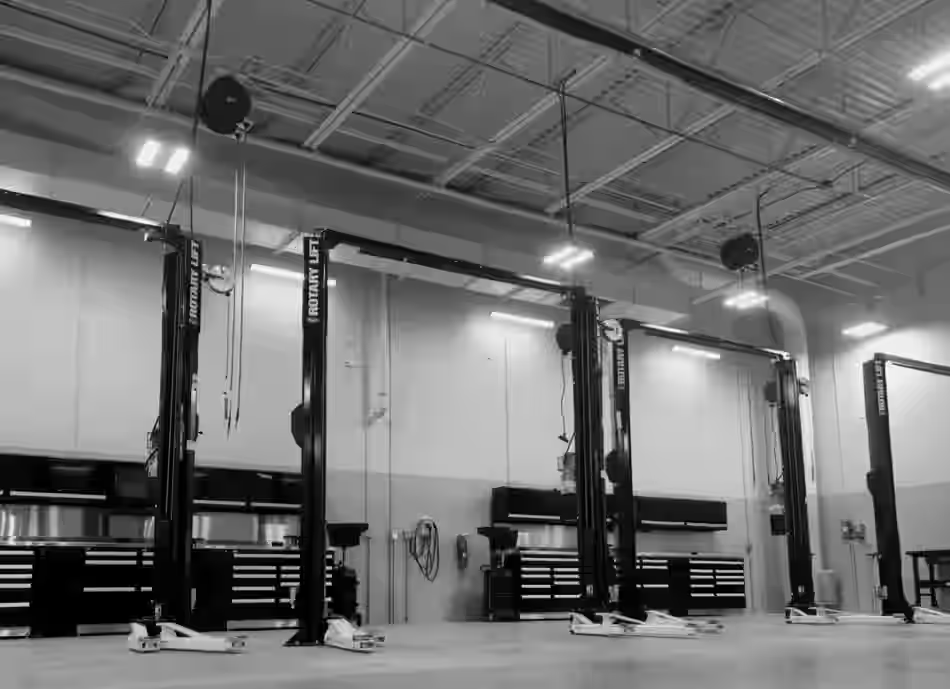
Professional car lift installation requires careful planning of concrete depth, electrical supply, and ceiling clearance. Unlike retail setups, commercial lifts must be anchored to certified concrete specifications (typically a minimum of 4 to 6 inches of 3,000 PSI concrete) to ensure safety and compliance with ANSI/ALI ALCTV standards. Partnering with certified installers ensures that the lift is properly calibrated, load-tested, and integrated into the shop's overall layout without disrupting other pneumatic or electrical infrastructure.
What safety protocols must technicians follow when handling high-pressure refrigerants?
Technicians must always wear proper personal protective equipment (PPE), including high-impact safety glasses and heavy-duty, insulated gloves, to prevent severe frostbite from liquid refrigerant contact.
Furthermore, refrigerant recovery cylinders must never be overfilled. Under federal safety standards, recovery tanks must not exceed 60% of their gross weight rating (or 80% of their liquid water volume capacity) to allow safe head-room for thermal expansion.
When operating high-pressure equipment like a 275C compressor, which pulls 20 amps maximum, has a maximum working pressure of 150 PSI, and operates on a 25% duty cycle, technicians must ensure all electrical wiring and fuses are correctly rated to prevent thermal overload. For comprehensive safety guidelines on auxiliary and compact compressor configurations, refer to the 10002_Manual.indd documentation.
Conclusion
Your shop's auto repair air system is the literal heartbeat of your service bays. From the rotary screw compressor in the utility room to the aluminum piping overhead and the advanced A/C recovery machines at the service bays, every component must work in perfect harmony to keep your technicians productive.
At AutoTech Solutions, we are dedicated to keeping your operations running at peak capacity. As a true one-stop-shop, we specialize in commercial automotive equipment sales, professional installation, rapid emergency service, and comprehensive preventative maintenance programs. Whether you operate a light-duty repair shop, a heavy-duty fleet facility, or a high-volume collision center, our mission is to minimize your downtime with expert technical support and fast repair response times.
We proudly serve commercial shops across Michigan and the Carolinas, with physical branch locations in:
- Charlotte, NC
- Raleigh, NC
- Wade, NC
- Novi, MI
Ready to upgrade your shop's air infrastructure, schedule a preventative maintenance check, or purchase industry-leading shop equipment? Contact our expert team today. For More info about service and repair support, visit our service portal and let us help you keep your shop running smoothly.