
Why the Right Vehicle Paint Booth Defines Your Shop's Output Quality
A vehicle paint booth is one of the most important investments a collision or auto body shop can make. It's not just a box you spray paint in — it's a precision-controlled environment that determines whether your finish looks factory-fresh or ends up with dust nibs, runs, and callbacks.
Quick answer: What is a vehicle paint booth?
| Feature | What It Does |
|---|---|
| Controlled enclosure | Isolates the spray area from shop contaminants |
| Filtered airflow system | Removes overspray and airborne particles |
| Heating/curing capability | Accelerates paint drying to production-ready speeds |
| Lighting system | Provides consistent visibility for accurate color matching |
| Compliance structure | Meets OSHA, NFPA 33, and local fire code requirements |
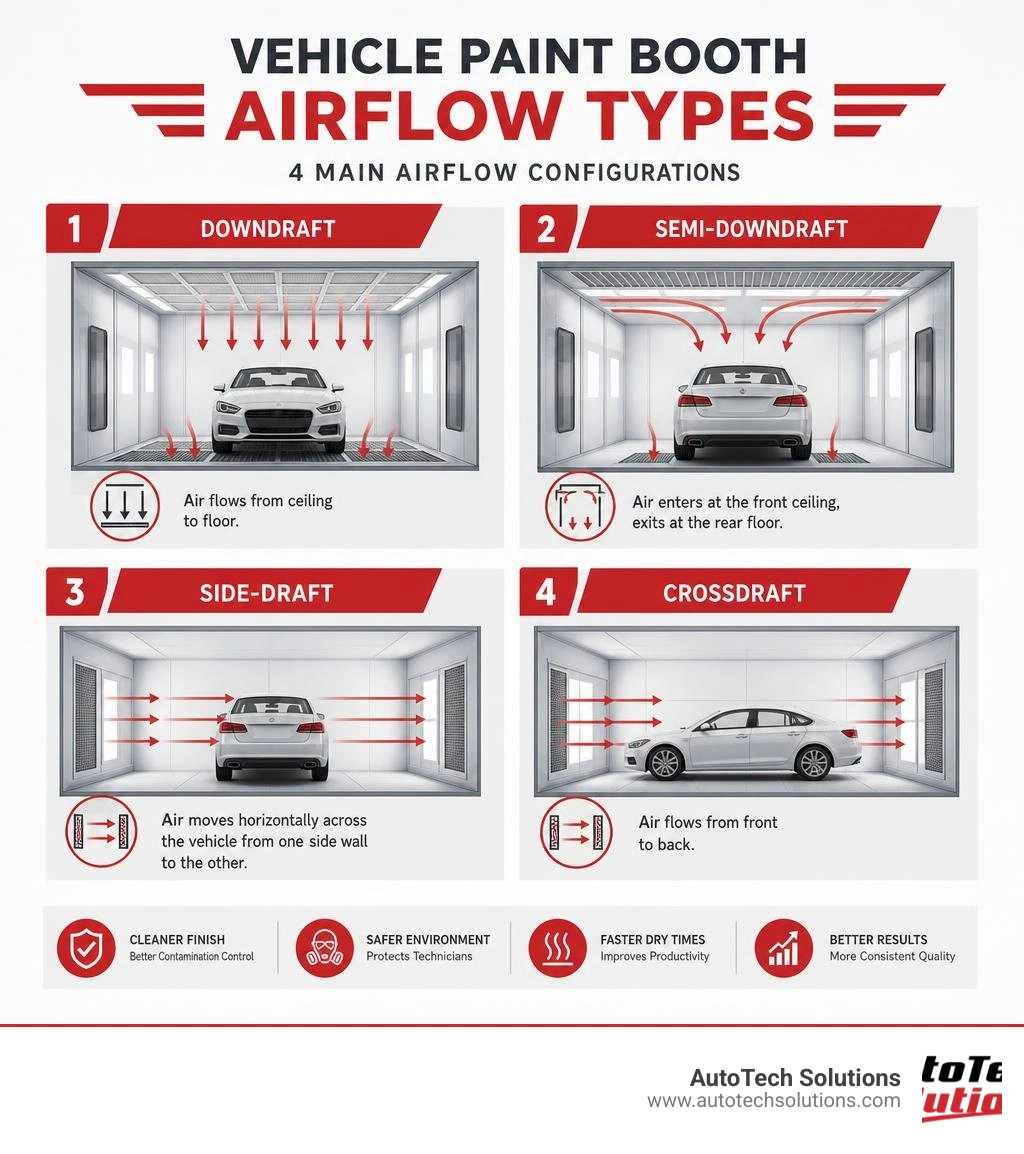
The four main types of vehicle paint booths are:
- Downdraft — air flows from ceiling to floor; cleanest finish; highest cost
- Semi-downdraft — air enters at the front ceiling, exits at the rear floor; good balance of performance and cost
- Side-draft — air moves horizontally across the vehicle from one side wall to the other
- Crossdraft — air flows front to back; most affordable; best for entry-level shops
Without the right booth, even skilled technicians struggle to produce consistent, contamination-free results. And in a competitive market where shops are measured on cycle time and rework rates, that's a problem you can't afford.
The good news is that today's commercial paint booth systems offer more flexibility, energy efficiency, and performance than ever before — whether you're refinishing commercial fleet vehicles or full-size heavy-duty trucks.
This guide walks you through everything you need to know to choose the right system for your operation.
What is a Vehicle Paint Booth and Why is it Essential?
A professional vehicle paint booth is a sealed, pressurized work area designed specifically for applying liquid coatings to vehicles. In a high-throughput collision center, it serves three critical functions: contamination control, technician safety, and curing acceleration.
When applying modern base coats and clear coats, even a microscopic dust particle can ruin a finish. A high-quality spray booth uses advanced multi-stage filtration to capture intake dust, while high-velocity exhaust fans pull overspray away from the vehicle surface. This ensures a clean environment where technicians can work without worrying about airborne debris settling on wet paint.
Beyond quality, safety is a massive factor. Spraying automotive paint releases volatile organic compounds (VOCs) and hazardous air pollutants. A properly ventilated booth keeps these vapors contained and exhausts them safely through filtered duct systems, protecting your crew and keeping your shop compliant with stringent environmental laws.
Finally, a booth is essential for proper curing. Modern waterborne and solvent-borne paints require precise temperature windows to flash off and cure correctly. High-end booths feature integrated heating systems that bake the finish, dramatically reducing drying times and boosting your shop's daily vehicle output. If you are planning an upgrade, exploring a professional Auto Body Paint Booth is the first step toward achieving flawless, factory-grade finishes.
Airflow Configurations: Choosing the Right Design for Your Shop
The way air moves through your booth directly impacts paint quality, overspray management, and the overall footprint of the equipment in your shop. Selecting the right airflow configuration is one of the most critical decisions you will make.
| Airflow Type | Air Path Direction | Contamination Risk | Excavation/Pit Required? | Ideal Shop Profile |
|---|---|---|---|---|
| Downdraft | Top ceiling to floor grates | Extremely Low | Yes (or raised basement) | High-volume collision centers |
| Semi-Downdraft | Top front ceiling to rear floor | Low to Moderate | No | Mid-sized shops looking for balance |
| Side-Draft | Ceiling to side walls | Low | No | Shops with height limits |
| Crossdraft | Front doors to back wall | Moderate | No | Entry-level shops, budget-conscious |
Downdraft Vehicle Paint Booth Systems
Downdraft booths represent the gold standard in automotive refinishing. In a true downdraft setup, air enters through a fully filtered ceiling plenum and is pulled straight down over the vehicle, exiting through grates in the floor.
Because gravity works with the airflow, overspray and dust are pulled downward instantly, away from the freshly painted panels. This minimizes the risk of contamination to almost zero. However, because the air exhausts through the floor, installing a downdraft booth usually requires concrete excavation to create a pit, or the installation of a raised basement. For a deeper look at what it takes to set up this premium system, check out our guide on Downdraft Paint Booth Installation.
Semi-Downdraft and Side-Draft Options
If excavating your shop floor isn't an option, semi-downdraft and side-draft configurations offer excellent alternatives.
In a semi-downdraft booth, air is introduced through the ceiling at the front of the booth and pulled diagonally across the vehicle to exhaust filters located at the rear floor level. This diagonal path provides excellent overspray management without requiring a pit.
Side-draft booths take air from the ceiling and exhaust it through vents along the lower side walls. This creates a clean, horizontal-to-vertical airflow pattern that keeps contaminants off the vehicle. Both options are highly popular for retrofitting existing buildings where structural modifications are difficult. You can compare these styles further by reviewing our complete resource on the Auto Body Paint Booth line.
Crossdraft Vehicle Paint Booth Setups
Crossdraft booths are the most straightforward and cost-effective designs on the market. Air enters through filters in the front main doors and flows horizontally across the length of the vehicle before exiting through an exhaust filter bank at the rear of the booth.
While crossdraft booths are highly affordable and easy to install, they do carry a slightly higher risk of contamination. Because the air travels horizontally, overspray from the front of the vehicle can potentially drift over the rear panels. However, for entry-level shops, restoration businesses, or operations focused on budget-friendly setups, a crossdraft booth is a highly reliable workhorse.
Key Features to Look For When Buying a Paint Booth
When shopping for a vehicle paint booth, it is easy to get distracted by shiny metal and big fans. However, the real value lies in the engineering of the core components.
- Lighting Quality: Accurate color matching requires shadow-free, color-corrected illumination. Look for booths equipped with high-efficiency LED fixtures mounted in both the ceiling and lower side walls.
- Filtration Efficiency: High-performance intake and exhaust filters are non-negotiable. For instance, manufacturers like RTT offer an industry-first 5-year warranty when using their high-performance RP W-Series exhaust filters, which drops to a standard 1-year warranty if alternative filters are used.
- Air Makeup Units (AMUs): An AMU replaces the air exhausted from the booth with heated, filtered outdoor air, maintaining a balanced pressure environment and ensuring consistent temperatures during spraying and curing.
Single-Skin vs. Dual-Skin Construction
One of the biggest manufacturing choices you will face is whether to buy a single-skin or dual-skin insulated paint booth.
Single-skin booths are constructed from single-sheet galvanized steel panels. They are highly durable and budget-friendly but offer no thermal insulation. This means the booth will lose heat quickly, resulting in longer bake cycles and higher fuel bills.
Dual-skin booths feature two layers of pre-coated steel sandwiching a thick layer of high-density insulation. This design excels at heat retention, which speeds up curing cycles and significantly lowers energy consumption. Dual-skin construction also provides superior structural strength and reduces the operating noise of the booth's heavy fans.
Energy Efficiency and Modern Controls
Operating a paint booth can be expensive, but modern technology has changed the game. Many advanced booths now feature smart control panels paired with Variable Frequency Drives (VFDs). VFDs automatically adjust fan speeds based on real-time filter loading, saving wear and tear on motors.
Energy-saving features can dramatically lower operating costs:
- Economy Modes: Systems like those found on the Ultra® XD Paint Booth - Global Finishing Solutions allow shops to save up to 60 percent in electricity and 75 percent in fuel costs by automatically idling the booth when it is not actively in use.
- Recirculation Technology: Advanced systems like the EcoProBooth – One Spray Booth for All Painting Tasks - Dürr use innovative recirculation modes that require only 5% fresh air. This technology achieves 75% lower energy consumption than booths using wet scrubbers, and 40% lower consumption than conventional dry scrubbers.
Essential Supporting Equipment and Accessories
To get the most out of your vehicle paint booth, you need to pair it with the right supporting infrastructure. A standalone booth cannot run efficiently without a dedicated ecosystem.
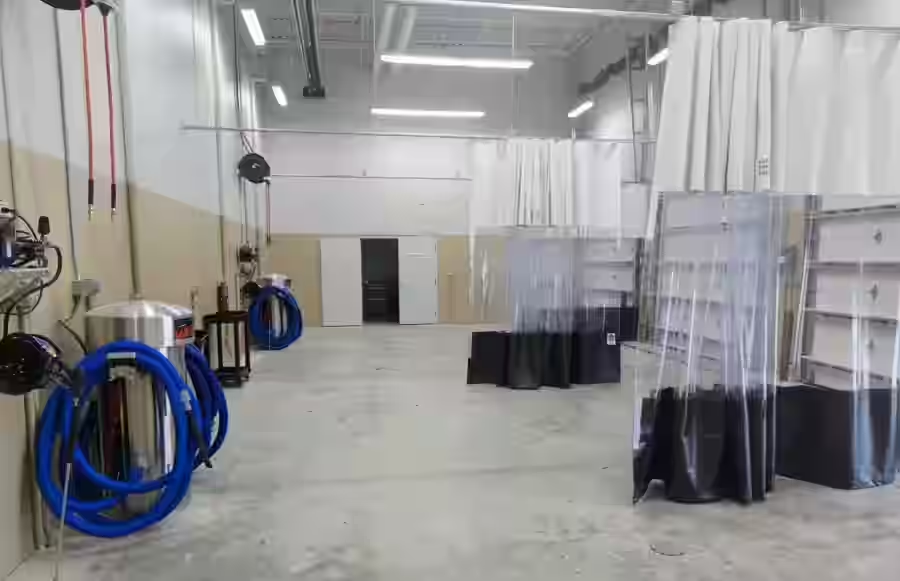
First, a certified Paint Mixing Room Equipment setup is critical. A mix room provides a clean, ventilated, and fire-safe space for technicians to prepare coatings, keeping hazardous fumes out of the main shop floor.
Second, if you are spraying waterborne coatings, an accelerated Waterborne Paint Drying System is highly recommended. Waterborne paints require high-velocity air movement to flash off water molecules quickly. Adding specialized ceiling jets or corner blowers can slash flash times in half.
Finally, do not forget about gun maintenance. Installing a high-quality Spray Gun Cleaning Machine right next to your mixing room ensures your expensive spray guns are thoroughly cleaned and maintained, preventing cross-contamination between paint jobs.
Compliance, Safety Standards, and Installation Costs
Operating a commercial paint booth means meeting strict safety and environmental standards. Your booth must comply with OSHA regulations and NFPA 33 (the standard for spray application using flammable or combustible materials). These codes govern everything from the distance of the booth from other operations to the installation of automatic fire suppression systems.
Furthermore, electrical components like fan motors, control panels, and light fixtures should carry ETL or UL listings to prove they are safe for use in hazardous, vapor-rich environments.
When planning your budget, the purchase price of the booth is only part of the equation. You must also account for permitting, ductwork, electrical hookups, gas line plumbing, and fire suppression installation. To plan your budget accurately, check out our comprehensive Paint Booth Installation Cost Guide and our Collision Center Equipment Installation Guide.
Frequently Asked Questions
How often does a vehicle paint booth require filter changes?
It depends on your spray volume, but as a general rule, exhaust filters should be replaced every 50 to 100 operating hours, while intake ceiling filters can last up to 500 hours. Always monitor your booth's draft pressure gauges; a drop in airflow is a clear sign that your filters are loaded. Keeping up with a strict schedule is a core part of Automotive Paint Booth Maintenance.
What is the difference between single-skin and dual-skin booth construction?
Single-skin booths are made of single-layer steel panels and are more affordable up front. Dual-skin booths feature insulated double-wall panels that retain heat exceptionally well, speed up paint curing times, reduce noise, and lower fuel consumption.
Do I need a permit to install a paint booth in my shop?
Yes. You will almost always need local building permits, electrical permits, and approval from your local fire marshal to ensure compliance with NFPA 33. Depending on your location, you may also need air quality permits from environmental agencies.
Conclusion
Investing in a high-quality vehicle paint booth is one of the most effective ways to elevate your shop's craftsmanship, speed up cycle times, and ensure a safe environment for your technicians. Whether you need a space-saving semi-downdraft model or a premium, high-efficiency dual-skin downdraft system, choosing the right configuration is the key to long-term profitability.
At AutoTech Solutions, we are dedicated to helping body shops and collision centers across Michigan and the Carolinas succeed. We are a true one-stop-shop, offering professional equipment sales, expert installation (including professional car lift installation), and comprehensive preventative maintenance programs.
Our ultimate goal is to minimize your shop's downtime with rapid-response repair services and expert support when you need it most. If you are ready to upgrade your refinishing capabilities, let us help you find the perfect setup. Get expert help with your Auto Body Paint Booth setup by contacting our team today.