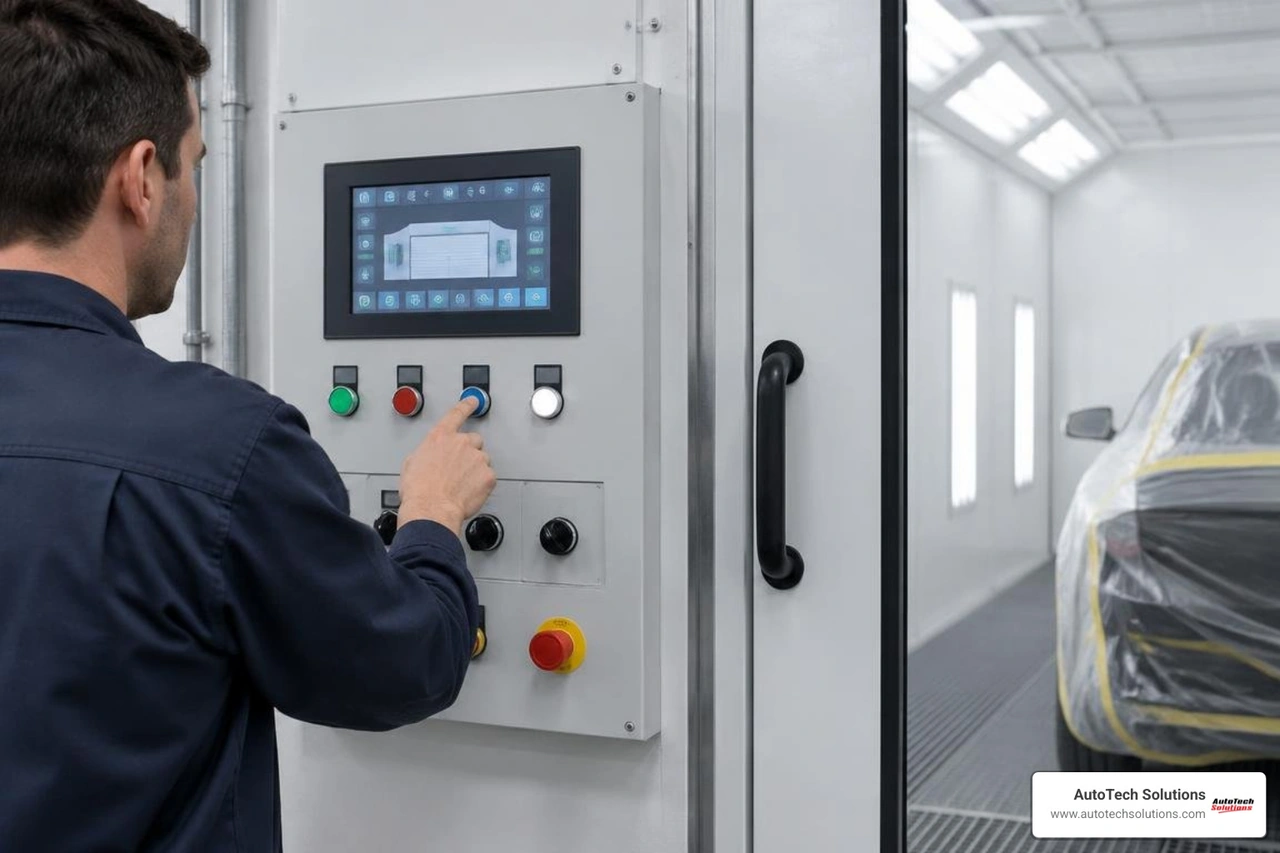
How to Choose a Paint Booth Control Panel
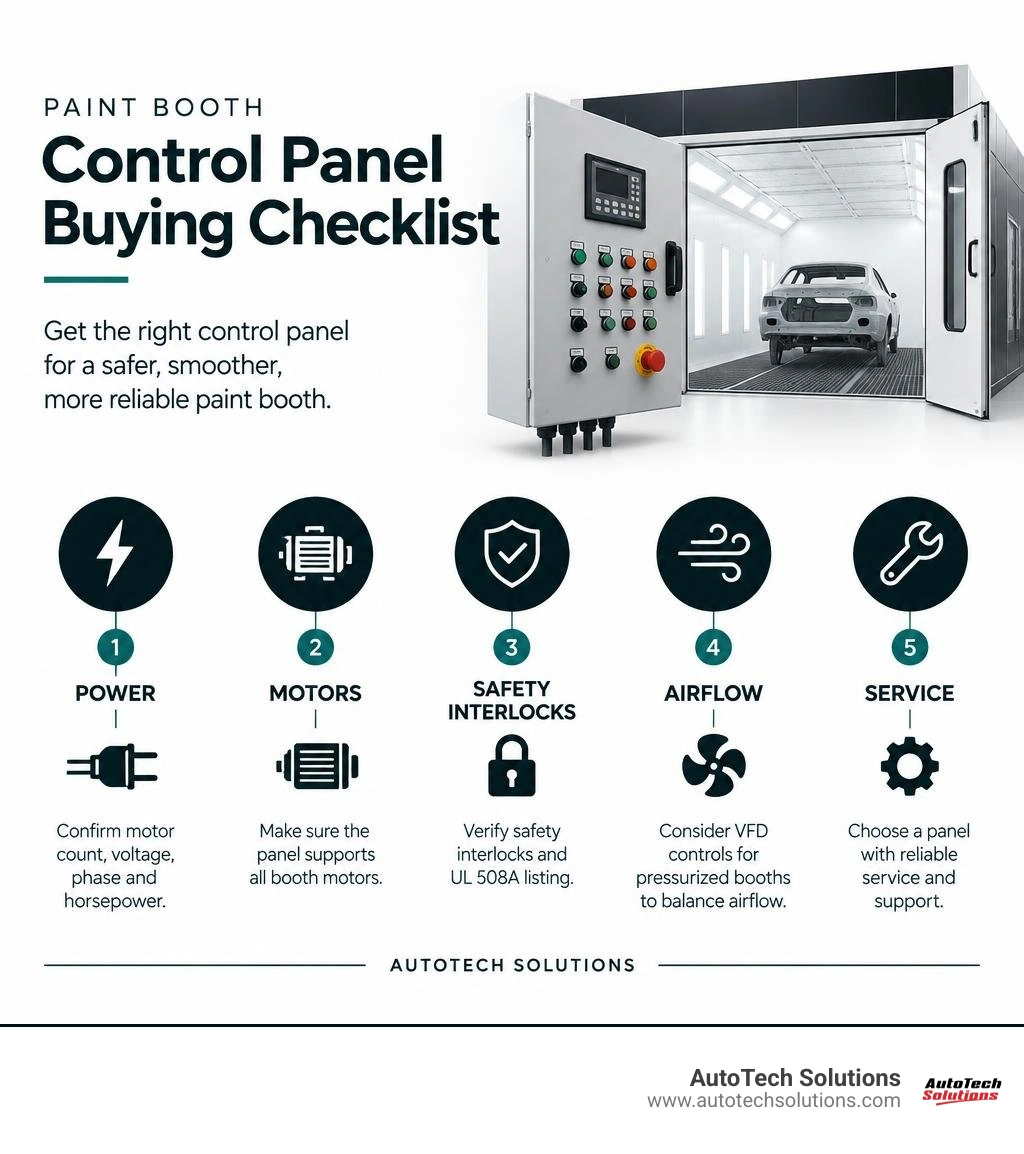
Paint booth control panel selection starts with your booth's motor count, voltage, phase, and horsepower. Before buying, confirm that the panel supports the booth's safety interlocks and has a recognized listing to UL 508A. A standard electromechanical panel may suit a non-pressurized booth; a pressurized booth may need VFD controls to balance airflow as filters load.
The right choice keeps spray cycles consistent and helps avoid shutdowns caused by mismatched equipment. At AutoTech Solutions, we help commercial facilities coordinate their auto body repair machine systems, specialized auto collision repair tools, and heavy-duty auto mechanic shop equipment for maximum uptime and efficiency.
Core Configurations: Choosing the Right Paint Booth Control Panel
Every modern commercial finishing operation relies on a central command hub to regulate airflow, illumination, heating cycles, and life-safety systems. Choosing the right spray booth electrical platform requires balancing facility electrical service with production demands. Commercial panels must handle supply options ranging from 120 VAC and 240 VAC up to 480 VAC across single-phase or three-phase systems, with motor capacities spanning 0.5 HP, 1 HP, 2 HP, 3 HP, 5 HP, 7.5 HP, 10 HP, 15 HP, 20 HP, and 25 HP.

When outfitting a commercial facility, selecting between electromechanical switches and programmable digital automation dictates long-term workflow efficiency. For facilities executing a downdraft paint booth installation, the choice of controls directly influences cabin pressure stability and finish quality.
| Feature / Specification | Standard Electromechanical Panel | Advanced Digital / VFD Touch Panel |
|---|---|---|
| Primary Interface | Push buttons, rotary selector switches, indicator lamps | Color touchscreens (HMI), programmable cycle menus |
| Airflow Control | Fixed speed via direct-on-line magnetic motor starters | Dynamic speed modulation via Variable Frequency Drives (VFD) |
| Pressure Management | Manual damper adjustments with visual manometer | Closed-loop automatic cabin pressure balancing |
| Purge & Ventilation Timers | Fixed electromechanical delay relays (e.g., 3-minute purge) | Programmable digital timers for prep, spray, flash, and cure |
| Integration Flexibility | Basic safety interlocks (solenoid, door limit switches) | Building management, fire suppression, pyrometer thermal tracking |
| Best Application | Non-pressurized crossdraft and side-downdraft booths | Pressurized downdraft, semi-downdraft, and multi-booth systems |
Standard Electromechanical Paint Booth Control Panel Systems
Standard electromechanical control panels deliver rugged, straightforward operation for commercial finishing environments. Built with robust components such as magnetic motor starters, thermal overload relays, and industrial LED pushbuttons, these systems eliminate unnecessary complexity in basic operations. In high-volume commercial refinishing, having clear visual status indicators ensures technicians can verify exhaust and illumination readiness at a single glance.
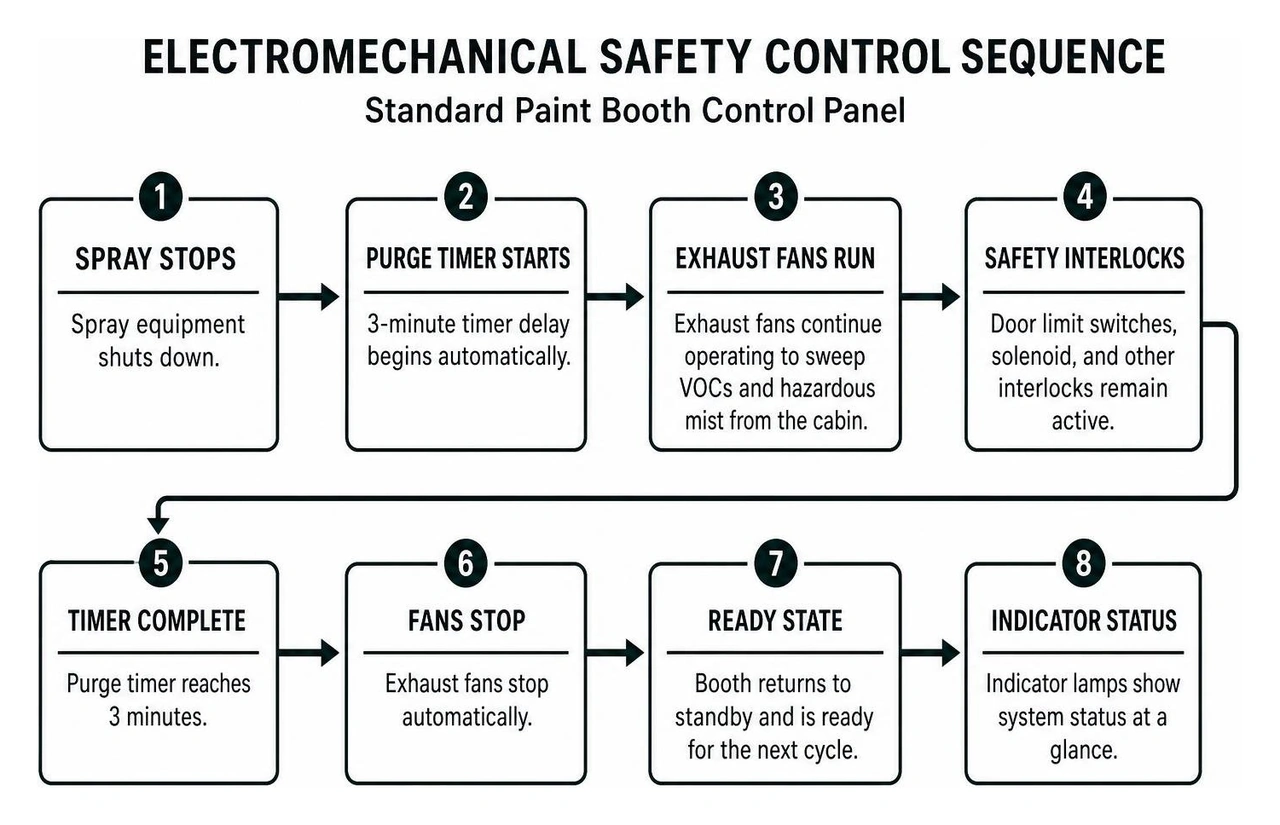
A foundational element in an electromechanical paint booth control panel is the dedicated purge delay timer. To meet stringent safety codes, the panel incorporates an automated three-minute timer delay. After spraying ceases or the spray equipment shuts down, the exhaust fans continue operating to sweep volatile organic compounds (VOCs) and hazardous mist out of the cabin through the filtration exhaust stack. Standard commercial systems rely on heavy-duty magnetic starters rather than standard lighting switches or breakers to handle motor inrush currents, significantly extending the service life of industrial fan assemblies as detailed in our automotive paint booth guide for 2026.
Advanced VFD and Touchscreen Paint Booth Control Panel Units
For high-production commercial facilities and industrial paint booth operations, advanced control architectures utilizing Variable Frequency Drives (VFD) and Programmable Logic Controllers (PLC) offer precise process control. Advanced control platforms replace manual switches with intuitive touchscreens, such as 5.7-inch color graphic displays or dedicated Smart Pad interfaces.
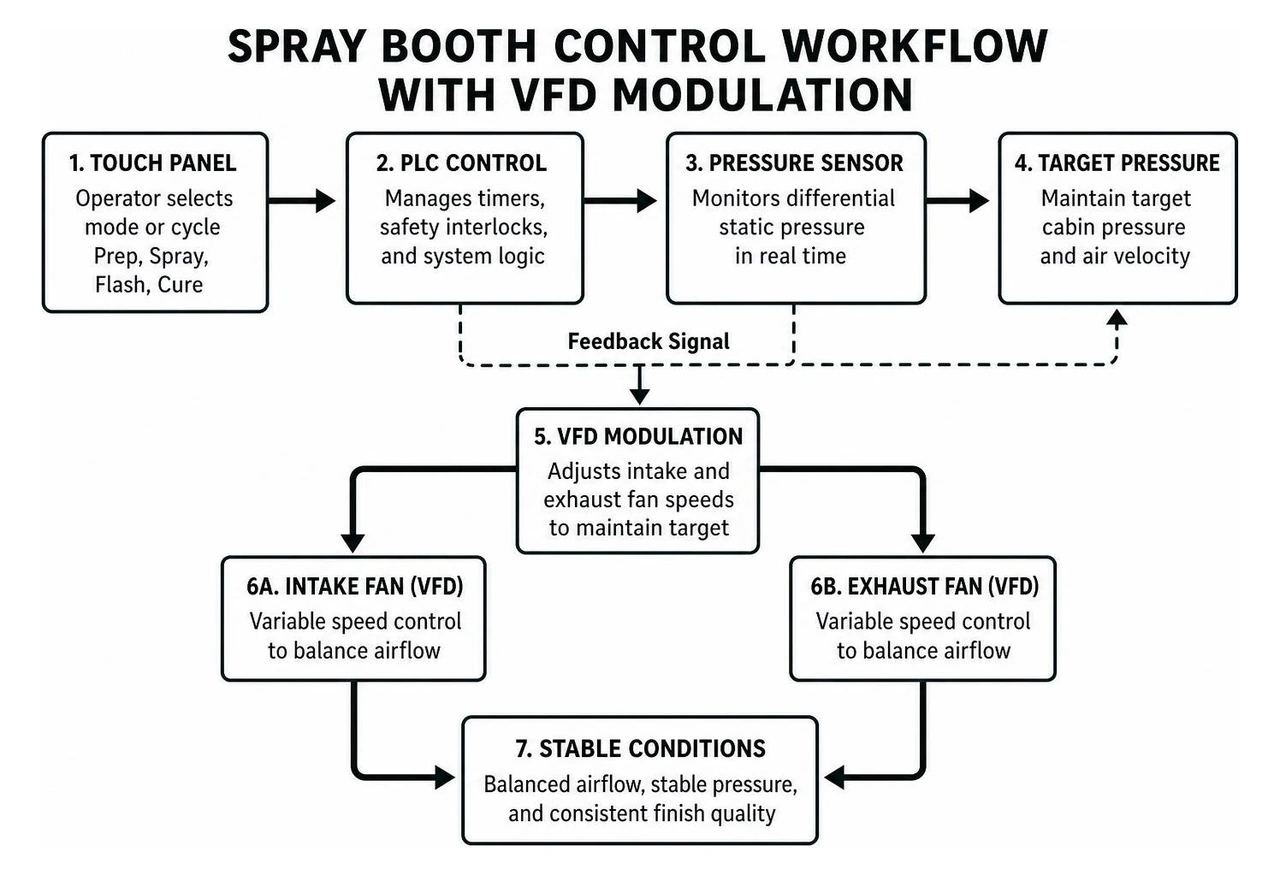
These systems excel at automatic airflow balancing. In a pressurized spray cabin, intake and exhaust filters inevitably load with overspray and ambient particulates over time. A standard fixed-speed fan system experiences declining air velocity and shifting cabin pressure as static resistance rises. VFD-equipped panels monitor differential static pressure continuously, modulating motor speeds in real time to maintain target cabin velocity without manual damper manipulation. This dynamic balancing eliminates booth turbulence, controls overspray drift, and reduces energy consumption during idle or flash-off stages.
Essential Safety Interlocks and Electrical Code Compliance
Operating an industrial spray enclosure involves managing atomized solvents, flammable vapors, and high-volume electrical infrastructure. Consequently, panel construction and field integration must adhere strictly to established safety standards, including NFPA 33 (Standard for Spray Application Using Flammable or Combustible Materials), NFPA 86 (Standard for Ovens and Furnaces), and the National Electrical Code (NEC).

All commercial enclosures must carry recognized safety listings, such as ETL certification verified against UL 508A (Standard for Industrial Control Panels) and CSA C22.2 No. 14. These standards mandate safe component spacing, short-circuit current ratings (SCCR), and reliable circuit isolation within industrial-grade NEMA 1 or NEMA 12 enclosures designed for non-hazardous placement outside the spray boundary.
Key mandatory safety interlocks routed through the main panel include:
- Compressed Air Solenoid Interlocks: An electric solenoid valve is plumbed directly into the compressed air supply feeding the spray equipment. The control panel energizes this valve only when exhaust fans achieve verified ventilation velocity. If exhaust air volume drops or power fails, the panel immediately cuts air to the spray equipment, preventing atomization in an unventilated cabin.
- Door Limit Switches: Hazardous vapor containment requires closed-door operation. Limit switches wired in series with the safety circuit signal the panel if an entry, exit, or access door opens during a cycle, instantly deactivating the spray air solenoid.
- Differential Pressure Manometers & Air Proving Switches: Commercial installations integrate static pressure sensors and air proving switches to monitor exhaust duct airflow. Integrating these sensors with the panel ensures reliable paint booth airflow validation and continuous alignment with safety standards outlined by the Occupational Safety and Health Administration (OSHA).
- Emergency Stop & Fire System Tie-Ins: Emergency shut-off pushbuttons and dry contact relays integrate the booth panel directly into the facility's master fire suppression and alarm systems to cut power and close intake dampers in an emergency.
Multi-Stage Curing Integration and Heat Management
Modern commercial refinishing requires streamlined transitions between application and curing phases. Integrated control panels manage these thermal transitions by coordinating direct-fired or indirect-fired air make-up units (AMUs), radiant heating systems, and multi-stage ventilation dampers across distinct cycle profiles:
- Prep & Spray Mode: Cabin temperature is regulated for material atomization while intake and exhaust systems maintain design laminar velocity.
- Flash-Off Mode: Fans modulate to accelerate solvent evaporation from the coating film without inducing skinning or solvent pop.
- Bake & Cure Mode: Recirculation dampers modulate while the heating system elevates cabin air up to curing temperatures (typically 140°F to 160°F for standard automotive topcoats), running on precision cycle timers before entering an automated cool-down purge.
For specialized curing workflows in modern collision repair paint booths, panels can also control high-output infrared curing lamp arrays. These high-efficiency radiant panels (often drawing up to 16.5 kW of electrical power) integrate pyrometer optical sensors directly back to the control panel. By reading real-time substrate surface temperatures, the panel modulates thermal output to prevent over-baking delicate composite components or clearcoats. Advanced setups can also incorporate UV-A LED auxiliary systems, enabling ultra-fast photo-polymerization drying cycles for specialized commercial primers.
Commercial Pricing, Selection, and Maintenance Considerations
Investing in a commercial control panel requires balancing upfront equipment costs against long-term operational reliability. Component pricing varies depending on scale, horsepower capacity, and automation complexity:
- Basic Replacement Components: Individual replacement components, such as basic replacement control modules, range between $330.95 and $410.95.
- Variable Frequency Drives (VFDs): Component-level VFDs scale by motor capacity and supply voltage. A 0.5 HP, 240V drive starts around $281.75, a 10 HP, 480V unit averages approximately $1,595.00, and high-capacity 20 HP, 480V drives reach upwards of $2,318.00.
- Touchscreen Interface Modules: Standalone commercial touch interfaces, such as Smart Pad digital controllers, list around $1,581.25.
- Complete Pre-Engineered Panels: Complete, certified industrial panels range from $1,512.00 for single-motor, single-phase electromechanical systems up to $1,875.00 for two-motor, three-phase configurations. Fully customized, multi-stage PLC control centers for large commercial booths represent higher-tier capital investments based on specific facility architecture.
When sizing a control panel, commercial shop managers must verify total connected electrical loads. Total motor horsepower across all intake fans, exhaust blowers, and burner motors must match the starter or drive amp ratings. In addition, line voltage (120V, 208V, 240V, or 480V) and electrical phase must align with the shop's main distribution panel. To budget for full-scale facility upgrades, consult our paint booth installation cost guide.
To maximize equipment lifespan and avoid unexpected downtime, incorporate panel inspections into your routine automotive paint booth maintenance schedule:
- Quarterly Terminal Torque Checks: Thermal cycling can loosen screw terminals inside the enclosure, creating resistance and heat. Technicians should verify torque specs on all power distribution blocks and contactors.
- Air Filter Servicing: Enclosure cooling vents and cabinet intake filters must remain clean and free from shop dust and overspray to prevent internal VFD overheating.
- Interlock Testing: Regularly test door switches, air solenoid cut-offs, and emergency stop circuits to confirm immediate safety system response.
- Visual Contactor Inspection: Check magnetic starter contact points for pitting or carbon buildup, replacing worn contacts before motor phase failure occurs.
Frequently Asked Questions About Spray Booth Electrical Controls
How does a paint booth air solenoid valve integrate with the control panel?
The air solenoid valve is an electrically operated valve plumbed into the compressed air line supplying atomizing air to the spray equipment. It is wired in series with the control panel's master safety circuit. The panel energizes and opens the solenoid only when all safety conditions are satisfied—specifically, when exhaust fans are actively running at verified pressure and all cabin doors are closed. If an exhaust fan fails, static pressure drops below safe thresholds, or a door opens, the panel instantly de-energizes the solenoid. This immediately cuts compressed air to the spray equipment, preventing any hazardous spraying in an unventilated or uncontained space.
What is the role of automatic airflow balancing in pressurized spray booths?
Automatic airflow balancing uses differential pressure transducers and Variable Frequency Drives (VFDs) to maintain stable cabin pressure and laminar airflow. As exhaust and ceiling intake filters capture overspray and ambient particulates over time, their static resistance increases, which naturally restricts air movement. In an automated control system, static pressure sensors inside the cabin continually communicate with the panel's PLC. The system dynamically ramps up exhaust or intake fan RPM to compensate for filter loading, maintaining neutral or slightly positive cabin pressure without requiring manual damper adjustments.
Why is UL 508A certification required for commercial paint booth panels?
UL 508A is the standard for the construction of Industrial Control Panels. Certification by a recognized Nationally Recognized Testing Laboratory (such as UL or Intertek/ETL) verifies that the panel has been designed, assembled, and tested to meet strict North American electrical safety criteria. This includes proper wire sizing, component spacing, short-circuit current ratings (SCCR), grounding, and thermal management. Operating an uncertified panel in a commercial facility violates OSHA regulations and local municipal fire codes (NFPA 33), and can result in failed building inspections, insurance coverage denial, or severe operational safety hazards.
Conclusion
A reliable paint booth control panel is the backbone of any commercial finishing facility. It coordinates airflow, precision thermal cycles, and essential life-safety interlocks to protect personnel, meet code compliance, and maintain exceptional finish quality. Upgrading to a certified, properly sized control system minimizes costly booth downtime and keeps production running smoothly.
For commercial automotive facilities across Michigan and the Carolinas seeking complete equipment solutions, expert installations, and prompt field support, trust the experienced technical team at AutoTech Solutions. Schedule professional paint booth service and repair to ensure your finishing operations remain safe, compliant, and operating at peak productivity.