
Why Preventative Maintenance Programs for Dealerships Are Essential to Your Bottom Line
Preventative maintenance programs for dealerships transform service departments from reactive repair shops into proactive revenue centers. Here's what a successful program delivers:
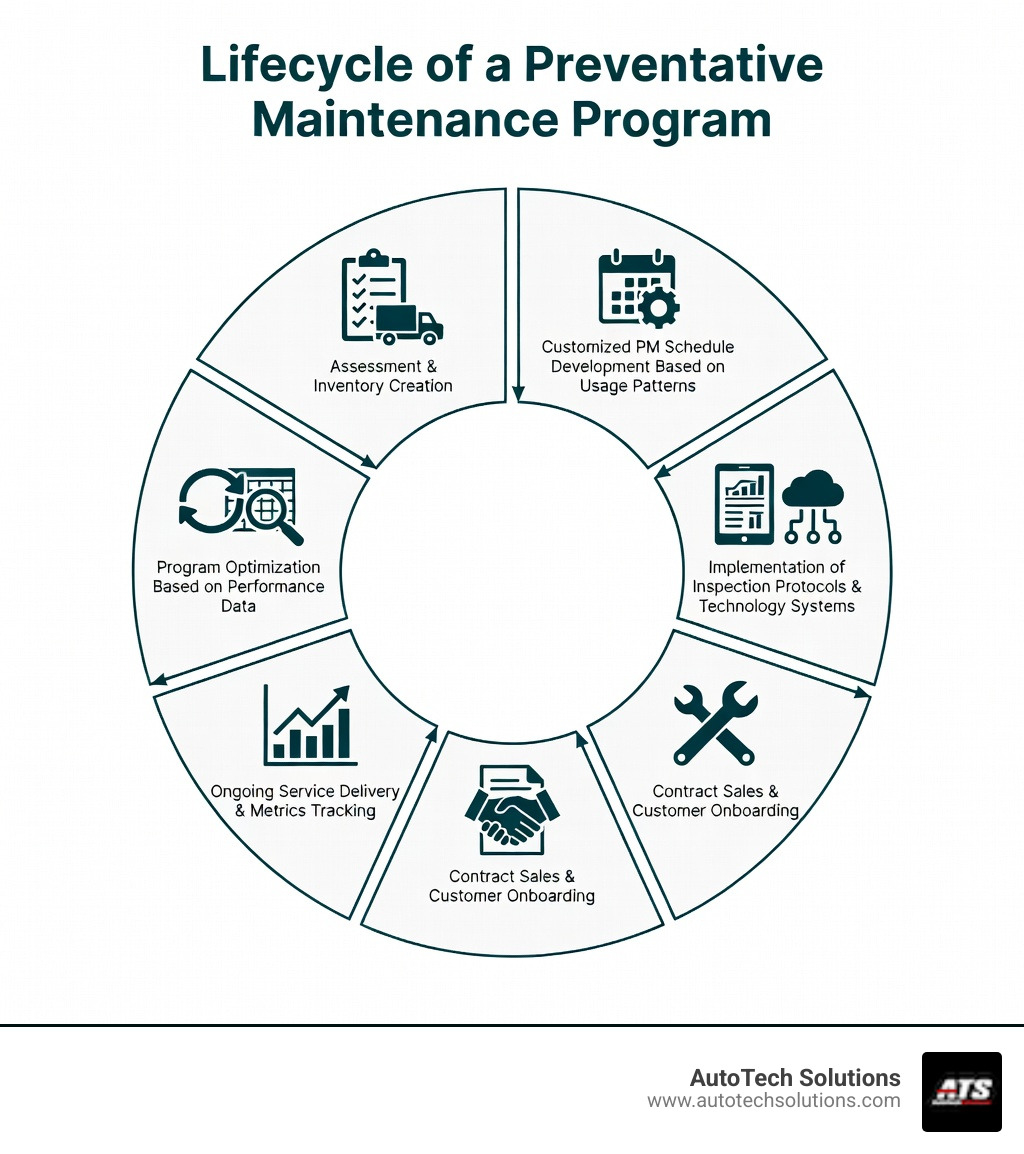
Core Components of a Dealership PM Program:
- Structured service levels - PM A, B, C, and D schedules based on mileage and usage
- Contract maintenance agreements - Monthly fees plus mileage charges for predictable fleet revenue
- Inspection protocols - Pre-service checks, inspection lanes, and yard inspections
- Technology integration - Fleet management software and automated diagnostic systems
- Compliance assurance - OSHA and ALI standards for safety and liability protection
The numbers tell a compelling story. Research shows that 90% of engine failures are preventable through proper maintenance programs. Yet many dealerships still operate on a break-fix model, leaving revenue on the table while their customers face unexpected downtime.
The technician shortage makes this even more critical. With 25,600 annual openings predicted for diesel technicians over the next decade, dealerships need smarter ways to manage service capacity. Contract maintenance programs let you schedule work during off-peak hours and build predictable workflows that maximize your existing team's productivity.
For fleets, preventative maintenance means predictable budgets and reduced downtime. For dealerships, it means steady revenue streams, stronger customer relationships, and better shop utilization. The best programs customize service intervals based on duty cycles and operating conditions rather than following one-size-fits-all schedules.
This guide walks you through building a program that works for both your service department and your fleet customers—from structuring service levels to implementing the technology and sales strategies that make PM programs profitable.
The Strategic Value of Preventative Maintenance Programs for Dealerships
When we talk about preventative maintenance programs for dealerships, we aren't just talking about changing oil. We are talking about a fundamental shift in how a dealership maintains its assets and serves its customers. At AutoTech Solutions, we’ve seen how a "break-fix" mentality can drain a shop’s resources. By the time a truck is towed in with a seized engine, the damage isn't just mechanical—it's financial.
Statistics show that 90% of engine failures are preventable with the right oversight. For a dealership, offering these programs creates a "win-win" scenario. You provide the fleet owner with revenue stability and reduced downtime, and in return, you secure a steady stream of service work that isn't dependent on the whims of fate (or a driver ignoring a dashboard light).
Combatting the Technician Shortage
The industry is currently facing a massive hurdle: the U.S. Bureau of Labor Statistics predicts 25,600 annual openings for diesel technicians over the next decade. This shortage makes it difficult for dealerships to handle sudden, massive influxes of emergency repairs. Preventative maintenance programs allow us to level out the "peaks and valleys" of shop workflow. Instead of five trucks showing up on Monday morning with blown turbos, you have twenty trucks scheduled throughout the month for routine checks. This predictability keeps your technicians happy and your bays full without the chaos.
Safety and Liability
Beyond the balance sheet, there is the matter of compliance. Federal and state regulations require systematic inspection and maintenance. If a fleet vehicle is involved in an accident and the brakes were found to be neglected, the liability can be catastrophic. A robust PM program ensures that every vehicle meets safety standards, protecting both the fleet and the dealership from potential litigation.
Structuring Service Levels and Customizing PM Schedules
A "one-size-fits-all" approach to maintenance is a recipe for either over-servicing (wasting money) or under-servicing (causing breakdowns). To build a bulletproof program, we categorize services into levels, often referred to as PM A, B, C, and D.

The PM Service Hierarchy
- PM A (Safety Check & Lubrication): This is your "minor" service. It typically occurs every 1,500 to 2,500 miles for light vehicles and 5,000 to 10,000 miles for medium/heavy trucks. It focuses on high-wear items: lights, tires, brakes, and basic lubrication.
- PM B (The Standard Service): This includes everything in PM A plus an oil and filter change. We also recommend engine and driveline checks and ECM (Electronic Control Module) downloads to check for hidden fault codes. This usually happens every 3,000 to 20,000 miles depending on the vehicle weight class.
- PM C (The Comprehensive Inspection): This is a deeper dive, often scheduled annually or every 11 months to align with DOT requirements. It involves more extensive component testing and adjustments.
- PM D (The Major Service): This level often includes seasonal work, such as cooling system flushes or major drivetrain components that require infrequent but vital attention.
Trailer and Auxiliary Maintenance
Don't forget the trailers! A truck is only as useful as what it's pulling. Trailer PM schedules (T1, T2, T3) should mirror the tractor's schedule. T1 every 3 months, T2 every 6 months, and T3 annually is a standard best practice. At AutoTech Solutions, we also emphasize shop design and consulting to ensure your facility is equipped to handle these diverse service levels efficiently.
Designing Preventative Maintenance Programs for Dealerships Based on Usage
The "manufacturer's manual" is a great starting point, but it doesn't know if your customer is hauling flowers in Raleigh or gravel in the Michigan winter. We must customize schedules based on:
- Duty Cycles: Is the vehicle idling 50% of the time? That's hard on the engine.
- Severe-Duty Conditions: Towing, off-road use, and extreme temperatures require shorter intervals.
- Usage Metrics: Some fleets prefer scheduling by engine hours or fuel consumption rather than just mileage.
By offering installations, upfits, and facility buildouts, we help dealerships create specialized areas to handle these high-frequency, high-customization checks.
Essential Checklists for Preventative Maintenance Programs for Dealerships
A PM program is only as good as the technician's checklist. If they skip a step, the program fails. Every routine inspection should include:
- Fluid Analysis: Checking for contaminants in oil and coolant.
- Brake Systems: Measuring pad thickness and checking for air leaks.
- Tire Health: Beyond tread depth, look for irregular wear patterns that signal alignment issues.
- Shop Equipment Safety: This is crucial. Your automotive lift installation must be inspected too. We check anchor bolts, safety shut-offs, and cable tension to ensure the technicians themselves are safe while performing the PM.
Implementing Contract Maintenance and Sales Strategies
The most successful preventative maintenance programs for dealerships are sold as contracts. Why? Because it locks in the relationship. When a fleet buys a truck, that is the perfect time to share financial projections showing how much they will save over five years by avoiding emergency repairs.
Pricing and Structure
Most contracts use a "monthly fee + mileage" structure. This makes budgeting predictable for the fleet manager. You can even wrap the cost of the maintenance contract into the vehicle's monthly payment. This "all-in" approach is highly attractive to fleets that want to avoid "repair bill shock."
The "Priority Service" Hook
One of the biggest selling points is priority service. Contract customers shouldn't wait in the same line as "walk-ins." By offering service repair and equipment support with dedicated lanes for PM customers, you reduce their downtime—which is their number one concern.
Leveraging Technology and Inspections for Maximum Efficiency
In the modern dealership, a clipboard and a pen won't cut it. To truly optimize preventative maintenance programs for dealerships, you need to leverage technology.
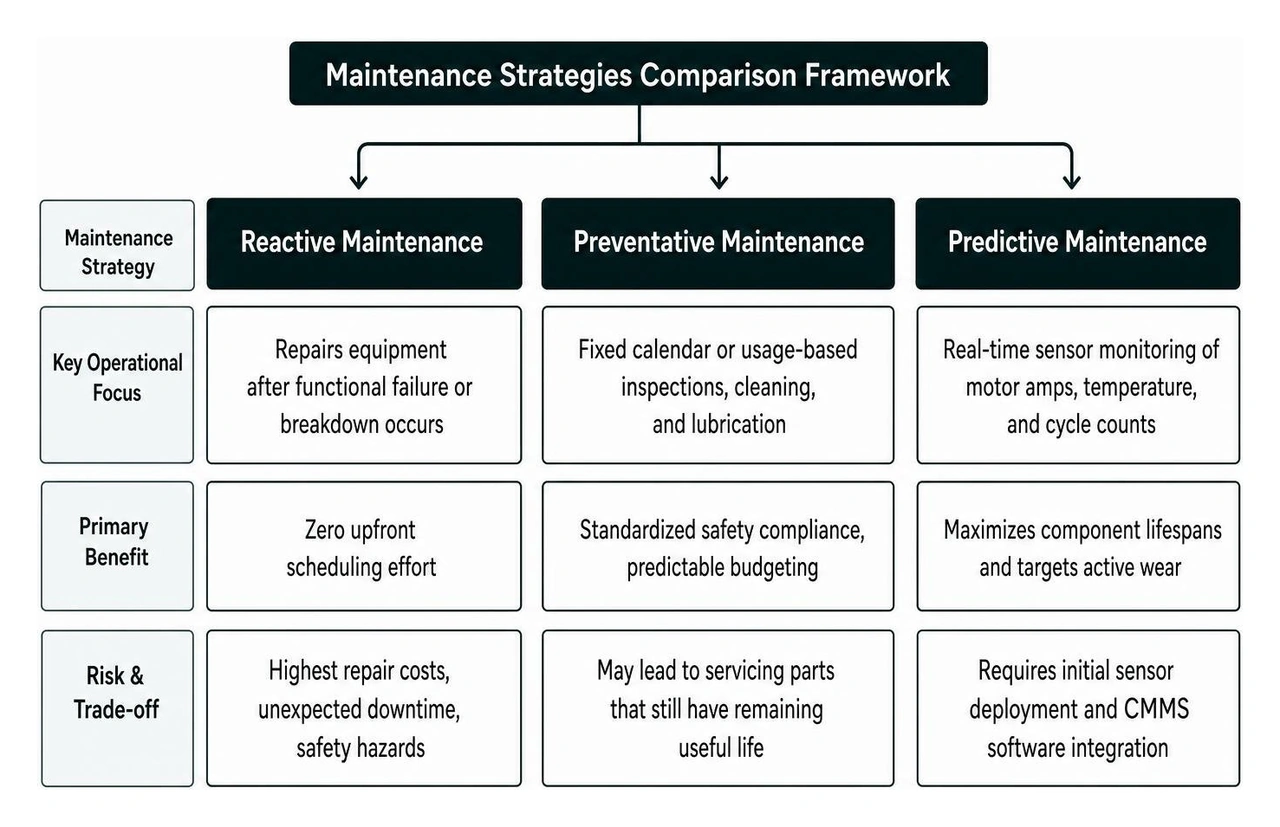
| Maintenance Type | Approach | Benefit | When to Use |
|---|---|---|---|
| Preventive | Scheduled tasks (Oil, filters, inspections) | Prevents common failures | For all fleet assets |
| Corrective | Reactive repairs (Fixing what's broken) | Restores function | Unforeseen accidents/failures |
| Predictive | Data-driven (Telematics, sensors) | Fixes things just before failure | High-value, critical components |
Inspection Lanes and Yard Checks
We recommend implementing "Inspection Lanes." When a truck enters the yard, it passes through a quick screening. This is where drivers and technicians can spot leaks, cracked lights, or low tires before the truck is even parked. "Yard checks" involve technicians cruising the lot at set times to inspect newly arrived equipment. This proactive approach catches small issues before they become "Red Tags" on the road.
Optimizing Preventative Maintenance Programs for Dealerships with Advanced Tools
Systems like the Hunter Quick Check can perform a full vehicle inspection—alignment, brakes, battery health, and tires—in under two minutes. This allows you to check every car or truck that enters the service drive.
Furthermore, we must adhere to ALI standards for our own shop equipment. If your lifts aren't maintained, your PM program stops. We provide automotive equipment repair and paint booth repair service to ensure your dealership's infrastructure supports your high-tech maintenance goals.
Compliance, Safety, and Measuring Program Success
How do you know if your program is actually working? You have to track the metrics. We recommend monitoring:
- Scheduled vs. Unscheduled Work: A healthy program should have at least 70-80% of work being scheduled.
- Downtime Tracking: How many hours is the average fleet vehicle out of service per month?
- ROI on PM: Compare the cost of the PM program against the historical cost of emergency repairs for that fleet.
The Shield of Compliance
By following elements of a successful PM program, you aren't just fixing trucks; you're building a legal defense. Annual lift inspections and OSHA-compliant records prove that you operate a professional, safe environment. This is especially vital for collision center solutions, where equipment safety is paramount.
Frequently Asked Questions about Dealership PM Programs
What is the difference between PM A and PM B service levels?
PM A is essentially a safety and "lube" job. It focuses on the basics to keep the vehicle legal and moving. PM B is more intensive, including the oil change and a deeper dive into the engine's electronic health via ECM downloads. Think of PM A as a check-up and PM B as a physical.
How do maintenance contracts help with the diesel technician shortage?
Because maintenance is scheduled, we can move work to times when the shop is less busy. This prevents technician burnout and allows us to use our most skilled people for complex diagnostics while newer techs handle the routine PM tasks. It creates a more sustainable workflow for the 25,600 annual openings we need to fill.
Why are pre-service inspections critical for new fleet vehicles?
You’d be surprised how many vehicles leave the factory with minor defects or suffer damage during transport. A pre-service inspection ensures the fleet owner receives exactly what they paid for and that the vehicle is safe the moment it hits the road. It also allows the dealership to address warranty issues immediately rather than three months later when the truck breaks down on a highway.
Conclusion
Building a bulletproof program takes more than a checklist; it takes a commitment to a proactive culture. At AutoTech Solutions, we specialize in helping dealerships from Michigan to the Carolinas build the infrastructure they need to succeed. Whether it's through expert equipment support, fast repair response, or consulting on shop design, we are your partners in minimizing downtime.
Ready to take your service department to the next level? Explore our Preventative Maintenance Programs and let us help you turn "broken" into "bulletproof."