The Real Cost of Skipping a Preventative Maintenance Service

A preventative maintenance service is a scheduled, proactive approach to inspecting, cleaning, lubricating, and servicing equipment before problems occur — keeping your shop running safely and efficiently.
Quick answer: What does a preventative maintenance service include?
- Routine inspections of critical equipment (lifts, compressors, dryers, hoists)
- Lubrication of moving and rotating parts
- Filter and fluid replacements on set schedules
- Belt, hose, and cable checks for wear and tension
- Performance testing to catch issues before they cause downtime
- Documentation of service history for compliance and warranty protection
Here's something worth thinking about: unplanned downtime costs industrial manufacturers an estimated $50 billion annually. And running equipment until it fails can cost ten times more than simply maintaining it on a regular schedule.
For automotive shops, that math hits close to home. A lift that fails mid-job, a compressor that dies during peak hours, or a paint booth that goes offline — these aren't just inconveniences. They stop production, strand customers, and put technicians at risk.
The good news? Most of these failures are preventable.
This guide walks you through how to choose the right preventative maintenance service for your shop's equipment, what to look for, and how to build a program that actually works.
What is a Preventative Maintenance Service?

At its heart, a preventative maintenance service is about taking control of your shop's destiny. Instead of waiting for a loud "bang" or a puddle of hydraulic fluid to tell you there’s a problem, we use systematic planning to keep your gear in peak condition. Think of it like a wellness checkup for your machinery.
This proactive category of maintenance is performed while the equipment is still in good working order. By addressing wear and tear, environmental factors, and minor misalignments early, we can significantly extend the lifespan of your most expensive assets.
The strategy usually involves a mix of cleaning, adjustments, repairs, part replacements, and asset overhauls. However, the exact approach depends on the standards of your industry. For example, the standards from the American National Standards Institute (ANSI) often dictate how frequently certain inspections must occur to remain compliant.
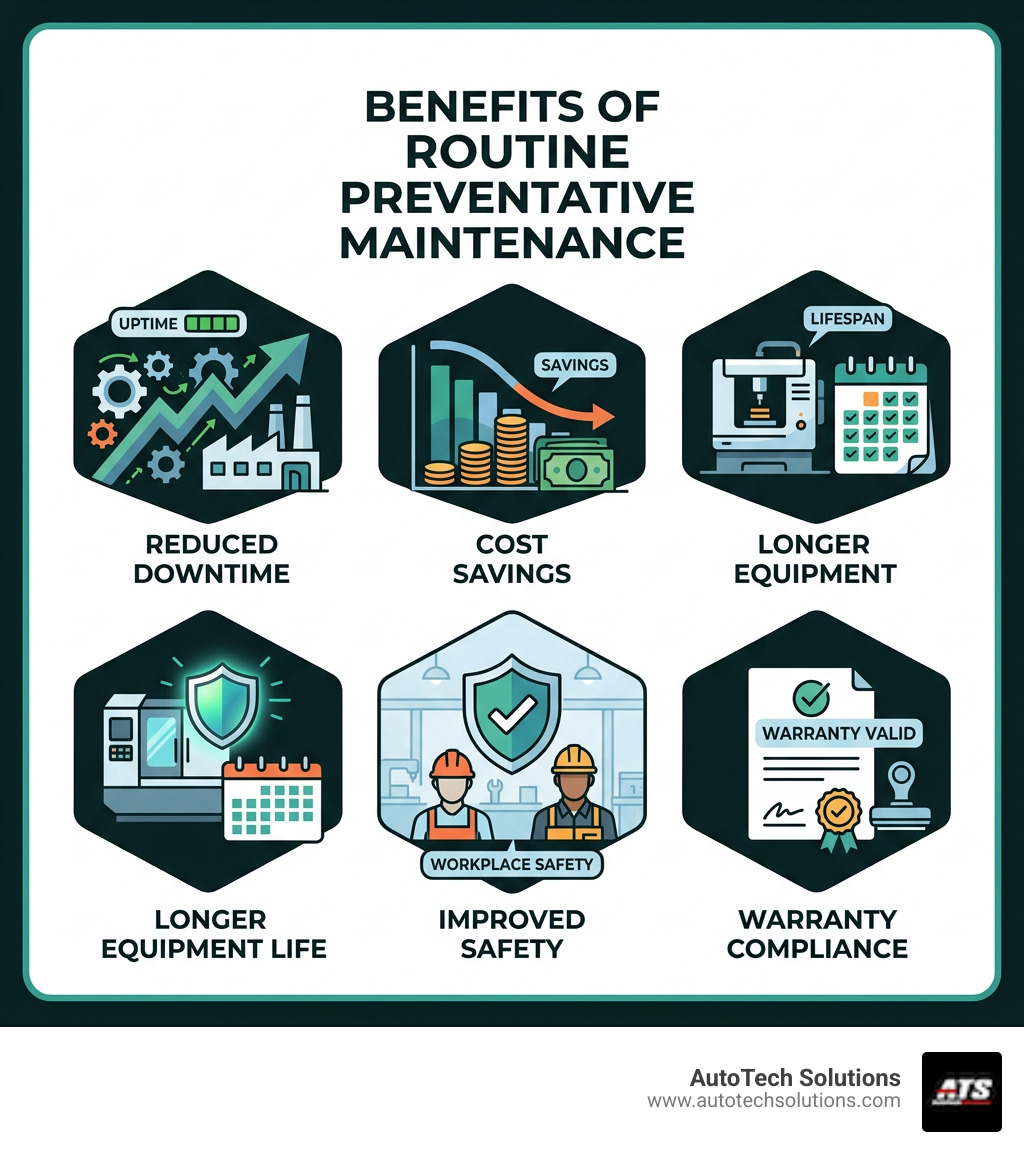
One of the biggest "hidden" benefits we see at AutoTech Solutions is warranty protection. Many equipment manufacturers will actually void your warranty if you can't prove that regular maintenance was performed. By investing in Service Repair and Equipment Support, you aren't just fixing things; you're insuring your investment.
Maintenance Comparison Table
| Feature | Reactive Maintenance | Preventative Maintenance | Predictive Maintenance |
|---|---|---|---|
| Timing | After failure occurs | Scheduled intervals | Based on data/sensors |
| Cost | High (10x more) | Moderate/Controlled | High initial setup |
| Downtime | Unplanned & long | Planned & short | Minimal |
| Complexity | Low | Moderate | High |
| Best For | Non-critical items | Critical shop gear | High-tech production |
The Core Types of Maintenance Strategies
Not all maintenance is created equal. To choose the best preventative maintenance service, you need to understand the different ways we trigger these tasks.
Time-Based Maintenance (Calendar-Based)
This is the most common type of proactive care. It involves scheduling service at regular intervals—every six months for an air compressor or annually for a vehicle lift. It’s easy to track and ensures that even if a machine isn't used heavily, it still gets inspected for environmental degradation, like rust or perishing rubber.
Usage-Based Maintenance
Some gear wears out based on how hard it works, not how long it sits. This strategy uses "triggers" like operating hours or cycle counts. For example, a high-volume collision shop might need to service its paint booth every 500 hours of operation rather than every six months. This prevents "over-maintenance" on machines that aren't used often while protecting the "workhorses" of your shop.
Prescriptive and Predictive Maintenance
While standard Automotive Equipment Repair focuses on schedules, advanced strategies use IoT (Internet of Things) integration. Prescriptive maintenance uses software to analyze data and literally "prescribe" a specific fix as needed. While highly efficient, these systems can be more complex and costly to implement than a standard preventative program.
Why Your Shop Needs Proactive Care
We’ve already mentioned that estimated $50 billion annually lost to downtime, but let's talk about what that looks like in a local shop in Novi, MI or Charlotte, NC.
When a piece of equipment goes down unexpectedly, it sets off a chain reaction:
- High Labor Costs: You’re paying technicians to stand around or move cars manually while they wait for a repair.
- Emergency Shipping: You’ll pay a premium to get parts overnighted.
- Missed Deadlines: Customers get frustrated when their "ready by Friday" car is stuck on a broken lift.
- Safety Risks: Emergency breakdowns are often violent or messy, creating hazards like oil spills or falling loads.
By following a Paint Booth Repair Tips Guide and maintaining a regular schedule, you move from "firefighting" mode into "management" mode.
How a Preventative Maintenance Service Saves Money
It might feel counterintuitive to spend money on a machine that is currently working fine. However, the ROI is undeniable. Regular maintenance leads to:
- Energy Efficiency: Clean filters and lubricated motors use less power.
- Resale Value: A well-documented service history makes your equipment worth more if you ever decide to upgrade.
- Reduced Repair Bills: Catching a worn belt for $50 is much better than replacing a seized motor for $5,000.
- Inventory Management: When we know a part is wearing out, we can order it at standard shipping rates rather than paying for "emergency" logistics.
At AutoTech Solutions, our Preventative Maintenance Programs are designed to keep these costs as low as possible for our Michigan and Carolina partners.
The Role of a Preventative Maintenance Service in Shop Safety
Safety isn't just a buzzword; it's the foundation of your business. Automotive lifts, in particular, require an ALI-certified inspection every year. These inspections check for structural integrity, weld cracks, and cable tension.
Without regular checks, a "small" issue like a fraying cable or a leaking hydraulic seal can lead to a catastrophic equipment failure. Keeping your shop compliant with OSHA and ALI standards doesn't just prevent fines—it protects the people who make your business possible.
Essential Checklist for Automotive Gear
What does a real-world preventative maintenance service look like on the ground? Here is a breakdown of the critical tasks we perform for our clients:
Vehicle Lifts
- Annual Inspections: Must be performed by ALI-certified inspectors.
- Structural Checks: Inspecting welds, anchors, and bolts.
- Lubrication: Keeping the carriage and chains moving smoothly.
- Safety Locks: Ensuring the mechanical locks engage fully every time.
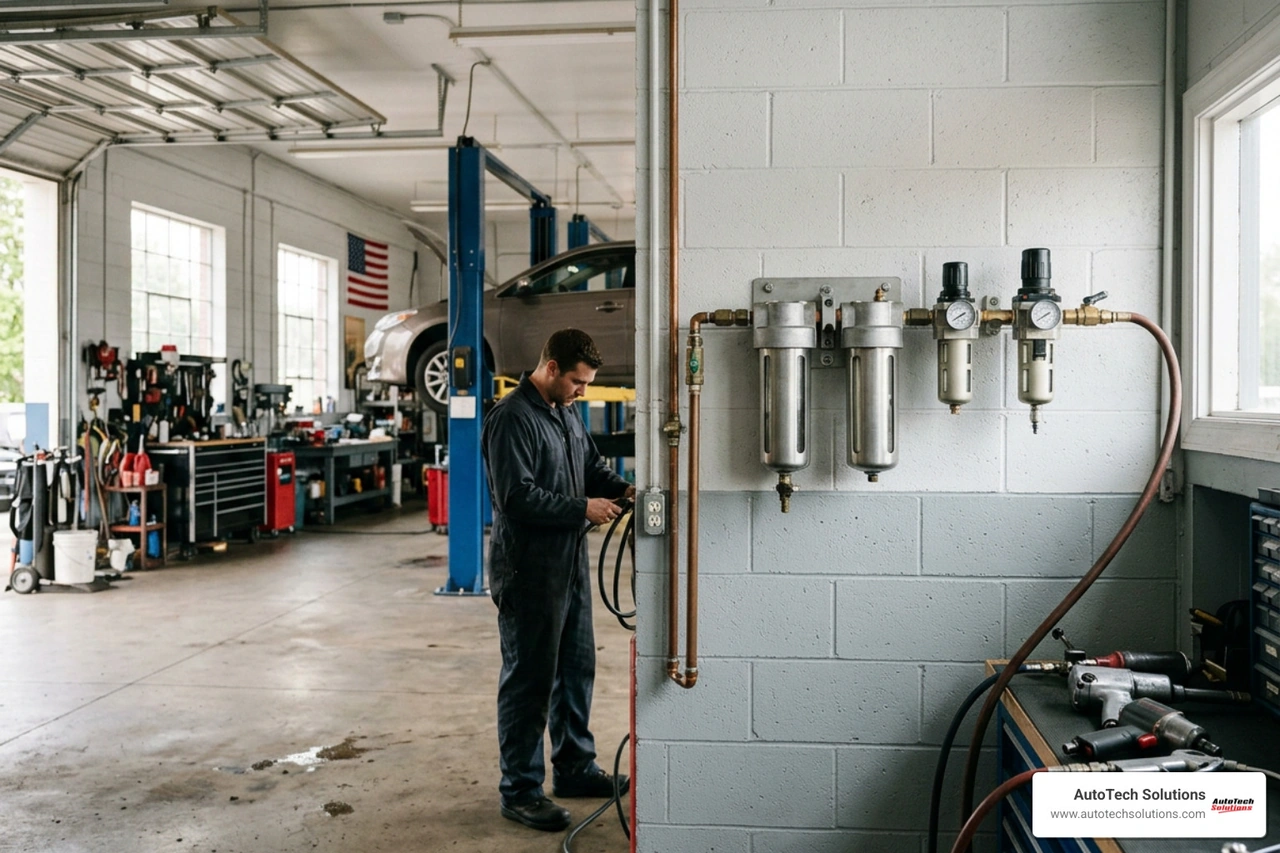
Air Compressors & Dryers
- Six-Month Service: Oil changes and air filter replacements are mandatory every six months.
- Drain Valves: Testing condensation drains to prevent water from entering your air lines.
- Belt Tension: Checking for cracks or slipping that can reduce efficiency.
- Dryer Care: Annual cleaning of condenser coils and replacement of filtration elements.
Paint Booths
- Filter Replacements: Intake and exhaust filters must be changed to maintain airflow and finish quality. Check out our Automotive Paint Booth Maintenance guide for more.
- Seal Inspections: Checking door seals to prevent dust contamination.
- Burner Service: Ensuring the heating system is burning clean and efficient.
Waste Oil Heaters & Pumps
- Emissions Testing: Annual stack testing to meet EPA and state requirements (like those in North Carolina).
- Ash Removal: Keeping the heat exchanger clean to prevent overheating.
- Pump Rebuilds: On-site service for lubrication pumps to ensure consistent fluid delivery.
Implementing a Program with Software
Gone are the days of grease-stained notebooks and "hoping" you remember the last time the compressor was serviced. Modern shops use CMMS (Computerized Maintenance Management System) software to stay organized.
Using a digital system allows us to follow the PDCA Model:
- Plan: Use equipment data to set schedules.
- Do: Perform the maintenance tasks.
- Check: Monitor KPIs (Key Performance Indicators) to see if downtime is actually decreasing.
- Act: Adjust the schedule based on what the data tells us.
Software helps with resource allocation by notifying us exactly when a machine is due for service, allowing us to schedule the work during slow periods so your shop stays productive.
Real-World Success and the 10% Rule
One of the best ways to decide whether to maintain or replace a piece of gear is the 10% Rule. This rule suggests that you should perform maintenance if the cost of the service is less than 10% of the equipment's total replacement cost. If a repair starts creeping toward 50% or more of the cost of a new machine, it might be time to look at an upgrade.
We’ve seen the power of these programs firsthand. In one instance, a production facility saw a 10% increase in production capacity within just six months of moving from a reactive to a digital preventative strategy. By eliminating the "surprise" breakdowns, they were able to run more vehicles through the shop every single day.
Frequently Asked Questions about Preventative Maintenance
How often should preventative maintenance be performed?
For most automotive shop equipment, a six-month interval is the standard for mechanical components like compressors, while a twelve-month interval is required for lift inspections. Always refer to your manufacturer's manual or ask the experts at AutoTech Solutions for a customized schedule based on your shop's volume.
Is preventative maintenance suitable for all equipment?
Most of the time, yes. However, for very old equipment where parts are no longer available, or for non-critical items (like a shop vacuum), a "run-to-failure" strategy might actually be more cost-effective. We focus our programs on the "critical assets" that would stop your shop from making money if they broke.
What is the 10% rule in maintenance?
The 10% rule is a guideline for budgeting. It suggests that if the cost of a preventative maintenance service is less than 10% of the replacement value of the asset, it is a "no-brainer" investment. It also applies to scheduling: some managers aim to complete 90% of their preventative tasks within a 10% window of their due date to stay on track.
Conclusion
Choosing the right preventative maintenance service isn't just about ticking a box for compliance—it's about building a more profitable, safer, and less stressful business. Whether you are running a light-duty repair shop in Raleigh or a heavy-duty collision center in Novi, the goal is the same: minimize downtime and maximize the life of your gear.
At AutoTech Solutions, we pride ourselves on being a one-stop-shop for automotive equipment. From sales and installation to expert support and fast repair response, we serve the Michigan and Carolina regions with a focus on keeping your bays full and your technicians safe.
Don't wait for a breakdown to realize the value of your equipment. Schedule your Preventative Maintenance Programs today and let us handle the heavy lifting while you focus on what you do best.