Why Dealerships Can't Afford to Keep Managing Dozens of Vendors

Vendor consolidation for dealership equipment service is the process of replacing a fragmented mix of suppliers — lifts, compressors, fuel, lubricants, DEF, pressure washers, and more — with a single, accountable service partner.
Here's what that looks like in practice:
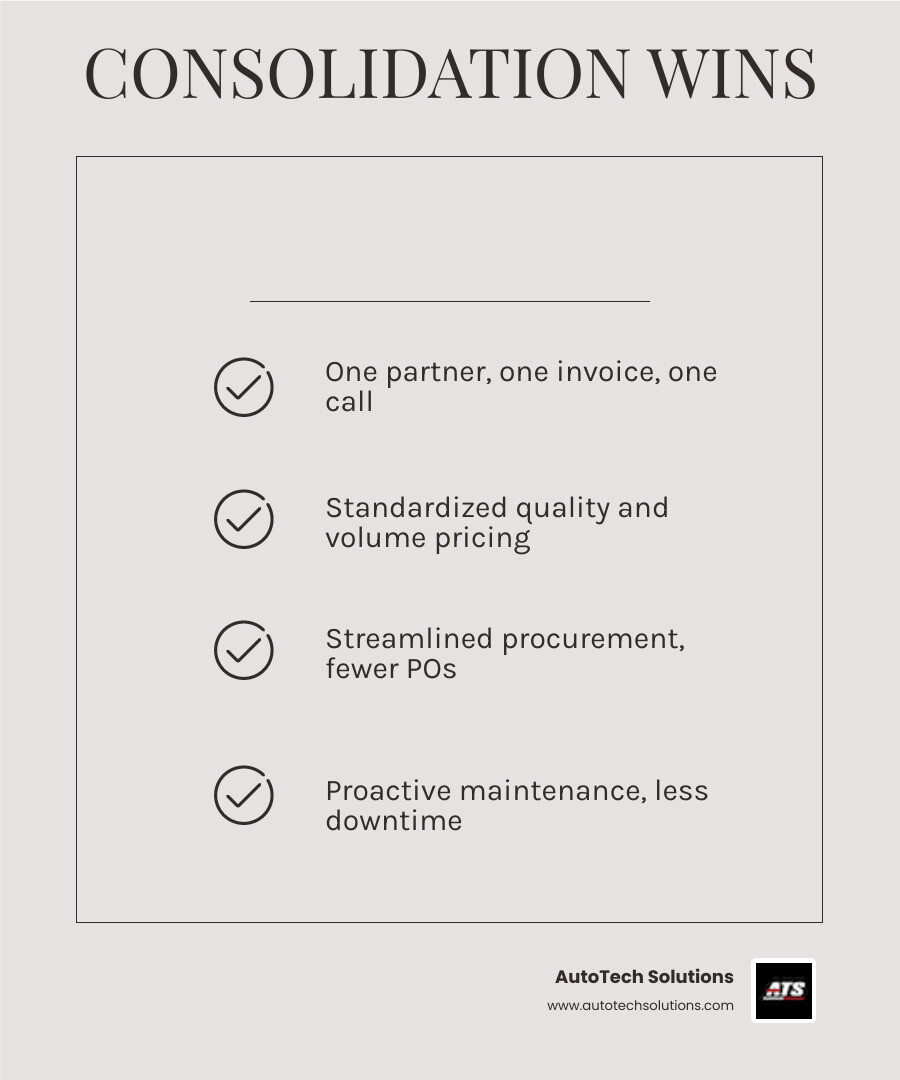
| Fragmented Model | Consolidated Model |
|---|---|
| Multiple vendors, invoices, and contacts | One partner, one invoice, one call |
| Inconsistent service quality and pricing | Standardized quality and volume pricing |
| High administrative overhead | Streamlined procurement and fewer PO touches |
| Unpredictable downtime | Proactive maintenance and faster response |
| Complex onboarding for each new vendor | Single onboarding, single support team |
If you run a dealership service department, you already know the pressure. Gross margins have dropped nearly 30% over the past five years. Every hour a lift is down, a bay sits empty. Every mismatched invoice slows your team down.
And yet, most dealerships are still managing a sprawling web of vendors — each with their own contracts, contacts, billing cycles, and service windows.
It doesn't have to work that way.
The good news: consolidating your vendor base is one of the most practical, high-impact moves you can make right now. It cuts costs, reduces downtime, and frees your team to focus on what actually matters — serving customers and growing the business.
This guide walks you through exactly how to do it.
The Strategic Value of Vendor Consolidation for Dealership Equipment Service
When we talk about vendor consolidation for dealership equipment service, we aren't just talking about cleaning up a filing cabinet. We are talking about a fundamental shift in how your dealership breathes. In the current automotive landscape, procurement isn't just a back-office chore; it is a primary driver of your profit margins.
Managing a fragmented vendor base creates a "massive administrative tax." Think about the time your service manager spends playing phone tag with three different companies just to get a lift fixed, a compressor serviced, and a lubrication leak plugged. That is time stolen from the service drive. By moving to a consolidated model, you replace that chaos with a leaner, intentional ecosystem.
Understanding Total Cost of Ownership (TCO)
Many dealerships fall into the trap of "piece-price" thinking—looking only at the lowest bid for a single repair. However, strategic leaders look at the Total Cost of Ownership. This includes the "soft costs" of processing dozens of purchase orders, the freight expenses of shipping parts from ten different locations, and the devastating cost of equipment failure.
The High Cost of Silence
Industrial downtime costs are no joke. Research shows that 83% of decision-makers report unplanned downtime costs their operation at least $10,000 per hour. In large-scale facilities, that number can skyrocket to $500,000 per hour. When your shop equipment fails and you don't know which vendor to call—or worse, they can't get to you for a week—your gross margin takes a direct hit.
By partnering with AutoTech Solutions, you gain a single point of accountability. Whether it's Automotive Equipment Installation and Service or an emergency repair, one call handles it all. This concentration of spend restores control through unified workflows and simplified approvals.

Reducing Costs through Vendor Consolidation for Dealership Equipment Service
The math behind consolidation is simple but powerful. When you spread your spending across twenty vendors, you have zero leverage. When you consolidate, you become a "priority account."
- Freight and Logistics: Ordering parts from one source allows for bundled shipping. Instead of paying ten separate "minimum freight" charges, you pay one.
- Administrative Efficiency: Industry data suggests that vendor consolidation typically delivers a 3–7% reduction in COGS (Cost of Goods Sold) and can cut purchase order "touches" by up to 40%.
- Transactional Speed: Every invoice your accounting team has to process costs money in labor. Consolidating vendors means fewer checks to cut and fewer Service, Repair, and Equipment Support contracts to track.
Key Equipment and Services to Consolidate Under One Roof
One of the biggest hurdles dealerships face is the belief that they must use specialized vendors for every single item. In reality, most high-performing shops can consolidate nearly all their "fixed op" needs under one roof. At AutoTech Solutions, we’ve seen that the most efficient dealerships integrate the following:
Vehicle Lifts and Compressed Air
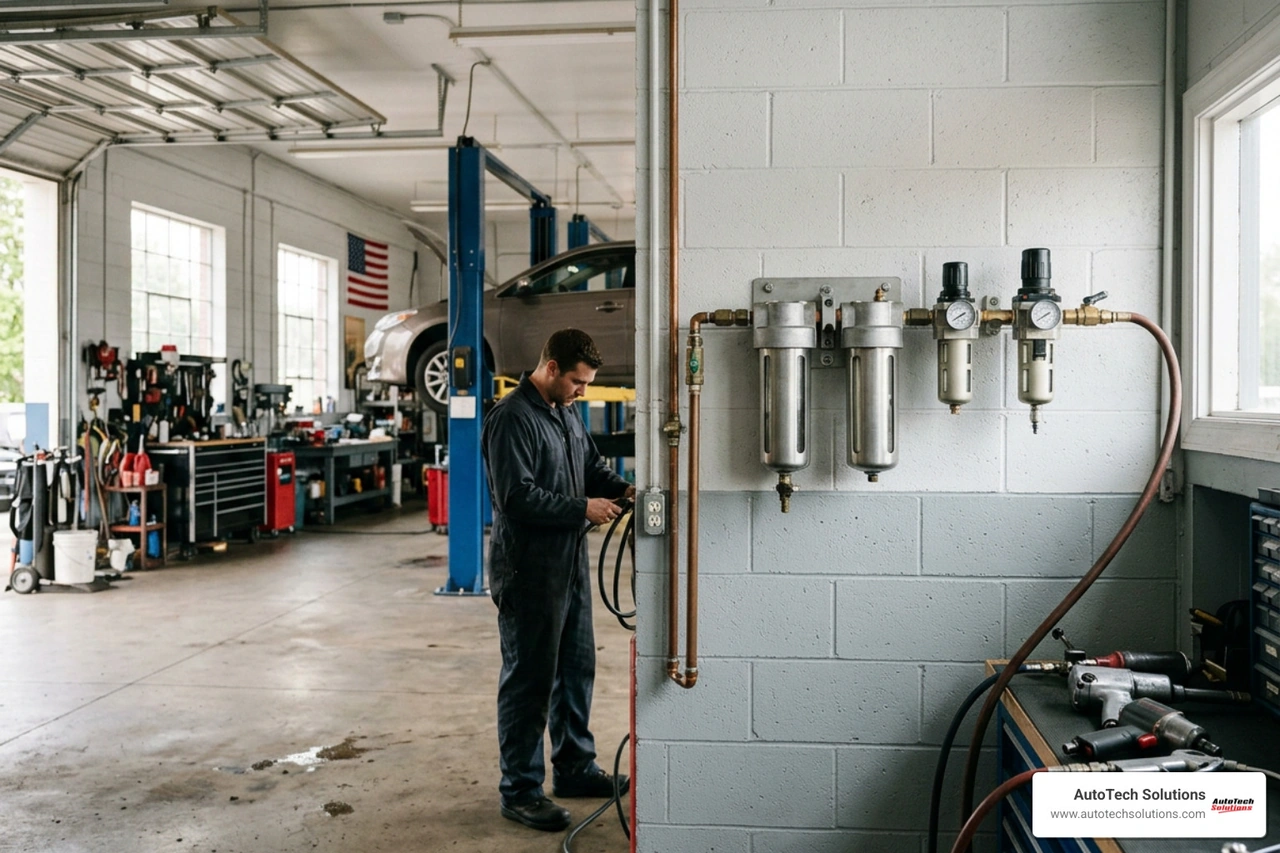
Lifts are the heart of your service bay. Whether you use two-post, four-post, or mobile column lifts, having the same partner handle the sales, installation, and annual safety inspections ensures nothing falls through the cracks. The same applies to air compressors; a failure here brings the entire shop to a grinding halt.
Lubrication, Fuel, and DEF
Managing fluids is a logistical headache. We can provide a comprehensive solution that covers:
- Bulk Fuel: Unleaded, diesel, and off-road diesel (often called dyed or farm diesel).
- DEF (Diesel Exhaust Fluid): Essential for modern diesel engines to meet emission standards.
- Lubrication Systems: From reels and pumps to Preventative Maintenance Programs that keep your fluid delivery lines from leaking.
Facility Maintenance Tools
Don't forget the peripheral equipment that keeps the shop running. Pressure washers for the detail bay and waste oil heating systems are perfect candidates for consolidation. In fact, using a waste oil furnace to heat your facility can eliminate disposal costs entirely while lowering your utility bills.
Streamlining Procurement with Vendor Consolidation for Dealership Equipment Service
When your systems don't communicate, you aren't operating at full speed. A fractured "tech stack" of different vendor portals leads to "financial blind spots." By using a single partner, you improve:
- Parts Availability: Strategic partners often see a 20% improvement in parts availability because they understand your specific inventory needs.
- Inventory Management: No more over-ordering filters or running out of critical seals.
- Invoice Accuracy: Matching invoices to purchase orders becomes an automated, seamless process rather than a manual nightmare.
When you need an Automotive Equipment Repair, you don't want to wait for a vendor to "onboard" your dealership. You want a partner who already has your shop’s layout, equipment history, and billing preferences on file.
How to Implement a Successful Consolidation Strategy
Transitioning to a consolidated model doesn't happen overnight, but it is a manageable process if you follow a roadmap. We recommend a phased approach over 6 to 12 months.
Step 1: The System Audit
Look at your last 12 months of spending. How many vendors did you pay? Which ones provided overlapping services? You’ll likely find that you have three different companies handling "compressed air" and two others for "lift repair." This fragmentation is a "silent growth killer."
Step 2: Get Team Buy-In
Successful adoption depends on your service advisors and technicians. Involve your team from the start by gathering feedback on which current vendors are failing them. When they realize that consolidation means less time waiting for parts and more time turning wrenches, resistance turns into enthusiasm.
Step 3: The Phased Transition
Don't fire everyone on Monday. Start with one category—perhaps vehicle lifts and lubrication. Once that transition is smooth, move to the next category. During this time, it’s wise to maintain a "safety stock buffer" of critical parts to ensure no service gaps occur while switching providers.
Step 4: Centralization
For dealer groups with multiple locations in North Carolina or Michigan, Centralized Equipment Service Coordination for Dealer Groups is the gold standard. It allows you to standardize processes across every rooftop, so a technician moving from your Raleigh location to your Charlotte location finds the exact same equipment and service protocols.
| Feature | Fragmented Model | AutoTech Solutions Model |
|---|---|---|
| Response Time | Best effort / Variable | Priority fast-response |
| Pricing | Standard retail | Volume/Bulk discounts |
| Maintenance | Reactive (Fix when broken) | Proactive (Preventative) |
| Accountability | The "Blame Game" | Single point of contact |
Mitigating Risks and Selecting the Ideal Service Partner
We often hear the concern: "Isn't putting all my eggs in one basket risky?" It’s a fair question. The "single point of failure" is a real concept, but it is easily mitigated by choosing the right basket.
Transparency and Stability
When you reduce your vendor count, you actually gain more transparency. Instead of having dozens of minor vendors you barely know, you build a deep, strategic partnership with a company whose financial stability and technical capability you have thoroughly vetted. You want a partner that is "service-first," meaning they sell the relationship and the support long before they sell the piece of equipment.
Quality and Certifications
Ensure your partner holds the necessary certifications and insurance. At AutoTech Solutions, we believe in the power of certified inspections. Whether it's a lift safety check or a compressor pressure test, unified quality standards ensure every piece of equipment meets the same rigorous safety protocols.
Scalability
If you are expanding to multiple locations, your partner must be able to grow with you. Standardized processes mean you aren't "reinventing the wheel" with every new site. This was a key takeaway when Brixey Meyer Capital Announces the Acquisition of Professional Maintenance Equipment Inc; growth should mean opportunity, not chaos.
Frequently Asked Questions about Dealership Vendor Consolidation
Does consolidation increase the risk of a single point of failure?
While it increases reliance on one partner, it eliminates the "invisible risks" of fragmentation. When you have 50 vendors, you have 50 chances for someone to go out of business or lose a technician. A strategic partner like AutoTech Solutions provides much deeper transparency into sub-tier risks and offers a dedicated support team that knows your facility inside and out. Accountability is much higher when one company is responsible for your shop's uptime.
How long does the transition to a consolidated model take?
A successful transition typically follows a 6-12 month timeline. We recommend a category-by-category approach. For example, month one might focus on consolidating your lubrication and DEF providers. Month three might move into air systems and lifts. This "implementation roadmap" prevents supply chain gaps and allows your accounting team to adjust to the new streamlined invoicing.
Will individual part prices increase when moving to one vendor?
Actually, the opposite is usually true. By concentrating your spend, you gain access to volume discounts that smaller, fragmented vendors can't offer. More importantly, your "total landed cost" decreases. Even if a specific filter costs the same, you save significantly on "soft costs" like freight optimization, reduced administrative labor, and, most importantly, the 30% reduction in unplanned downtime that consolidation typically delivers.
Conclusion
The days of managing a dealership through a chaotic web of vendors are coming to an end. With declining margins and the high cost of downtime, vendor consolidation for dealership equipment service is no longer a luxury—it’s a survival strategy.
By consolidating, you gain operational agility, protect your margins, and create a scalable model that works whether you have one rooftop in Novi, MI, or a dozen across the Carolinas. You deserve a partner who cares about your profitability as much as you do.
At AutoTech Solutions, we are committed to minimizing your downtime with expert support and lightning-fast response times. We don't just sell equipment; we sell the peace of mind that comes with knowing your shop is always ready to work.
Ready to stop chasing vendors and start growing your business? Schedule a consultation for dealership equipment services with AutoTech Solutions today. Let’s build a stronger, more connected future for your dealership together.