Why Aluminum Repair Equipment Maintenance Matters for Your Shop
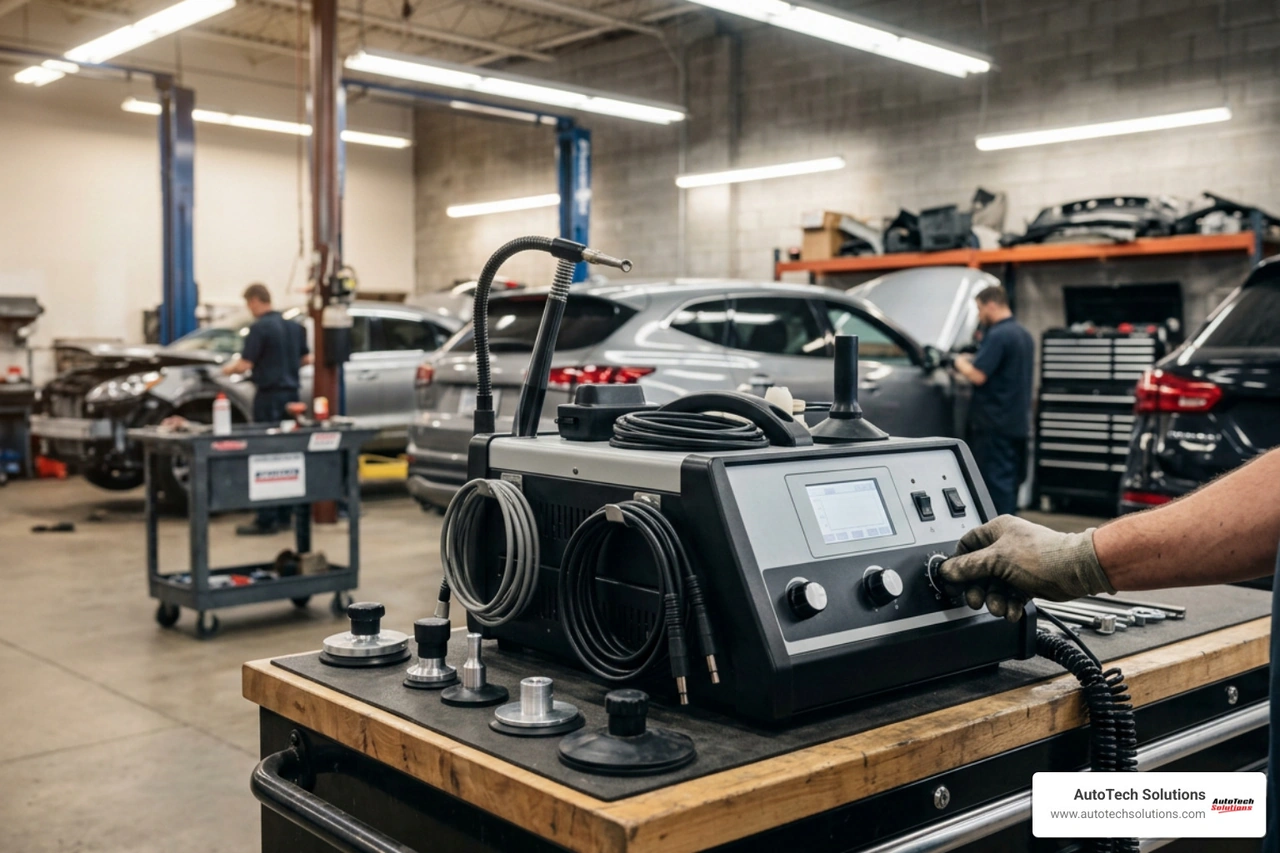
Aluminum repair equipment maintenance is the systematic care and servicing of specialized tools used to weld, bond, and repair aluminum components in automotive and industrial settings. Without proper maintenance, equipment failures cause porosity, cracking, and contamination that compromise structural integrity and waste time on rework.
Quick Answer: Essential Aluminum Repair Equipment Maintenance Steps
- Inspect welding liners and cables weekly for kinks, wear, and contamination
- Use dedicated stainless steel brushes exclusively for aluminum to prevent galvanic corrosion
- Clean non-welding tools with compressed air after each use to remove steel particles
- Check shielding gas purity and flow rates before every welding session
- Service rivet guns monthly including hydraulic fluid, seals, and pressure calibration
- Store aluminum filler wire in dry, room-temperature conditions to prevent moisture absorption
Aluminum has rapidly become a dominant material in automotive manufacturing, with brands like Ford, Tesla, and Audi using it extensively for weight reduction and fuel efficiency. But aluminum's unique properties create serious challenges for repair shops.
The material conducts heat three times faster than steel, oxidizes instantly when exposed to air, and attracts hydrogen contamination like a magnet. These characteristics mean your repair equipment needs different care than steel tools, and mixing the two causes expensive failures.
Research from welding experts confirms that contamination from steel dust, inadequate pre-weld cleaning, and worn liners are the leading causes of aluminum weld porosity and cracking. Even skin contact from ungloved hands leaves oils that compromise bond strength.
For shop managers, equipment downtime translates directly to lost revenue and frustrated technicians. A single failed weld on an aluminum body panel can require complete rework, eating into profit margins already squeezed by rising labor costs.
The good news? Most aluminum repair equipment failures are preventable through systematic maintenance protocols.

Why Aluminum Repair Equipment Maintenance is Critical for Quality
In collision repair, aluminum is a "fussy" metal. It doesn't behave like the mild steel most technicians grew up working on. Because aluminum has a high hydrogen affinity, any moisture, grease, or dirt on your equipment or the workpiece will turn into gas bubbles (porosity) inside the weld. This is why aluminum repair equipment maintenance isn't just a chore—it’s the foundation of structural safety.
When we talk about Preventative Maintenance Programs, we are focusing on the specific physics of aluminum. For instance, aluminum's thermal conductivity is significantly higher than steel's, meaning heat dissipates rapidly. If your welder isn't calibrated or the cables are frayed, you won't get the consistent "hot-and-fast" arc needed to penetrate the metal before the heat vanishes.
Furthermore, aluminum forms a "hydrated" oxide layer almost immediately. This layer has a much higher melting point than the aluminum itself. If your cleaning tools—like your stainless steel brushes—are worn out or contaminated with steel particles, you’ll push those oxides and contaminants into the repair area rather than removing them. Following Repairing Aluminum Structures: A Guide to Best Practices requires equipment that is as clean as a surgeon's scalpel. Poor maintenance leads to weak bond strength and reduced longevity, which can be catastrophic in structural automotive applications.
Essential Aluminum Repair Equipment Maintenance Protocols
To keep your shop running smoothly from Novi, Michigan, down to Charlotte, North Carolina, you need a rigorous schedule. Aluminum repair requires specialized tools: pulse MIG welders, self-piercing rivet guns, and dedicated hand tools. Each of these requires a different touch.
At AutoTech Solutions, we emphasize that Service, Repair, and Equipment Support should always align with manufacturer-recommended schedules. Whether you are using high-end gear from ProSpot, Lincoln Electric, or Miller, the basics of care remain the same. This includes checking torque values on fasteners and ensuring all lubrication points on moving machinery are serviced with the correct non-contaminating grease.
Maintaining Welding Liners and Gas Systems for Aluminum Repair Equipment Maintenance
The "heart" of aluminum welding is the wire delivery and gas shielding system. Aluminum wire is soft; if you try to push it through a standard steel liner, it will shave, kink, and "birdnest" at the drive rolls.
- Teflon or Nylon Liners: These are essential to reduce friction. Inspect them weekly for kinking or internal wear. If you see aluminum "shavings" near the drive rolls, your liner is likely worn or the tension is too high.
- Argon Gas Systems: Aluminum welding typically requires 100% pure Argon or an Argon-Helium mix. Check your regulators and hoses daily for leaks. Even a tiny leak can draw in atmospheric moisture, leading to weld failure.
- Contact Tips: Aluminum expands when heated. Use tips specifically sized for aluminum (often marked with an 'A') which have slightly larger clearances.
- Drive Rolls: Use U-groove drive rolls to avoid crushing the soft wire. Clean these rolls with a soft brush to remove any metal dust that could hinder Automotive Equipment Repair quality.
Servicing Rivet Guns and Specialized Fastening Tools
Self-piercing rivet (SPR) guns are the workhorses of modern aluminum body repair. These tools operate under immense hydraulic pressure to join panels without the heat of welding.
- Hydraulic Fluid: Check levels monthly. Use only the manufacturer-specified fluid to prevent seal degradation.
- Seal Inspection: Look for "weeping" fluid around the actuators. A blown seal can lead to inconsistent pressure, resulting in rivets that don't set correctly.
- Mandrel and Die Cleaning: Aluminum is "sticky." Fragments can build up in the dies. Clean them after every job to ensure the Auto Collision Repair Tools maintain their precision.
- Pressure Calibration: Periodically verify that the gun is hitting its target PSI. If the pressure is too low, the joint won't reach its rated structural strength.
Preventing Cross-Contamination in the Aluminum Workspace
The biggest enemy of an aluminum repair is a tiny piece of steel. If steel dust lands on an aluminum panel and gets trapped under paint or a weld, it creates a "galvanic cell." Because these two metals don't get along, the aluminum will literally start to rot away around the steel (corrosion).
To prevent this, we recommend a "clean room" or a segregated workspace. This is a fundamental part of the Aluminum Repair Matrix guidelines.
| Requirement | Aluminum Tools | Steel Tools |
|---|---|---|
| Brushes | Stainless Steel (Dedicated) | Carbon Steel |
| Abrasives | Dedicated (Finer than 80 grit) | Standard |
| Environment | Isolated/Curtained | General Shop |
| Fasteners | Aluminum or Coated | Steel |
| PPE | Clean Nitrile/Latex Gloves | Standard Work Gloves |
Cleaning Non-Welding Tools and Chemical Handling Safety
Maintaining your non-welding tools is just as important. Grinders, sanders, and even your Paint Booth Repair Service equipment must be kept free of cross-contaminants.
- Dedicated Abrasives: Never use a grinding disc on aluminum if it has touched steel. We recommend marking aluminum-only tools with bright green tape or paint for easy identification.
- Chemical Cleaning: Before any repair, use a high-quality organic solvent like acetone or a citrus-based degreaser to remove oils. Always remove hydrocarbons before you start brushing. If you brush first, you’re just grinding the oil into the metal.
- Safety Protocols: When handling oxide removal solutions or solvents, follow General Guidelines For Repairing Three-Dimensional Aluminum Features. This means wearing nitrile gloves—not because the aluminum is toxic, but because the oils from your skin can ruin the repair! Ensure your ventilation is top-notch, as many aluminum cleaning chemicals can be harsh.
Troubleshooting Common Failures and Maintenance Mistakes
Even with the best intentions, things go wrong. Most issues we see in the field can be traced back to a lapse in aluminum repair equipment maintenance.
One common question we get is, Can I Use JB Weld to Repair Aluminium?. While epoxy can work for non-structural, cosmetic fixes (like a small leak in a radiator), it should never be used for structural automotive components. For those, you need a high-quality weld, and that requires a clean machine.
Avoiding Porosity Through Proper Aluminum Repair Equipment Maintenance
Porosity looks like Swiss cheese inside your weld. It’s caused by gas getting trapped as the metal cools. To stop it:
- Store your wire correctly: Keep aluminum filler wire in its original packaging in a climate-controlled cabinet. Moisture from Michigan or North Carolina humidity will condense on the wire and cause porosity.
- Check your gas flow: Too little gas won't protect the weld; too much gas creates turbulence that sucks in air.
- Maintain your liners: A kinking liner causes "stuttering" in the wire feed, which leads to an unstable arc and air pockets. Even during Automotive Lift Installation, keeping the shop environment clean helps prevent dust from settling on your welding gear.
Correcting Tool Wear in Non-Structural Repairs
For sheet metal work, tool maintenance is about precision. If you are following the General Guidelines For The Repair Of Sheet Metal Aluminum Features, you know that aluminum is prone to "work hardening."
- Abrasive Selection: Use grade 80 grit or finer. Coarse discs can tear the surface of thin aluminum.
- Pneumatic Tool Care: Oil your air tools daily, but be careful! Excess oil can blow out of the exhaust and land on your clean aluminum panel. We suggest using "oil-free" air systems or dedicated filters for aluminum work.
- Heat Indicators: Aluminum doesn't turn red before it melts. When using heat to straighten a panel (typically around 400°F), use heat-sensing crayons or digital thermometers to ensure you don't compromise the metal's temper or de-bond nearby adhesives prematurely.
Frequently Asked Questions about Aluminum Repair Equipment Maintenance
How often should aluminum welding liners and cables be inspected?
We recommend a visual inspection weekly. Look for any kinking in the lead, as aluminum wire is very sensitive to feed resistance. Every month, blow out the liner with low-pressure compressed air to remove any aluminum dust buildup.
What is the most common maintenance mistake leading to aluminum weld failure?
The most common mistake is cross-contamination. Using the same wire brush for steel and aluminum, or failing to degrease the metal before brushing, accounts for the vast majority of "dirty" welds and porosity.
Why must stainless steel brushes be dedicated strictly to aluminum work?
If a brush touches steel, it picks up microscopic carbon steel particles. When you use that same brush on aluminum, those particles become embedded in the soft aluminum surface, leading to galvanic corrosion and weld inclusions.
Conclusion
Mastering aluminum repair equipment maintenance is the difference between a shop that thrives in the modern automotive landscape and one that struggles with rework and liability. From ensuring your pulse MIG welders are feeding smoothly to keeping your SPR guns calibrated, every minute spent on maintenance saves an hour of frustration later.
At AutoTech Solutions, we are dedicated to helping shops from Michigan to the Carolinas minimize downtime. Whether you need a new equipment installation, a customized preventative maintenance program, or emergency repair for your specialized aluminum tools, our expert team is ready to support you. Don't let a poorly maintained liner or a contaminated brush stand in the way of a perfect repair.
Protect your investment and your reputation by partnering with us for all your Collision Center Solutions. Together, we can ensure your equipment is always ready for the next aluminum challenge.