Choose Auto Shop Car Lifts That Match Your Bay Workflow
The right auto shop car lifts improve technician access, reduce vehicle repositioning, and help keep profitable service bays moving. For most commercial shops, the best choice comes down to the work performed, the vehicles serviced, and the building itself:
- Two-post lifts are the go-to for general repair, brakes, suspension, and underbody work.
- Four-post lifts suit alignment, inspections, heavier vehicles, and drive-on staging; bridge jacks add wheel-free service access.
- Scissor lifts fit fast-service and wheel-service bays where footprint and vehicle access matter.
- Mobile column lifts serve fleets, buses, and trucks that exceed the practical range of standard two- or four-post systems.
Capacity is only one part of the decision. A shop also needs the right ceiling clearance, engineered concrete slab, electrical supply, certified safety systems, and a maintenance plan that prevents unexpected downtime. Most standard lifts need roughly 10 feet of clear ceiling height, while slab requirements commonly start at 4 inches of 3,000 PSI concrete and rise to 6 inches or more for heavier commercial equipment, subject to the lift manufacturer's requirements and local codes. The Automotive Lift Institute maintains certification standards that help commercial operators compare hoist safety and structural performance.
In this guide, AutoTech Solutions Staff compares commercial hoist types, hydraulic systems, installation needs, safety standards, and ownership costs so you can equip each bay for safe, efficient work. Upgrading your service facility involves integrating dependable auto garage tools equipment, investing in modern automotive shop equipment, and securing certified heavy duty equipment installation to ensure maximum bay productivity.

Primary Types of Auto Shop Car Lifts and Commercial Applications
Every commercial repair facility operates around bay velocity. Choosing the right machinery requires matching lifting capacity, duty cycles, and vehicle chassis designs to specific service specializations. For a deeper breakdown of structural configurations, consult our overview of commercial lifting platforms.

Two-Post Auto Shop Car Lifts: Symmetrical vs. Asymmetrical Configurations
Two-post surface-mounted hoists remain the workhorses of general repair and collision facilities. By gripping vehicle frames at specific pick points, they leave the entire suspension, driveline, and wheel assemblies unobstructed for service.
Selecting the right arm geometry impacts daily bay flow:
- Symmetrical Arms: Symmetrical configurations position the vehicle directly centered between the two structural columns (a 50/50 balance). This setup handles long-wheelbase delivery vans, commercial work trucks, and balanced medium-duty chassis. However, wide truck bodies can limit technician door-opening clearance.
- Asymmetrical Arms: Asymmetrical designs rotate the columns or utilize shorter front reach arms and longer rear reach arms (creating an approximate 30/70 load offset). This configuration shifts the vehicle's center of gravity rearward, aligning the vehicle doors behind the vertical columns. Technicians can easily swing cabin doors open for interior diagnostic work, dash access, or alignment verification without body strikes.
To learn more about arm engineering and load balancing, review our two-post hoist commercial selection guide and evaluate clear-floor versus floor-plate systems.
Four-Post Auto Shop Car Lifts: Heavy-Duty Alignment and Inspection Racks
Four-post hoists utilize drive-on runways to provide continuous drive-on support. These systems eliminate the need to hunt for frame pick points, drastically accelerating intake for high-volume commercial diagnostic lanes and rapid vehicle inspections.
When fitted with wheel-alignment turnplates, slip plates, and optical targets, four-post platforms form high-precision alignment bays. By incorporating pneumatic or hydraulic rolling bridge jacks between the structural runways, technicians can raise the vehicle off the runways directly on the lift, granting wheel-free access for brake jobs, tire rotations, and suspension repairs. Explore our dedicated commercial four-post vehicle hoists as well as our heavy-duty commercial truck lifts.
Specialty Commercial Hoists: Scissor, Parallelogram, and Mobile Column Systems
Specialized commercial service bays frequently demand hoists engineered for specific workflow constraints:
- Wheel-Service Scissor Lifts: Scissor hoists utilize low-profile, pantograph-style hydraulic lifting linkages. Low-rise and mid-rise scissor platforms support tire, wheel, and body shops by providing rapid elevation without vertical posts blocking side bays.
- Parallelogram Lifts: Engineered for commercial transit, bus fleets, and heavy vocational municipal trucks, parallelogram systems provide pure vertical or sweeping lift paths without floor obstruction, supporting heavy distributed axle loads.
- Mobile Column Lifts: When commercial bays service mixed heavy-duty fleets, synchronized mobile columns (often deployed in synchronized sets of 4, 6, or 8 battery-powered or cabled units) offer modular lifting flexibility. Each column features integrated hydraulic lift carriages that engage vehicle wheel assemblies directly, allowing service technicians to reconfigure the bay based on changing commercial fleet requirements.
Technical Comparison of Commercial Hoists and Hydraulic Systems
Evaluating commercial equipment involves analyzing mechanical lock tolerances, lifting cycle speeds, and hydraulic circuit architectures.
| Lift Category | Standard Commercial Capacity | Typical Rise Time | Hydraulic Architecture | Primary Bay Suitability |
|---|---|---|---|---|
| Two-Post Overhead | 9,000 – 20,000 lbs | 45 – 79 sec | Direct-Drive / Chain-Over-Roller | General mechanical, fleet service, underbody |
| Two-Post Floor-Plate | 9,000 – 12,000 lbs | 50 – 60 sec | Dual hydraulic cylinders, floor track | Low-overhead bays, mechanical service |
| Four-Post Commercial | 10,000 – 40,000+ lbs | 40 – 60 sec | Hydraulic cylinder / Cable & Pulley | Alignment, express maintenance, inspections |
| Full-Rise Scissor | 8,000 – 14,000 lbs | 35 – 50 sec | Dual-synchronized hydraulic circuits | Express lube, brake service, collision bays |
| Mobile Column Set | 30,000 – 140,000+ lbs | 60 – 90 sec | Electro-hydraulic ball-screw / cylinder | Municipal buses, heavy commercial fleets |
Understanding total commercial cost requires balancing purchase price against installation scope, slab preparation, and bay utilization. For financial and operational budgeting metrics, review our breakdown on commercial lift pricing and budgeting.
Clear-Floor Overhead vs. Floor-Plate Two-Post Designs
Two-post systems divide into two primary structural variants:
- Clear-Floor (Overhead) Systems: Hydraulic lines and equalization cables route through an overhead crossbeam connecting the column tops. This design keeps the concrete floor between the columns clear, allowing under-vehicle transmission jacks, high-capacity oil drains, engine cranes, and tool carts to roll without obstruction. Most overhead models incorporate a padded overhead shutoff bar that instantly cuts motor power if a tall roofline makes contact. For design specifics, see our two-post overhead hoist engineering resource.
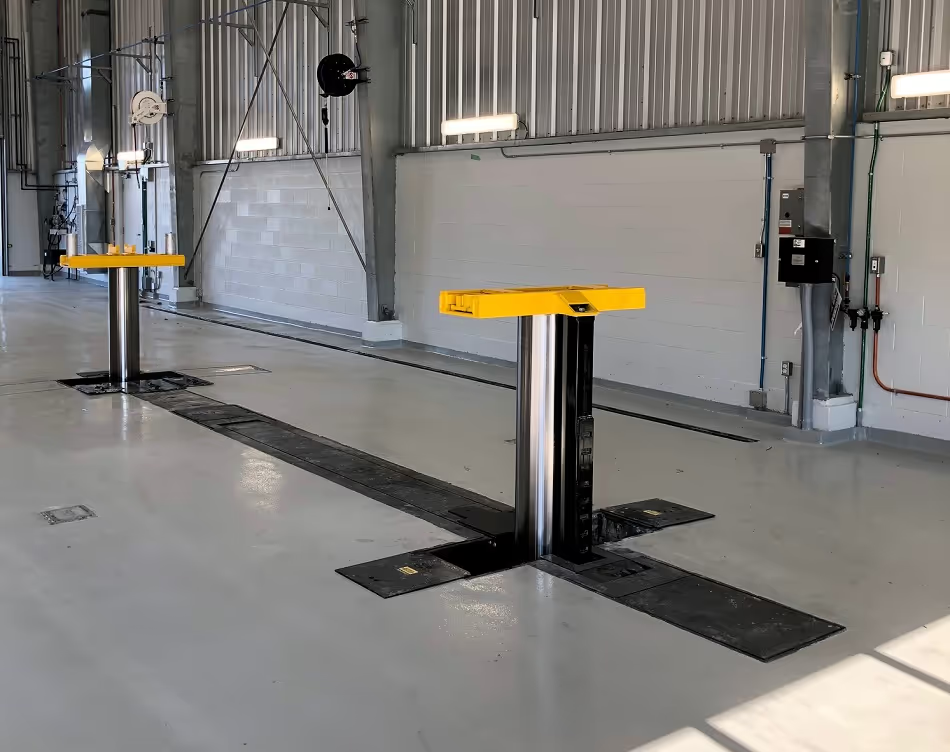
- Floor-Plate (Baseplate) Systems: In commercial bays with low ceiling clearances (sub-12 feet), overhead beams cannot clear structural rafters or shop exhaust ductwork. Floor-plate lifts route cables and hydraulic lines under a beveled steel threshold across the shop floor. While this enables installation in lower-clearance bays, rolling heavy equipment across the floor plate requires extra effort.
Load Capacity Planning: Light-Duty to Super-Duty Commercial Fleets
Under-sizing a commercial lift creates severe safety risks and drives up bay maintenance costs. Structural lift components must handle dynamic load transfers when heavy drivetrains, powertrains, or rear axle assemblies are removed from commercial vehicles.
- 9,000 to 10,000 lbs: Handles standard passenger vehicles, light fleet sedans, crossovers, and half-ton utility pickups.
- 12,000 to 15,000 lbs: Required for heavy-duty commercial vans, 3/4-ton to 1-ton fleet pickups, ambulances, and dual-rear-wheel utility platforms.
- 18,000 to 20,000+ lbs: Built for Class 4 through Class 6 commercial medium-duty chassis, utility service trucks, and small transit vehicles. High-capacity units like 20,000-lb direct-drive systems feature massive structural steel columns, direct-drive hydraulics, and multi-stage telescoping arm assemblies rated to handle extreme point loads.
To equip heavy-duty inspection bays, commercial operators frequently integrate drive-on accessories and heavy-duty staging ramps and equipment.
Facility Requirements and Commercial Lift Installation Standards

Professional installation ensures safety and protects equipment warranties. Commercial shops in the Carolinas and Michigan must evaluate foundation engineering, structural bay heights, and electrical connections prior to placing equipment. For full bay preparation checklists, check our automotive hoist installation planning guide and commercial lift setup requirements.
Structural Slab Preparation and Anchor Bolt Engineering
Automotive lift baseplates transfer extreme tensile and shear forces into commercial concrete foundations. Standard commercial specifications require:
- Compressive Strength: Concrete must test at a minimum compressive rating of 3,000 to 3,500 PSI.
- Slab Thickness: Lighter commercial hoists require a continuous 4-inch reinforced slab, while heavy-duty systems (12,000 to 20,000 lbs) require an engineered 6-inch to 8-inch slab reinforced with steel rebar or structural fiberglass mesh.
- Anchor Bolt Embedment: Installers use wedge anchors torqued to strict manufacturer specifications (typically 85 to 150 ft-lbs depending on bolt diameter). Anchors must maintain proper clearance from expansion joints, floor cracks, and slab edges to prevent blowout under heavy tensile loads.
Professional shop owners rely on certified lift installation procedures and professional hoist assembly to ensure safe operational baselines.
Safety Certifications and Regulatory Compliance
Never install uncertified lifting equipment in a commercial bay. When sourcing equipment, verify:
- ALI/ANSI Certification: The Automotive Lift Institute (ALI), in partnership with ANSI (ANSI/ALI ALCTV), provides independent, third-party certification. Certified hoists undergo rigorous physical testing, verifying they can sustain 115% of dynamic rated capacity and 150% of static load capacity without structural failure.
- Mechanical Safety Locks: High-grade commercial hoists incorporate multi-position, gravity-engaged mechanical safety lock ladders in each column with single-point or dual-point pneumatic/manual release mechanisms.
- Restraint Systems: Two-post arms must feature automatic swing-arm gear restraints that lock securely upon elevation and withstand high lateral forces to prevent vehicle slippage.
Ensure your shop schedules regular commercial lift safety inspections to maintain compliance with OSHA regulations and national safety standards.
Preventative Maintenance and Minimizing Commercial Bay Downtime
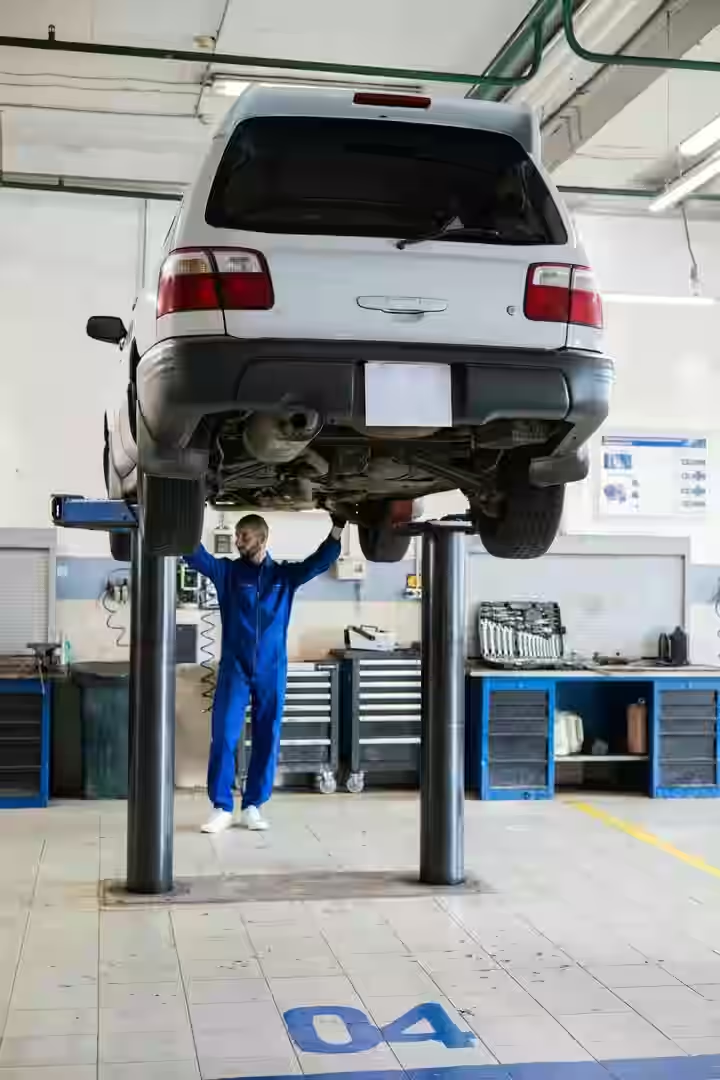
A disabled lift eliminates bay revenue while overhead costs continue to accrue. Structured maintenance ensures high operational reliability and worker safety across all shifts. Establish clear inspection protocols using our preventative maintenance scheduling and routine lift maintenance protocols.
Hydraulic System Care: Cylinders, Hoses, and Valves
Hydraulic systems require clean fluid and consistent operating pressure to perform reliably under commercial workloads:
- Hydraulic Seal Integrity: Inspect chrome cylinder rods regularly for pitting, scoring, or fluid weepage. Blown wiper seals let environmental contaminants into the hydraulic fluid, which can score cylinder walls. For specialized repairs, reference our hydraulic cylinder repair techniques and commercial hoist repair troubleshooting.
- High-Pressure Hoses: Check commercial hydraulic lines for outer jacket abrasion, blistering, or crimp fitting weeping. High-pressure leaks reduce lift performance and create safety hazards.
- Pressure Relief Calibration: Test the hydraulic power unit's integrated pressure relief valve periodically to ensure it prevents overloaded lift cycles without bypassing pressure under normal operating loads.
Rapid Repair and Downtime Reduction Strategies
To keep fleet and service bays running at full capacity, high-volume commercial operations maintain structured contingency plans:
- Equalization Cables: Steel wire equalization cables on two-post hoists stretch over time. Technicians must inspect them monthly for fraying, bird-caging, or loose tension, adjusting the locking nuts to keep both carriages rising synchronously.
- Anchor Bolt Torque Checks: Regular checks confirm foundation anchor bolts maintain their specified torque, preventing column shifting under heavy vehicle loads.
- Rapid Component Sourcing: Maintaining on-hand supplies of contact pads, arm restraint gears, limit switches, and safety release springs helps shops prevent prolonged bay closures.
Learn how to maintain bay productivity with our guide to minimizing repair downtime, troubleshoot unexpected breakdowns using our overview on addressing common lift failures, and stock high-wear parts directly through our catalog of commercial hoist replacement parts.
Frequently Asked Questions About Commercial Auto Shop Car Lifts
What concrete specifications are required for commercial auto shop car lifts?
Most commercial two-post and four-post lifts (up to 10,000 lbs capacity) require a cured, level concrete slab with a minimum compressive strength of 3,000 to 3,500 PSI and a minimum thickness of 4 inches. Heavy-duty commercial lifts rated from 12,000 to 20,000 lbs require a 6-inch to 8-inch reinforced concrete slab. Wedge anchor bolts must achieve proper embedment depth (typically 3.25 to 5+ inches) away from expansion seams and slab edges.
How do asymmetric and symmetric arm configurations differ in commercial service?
Symmetric lifts position the vehicle evenly (50/50 load balance) with equal-length swing arms, which is ideal for long-wheelbase delivery vans, commercial trucks, and vehicles with centered weight distribution. Asymmetric lifts use rotated columns or staggered arm lengths to position the vehicle rearward (30/70 load balance). This places the vehicle doors behind the main columns, allowing technicians to open the cabin doors easily for diagnostic and interior service work.
Why are rolling bridge jacks critical for four-post service lifts?
While four-post lifts support vehicles on drive-on runways, standard runways prevent wheel-free maintenance. Rolling bridge jacks mount across the interior rails of the four-post runway assembly, using dedicated hydraulic or pneumatic power to lift the vehicle frame directly off the runways. This enables brake inspections, tire changes, hub repacking, and suspension servicing on a four-post platform.
Conclusion: Selecting and Equipping Your Commercial Service Bays
Maximizing bay revenue requires selecting lifting systems tailored to your facility's vehicle volume, ceiling geometry, and daily service operations. From high-throughput two-post overhead hoists to heavy-duty alignment racks and mobile column networks, the right equipment powers technician productivity and delivers consistent long-term returns.
AutoTech Solutions provides end-to-end commercial automotive shop equipment sales, certified turnkey installation, OSHA/ALI-compliant safety inspections, and rapid-response repair services. We help commercial service facilities, fleet operations, and collision centers minimize downtime across Charlotte, Raleigh, Wade, and Novi.
Ready to upgrade your commercial service facility? Explore our complete inventory of commercial automotive shop equipment and lift solutions or contact the equipment specialists at AutoTech Solutions to design, equip, and maintain your service bays.