Why the Right Autobody Repair Tools Define Shop Performance
The autobody repair tools your collision shop runs on directly determine how fast your technicians work, how consistent the quality is, and how profitable each job becomes.
Quick answer — the essential autobody repair tool categories every professional collision shop needs:
| Tool Category | Primary Function |
|---|---|
| Body hammers and dollies | Metal shaping and panel restoration |
| Glue pull repair (GPR) / PDR systems | Dent removal without damaging paint |
| Frame straighteners and pulling towers | Structural realignment after collision |
| Hydraulic jacks and spreader rams | Force application for frame and body work |
| Air and electric sanders/grinders | Surface preparation and finishing |
| Dust extraction systems | Shop air quality and technician safety |
| Auto glass cut-out tools | Windshield and glass removal |
| Personal protective equipment (PPE) | Technician safety and compliance |
Running a collision repair facility means managing a lot of moving parts. Equipment downtime costs money. Undertooled technicians slow down every job. And the wrong tools — or poorly maintained ones — create rework, safety risks, and unhappy clients.
The collision repair industry spans a wide range of equipment, from hand tools like picks and dollies to heavy hydraulic systems capable of generating 6 tons or more of straightening force. Choosing and organizing the right mix for your shop is not a simple task.
This guide breaks down every major tool category, how each one works, and what professional shops should consider when building or upgrading their toolkit.
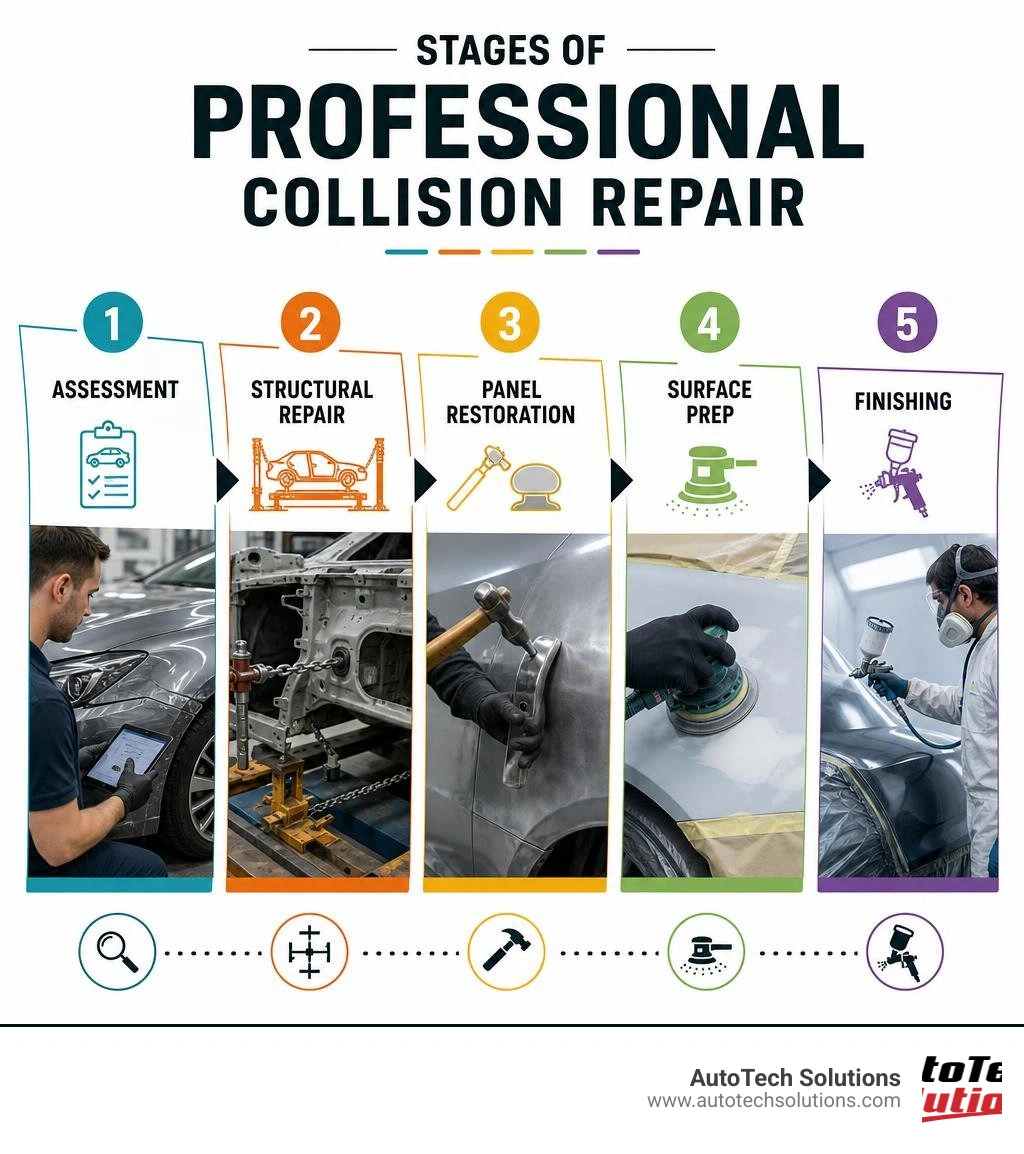
Handy autobody repair tools terms:
Essential Autobody Repair Tools for Surface and Panel Restoration

When a vehicle enters a collision center, restoring the exterior panels to their original factory contours is often the most time-consuming phase of the job. Technicians rely on a specialized collection of Auto Collision Repair Tools to manipulate sheet metal and advanced alloys back into position.
To achieve a flawless, pre-accident condition, shops must source professional-grade gear. Using generic hand tools simply will not cut it when working on modern vehicle architectures. High-quality Auto Body Repair Tools and commercial-grade Auto Body Repair Tools & Equipment | Collision Services ensure that metal can be formed without stretching or cracking.
Among the most innovative advancements in rapid panel restoration is the portable vacuum-assisted puller. For example, the GUNI™ Fast Puller | Portable Dent Puller | GUNI Products utilizes pneumatic pressure to establish a rock-solid vacuum seal on flat surfaces. Delivering 550 lbs of pulling force, this lightweight aluminum system features a dedicated base, guide pulley, tower, and ratchet system. It allows technicians to pull out minor to medium dents along door frames, rocker panels, and structural pillars with virtually zero setup time, optimizing shop throughput.
Traditional Metal Shaping with Hammers and Dollies
Despite the rise of high-tech pulling systems, traditional metal shaping remains the foundation of panel restoration. Technicians must master the physics of metal displacement using specialized body hammers and dollies.
- Standard Body Hammers: Feature flat or crowned faces designed to strike the metal directly, flattening high spots or raising low areas.
- Pick Hammers: Equipped with a pointed tip on one end, ideal for pinpointing small, isolated low spots from the backside of a panel.
- Shrinking Hammers: Designed with a checkered or spiral face that slightly twists or gathers the metal upon impact, helping to shrink stretched metal sections back to their original density.
- Dollies: Heavy steel hand-held anvils available in various shapes (such as heel, toe, utility, and comma). Technicians hold a dolly behind the sheet metal to act as an anvil while striking the front with a hammer.
Understanding the difference between hammer-on-dolly and hammer-off-dolly techniques is critical:
- Hammer-on-dolly: The technician strikes the metal directly where the dolly is positioned underneath. This action compresses and stretches the metal, making it thinner and raising the low spots.
- Hammer-off-dolly: The dolly is placed in a low spot while the hammer strikes an adjacent high spot. This coaxes the metal back into its original plane without stretching it, making it the preferred method for initial contour leveling.
Modern Glue Pull Repair (GPR) and Paintless Dent Repair (PDR) Systems
Modern automotive manufacturing heavily incorporates thin-gauge aluminum and high-strength steels. Traditional methods that involve grinding down panels or drilling holes can compromise the structural integrity of these materials. This has driven the widespread adoption of Glue Pull Repair (GPR) and Paintless Dent Repair (PDR) systems.
GPR works by adhering specialized plastic pulling tabs to the exterior of the damaged panel using high-strength hot or cold adhesive. Once the glue cures, a tension-pulling tool (such as a slide hammer, mini-lifter, or bridge puller) is attached to the tab to draw the dent outward. Because the adhesive grips the paint surface directly, this method preserves the original factory corrosion-resistant coatings and paint finishes.
Professional setups, like the Adhesion Pro GP Glue Pull Repair System, come as comprehensive 187-piece kits housed in heavy-duty, lockable 4-drawer carts. These systems include cordless 18V glue guns, digital infrared thermometers to monitor panel temperatures (ensuring optimal glue adhesion), specialized pulling bridges, and PDR reflector boards to read the distortion of the metal. By utilizing both hot and cold glue technologies, technicians can safely repair aluminum panels without risking the structural heat damage associated with older pulling methods.
Heavy-Duty Structural Realignment and Frame Straightening Systems
Severe collisions often result in structural frame damage that renders a vehicle unsafe to drive. Restoring a vehicle's structural integrity requires heavy-duty machinery capable of measuring and applying massive amounts of hydraulic force. Without precise structural alignment, advanced driver assistance systems (ADAS), suspension geometry, and crumple zones cannot function correctly. For a detailed breakdown of these structural processes, consult our Automotive Frame Repair Complete Guide.
Hydraulic Pulling Towers and Frame Straighteners
To correct major structural deformation, shops must utilize an Auto Body Shop Frame Machine. These systems consist of a rigid steel platform where the vehicle is securely anchored using specialized pinch-weld clamps. Once the vehicle is secured, hydraulic pulling towers are positioned around the perimeter to apply targeted tension.
A prime example of a compact, highly capable structural alignment system is the 6T Auto Body Frame Puller Straightener. This system delivers up to 6 tons of pulling force and features an adjustable post that can swing from -60° to +60° while tilting up to 35° for precise angles of pull. It also includes a 3T airbag jack with a lifting range of 5.7 to 15.75 inches, allowing technicians to easily position the vehicle at an ergonomic working height. The hydraulic foot pump generates up to 6,000 PSI of fluid pressure, enabling smooth, controlled pulls that slowly coax hardened frame rails back to their original factory specifications.
Portable Hydraulic Jacks and Spreader Rams
While large frame machines handle primary structural pulls, technicians frequently require portable, localized force to align inner structures, radiator supports, and door pillars. This is where portable hydraulic jacks—commonly referred to as "porta-powers"—become indispensable.
The XtremepowerUS 10 Ton Hydraulic Jack Air Pump Lift Ram Body Frame Porta is a staple for heavy-duty pushing and spreading. Supporting a load capacity of up to 10 tons (22,046 lbs), this kit uses an air-powered hydraulic pump to drive heavy-duty rams with a lifting range of 13 to 18 inches.
For comprehensive repair capabilities, many shops rely on the AFF 817SD 10-Ton Body and Frame Repair Kit – Automotive Service Equipment . This super-duty kit features:
- A 10-ton hydraulic ram for heavy pushing.
- A 1/2-ton spreader ram for tight clearances.
- A 5-foot high-pressure hydraulic hose.
- Chrome-plated components to resist wear and corrosion.
- An auto air-bleed pump that eliminates the need to manually bleed the system before use.
These portable kits are highly versatile, allowing technicians to swap out various extension tubes, wedge heads, and flat bases to safely push structural members back into alignment.
Power Tools and Infrastructure for Surface Preparation and Finishing
Once structural and panel repairs are complete, the vehicle moves to the surface preparation stage. This phase requires a combination of high-performance power tools and shop-level infrastructure to prepare the panels for primers, basecoats, and clearcoats. Managing this stage efficiently requires a full inventory of Auto Body Paint Shop Supplies.
Choosing Air vs. Electric Autobody Repair Tools
One of the most important decisions a collision shop manager must make is whether to equip technicians with pneumatic (air-powered) or electric tools for sanding, grinding, and cutting. Both technologies have distinct advantages and operational costs.
| Feature | Pneumatic (Air) Tools | Electric Tools (Corded/Battery) |
|---|---|---|
| Weight & Ergonomics | Lightweight, compact, comfortable for long-term use. | Slightly heavier due to internal motors and batteries. |
| Durability | Extremely durable; fewer moving parts; can run continuously. | Sensitive to dust buildup; brushless motors have improved lifespan. |
| Energy Efficiency | Low efficiency; requires massive, power-hungry air compressors. | High efficiency; draws power directly from the wall or battery. |
| Maintenance Costs | Requires daily oiling and clean, dry, moisture-free air. | Minimal tool maintenance, but batteries degrade over time. |
| Portability | Tethered to air hoses, limiting movement across the shop. | High portability, especially with modern 20V cordless platforms. |
While electric tools have made massive leaps in battery life and power output, many high-volume shops still prefer pneumatic dual-action (DA) sanders and die grinders due to their lightweight profiles and ability to withstand the harsh, dusty environment of a prep bay. However, electric tools are rapidly closing the gap, offering lower energy costs and eliminating the need for extensive shop air piping.
Dust Extraction and Shop-Level Air Filtration Systems
Surface preparation generates a massive volume of fine particulate dust from body fillers, primers, and clearcoats. If left unmanaged, this dust settles on freshly painted panels, causing surface defects like "fish-eyes" and nibs that require costly buffing and rework. More importantly, airborne dust poses severe respiratory health risks to shop staff.
To maintain a clean and compliant workspace, professional shops install centralized dust extraction systems. Modern dustless sanding blocks and DA sanders are designed with integrated vacuum shrouds that capture up to 99% of sanding dust directly at the source. This dust is drawn through anti-static hoses into a central filtration unit equipped with HEPA filters.
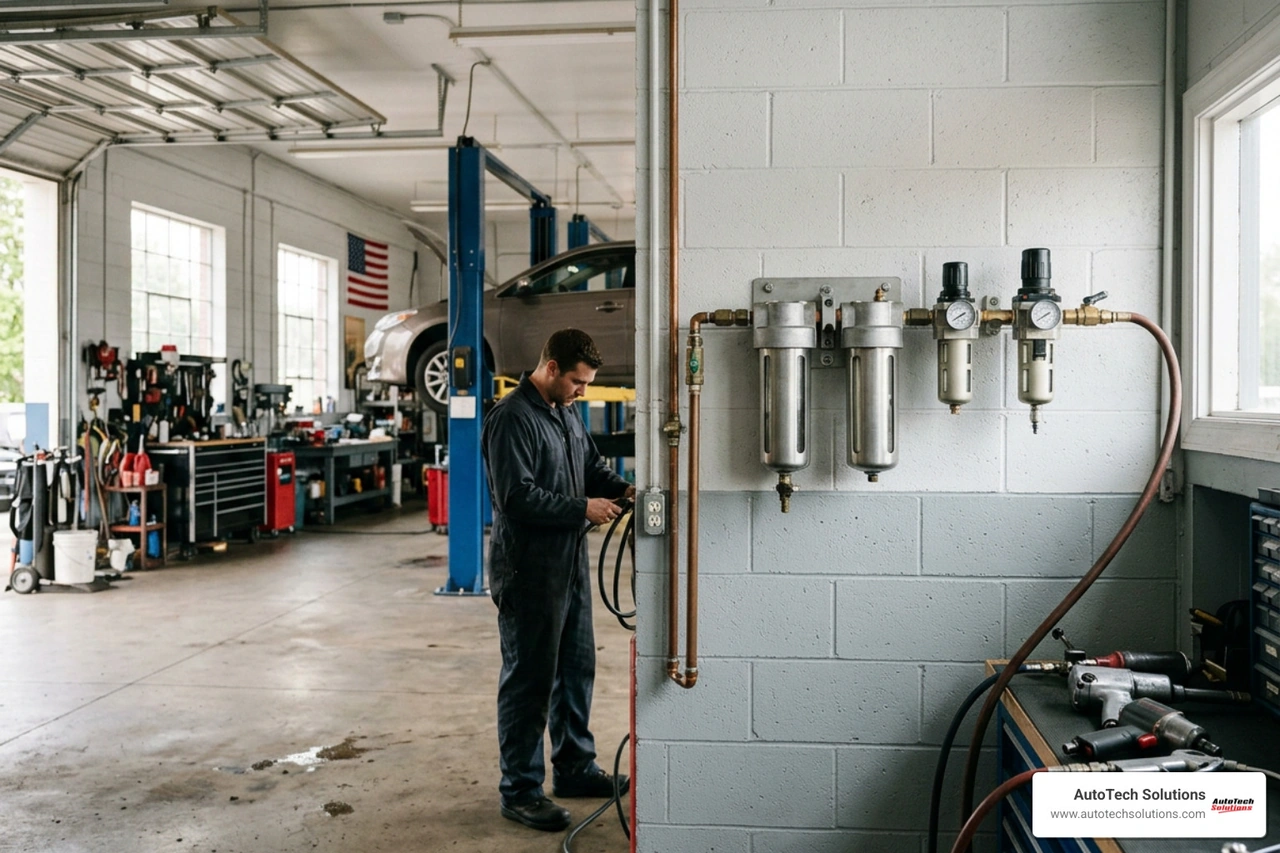
In addition to dust extraction, shops must invest in robust air filtration and breathing air systems. Clean, dry air is not only crucial for breathing masks but is also essential for pneumatic tools and paint application. High-capacity desiccant air dryers and multi-stage filtration units must be installed along the main air lines to strip out moisture, oil vapors, and particulates before they reach the technician's tools or paint guns.
Specialized Shop Equipment and Glass Removal Technology
Beyond standard panel beaters and sanders, modern collision shops require highly specialized equipment to handle complex disassembly and assembly tasks. Removing undamaged glass panels without breaking them, lifting heavy vehicles safely, and maintaining an organized workshop are all vital to keeping labor hours down and insurance cycle times fast.
Advanced Glass Cut-Out and Urethane Removal Systems
Replacing or temporarily removing windshields and quarter glass panels requires tools that can slice through tough, modern polyurethane sealants without damaging the surrounding painted metal pinch-welds. Traditional manual wire-pulling systems are slow and carry a high risk of scratching the vehicle's paint or injuring the technician.
Today, shops utilize advanced power tools specifically designed for glass removal. The GT.50 Reaper™ 20V Brushless Auto Glass Cut Out Tool – GT Tools® represents the cutting edge of this technology. Operating on a compatible 20V battery platform, this tool delivers up to 3,200 strokes per minute with an optimized 0.30-inch stroke designed specifically to slice through dense urethane beads.
Key features of professional glass removal systems include:
- Brushless Motors: Provide constant torque under heavy loads without overheating.
- Billet Aluminum Sheath Clamps: Securely hold the reciprocating blades in place.
- Thin-Profile Sheath Blades: Protect the vehicle's interior trim and exterior paint from friction damage.
- Variable Speed Triggers: Allow technicians to carefully control the plunge cut before throttling up along straight runs.
How to Safely Store and Organize Autobody Repair Tools
A disorganized shop is an inefficient shop. Technicians waste hours searching for misplaced dollies, sockets, or pulling tabs, which directly delays vehicle delivery. Implementing a strict tool organization and inventory control system is essential for maintaining high shop efficiency.
Professional shops utilize heavy-duty, mobile tool carts equipped with custom-cut foam inlays. These foam inserts provide a dedicated, highly visible home for every single tool. For example, high-end glue pull kits are organized in lockable, multi-drawer carts where missing tools can be identified at a glance before a vehicle leaves the bay.
Best practices for tool organization include:
- Engraving and Labeling: Permanently engrave shop-owned tools with identification numbers to prevent loss or mix-ups among technicians.
- Shadow Boards: Mount frequently used air blowers, tape measures, and panel clip removers on wall-mounted shadow boards near the work bays.
- Dedicated Mobile Carts: Use specialized parts caddies and mobile carts to hold disassembled bumper covers, headlights, and hardware associated with a specific job, keeping the bay floor clear of clutter.
If you are looking to source high-quality storage systems or upgrade your shop's footprint, searching for Auto Body Tools Near Me can connect you with local commercial storage solutions.
Frequently Asked Questions
What safety equipment is required for professional collision repair?
Technician safety is paramount in a professional collision shop. To maintain OSHA compliance and protect workers from hazardous dust, chemical vapors, and high noise levels, the following personal protective equipment (PPE) is required:
- Respirators: Technicians must use OSHA fit-tested, cartridge-type respirators (such as 3M dual-cartridge masks) when sanding or applying chemical fillers. Supplied-air respirator systems are mandatory inside paint booths.
- Eye and Face Protection: Impact-resistant safety glasses are required at all times. Full-face shields should be worn during heavy grinding, cutting, or glass removal tasks.
- Hearing Protection: High-noise environments containing air compressors, air chisels, and sanders require earplugs or earmuffs rated for the appropriate decibel levels.
- Protective Apparel: Techs should wear durable, tear-resistant work suits and heavy-duty nitrile or mechanics gloves to prevent skin contact with solvents, adhesives, and sharp metal edges.
How do GPR systems compare to traditional pulling methods?
Glue Pull Repair (GPR) and traditional pulling methods (such as pin pulling and slide hammering) each have their place in a modern shop:
- Paint and Coating Preservation: GPR does not require grinding off the vehicle's original paint, protecting the factory-applied ecoat and zinc coatings. Traditional mechanical pulling requires stripping the panel to bare metal, which can compromise long-term corrosion resistance.
- Material Compatibility: GPR is highly effective on both aluminum and high-strength steel panels because it does not introduce heat, which can weaken these advanced metals. Traditional pulling can warp thin-gauge aluminum if not carefully managed.
- Repair Speed: For shallow, wide dents, GPR is significantly faster because it eliminates the need for post-pull metal grinding, extensive body filling, and priming stages.
What are the benefits of mobile column lifts in a collision shop?
Mobile column lifts offer incredible flexibility compared to traditional in-ground or two-post surface lifts:
- Space Optimization: Unlike fixed lifts, mobile columns can be rolled out of the way when not in use, freeing up valuable bay floor space for other tasks.
- High Lifting Capacity: Heavy-duty mobile columns, such as OMER wireless columns, can support 14,500 lbs to 19,000 lbs per column. They can be synchronized in sets of two, four, or more to lift everything from passenger cars to heavy-duty commercial vehicles.
- Ergonomic Access: By lifting the entire vehicle to an adjustable working height in under 90 seconds, technicians can perform lower-body panel repairs, frame measurements, and suspension work without bending or kneeling, reducing fatigue and workplace injuries.
Conclusion
Equipping your collision repair shop with the right autobody repair tools is only half the battle. To maximize shop productivity, minimize costly downtime, and ensure safety, you need a reliable partner to keep your heavy equipment operating at peak performance.
At AutoTech Solutions, we are a premium one-stop-shop for commercial automotive equipment sales, professional installation, emergency service, and customized preventative maintenance. We understand that every hour a frame machine, lift, or compressor is out of service directly impacts your bottom line. Our primary mission is minimizing shop downtime with expert support and fast, reliable repair response times.
Whether your facility is located in Michigan or down through the Carolinas, we support shops across our key service regions, including:
- Novi, MI (serving the broader Detroit metro area, home to top-tier facilities like Novi MI Auto Body Repair - Gerber Collision )
- Charlotte, NC
- Raleigh, NC (supporting leading local providers like Auto Body Shop Raleigh, NC | Piperformance )
- Wade, NC
From initial equipment sales and professional calibration to routine preventative maintenance, we ensure your shop remains compliant, efficient, and highly profitable. Our industry expertise is backed by strategic partnerships with leading automotive sector investors, such as AutoTech Solutions - Harvey & Company LLC .
Ready to upgrade your collision center's capabilities or schedule a preventative maintenance service? Contact us today to explore our complete Collision Center Solutions and keep your shop moving forward.