
Why Automotive Machine Repair Keeps Your Shop Running Profitably
Automotive machine repair is the process of diagnosing, servicing, and restoring the specialized equipment that professional service facilities depend on every day — from hydraulic lifts and tire changers to alignment racks and air compressors.
If you manage a shop and need fast answers, here's what you need to know:
- Tire changers and wheel balancers require regular calibration and component checks to protect expensive wheels and maintain throughput
- Hydraulic lifts need scheduled inspections for cylinder wear, safety latch function, and cable tension
- Alignment racks and ADAS systems demand precise leveling and sensor calibration to deliver accurate results
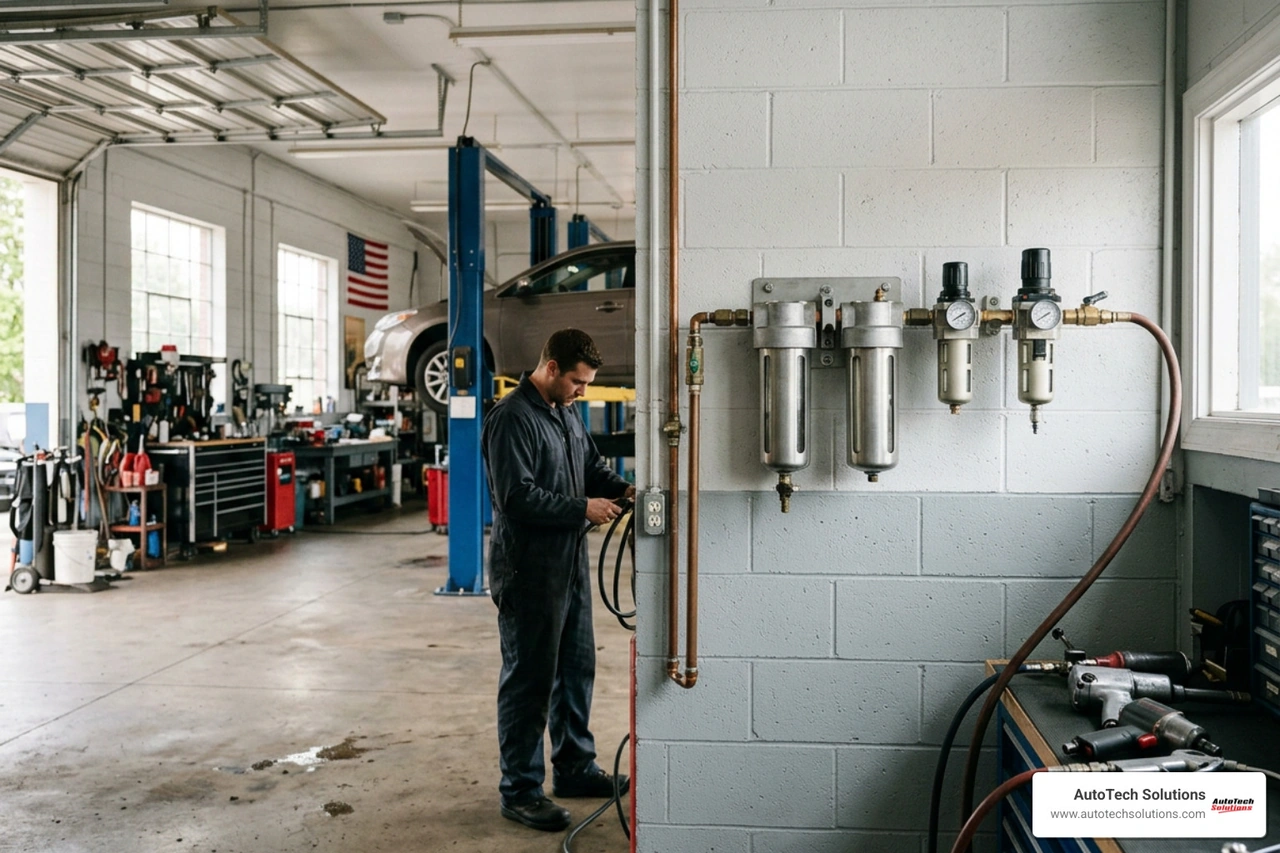
- Air compressors and climate control units depend on moisture filtration, pressure regulation, and seal integrity
- Exhaust and ventilation systems must maintain correct airflow to meet safety and compliance standards
The bottom line: when shop equipment goes down, so does technician productivity and revenue.
Equipment failure is one of the most disruptive and costly events a facility manager can face. A single hydraulic lift out of service can stall multiple bays. A miscalibrated tire changer can damage customer wheels. An underperforming compressor can slow every pneumatic tool in the shop.
This guide covers the full range of professional shop equipment repair — from routine preventative maintenance to emergency response — so you can keep your operation running at full capacity.
Automotive machine repair terms to learn:
The Essentials of Professional Automotive Machine Repair
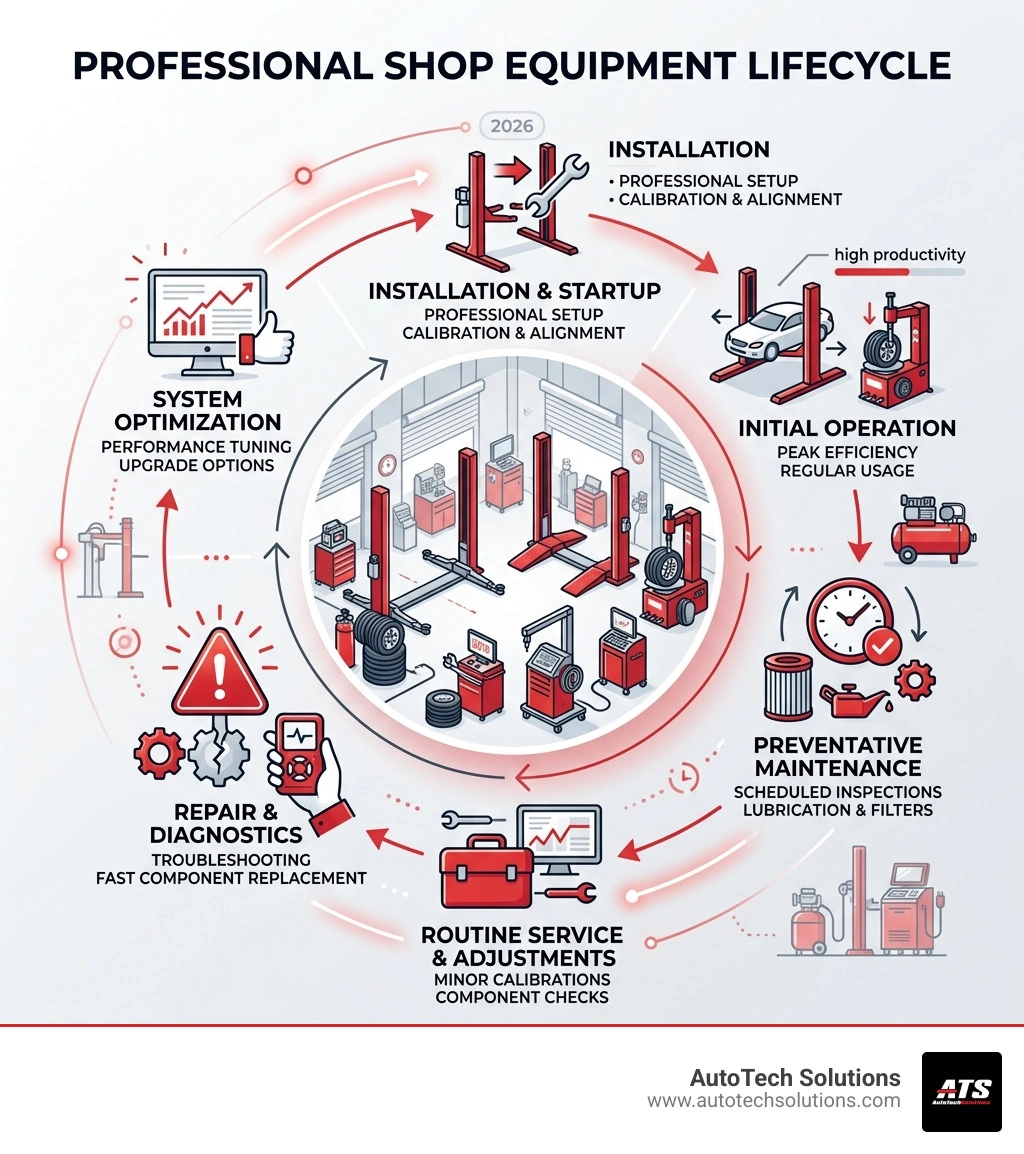
In the world of May 2026, the complexity of shop machinery has reached new heights. Gone are the days when a quick turn of a wrench could fix any piece of equipment. Today, automotive machine repair requires a deep understanding of hydraulics, electronics, and precision software. At AutoTech Solutions, we see how maintaining these systems isn't just about fixing what’s broken—it’s about ensuring the longevity of your most expensive assets.

The foundation of a profitable shop is the reliability of its equipment. When a machine is properly maintained, it operates within its engineered tolerances, reducing the risk of catastrophic failure. This is why we emphasize Preventative Maintenance and Repair Provider for Automotive Equipment services. By catching small issues—like a fraying cable or a slow hydraulic leak—before they cause a shutdown, we help you avoid the high costs of emergency repairs and lost labor hours. For a deeper dive into these processes, check out our Automotive Shop Equipment Repair Guide.
Diagnostic Tools for Automotive Machine Repair
Modern automotive machine repair relies heavily on advanced diagnostics. Just as your technicians use scanners to talk to a vehicle’s ECU, we use specialized tools to diagnose the "health" of shop machinery. This includes:
- Computerized Diagnostics: Monitoring control boards on tire changers and alignment racks to identify software glitches or sensor failures.
- Hydraulic Pressure Testing: Using high-precision gauges to ensure your lifts and bead breakers are producing the necessary force without internal bypass issues.
- Sensor Calibration: Ensuring that the digital "eyes" of your equipment—like those on a wheel balancer—are seeing the world accurately.
Effective Automotive Equipment Repair starts with an accurate diagnosis. Without it, you’re just throwing parts at a problem, which is a great way to waste money and keep a bay empty for longer than necessary.
Emergency Automotive Machine Repair Protocols
We know that some repairs simply cannot wait until Monday morning. When your primary lift fails with a customer's vehicle stuck six feet in the air, you need an immediate response. Our emergency protocols are designed to minimize downtime by prioritizing critical failure points.
Whether it’s a burst hydraulic line or a total electrical failure, having access to After Hours Automotive Lift Repair is a lifesaver for high-volume shops in Novi, MI, or Charlotte, NC. Minimizing downtime isn't just a goal for us; it’s our USP. We strive to get a technician to your site fast, equipped with the parts needed to get you back in business.
Servicing Tire Changers and Wheel Balancers
Tire service is a high-volume, high-margin part of your business, but it’s also where equipment takes a beating. The latest tire changers feature "leverless" tool heads and "Do No Harm™" technologies designed to protect expensive alloy wheels. However, these features require precise adjustment to function correctly.
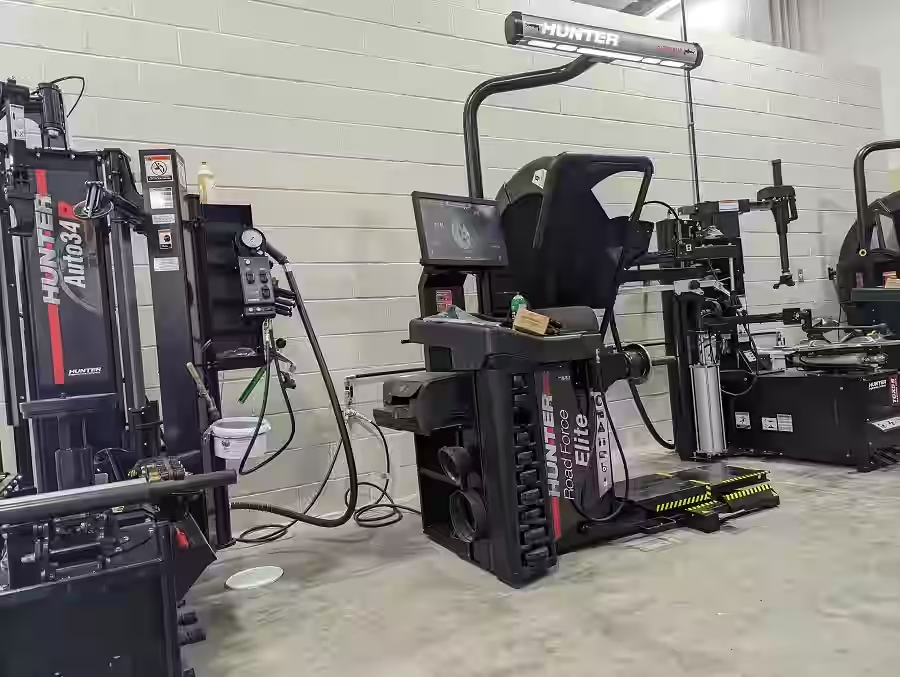
At AutoTech Solutions, we provide comprehensive Service, Repair, and Equipment Support for the industry's most advanced tire machines. This includes servicing center-clamp systems that prevent rim marring and hydraulic bead breakers that exert hundreds of pounds of torque. If your bead breaker is sluggish or your Smart Vision™ laser profiling is off, your technicians will struggle, and the risk of wheel damage skyrockets.
Precision Balancing Equipment
A wheel balancer that isn't calibrated is worse than no balancer at all. It gives your technicians a false sense of security, leading to customer "comebacks" for vibrations. Modern balancers use SmartWeight technology to minimize weight usage and maximize productivity, but this requires the machine’s vision systems and rim runout diagnostics to be perfectly tuned.
| Feature | Manual/Traditional Tire Changers | Autonomous/Leverless Tire Changers |
|---|---|---|
| Technician Fatigue | High - requires physical prying | Low - machine does the heavy lifting |
| Risk of Rim Damage | Moderate to High | Very Low - no metal-to-metal contact |
| Speed | Variable based on skill | Consistent and repeatable |
| Learning Curve | Steep | Shallow - automated steps |
| Torque Control | Manual | Integrated inverter/electric motors |
Maintaining Climate Control and Fluid Recovery Systems
Climate control service is a seasonal goldmine, but only if your recovery machines are working. These units are highly sensitive to contamination and leaks. If a vacuum pump isn't pulling a deep enough vacuum, or if the internal seals are leaking, you aren't just losing time — you might be violating EPA Section 609 regulations regarding refrigerant handling.
Our Refrigerant Recovery Machine Repair Service focuses on maintaining the efficiency of these units. We check for internal leaks, replace worn filters, and ensure the scale is calibrated so you know exactly how much refrigerant you’re recovering and recharging.
Fluid Management Infrastructure
Beyond AC, your shop’s fluid management infrastructure — the pumps, reels, and tanks that handle oil and waste fluids — is the "circulatory system" of your facility. A failure here can lead to messy spills and safety hazards. We inspect pump seals and waste fluid containment systems to ensure everything stays in the pipes where it belongs. This is a core part of any Automotive Shop Equipment Repair Guide because fluid leaks are both a financial loss and a slip-and-fall liability.
Heavy-Duty Lift and Infrastructure Maintenance
Your lifts are the literal backbone of your shop. They are also the most dangerous pieces of equipment if they aren't maintained. We specialize in the repair of two-post, four-post, and scissor lifts across our service areas. Common issues we address include:
- Hydraulic Cylinder Repair: Fixing leaks and "drifting" where a lift won't hold its height.
- Safety Latch Synchronization: Ensuring both sides of the lift engage simultaneously — a critical safety requirement emphasized by the Automotive Lift Institute (ALI).
- Cable Tensioning: Adjusting the cables that keep the lift level and prevent uneven wear on the carriages.
Understanding the Common Causes of Automotive Lift Downtime helps us perform more effective Two Post Lift Repair. Often, it’s something simple like lack of lubrication or debris in the tracks that leads to a major failure.
Alignment Rack Calibration
Alignment is one of the most profitable services you can offer, but it relies on absolute precision. If your four-post lift or scissor rack isn't perfectly level, your alignment readings will be garbage. With the rise of ADAS (Advanced Driver Assistance Systems), alignment racks now serve as the foundation for sensor calibration. If the rack is out of level by even a fraction of a degree, the ADAS calibration will fail.
Daily Lift Safety Checklist:
- Check for hydraulic fluid leaks around cylinders and hoses.
- Listen for unusual noises during ascent and descent.
- Verify that safety latches are clicking in unison.
- Inspect cables for any signs of fraying or slack.
- Ensure the floor area around the lift is clear of debris and oil.
Air Compressors and Paint Booth Systems
Pneumatic tools are only as good as the air that powers them. If your compressor is failing, the entire shop slows down. We service commercial-grade rotary screw and reciprocating compressors, focusing on moisture filtration and pressure regulation.
Moisture is the enemy of pneumatic tools and paint finishes. Our Air Compressor Repair and Maintenance for Automotive Shops includes servicing dryers and drains to ensure your air is clean and dry. In Michigan and the Carolinas, humidity can be a major factor, making moisture control a top priority.
Exhaust and Ventilation Repair
For collision shops, the paint booth is the heart of the operation. Maintaining airflow velocity is critical for both the quality of the finish and the safety of the technician. We provide expert support for intake fan maintenance and filter replacement. If your booth's pressure isn't balanced, you'll end up with "overspray" or dust in the clear coat. For more tips on keeping your booth in top shape, see our Paint Booth Repair Tips Guide.
Furthermore, general shop exhaust extraction systems must be kept in good repair to ensure a healthy working environment. We inspect and repair the fans and ductwork that remove harmful fumes from your service bays, ensuring you stay compliant with local health and safety regulations.
Frequently Asked Questions about Shop Equipment Maintenance
How often should shop equipment undergo professional inspection?
Most manufacturers recommend a thorough professional inspection at least once a year. However, high-volume shops should consider semi-annual inspections for critical equipment like lifts and compressors. Regular "check-ups" are the best way to prevent the need for major automotive machine repair.
What are the primary causes of automotive lift failure?
The most common culprits are lack of lubrication, neglected cable adjustments, and hydraulic seal wear. Environmental factors, like salt and slush dripping from vehicles in Novi, MI, can also accelerate corrosion on lift components if they aren't cleaned regularly.
Why is moisture control critical for pneumatic tool systems?
Moisture causes internal corrosion in expensive air tools and can lead to "fish-eyes" in paint work. It also freezes in lines during cold Michigan winters, potentially causing a total air system blockage. Proper maintenance of air dryers and auto-drains is essential.
Conclusion
At AutoTech Solutions, we understand that your shop is a complex machine in itself. Every piece of equipment—from the smallest air regulator to the largest heavy-duty lift—must work in harmony to keep your business profitable. We are proud to be your one-stop shop for equipment sales, installation, and, most importantly, expert service.
From our locations in Charlotte, Raleigh, Wade, and Novi, we provide the fast repair response you need to minimize downtime. Whether you’re dealing with a broken tire changer or need a full shop equipment audit, our team is ready to support your facility with the highest level of technical expertise. Don't wait for a total breakdown to call the experts.
Schedule your equipment service with AutoTech Solutions today and keep your shop moving forward.