
How Heavy Truck Collision Repair Shop Equipment Works
Heavy truck collision repair in a commercial shop starts with a safety check and damage assessment. Technicians document visible damage, remove affected parts to find hidden damage, then repair or replace damaged structures and systems. Before the truck returns to service, they check alignment and confirm that the repairs are safe. The timeline depends on the damage, parts availability, and insurance approval.
For commercial collision shops, heavy-duty lifting, frame, welding, and paint equipment supports that work at each stage. We are AutoTech Solutions Staff, and this guide explains the shop equipment and infrastructure that keeps fleet downtime in check.

Common heavy truck collision repair shop equipment topics:
Immediate Post-Accident Workflow and Commercial Estimating Equipment
When commercial equipment requires collision assessment, commercial collision centers rely on dedicated estimating and blueprinting bays to establish an accurate repair scope. Initial visual evaluations provide baseline documentation for repair staging, but uncovering deep structural requirements necessitates engineered bay tooling and teardown equipment.
Below is an overview of how shop-level evaluation equipment supports the intake and blueprinting workflow:
| Evaluation Stage | Primary Shop Equipment | Structural Assessment Capabilities | Estimating & Timeline Impact |
|---|---|---|---|
| Initial Intake Scanning | Digital estimating kiosks, 3D imaging hardware, high-intensity inspection lighting | Scans surface profiles and captures baseline dimensional data | Establishes preliminary repair orders and insurance documentation |
| Teardown & Blueprinting Bays | Hydraulic separation tooling, overhead cranes, pneumatic unbolting systems | Enables complete structural access and deep laser-guided verification | Identifies hidden frame stresses and generates verified supplement requests |

Triage, Initial Assessment, and Serviced Fleet Vehicle Types
Commercial collision facilities utilize dedicated digital scanning stations and heavy duty diagnostic equipment to interface directly with commercial electronic management systems. These commercial diagnostic consoles communicate with onboard systems across Class 8 tractors, vocational severe-duty platforms, municipal utility units, and emergency apparatus to identify error codes, verify sensor communication, and validate Advanced Driver Assistance Systems (ADAS) calibration requirements before structural teardown commences.
Technicians position vehicles in specialized diagnostic bays equipped with ruggedized rolling consoles and multi-protocol interface adapters. By evaluating electronic control modules alongside physical laser measuring systems early in the intake phase, estimators can map out electronic faults that correlate directly with mechanical collision impact zones.
Managing Insurance Coordination, Teardowns, and Hidden Damage
Commercial repair estimating requires precise documentation using specialized blueprinting infrastructure. Within dedicated teardown bays, technicians utilize high-capacity lifting apparatus, mobile parts organization carts, pneumatic separation tools, and computerized structural measurement tooling to uncover concealed alignment variations.
Documenting structural deviations with digital imaging and computerized 3D measuring systems allows estimating teams to generate comprehensive supplement packages for insurance carriers, ensuring full alignment with commercial safety specifications. High-resolution imaging towers and articulating inspection arms provide clear photographic proof of micro-fractures, twisted crossmember flanges, and shifted suspension mounts, eliminating ambiguity during claim negotiations and keeping project timelines on schedule.
Core Shop Equipment for Heavy Truck Collision Repair
Managing comprehensive structural restoration requires heavy-duty machinery, synchronized shop systems, and strict adherence to industrial standards, such as the Automotive Service and Collision Industry Hazard Information guidelines.
The equipment workflow spans several shop-level operational phases:
- Intake, Scanning & Triage: High-capacity diagnostic stations and electronic scanning grids.
- Disassembly & Blueprinting: Overhead cranes, mobile parts management carts, and pneumatic extraction equipment.
- Chassis & Cab Structural Realignment: Heavy-duty frame racks, floor anchor grids, and high-tonnage hydraulic pulling towers.
- Composite & Panel Restoration: Professional composite curing stations, pneumatic riveting tools, and structural bonding systems.
- Surface Preparation & Media Blasting: Enclosed abrasive media blasting systems and high-cfm dust collection bays.
- Commercial Refinishing & Curing: Down-draft drive-through spray enclosures with heated air makeup and automated bake cycles.
- Reassembly & Digital ADAS Calibration: Computerized optical targets, radar reflectors, and precision calibration rigs.
- Final Alignment & Safety Verification: Multi-axle laser alignment benches and computerized geometry consoles.
Structural Restoration Equipment and Heavy Truck Collision Repair Protocols
Structural realignment requires high-tonnage anchoring hardware and precision measurement grids. Commercial shops utilize heavy-duty vehicle frame straightening systems anchored directly into reinforced concrete flooring, pairing multi-point electronic laser measurement systems with mobile pulling towers capable of delivering tens of tons of directional force.
These high-tensile steel floor tracks and modular anchoring pits allow technicians to apply simultaneous multi-vector corrective forces, reversing complex chassis sways, twists, and diamond conditions. Maintaining the accuracy and safety of high-capacity structural pulling equipment and shop tooling requires routine collision welding equipment service alongside structured preventative maintenance programs for hydraulic rams, computerized consoles, and electrical power units.
Cab Structure Rebuild Equipment, Metal Fabrication, and Fiberglass Repair

Commercial collision repair shops rely on dedicated tooling stations to service both rigid metals and modern composite assemblies:
- Cab Squaring and Hydraulic Anchoring Systems: Industrial cab repair benches, universal fixture systems, and multi-directional hydraulic rams restore structural squareness and cab mount geometry.
- Pneumatic Riveting and Bonding Equipment: High-tonnage blind-rivet guns and pneumatic adhesive dispensing systems deliver uniform clamping force without introducing thermal distortion.
- Composite Curing and Repair Stations: Specialized dust-extracted sanding stations, composite heating blankets, and controlled resin curing systems restore structural fiberglass, sheet-molding compound (SMC), and lightweight carbon composite assemblies.
- Precision Cutting and Clamping Jigs: Industrial plasma cutters, pneumatic body saws, and heavy-duty structural clamping rigs support seamless sectioning and panel installation.
Commercial Surface Prep, Sandblasting, and Paint Refinishing Equipment
High-durability commercial coatings require dedicated surface preparation machinery and climate-controlled finishing bays. Shops utilize closed-loop media blasting booths equipped with high-volume dust collectors, pneumatic pressure-blast pots, and media recovery systems to strip oxidation, scale, and damaged coatings while profiling substrates for optimal paint adhesion.
Following preparation, work progresses into high-capacity commercial collision repair paint booths. These industrial booths feature advanced downdraft airflow dynamics, high-efficiency intake filtration, and programmable heated bake cycles to cure multi-stage commercial finishes evenly.

Integrated gas-fired direct air makeup units supply filtered, tempered air to maintain stable booth pressurization during spraying and accelerate paint cross-linking during curing cycles.
Outfitting Commercial Facilities for Heavy Duty Body Work
Managing heavy commercial collision repair requires purpose-built facility infrastructure capable of supporting large vehicle weights and dimensions. Commercial shops must organize bay layouts to ensure safe technician movement, efficient material handling, and steady vehicle throughput across each production stage.
Proper commercial facilities rely on comprehensive heavy duty shop equipment, including overhead gantry cranes, dedicated pneumatic distribution lines, and high-efficiency exhaust extraction systems. These track-mounted source-capture exhaust extraction rails capture diesel fumes directly at the tailpipe during low-speed bay maneuvering and functional diagnostic testing, keeping shop environments safe, healthy, and compliant with environmental standards.
In addition, integrated oil-water separation equipment, explosion-proof paint storage mixing rooms, and high-capacity compressed air dryers ensure clean, dry pneumatic air delivery to sensitive rivet guns, plasma cutters, and precision paint spray equipment.
Essential Equipment for Heavy Truck Collision Repair Facilities
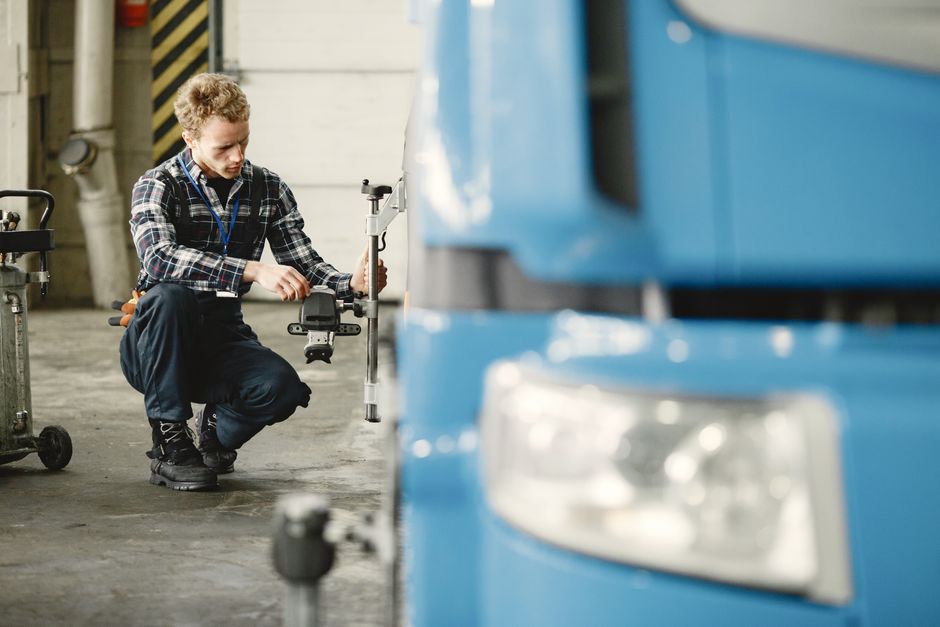
To repair heavy-duty commercial vehicles accurately and efficiently, commercial collision centers require industrial-grade shop tools:
- High-Capacity Anchoring Racks: Floor-mounted structural steel channels equipped with 20- to 50-ton mobile hydraulic pulling towers to reverse major structural rail bends and crossmember twists.
- Laser-Guided Alignment Racks: Computerized systems featuring a commercial collision repair alignment system to correct multi-axle thrust angles, kingpin inclination, scrub radius, and caster/camber geometry.
- Pneumatic Rivet Guns & Structural Clamping Rigs: Industrial tooling designed to deliver consistent clamping force and exact setting pressures during structural panel and hood installation.
- Down-Draft Drive-Through Paint Enclosures: Industrial paint booths engineered with heated intake makeup units, continuous air filtration, and extended ceiling clearance to accommodate full-height commercial cabs and utility bodies.
- Heavy-Duty Wheel Balancers and Runout Gauges: Commercial wheel balancing and rim runout tooling that detect impact-related rotational imbalance across multi-axle commercial assemblies.
Fleet Downtime Optimization and Shop Selection Criteria
For commercial fleet owners and operations managers, managing downtime is critical to protecting operational revenue and meeting customer commitments. Selecting the right collision repair facility requires evaluating shop-floor capabilities, diagnostic systems, physical footprint, and technical certifications.
When evaluating a commercial collision repair facility, fleet managers should consider the following criteria:
- Comprehensive In-House Capabilities: Facilities that handle structural straightening, electronic diagnostics, mechanical multi-axle alignment, panel fabrication, and refinishing under one roof minimize sublet transport delays and ensure tighter quality control.
- Dedicated Parts Inventory & Logistics: Direct relationships with original equipment manufacturers (OEM) and on-site inventory management systems reduce lead times for specialized frame crossmembers, cab panels, and structural hardware.
- Experienced Master Technicians: Shops with low staff turnover, ongoing technical training, and certified equipment operators ensure consistent, high-quality structural repairs that adhere to factory engineering tolerances.
- Direct Carrier Claim Handling: Repair centers with established insurance partnerships, computerized blueprinting software, and digital imaging estimating kiosks accelerate supplement approvals and shorten administrative delays.
- DOT Safety & Compliance Verification: Comprehensive post-repair quality audits confirm multi-axle tracking, brake system safety, optical sensor positioning, and ADAS sensor calibrations before vehicles return to revenue-generating service.
- Preventative Equipment Calibration Protocols: Facilities that routinely certify, calibrate, and service their frame pulling towers, alignment benches, and spray booth airflow systems deliver consistent, repeatable repair precision.
Conclusion
Restoring severe commercial vehicle damage requires specialized infrastructure, trained technicians, and industrial-grade equipment. From laser-guided chassis straightening and structural composite repair to controlled downdraft spray booth refinishing, commercial collision centers depend on robust machinery to return commercial assets to service safely.
Commercial collision repair centers can outfit and maintain their facilities with turnkey collision center solutions from AutoTech Solutions. AutoTech Solutions delivers end-to-end commercial equipment sales, installation, certified service, and preventative maintenance across North Carolina and Michigan—helping commercial shops operate efficiently, maintain strict safety standards, and minimize fleet downtime.