Why Two Post Lift Repair Matters for Your Shop's Bottom Line

Two post lift repair is critical to preventing costly downtime and maintaining safe operations in any automotive facility. When your lift malfunctions, every minute it sits idle translates to lost revenue and frustrated technicians.
Quick Troubleshooting Guide for Common Two Post Lift Issues:
| Problem | Most Likely Cause | Immediate Action |
|---|---|---|
| Uneven lifting | Air in hydraulic system or cable tension | Bleed hydraulic lines; adjust equalizing cables |
| Lift won't rise | Low hydraulic fluid or dirt in check valve | Check fluid level; clean valve |
| Loud noises | Air contamination or mechanical wear | Open heat valve to release air; inspect for damage |
| Safety locks not engaging | Worn springs or misalignment | Test monthly; replace immediately if faulty |
| Hydraulic leaks | Damaged seals or loose fittings | Identify source; tighten or replace components |
Here's what many shop owners don't realize: most two-post lift failures are preventable. According to industry standards, anchor bolts need retorquing to 70-110 foot-pounds within the first three months of installation, then annually. Hydraulic fluid should be changed yearly (or every 6-8 months in high-use environments). Safety locks must be tested monthly.
The research is clear—regular maintenance takes about 1.5 hours annually but can prevent thousands of dollars in emergency repairs and lost productivity. Yet many shops skip these basic steps until something breaks.
When you understand how to diagnose common issues like hydraulic leaks, uneven lifting, or safety lock failures, you can often address minor problems before they become major headaches. Some repairs require professional intervention, but many routine maintenance tasks fall within the capability of trained shop personnel with the right tools and knowledge.
This guide walks you through the most common two-post lift problems, how to diagnose them, and when to tackle repairs yourself versus calling in experts. Whether you're dealing with erratic hydraulic behavior, mysterious noises, or safety concerns, you'll learn practical troubleshooting steps that minimize downtime and keep your operation running smoothly.
Common Issues and Two Post Lift Repair Diagnosis
In our experience at AutoTech Solutions, diagnosing a lift issue is half the battle. When a technician tells us their lift is "acting up," we look for specific symptoms. The most common problems we encounter across Michigan and the Carolinas include uneven lifting, hydraulic leaks, and safety lock failures.

Uneven lifting is a classic symptom that can stem from two different areas: the hydraulic system or the mechanical equalization system. If one side lags behind the other, you are likely looking at air in the lines or stretched cables. Hydraulic leaks, on the other hand, are usually easy to spot-look for puddles around the base or "weeping" cylinders.
Safety lock failure is perhaps the most critical issue. If you don't hear that rhythmic "click-click-click" as the lift rises, or if one side fails to click, stop immediately. This indicates a broken spring or a jammed mechanism. For more on keeping your equipment in peak condition, explore our Automotive Equipment Repair services.
For additional best practices on routine lift care, see this external reference on vehicle lift safety and maintenance.
Identifying Hydraulic vs. Mechanical Faults
Distinguishing between a hydraulic and mechanical fault is essential for an efficient two post lift repair.
- Hydraulic Faults: These usually manifest as sagging arms (where the lift slowly lowers on its own), a humming motor that won't lift, or "spongy" operation. If you hear a crackling noise, it often indicates air contamination in the oil.
- Mechanical Faults: Grinding noises or loud "clunks" usually point to mechanical wear in the carriages or pulleys. If the motor runs but the lift doesn't move, and the fluid levels are fine, you might have a sheared keyway or a failed coupling.
- Electrical Faults: If the motor won't even hum, check for blown fuses or a tripped thermal overload.
For deep-dive support, we offer comprehensive Service, Repair, and Equipment Support to get your shop back to 100% capacity.
Safety Risks of Delayed Two Post Lift Repair
We cannot stress this enough: a malfunctioning lift is a liability. The safety locks are your primary protection against hydraulic failure. If a seal blows while a vehicle is in the air and the locks aren't engaged or functional, the result is a catastrophic structural collapse. Beyond the risk of vehicle tipping, a malfunctioning lift puts your technicians' lives at risk. Never "work around" a lift issue; address it the moment it arises.
Step-by-Step Troubleshooting for Hydraulic and Electrical Failures
When the "up" button doesn't produce the desired result, it’s time to get systematic. Most hydraulic issues in two-post lifts are caused by air, dirt, or low fluid.
Start by checking the fluid reservoir. Most lifts require a high-quality ISO 32 or ISO 46 hydraulic oil. If the fluid is dark or cloudy, it has likely degraded and needs a full change. If the motor is running but the lift won't rise, there may be dirt under the check valve. A quick pro-tip: try pressing the down lever and the up button simultaneously for 10-15 seconds to flush out minor debris. If you're setting up a new bay, proper Automotive Lift Installation is the best way to prevent these issues from day one.
How to Bleed Air from the Hydraulic System
If your lift feels "bouncy" or the carriages are out of sync, you probably have air trapped in the cylinders. This is common after a hose replacement or if the fluid level was allowed to get too low.
- Raise the lift: Bring the carriages up about 2 feet off the ground.
- Open the bleeder screws: Located at the top of the cylinders. Open them about two turns.
- Watch the fluid: You will hear air hissing out. Wait until a steady stream of fluid (without bubbles) appears.
- Tighten and Repeat: Close the screws and cycle the lift up and down 3-4 times to ensure all air is purged.
| Fluid Type | Best Use Case | Maintenance Interval |
|---|---|---|
| ISO 32 | Standard temperature shops | Change annually |
| ISO 46 | High-heat environments | Change every 8 months |
| Dexron III | Some specialized power units | Per manufacturer spec |
Resolving Common Electrical Issues
If the lift is completely dead, start at the wall. Check for blown fuses or tripped breakers. Two-post lifts typically run on 220V motors that pull significant amperage; if your wiring is frayed or the voltage drops below 197V, the motor may hum but fail to turn.
Check the "up" button and the overhead safety limit switch. The overhead bar is designed to cut power if a tall vehicle touches it—sometimes this switch gets stuck in the "off" position due to dust or a bump. For complex shop setups, our team handles Installations, Upfits & Facility Buildouts to ensure your electrical load is balanced correctly.
Essential Two Post Lift Repair for Cables, Anchors, and Arm Restraints
The mechanical backbone of your lift consists of the equalizing cables and the anchor bolts. If these fail, the hydraulics won't matter.
Inspecting and Adjusting Equalizing Cables
On a two-post lift, the cables don't actually do the heavy lifting—the hydraulic cylinders do. The cables are there to ensure both carriages rise at the exact same rate.
Signs you need cable repair:
- The "Pinch Test": With the lift slightly raised, pinch the two cables together. They should touch with some effort but shouldn't be "floppy."
- Visible Damage: If you see 12 or more broken wires in one "lay" (one full twist of the cable), the cable is legally and practically "dead" and must be replaced.
- Kinking: Any permanent bend or kink in the cable is a structural weak point.
To adjust them, tighten the nut on top of the carriage to remove slack. Always adjust them so that both safety locks click at the exact same time. This is a core part of our Preventative Maintenance Programs.
Anchor Bolt Maintenance and Torque Procedures
Your lift is only as strong as the concrete it’s bolted to. Most 12,000 lb lifts require a minimum of 4 inches of 3000 PSI concrete.
The Golden Rules of Anchors:
- Initial Check: New anchors often settle. Check them within the first 30 days.
- Monthly Torque: Use a calibrated torque wrench to check bolts. Depending on your lift model, they should be torqued to between 70 and 110 foot-pounds.
- Base Plate Stability: If you see the base plate "shimming" or moving when a vehicle is lifted, stop immediately. You may need to repour the concrete or use larger anchors.
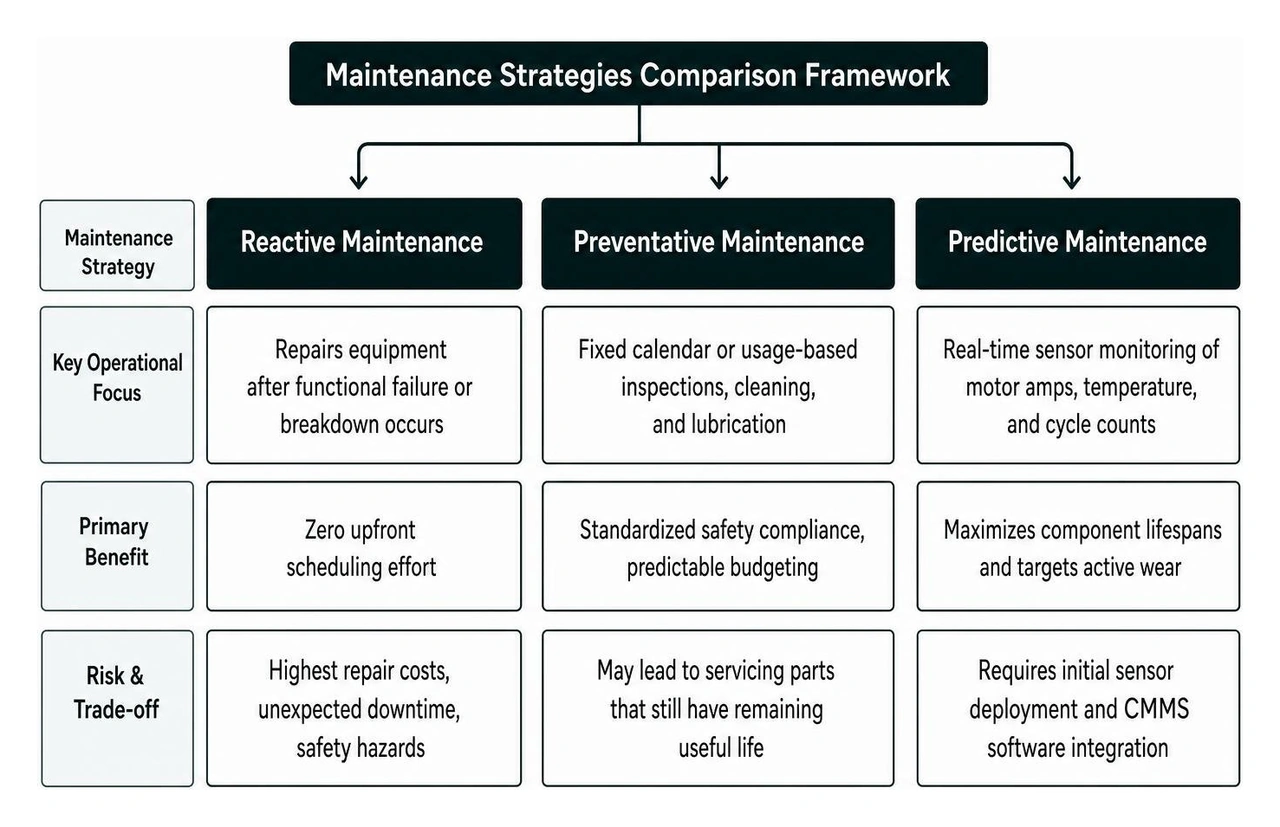
Preventative Maintenance: Avoiding Future Two Post Lift Repair
We always tell our clients: an ounce of prevention is worth a pound of two post lift repair. A well-maintained lift can last 20+ years; a neglected one might be scrap in five.
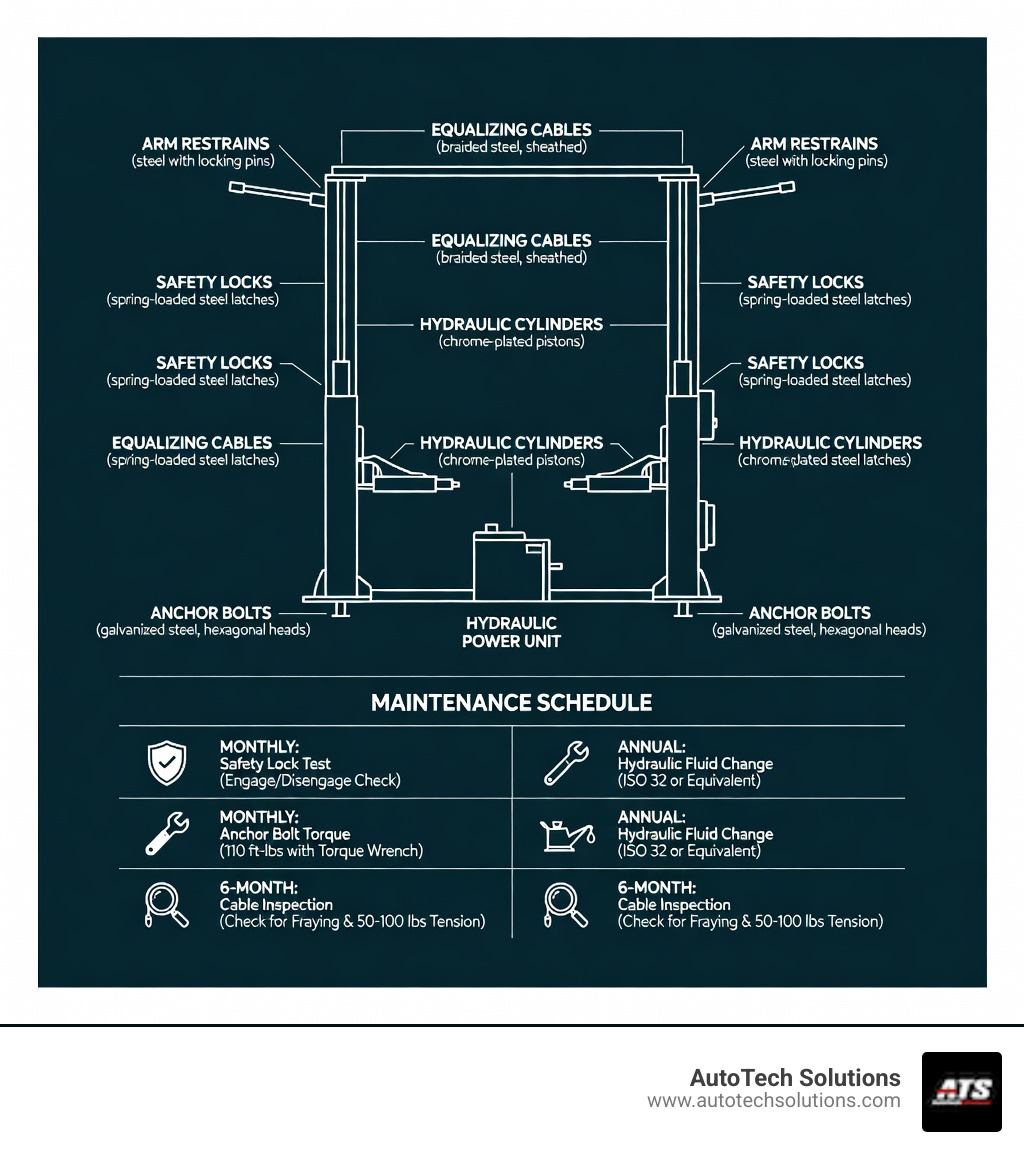
Monthly and Annual Maintenance Checklists
To keep your shop running without a hitch, follow this simple schedule:
Monthly:
- Check anchor bolt torque (110 ft-lbs for heavy-duty models).
- Test safety locks—ensure they engage and disengage cleanly.
- Lubricate the "corners" of the columns where the carriages slide.
- Check arm restraints. These should lock automatically when the lift leaves the floor.
Annually:
- Change the hydraulic fluid.
- Inspect cables for fraying or diameter reduction.
- Lubricate arm pins by removing the snap rings and applying a thin coat of grease.
- Get an ALI-certified inspection.
For professional assistance with these tasks, check out our Preventative Maintenance Programs and the expert support we provide.
When to Call Professionals for Two Post Lift Repair
While you can certainly bleed your own lines or grease your own pins, some things are best left to the pros at AutoTech Solutions. You should call us if you notice:
- Structural cracks in the arms or columns.
- Cylinders that continue to leak after seal replacement.
- Anchors that will not hold their torque (this indicates a concrete failure).
- Any issue that prevents the safety locks from functioning.
Professional repair ensures you stay in compliance with OSHA and insurance requirements. You can find more about our Service, Repair, and Equipment Support here.
Frequently Asked Questions about Two Post Lift Repair
How often should I torque my lift's anchor bolts?
You should perform an initial check within the first 3 months of installation, as anchors often settle into the concrete. After that, we recommend a monthly check to 110 ft-lbs (or 70 ft-lbs depending on your manual) and a mandatory annual re-torquing.
What are the signs that my equalizing cables need replacement?
Look for "bird-caging" (strands puffing out), kinking, or rust. If you count 12 broken wires in one section of the cable, or if the cable has stretched so much that it can no longer be adjusted to sync the locks, it’s time for a replacement.
Why is my lift motor running but the arms aren't rising?
This is usually a "prime" issue. Either your hydraulic fluid is too low, or air is trapped in the pump. It can also be caused by a piece of debris stuck in the lowering valve, which keeps the system from building pressure.
Conclusion
At AutoTech Solutions, we know that your lifts are the heart of your shop. Whether you are in Charlotte, Raleigh, or Novi, our goal is to help you handle two post lift repair with confidence and minimize your downtime. By following a strict maintenance schedule and knowing when to turn the wrench yourself versus when to call in our expert team, you ensure a safe and profitable environment for your technicians.
Ready to schedule a professional inspection or need a fast repair response? Request professional service from AutoTech Solutions today and let us keep your shop moving.