

Why Brake Lathe Repair Parts Are Critical to Shop Uptime
Brake lathe repair parts are the consumable and wear components that keep your shop's brake lathe cutting accurately and running reliably — and replacing them on time is one of the most overlooked causes of rotor resurfacing quality problems.
The most commonly replaced brake lathe parts include:
- Shear gears — protect the drivetrain from overload damage
- Spindle boots — seal out metal debris and coolant contamination
- Feed nuts and lead screws — control cutting depth and lateral movement
- Carbide inserts and tool holders — determine surface finish quality on rotors and drums
- Silencer bands — reduce chatter and vibration during resurfacing
- Centering cones and bell clamps — ensure accurate workpiece mounting
- Spindle seals and springs — maintain alignment and protect internal components
Suppliers like MT-RSR carry over 330 brake lathe parts and accessories, while distributors such as SVI International offer same-day shipping from multiple U.S. warehouses — so sourcing the right part quickly is very achievable.
For a busy commercial shop, a worn feed nut or a cracked spindle boot is not a minor inconvenience. It means inaccurate cuts, comeback jobs, and a lathe that can't be trusted. Equipment downtime is lost revenue, and brake lathes are no exception.
This guide covers everything shop managers need to know: which parts wear fastest, how to spot failure early, how to compare OEM versus aftermarket options, and how to source quality components efficiently.
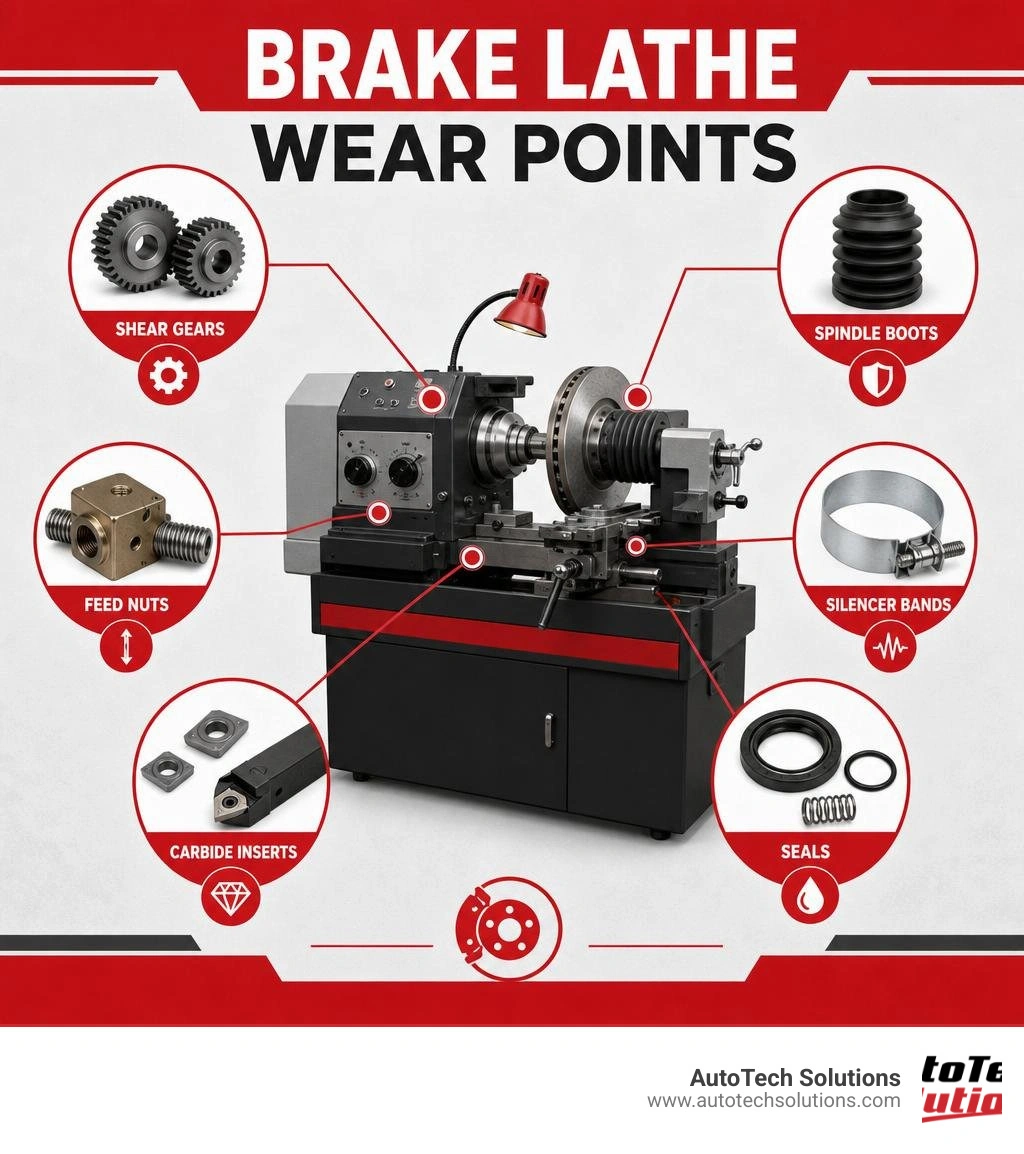
Brake lathe repair parts word roundup:
Essential Brake Lathe Repair Parts for Commercial Shops

In high-volume commercial repair facilities, dealerships, and fleet maintenance shops across Michigan and the Carolinas, brake lathes are subjected to daily, heavy-duty operation. To prevent unexpected breakdowns and maintain the precision required for modern braking systems, shop managers must understand the critical wear components that comprise their lathes.
Using high-quality brake lathe repair parts ensures that your equipment remains accurate, protecting your shop from costly comebacks and maintaining high throughput. For a comprehensive look at commercial shop equipment care, see our Automotive Shop Equipment Repair Guide.
Several key components require regular monitoring and timely replacement:
- Shear Gears: Designed as a mechanical safety mechanism, the shear gear is engineered to break or strip if the lathe's tool bit experiences an overload or a jam. This sacrificial part prevents catastrophic and highly expensive damage to the electric motor and main drive gears.
- Spindle and Feed Boots: These protective rubber accordion-style boots seal out abrasive cast-iron dust, metal shavings, and cutting oils from the precision ground spindles and lead screws. When boots crack or tear, debris quickly contaminates the lubricating grease, leading to rapid wear of the underlying metal components.
- Feed Nuts and Lead Screws: The feed nut engages with the lead screw to translate rotational power into steady, linear movement for the cutting head. Over time, friction wears down the threads of the feed nut, introducing backlash and causing inconsistent feed rates.
- Tool Holders: The tool holder secures the carbide cutting bits at the precise angle required for machining. Vibration, accidental impacts, and thread wear on the locking screws can compromise the rigidity of the holder, leading to poor surface finishes.
To keep these essential components stocked, commercial operations frequently source components from specialized catalogs like Brake Lathe Repair & Maintenance Car Parts , which provide direct access to exact-fit replacement gears, boots, and hardware.
Identifying Wear in Critical Brake Lathe Repair Parts
Detecting wear in your lathe before it causes a complete machine failure is crucial for maintaining shop productivity. Technicians should be trained to recognize the following warning signs during daily operation:
- Excessive Vibration and Chatter: If a lathe that previously cut smoothly begins to emit high-pitched squeals or visible vibration during a pass, it usually indicates play in the spindle bearings, a worn tool holder, or a degraded silencer band.
- Visual Inspection of Boots: Regularly inspect all rubber boots. If you spot tears, dry rot, or grease leaking through cracks, the boots must be replaced immediately before abrasive metal dust ruins the precision-ground shafts.
- Backlash in the Feed Controls: Turn the handwheels and observe how much rotation occurs before the cutting head actually begins to move. Excessive play (backlash) points directly to a worn feed nut or a degraded lead screw.
- Spindle Play and Runout: With the machine powered off, attempt to physically wiggle the spindle arbor up and down. Any detectable movement indicates worn spindle bearings or failing seals, which will directly translate into lateral runout on the resurfaced brake rotors.
The Role of Silencer Bands and Carbide Inserts in Resurfacing Quality
The ultimate quality of a resurfaced rotor or drum relies heavily on the interface between the cutting tip and the workpiece. Two relatively inexpensive consumables play a massive role in this process:
- Carbide Inserts (Cutting Bits): These small, indexable carbide tips do the actual work of shearing metal off the rotor face. Modern commercial shops typically utilize negative-rake carbide inserts (such as the popular 7914-10 style) because they feature multiple cutting edges per insert, providing excellent cost-per-cut efficiency. Dull or chipped inserts leave a rough, torn surface finish that will cause immediate brake noise and pad wear on the customer's vehicle.
- Silencer Bands: When a rotor spins on a lathe arbor, it acts like a tuning fork, generating high-frequency harmonic vibrations. Silencer bands—made of weighted rubber, heavy-duty lead-free materials, or spring-loaded steel—are wrapped tightly around the rotor's perimeter to damp these vibrations. Without effective vibration control, "chatter marks" (tiny, visible waves) will be machined directly into the rotor surface, ruining the lateral runout tolerances.
To maintain a consistent supply of these high-wear consumables, shops rely on professional-grade inventories like Brake Lathe Parts | Brake Clamps, Silencers, & Adapters - MT-RSR and Repair Parts Archives to source premium silencers, vibration dampeners, and carbide inserts.
Sourcing and Compatibility: OEM vs. Aftermarket Components
When sourcing brake lathe repair parts, commercial shop owners and service managers must decide between Original Equipment Manufacturer (OEM) parts and high-quality aftermarket equivalents. Understanding the trade-offs in compatibility, cost, and material quality is essential for making smart procurement decisions. For a deeper look at machinery maintenance, consult our Automotive Machine Repair Guide 2026.
| Feature / Consideration | OEM Brake Lathe Parts | Premium Aftermarket Parts (e.g., MT-RSR, SVI) |
|---|---|---|
| Compatibility | Guaranteed exact fit for specific proprietary models. | Engineered to meet or exceed original specs; often cross-compatible. |
| Material Quality | High standard, matching original machine specifications. | Often uses modern metallurgy or improved polymers (e.g., upgraded boots). |
| Cost & Value | Generally higher price point; premium brand markup. | Highly competitive pricing; often available in bulk or bundled kits. |
| Availability | Can face long lead times, especially for older or discontinued models. | Excellent availability with fast shipping from regional warehouses. |
| Warranty Support | Covered under manufacturer-specific equipment warranties. | Covered by independent supplier warranties (typically 1 year). |
While OEM components offer guaranteed compatibility, reputable aftermarket manufacturers often redesign common failure points—such as upgrading standard rubber boots to more durable polyurethane blends or reinforcing shear gears—to provide longer service life at a lower operating cost.
Selecting the Right Brake Lathe Repair Parts and Adapters
Achieving a perfectly flat, hub-concentric cut on a rotor or drum requires precise mounting on the lathe arbor. Most professional-grade lathes utilize a standard 1-inch arbor, making adapters and mounting accessories highly interchangeable across major brands like Ammco, Hunter, Accu-Turn, Bosch, FMC, and Ranger.
To ensure your technicians have the correct tooling for every commercial vehicle that enters the bay, investing in comprehensive adapter sets is highly recommended:
- Passenger Car & Light Truck Sets: A complete setup, such as the 20-Piece Brake Lathe Passenger Car & Light-Duty Truck Bell Clamp & Cone Set for 1" Arbors , provides a wide range of centering cones, double-ended adapters, and bell clamps. This ensures perfect centering on everything from compact sedans to half-ton fleet trucks.
- All-in-One Premium Kits: For high-volume shops operating multiple lathe brands, the 31 Piece Premium Choice Brake Lathe Adapter Set for Ammco, Accu-Turn & Bosch - 1" Arbor offers a complete array of adapters, truck flange plates, and silencer bands, eliminating the need to search for separate brand-specific tooling.
- Heavy Axle and Trailer Assemblies: When servicing heavy-duty commercial trailers or utility fleets, technicians often encounter specialized hub-and-bearing assemblies. In these cases, utilizing high-quality replacement assemblies like the Lippert 12" Brake Hub Complete Kit with Installed Bearings - 6,000-lb. Axles, 6 on 5-1/2" Bolt Pattern, 1/2" Stud Size #2024013262 | Lippert ensures that the entire hub and brake drum assembly matches factory tolerances when mounted on heavy-duty arbors for resurfacing.
Maintenance Kits vs. Individual Component Replacement

When a brake lathe component wears out, shop owners often face a choice: replace only the single broken part, or perform a complete machine tune-up using a comprehensive maintenance kit.
While purchasing individual parts might seem cost-effective initially, it often leads to repeated machine downtime. If a spindle boot has torn due to age, it is highly likely that the companion seals, brass plugs, and shear gears are also nearing the end of their operational lifespan. To keep your shop running smoothly, check out our Automotive Equipment Repair services for expert assistance.
Opting for a bundled kit, such as the MT-RSR 90450 Deluxe Brake Lathe Repair Kit for Ammco (typically priced around $218), provides several operational advantages:
- Reduced Downtime: You only take the machine out of service once to replace all high-wear components, rather than stopping work repeatedly for individual failures.
- Cost Efficiency: Bundled kits offer significant savings compared to purchasing shear gears, boots, brass rings, and silencer bands separately.
- Preventative Peace of Mind: Replacing all wear-prone parts simultaneously restores the lathe's precision and prevents minor wear from cascading into major mechanical damage.
Step-by-Step Installation of Common Replacement Parts
Maintaining your shop's brake lathe is a straightforward process for professional technicians. Below is a standard operational workflow for performing routine component replacements on commercial bench lathes:

1. Spindle Boot Replacement
- Disconnect the lathe from its main power source.
- Remove the arbor nut, spacers, and any mounted adapters.
- Slide the old, damaged spindle boot off the shaft.
- Thoroughly clean the precision spindle shaft using a lint-free cloth and a mild degreaser to remove old grease and metal grit.
- Apply a thin layer of high-quality machine lubricant to the shaft.
- Slide the new spindle boot into place, ensuring the sealing lips seat firmly in their retaining grooves.
2. Shear Gear Installation
- Locate the right-angle drive or feed gearbox housing.
- Remove the protective cover or retaining pin securing the sheared gear.
- Slide the broken gear pieces off the shaft.
- Inspect the mating metal gears for any debris or chipped teeth. Clean the area thoroughly.
- Slide the new aftermarket shear gear onto the shaft.
- Secure the gear with a fresh shear pin or retaining clip. Never replace a shear pin with a standard hardened bolt, as this defeats the safety design of the gear.
3. Tool Holder Alignment and Calibration
- Remove the tool holder mounting screws and detach the holder from the twin cutter assembly.
- Clean the mounting surfaces to ensure no metal shavings are trapped underneath, which would cause misalignment.
- Install the new tool holder and loosely tighten the mounting hardware.
- Utilize a dial indicator to verify that the tool holder is perfectly perpendicular to the spindle axis.
- Torque the mounting screws to the manufacturer's specified tightness.
- Install fresh carbide inserts, ensuring they are seated perfectly flat in their pockets.
Frequently Asked Questions about Brake Lathe Maintenance
To assist shop managers in keeping their equipment running at peak performance, we have compiled answers to some of the most common questions regarding commercial brake lathe service. For professional support, parts sourcing, and on-site repair, you can also consult resources like Brake Lathe Service Tech Parts, Sales, Used and Repair .
How often should brake lathe spindle boots and shear gears be replaced?
Spindle boots should be inspected weekly and replaced immediately upon detecting any tears, cracks, or structural softening caused by oil exposure. On average, busy commercial shops replace spindle boots annually as part of preventative maintenance.
Shear gears do not have a set replacement interval; they are designed to fail during an overload event. However, keeping at least two spare shear gears in your shop's tool crib is highly recommended to avoid multi-day downtime when a jam occurs.
Can I use universal adapters across different brake lathe brands?
Yes, provided the lathes share the same arbor diameter. The vast majority of professional bench brake lathes—including models from Ammco, Hunter, FMC, Accu-Turn, Bosch, Ranger, and Rels—utilize a standard 1-inch diameter arbor.
This standardization allows high-quality passenger car and light truck cone and bell clamp sets to be shared across different machines in your shop, maximizing your tooling investment.
How do quality replacement parts extend the lifespan of shop lathes?
Quality replacement parts prevent minor wear from turning into major mechanical failures. For example:
- A new, tight-fitting spindle boot keeps abrasive cast-iron dust out of the spindle bearings, preventing premature bearing failure and maintaining cutting accuracy.
- A fresh feed nut eliminates backlash, preventing the cutting head from jumping or gouging the rotor, which protects the expensive lead screw from damage.
- Precise tool holders and high-grade carbide inserts reduce cutting resistance, lowering the operating temperature and reducing strain on the lathe's electric motor and drive gears.
Conclusion
A high-performing brake lathe is a cornerstone of profitability for any commercial automotive service department, collision center, or fleet maintenance facility. By understanding the critical role of brake lathe repair parts, recognizing the early signs of wear, and choosing high-quality replacement components, shop managers can eliminate costly downtime and ensure every brake job is completed to exact tolerances.
At AutoTech Solutions, we are dedicated to keeping your shop's equipment running at peak efficiency. As a premier one-stop-shop for commercial automotive equipment sales, professional installation, scheduled servicing, and preventative maintenance, we support light-duty, heavy-duty, and collision shops throughout Michigan and the Carolinas.
With physical locations in Novi, MI, Charlotte, NC, Raleigh, NC, and Wade, NC, our expert technicians are always nearby to minimize your downtime and provide rapid repair response.
Don't let a worn gear or a torn boot slow down your service bays. Schedule professional equipment support and repair services with AutoTech Solutions today and keep your shop moving forward.