Why Proper Car Hoist Installation Matters for Your Shop's Success
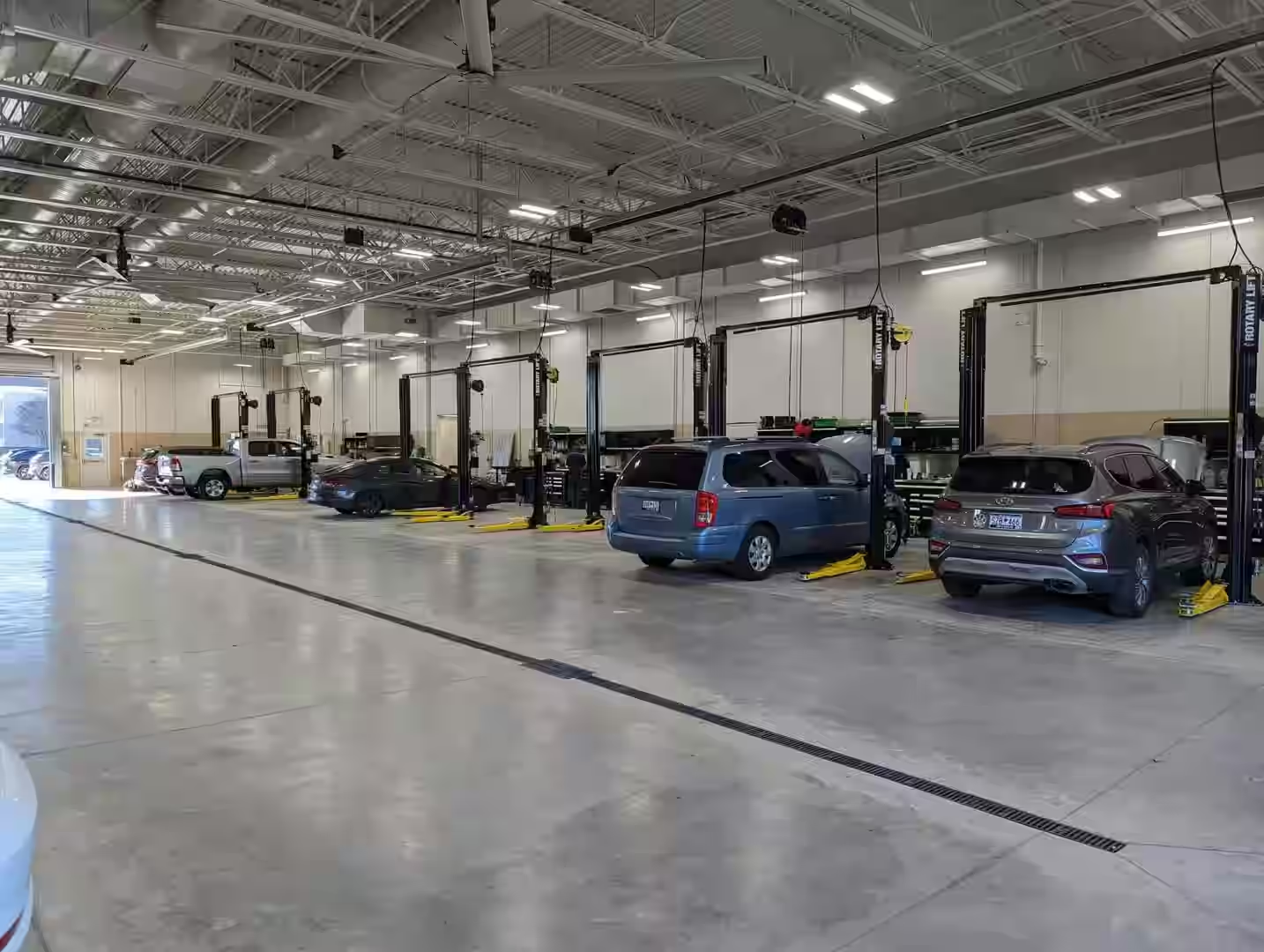
Car hoist installation is a critical investment that directly impacts your shop's productivity, safety, and profitability. Whether you're setting up a new facility or upgrading existing equipment, getting the installation right the first time prevents costly downtime and potential safety hazards.
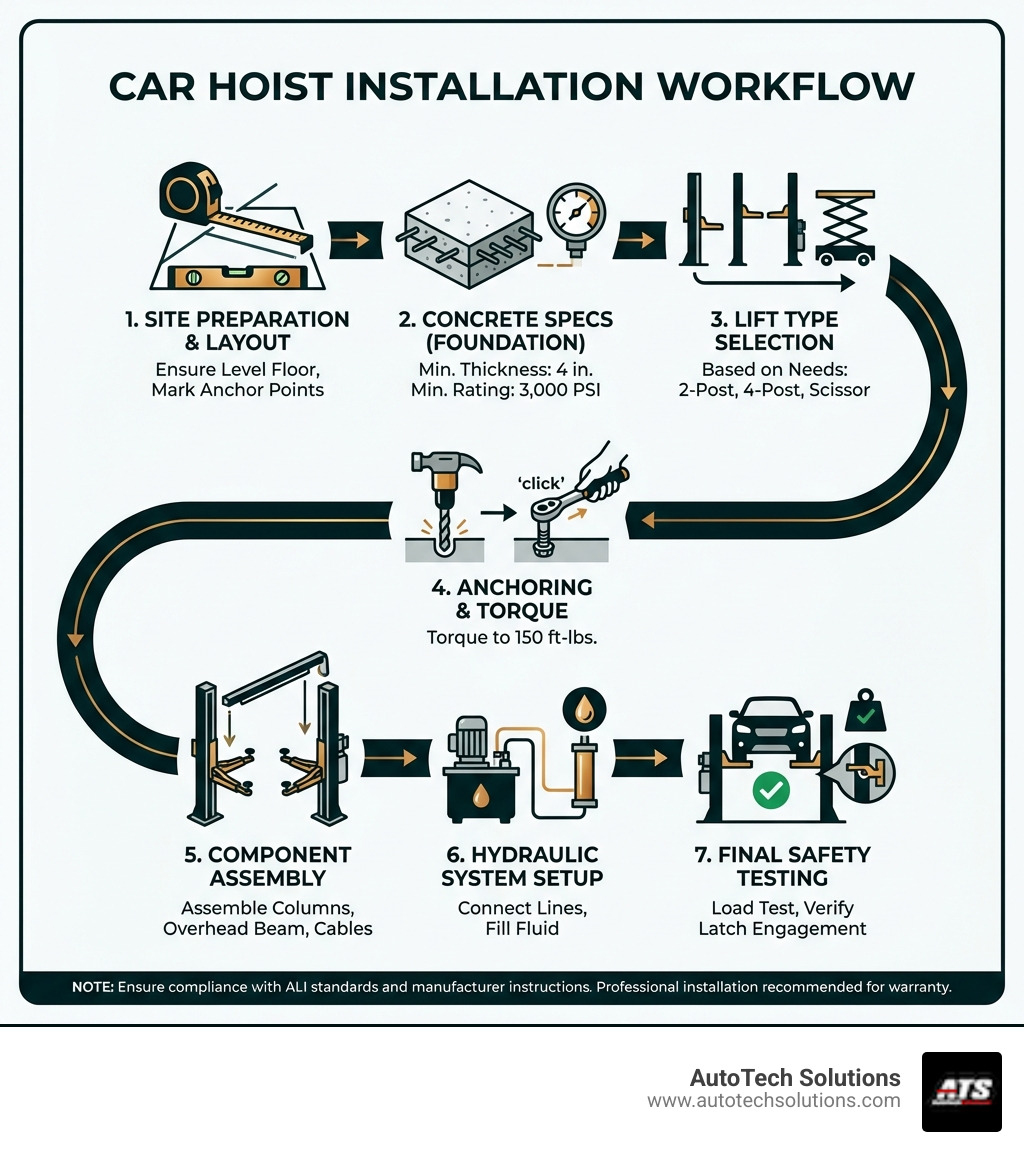
Quick Guide: Essential Car Hoist Installation Steps
- Check your concrete - Minimum 4 inches thick, 3,000 PSI rating required
- Verify ceiling clearance - At least 12 feet from floor to ceiling
- Choose your lift type - Two-post, four-post, or scissor lift based on your needs
- Prepare the site - Mark anchor points, drill holes, ensure level floor
- Anchor the columns - Torque bolts to 150 ft-lbs for secure installation
- Assemble components - Overhead beam, hydraulic lines, and equalizing cables
- Test thoroughly - Load test and verify latch engagement before use
Installing a car lift on your own is no small matter. As one industry guide notes, "If you aren't entirely confident that you know how to install a car lift safely, you may want to call a professional service to do the job for you."
The foundation makes or breaks your installation. A proper concrete slab with the right PSI rating prevents anchor failure and ensures decades of reliable service. Meanwhile, inadequate ceiling height or poor column placement can limit the vehicles you can service and create dangerous working conditions.
Most manufacturers require professional installation to maintain warranty coverage. Even experienced shop owners benefit from factory-authorized installation to ensure ALI certification standards are met and all safety systems function correctly.
The cost of mistakes is high. Improper installation can damage expensive equipment, void warranties, and create liability risks. But with the right preparation and understanding of the process, you can make informed decisions about DIY versus professional installation.
Planning Your Car Hoist Installation: Location and Clearance
Before you even order a lift for your shop in Raleigh or Novi, you need to grab a tape measure and a chalk line. Shop layout is the most overlooked aspect of car hoist installation. You aren't just fitting a piece of machinery; you're creating a workspace where technicians need to move freely, open vehicle doors, and roll toolboxes.
Ceiling height is the primary "deal-breaker." For a standard two-post or four-post lift, we typically require a minimum of 12 feet from the floor to the lowest overhead obstruction (like heaters, lights, or rafters). If you are installing a heavy-duty model like the Rotary Solutions SPO18, you might need upwards of 15 to 16 feet of clearance depending on the configuration.

When planning your bay dimensions, consider the difference between asymmetric and symmetric designs. Symmetric lifts center the vehicle between the columns, which is great for heavy trucks. Asymmetric lifts, however, rotate the columns slightly and use different arm lengths to allow the vehicle to sit further back. This is a lifesaver for passenger cars because it allows the doors to open wider without hitting the columns. For an asymmetric setup, ensure you have at least nine feet of clearance from the nearest wall to allow for proper arm swing and vehicle positioning.
Finally, don't forget the red tape. Local building codes in North Carolina and Michigan often require specific permits for automotive equipment. At AutoTech Solutions, we always recommend checking with your local municipality to ensure your shop remains compliant with safety and zoning regulations.
Selecting the Right Lift Type
Choosing the right lift is about matching the tool to the task. Not every shop needs an 18,000-lb monster, just as a high-volume tire shop shouldn't rely on a slow storage lift.
| Lift Type | Typical Capacity | Best Use Case | Space Requirement |
|---|---|---|---|
| Two-Post | 9,000 - 18,000 lbs | General repair, suspension, brakes | Moderate (Permanent) |
| Four-Post | 7,000 - 14,000 lbs | Alignment, storage, oil changes | Large (Can be portable) |
| Scissor | 5,000 - 15,000 lbs | Quick service, tires, body work | Compact (Low profile) |
Two-post lifts are the industry standard for general repair because they provide total access to the wheels and undercarriage. Four-post lifts are the kings of stability and are often used for wheel alignments or doubling up parking space. Scissor lifts are excellent for shops with limited space or those focusing on "express" services where frame-engaging lifting isn't always necessary.
Electrical and Air Requirements
Your car hoist installation isn't complete until it has power. Most professional two-post lifts require a 208-230V single-phase circuit to run the 2 HP motors. Some larger four-post storage lifts can run on standard 110V power, but these are generally slower.
If you are adding rolling jacks or pneumatic safety locks, you will also need to plumb air lines to the lift location. Proper service, repair, and equipment support ensures that your electrical and air systems are sized correctly to prevent the motor from burning out or the locks from failing to engage.
Concrete Floor Requirements and Safety Precautions
The most important part of your car hoist installation is the one you can't see: the floor. You are essentially asking a few steel bolts to hold up several tons of metal. If the concrete fails, the lift fails.
We require a minimum concrete strength of 3,000 PSI. The slab must be at least 4 inches deep, though 6 to 12 inches is the ideal range for heavy-duty applications. If your floor has cracks within 36 inches of the base plates or seams within 6 inches of the anchor points, the structural integrity is compromised. Never install a lift on asphalt; it simply doesn't have the "bite" required to hold anchors under load.
Safety during installation is non-negotiable. Always work with at least one helper—these columns are heavy and awkward. Use proper Personal Protective Equipment (PPE), including safety glasses, heavy-duty gloves, and steel-toed boots. Ensuring the lift is ALI-certified means it has been third-party tested to meet rigorous safety standards, but that certification only matters if the installation is done correctly.
Essential Tools for Installation
Don't try to wing it with a standard DIY toolkit. To do the job right, you'll need:
- Rotary Hammer Drill: With a 3/4" carbide bit for anchor holes.
- Torque Wrench: Capable of reaching at least 150 ft-lbs.
- Level and Plumb Bob: To ensure columns are perfectly vertical.
- Chalk Line: For precise layout marking.
- Horseshoe Shims: For leveling columns (do not exceed 1/2" thickness).
- Ladders: Two high-quality A-frame ladders for overhead beam assembly.
- Hydraulic Fluid: Typically 10 quarts of AW 32/46 or Dexron III ATF.
Step-by-Step Guide to Car Hoist Installation
Once the planning is done, it's time to get to work. Start by snapping your chalk lines. Mark the exact perimeter of the base plates, ensuring the columns are perfectly parallel and aligned with your shop's workflow.
Position the first column (usually the "power-side" column where the motor will sit) and drill your first hole. Vacuum out the dust—leaving dust in the hole reduces anchor grip. Drop the anchor in and tap it down. Before tightening, use your level to check the column. Use shims to get it perfectly plumb.
Repeat this for the second column, measuring the distance between them meticulously. A fraction of an inch off at the base can lead to several inches of misalignment at the top. For more detailed technical insights, you can review our guide on Automotive Lift Installation. Once aligned, torque the anchor bolts to 150 ft-lbs. If the anchor spins or fails to hit this torque, your concrete is likely insufficient, and you may need to pour a reinforced pad.
Assembling Components and Hydraulic Systems
With the columns standing, it's time for the "heavy lifting." Use your ladders and a helper to bolt the overhead beam into place. Ensure the bolts are installed from the inside out to prevent them from interfering with the cables later.
Next, mount the power unit to the main column. When installing the Forward Lift or Rotary systems we carry, you'll then route the equalizing cables. These cables don't lift the car; they ensure both carriages move at the exact same speed so the vehicle doesn't tilt.
Install the hydraulic hoses, making sure to "dress" them properly with zip ties so they don't rub against moving parts. If you need assistance with specific components, our Automotive Equipment Repair team can provide guidance on complex hydraulic setups. Once connected, fill the reservoir and bleed the air from the cylinders by cracking the bleeder valves at the top of the cylinders until a steady stream of fluid appears.
Finally, attach the lift arms. Ensure the arm restraints are functioning—these are the gears that lock the arms in place so they don't swing out while the vehicle is in the air.
Testing, Maintenance, and Professional Support
Before you put a customer's vehicle on the lift, you must perform a dry run. Cycle the lift up and down several times. Listen for the "click-click-click" of the safety latches. If they aren't synchronized, adjust the equalizing cables until they engage at the same time.
Once satisfied, perform a load test with a vehicle that is well within the lift's capacity. Raise it just a few inches, check the stability, then continue to full height. Check for hydraulic leaks at every fitting.
Ongoing maintenance is the key to equipment longevity. We recommend:
- Daily: Check for hydraulic leaks and verify latch operation.
- Weekly: Inspect cables for fraying and check anchor bolt tightness.
- Monthly: Lubricate the column tracks and latch shafts.
- Annually: Schedule professional safety inspections to maintain compliance and catch small issues before they become catastrophes.
When to Hire a Professional for Car Hoist Installation
While the DIY route is tempting, car hoist installation is a high-stakes task. Hiring AutoTech Solutions ensures your lift is installed to factory specifications, which is often a requirement to keep your warranty valid.
Professional installers handle the "invisible" challenges: ensuring the floor is truly level, managing complex 230V electrical wiring, and verifying that the structural integrity of your shop can handle the load. We provide comprehensive installations, upfits & facility buildouts across Michigan and the Carolinas, giving you peace of mind that your team is working under safe equipment.
Frequently Asked Questions about Car Hoist Installation
What is the minimum concrete thickness for a car lift?
For most light-duty lifts (up to 10,000 lbs), the absolute minimum is 4 inches of 3,000 PSI concrete. However, for heavy-duty or commercial applications, we strongly recommend a depth of 6 to 12 inches to provide a more stable foundation for the anchors.
Can I install a car hoist on asphalt?
No. Asphalt is a "viscous" material that softens in heat and lacks the structural density to hold expansion anchors. Installing a lift on asphalt will lead to the anchors pulling out, resulting in a catastrophic lift failure. If your shop has asphalt floors, you must cut out a section and pour a proper concrete pad.
How much ceiling height do I need for a full-size lift?
A minimum of 12 feet is standard for most two-post lifts. This allows you to lift a standard vehicle high enough for a technician to stand underneath comfortably. If you plan to service high-roof vans or large trucks, you may need 14 to 16 feet of clearance.
Conclusion
A successful car hoist installation starts long before the first bolt is turned. It begins with a solid foundation, careful shop planning, and the right choice of equipment. By following these guidelines and prioritizing safety, you're setting your shop up for years of efficient service.
At AutoTech Solutions, we specialize in helping shops from Charlotte to Novi minimize downtime with expert support and fast response times. Whether you need a new Forward Lift installed or require a complete facility upgrade, we are your one-stop-shop.
Ready to level up your shop? Contact us today for more information on our installations, upfits & facility buildouts. We’ll help you build a foundation for success that lasts.