Why Proper Equipment Installation Can Make or Break Your Shop's Productivity
Equipment installation done right is the difference between a shop that runs at full capacity from day one and one that bleeds revenue through delays, downtime, and rework.
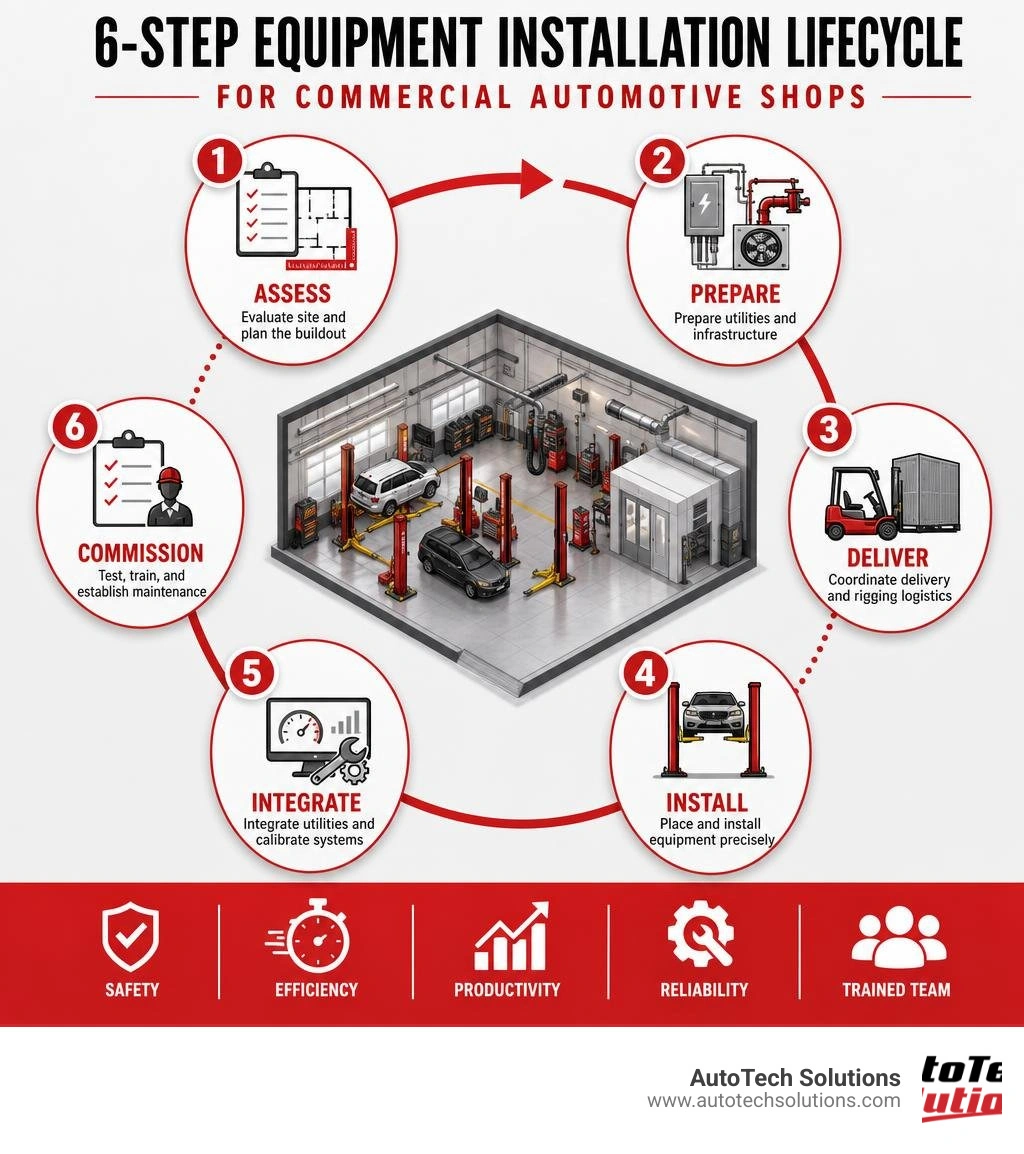
Here's a quick overview of the 6 steps to install commercial shop equipment correctly:
- Site Assessment and Facility Buildout Planning — evaluate floor load, clearances, and structural requirements
- Infrastructure and Utility Preparation — run electrical drops, pneumatic lines, and exhaust extraction systems
- Equipment Delivery and Rigging Logistics — coordinate timed delivery and use professional rigging for heavy equipment
- Precision Placement and Automotive Equipment Installation — set car lifts, alignment racks, and paint booths to exact specifications
- Utility Integration and Calibration — complete final connections and calibrate systems like ADAS
- Commissioning, Training, and Preventive Maintenance — test for safety, train operators, and establish a maintenance plan
Any local contractor can bolt down a single piece of equipment. But when you're outfitting an entire commercial automotive facility — multiple bays, heavy lifts, compressed air systems, exhaust extraction — the complexity multiplies fast.
Get it wrong and you're looking at production halts, failed inspections, or equipment that underperforms from the start.
This guide walks AutoTech Solutions' proven 6-step process for commercial shop equipment installation, built specifically for automotive service, collision, and industrial facility operators.
Preparing Your Facility for Industrial Equipment Installation

Before a single piece of heavy machinery arrives at your loading dock, your facility must be prepared to receive it. Rushing into an installation without a rigorous site preparation phase is a recipe for disaster. We have seen shops purchase top-tier heavy-duty lifts or advanced spray booths, only to realize on delivery day that their concrete floor is too thin to support the load, or their electrical panel lacks the capacity to power the system.
Proper preparation requires a detailed analysis of your physical space, structural integrity, and utility capacity. For example, heavy industrial systems often require reinforced concrete foundations. While light equipment might get by on standard commercial pads, heavy-duty commercial lifts and alignment racks demand deep, high-PSI concrete bases to anchor safely.
Furthermore, you must plan for complex utility routing. This involves mapping out where your three-phase power lines, pneumatic piping, and ventilation systems will run. Working with experienced industrial contractors is the best way to ensure your facility meets these rigorous standards. If you are planning the electrical layout, reviewing a professional Industrial wiring guide is an excellent starting point. Additionally, referencing certified engineering documents, such as these Electrical installation instructions, can help your team understand the strict wiring and grounding protocols required for commercial-grade hardware.
Step 1: Site Assessment and Facility Buildout Planning
The first physical step in our 6-step process is a comprehensive site assessment. During this phase, we look at the physical blueprint of your shop to map out workflows, clearances, and structural limits.
Clearance is one of the most frequently overlooked aspects of shop planning. You must measure not just the footprint of the machine itself, but the "working clearance" around it. For instance, a two-post commercial lift requires ample vertical clearance for high-roof transit vans, as well as side-to-side clearance so technicians can open vehicle doors and move tool carts freely.
Additionally, we evaluate the floor load capacity. Standard commercial concrete is typically 4 inches thick, which may be insufficient for heavy-duty lifts or heavy alignment machines. Some advanced industrial systems require a minimum of 8 inches of reinforced concrete to handle dynamic loads and heavy vibration. If your floor doesn't meet these requirements, we must plan for structural reinforcement, which may involve cutting, excavating, and pouring new high-strength concrete pads before the equipment arrives.
By integrating these metrics early, you can avoid costly structural retrofits. To learn more about aligning your shop's footprint with your operational goals, check out our guide on Facility buildout equipment planning.
Step 2: Infrastructure and Utility Preparation
Once the spatial layout is finalized, we shift our focus to the lifeblood of your shop: utilities. A high-performing automotive service or collision center relies on a web of electrical drops, pneumatic lines, and ventilation systems.
First, let's talk about power. Most commercial shop equipment — such as heavy-duty air compressors, hydraulic power units, and paint booth extraction fans — runs on three-phase electrical power. We must verify that your main electrical panel can handle the added amperage without overloading. This step involves installing dedicated circuit breakers, running heavy-duty conduit, and drop-testing the voltage to prevent drops that can damage sensitive electronics.
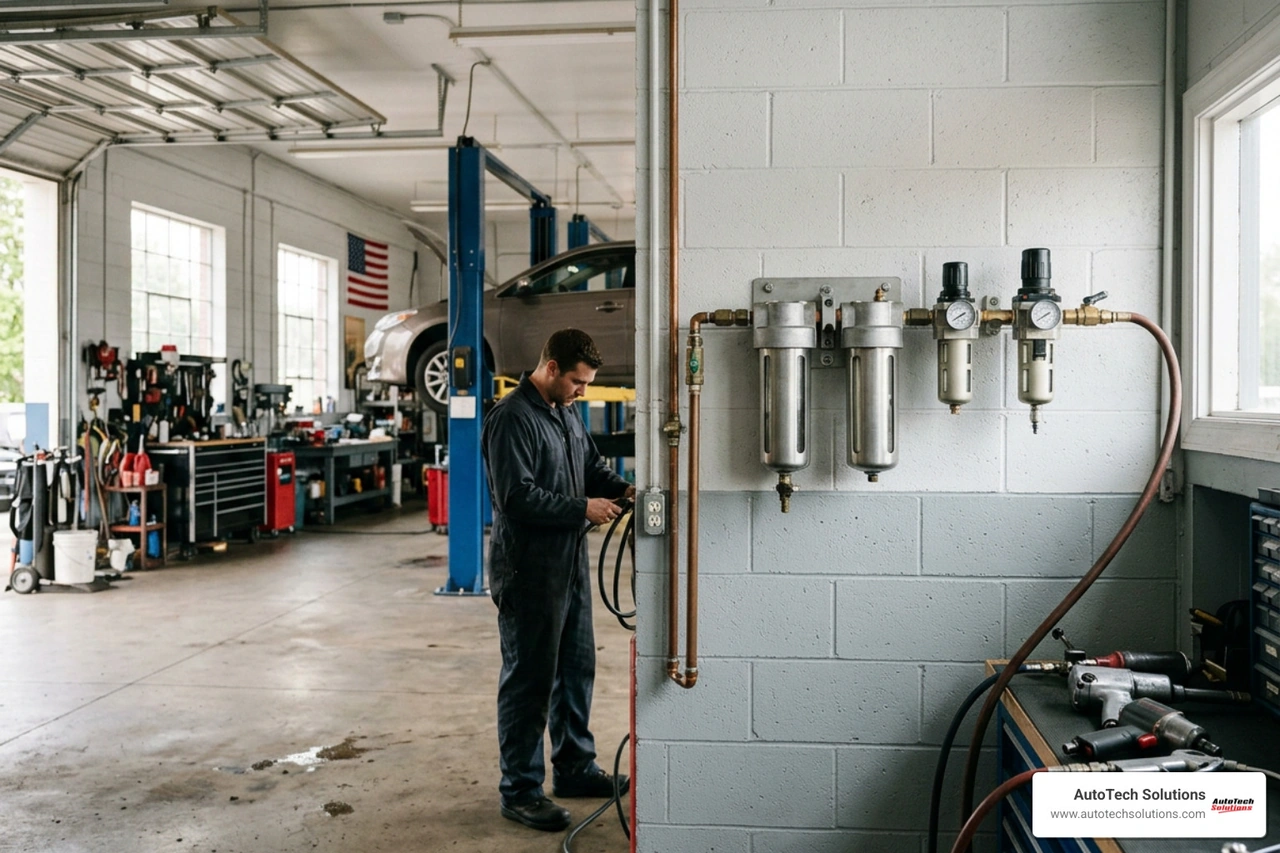
Second, pneumatic systems are vital for powering air tools and inflation systems. A poorly designed compressed air network leads to pressure drops and moisture buildup, which ruins air tools and compromises paint finishes. Designing a loop system with proper moisture separators and drop legs is essential. For a deep dive into setting up a reliable air system, read our article on Air compressor installation for automotive shop.
Finally, commercial shops must maintain clean, safe air. Running vehicles indoors releases toxic carbon monoxide and particulates. To protect your technicians and comply with local environmental codes, you need a robust exhaust extraction system. Setting up these systems requires specialized ducting and powerful blowers. You can read more about these requirements in our guide on Exhaust system installation.
Executing the Physical Equipment Installation Process
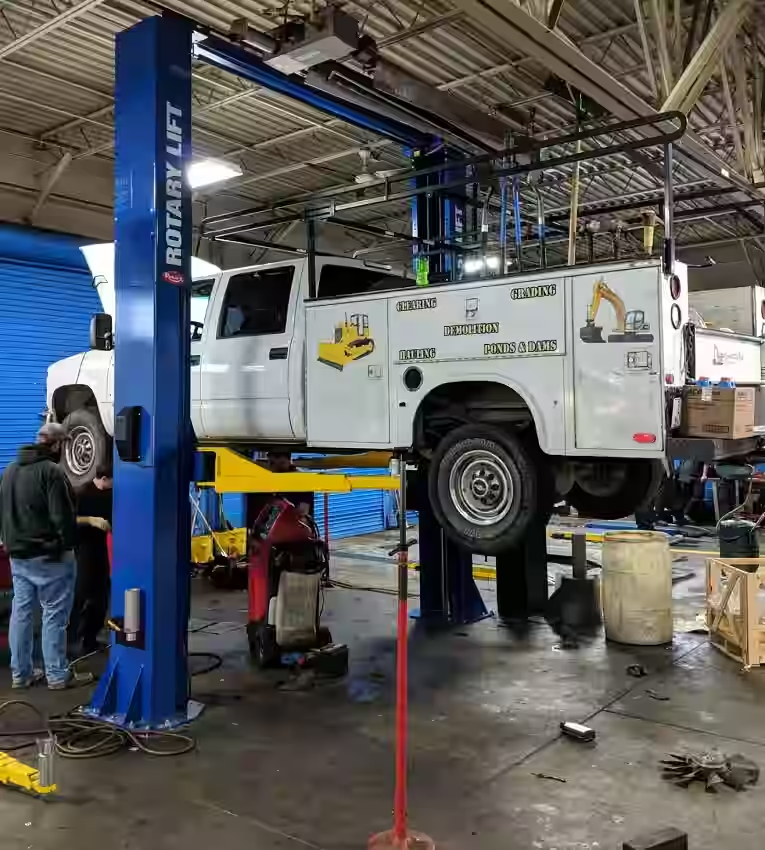
With the facility fully prepped, the physical equipment installation begins. This is where precision planning meets heavy-duty execution. Installing commercial automotive equipment is not a matter of simply unboxing and plugging things in; it requires specialized machinery, exact measurements, and strict safety protocols to ensure the machinery operates safely for years to come.
During this phase, we coordinate the delivery, rigging, placement, anchoring, and calibration of your new assets. Whether we are installing a fleet of heavy-duty lifts in Charlotte, NC, or setting up a high-tech collision center in Novi, MI, our team follows a highly coordinated sequence to minimize disruption to your ongoing operations.
Step 3: Equipment Delivery and Rigging Logistics
The physical process starts at the loading dock. Commercial automotive equipment is incredibly heavy and bulky. A single four-post lift or a complete paint booth shipment can weigh several tons and arrive on multiple flatbeds.
Coordinating this delivery requires careful timing. We schedule deliveries to avoid peak operational hours, ensuring your service bays remain accessible. Once the equipment arrives, professional rigging is required. This isn't a job for a standard warehouse forklift. We utilize heavy-duty rigging equipment, specialized cranes, and certified machinery movers to safely unload and transport the equipment into your bays.
Using the correct lifting points is critical. For example, handling heavy structural steel columns or large fan assemblies incorrectly can bend frames or damage internal components before they are even erected. Our rigging teams ensure that every load is balanced, secured, and placed precisely where it needs to go.
Step 4: Precision Placement and Automotive Equipment Installation
Once the equipment is rigged into the service bays, our technicians begin the precision assembly and anchoring. This is the core of the physical installation process.
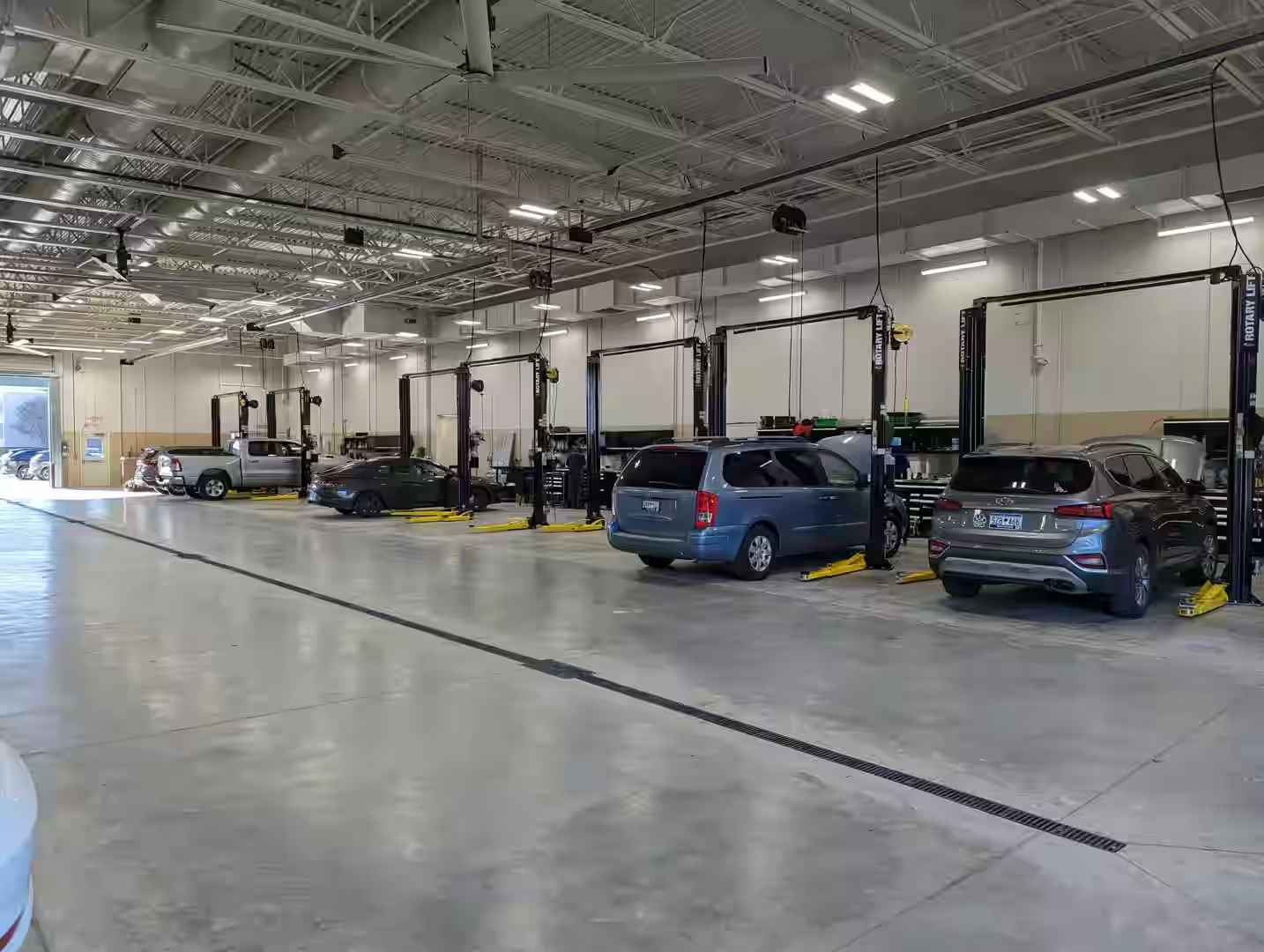
For professional car lift installation and alignment racks, precision is non-negotiable. If a lift is out of plumb by even a fraction of an inch, it will experience uneven wear, bind during operation, or present a serious safety hazard. We use advanced laser leveling systems to ensure columns are perfectly vertical and runways are completely level. Once aligned, we drill deep into the concrete to set heavy-duty anchor bolts, torqueing them to exact manufacturer specifications to guarantee stability. For a comprehensive look at this process, check out our Car lift installers complete guide.
In collision centers, installing spray booths and prep stations requires a different set of specialized skills. These structures must be completely airtight to prevent dust contamination and overspray migration. We carefully assemble the insulated wall panels, install high-efficiency intake and exhaust filtration systems, and mount heavy-duty ductwork through the roof. If you are upgrading your collision repair setup, read our detailed Collision center equipment install guide to understand the mechanical and structural nuances involved.
Step 5: Utility Integration and Calibration
With the physical structures securely anchored, we perform the final utility connections and system calibrations. This step bridges the gap between static machinery and a fully operational shop system.
Our technicians connect the electrical drops to the equipment control panels, wire up safety limit switches, and hook up the pneumatic supply lines. Once power and air are flowing, we don't just flip the switch and walk away. Modern automotive equipment is highly sophisticated and requires precise calibration to function correctly.
This is especially true for Advanced Driver Assistance Systems (ADAS) calibration frames and computerized wheel alignment machines. These systems rely on ultra-sensitive cameras, radars, and software to ensure vehicles are serviced to OEM standards. Even a tiny misalignment in the calibration fixture can lead to safety systems malfunctioning on the road. We perform rigorous multi-point calibrations to ensure your shop can service modern vehicles safely. To learn more about this specialized process, refer to our ADAS equipment installation complete guide.
Finalizing the Setup: Commissioning and Post-Installation Support
The physical installation and calibration are complete, but the job isn't finished. Before we hand over the keys to your team, the equipment must go through a formal commissioning process. This phase ensures that every system operates at peak efficiency, complies with all local safety codes, and that your team is fully prepared to operate it safely.
At AutoTech Solutions, we believe that an installation partnership doesn't end when the bolts are tightened. We provide comprehensive post-installation support to protect your investment and keep your shop running smoothly.
Step 6: Commissioning, Training, and Preventive Maintenance
Commissioning is our final quality assurance check. During this step, we run the newly installed equipment through a series of rigorous performance and safety tests.
For commercial car lifts, this includes load-testing the system to its rated capacity, verifying that all mechanical safety locks engage perfectly, and testing the emergency stop systems. For compressed air networks, we pressurize the lines and perform leak-down tests to ensure there are no pressure drops. For ventilation and paint booths, we measure airflow rates (CFM) and test pressure balances to confirm the system exhausts fumes safely and efficiently.
Once the equipment passes all safety checks, we conduct thorough operator training for your technicians. Even the most advanced equipment is only as good as the people operating it. We teach your team proper operation protocols, daily safety checks, and basic troubleshooting.
Finally, we work with you to establish a customized preventive maintenance program. Regular servicing is the single best way to prevent unexpected breakdowns and extend the lifespan of your hardware. And if an unexpected issue ever does arise, we provide rapid emergency repairs across Michigan and the Carolinas to minimize your shop's downtime.
Key Considerations for Commercial Equipment Installation
When managing a commercial facility, equipment installation involves navigating a complex web of safety regulations, electrical codes, and operational demands. Cutting corners during this process doesn't just risk equipment damage; it can lead to catastrophic workplace accidents, failed municipal inspections, and costly legal liabilities.
To ensure a seamless, compliant installation, shop owners must keep several critical factors in mind:
- Safety and Compliance: All installations must comply with federal OSHA regulations, local building codes, and industry-specific standards (such as the Automotive Lift Institute - ALI standards for car lifts).
- Technician Certification: Ensure that the technicians installing your equipment are fully certified and trained by the manufacturers. Specialized equipment requires specialized hands.
- Multi-Site Consistency: If you operate multiple locations across Charlotte, Raleigh, or Novi, maintaining consistent installation standards is vital for operational efficiency and uniform technician training.
- Industrial Electrical Standards: High-voltage electrical connections must comply with the National Electrical Code (NEC). Proper grounding and surge protection are essential to safeguard your computerized diagnostic and calibration systems.
The Benefits of Outsourced Equipment Installation
For many manufacturers and shop operators, trying to manage equipment installations in-house is an operational nightmare. It diverts your valuable internal resources away from your core business and exposes you to significant liability.
Outsourcing your installations to a specialized B2B partner like AutoTech Solutions offers massive advantages. It reduces your administrative overhead, accelerates your timeline to realize revenue from your new assets, and guarantees that the job is done right the first time. We leverage a deep network of highly skilled, certified technicians who specialize in commercial automotive systems, allowing us to scale installations quickly and consistently across multiple regions.
The table below highlights the key differences between trying to perform installations yourself versus partnering with a professional service provider:
| Feature / Consideration | Self-Performed Installation | Outsourced Partner (AutoTech Solutions) |
|---|---|---|
| Technical Expertise | Limited to in-house staff knowledge; high risk of calibration errors | Certified, manufacturer-trained technicians with specialized tools |
| Safety & Code Compliance | High risk of code violations, failed inspections, and OSHA fines | Guaranteed compliance with local codes, NEC, and ALI standards |
| Project Management Overhead | Heavy; requires coordinating multiple local contractors and riggers | Single point of contact; turnkey logistics and coordination |
| Downtime & Efficiency | Often delayed due to unexpected hurdles and lack of specialized tools | Optimized processes designed to minimize shop downtime |
| Post-Install Support | None; must call third-party repair services when issues arise | Integrated preventive maintenance, training, and emergency repairs |
Frequently Asked Questions about Commercial Equipment Setup
What are the floor thickness requirements for heavy automotive lifts?
For standard commercial automotive lifts (such as 10,000 to 12,000-lb two-post lifts), a minimum concrete thickness of 4 to 6 inches is typically required, with a compression strength of at least 3,000 PSI. For heavy-duty commercial lifts, alignment racks, or industrial machinery, the requirements are much stricter, often demanding 8 inches or more of high-strength, steel-reinforced concrete. Always consult the specific manufacturer's installation manual and an structural engineer to verify your floor's weight capacity before anchoring any heavy lift.
How do companies plan for electrical and pneumatic requirements before installation?
Planning begins with a thorough utility mapping and load calculation. You must identify the voltage, phase (single-phase vs. three-phase), and amperage requirements for every piece of equipment. This prevents voltage drops and panel overloads. For pneumatic systems, you must calculate the total CFM (cubic feet per minute) demand of your air tools and equipment to size your air compressor correctly. It is highly recommended to work with specialized Industrial Electrical Contractors Novi, MI or local commercial contractors in your area to run dedicated conduits and air lines safely.
What post-installation services should be included in a partnership?
A comprehensive installation partnership should always go beyond the physical setup. It must include formal equipment commissioning and safety testing, thorough operator training for your technicians, a structured preventive maintenance program to protect your warranty, and rapid emergency repair support. Having a partner who can provide ongoing maintenance and fast repair response is critical to minimizing long-term operational downtime.
Conclusion
A successful equipment installation is the foundation of a highly productive, safe, and profitable automotive shop. By following a structured, professional 6-step process — from initial site planning to physical rigging, precision calibration, and formal commissioning — you can avoid the costly delays and safety hazards that plague poorly executed setups.
At AutoTech Solutions, we are dedicated to minimizing your downtime and maximizing your shop's efficiency. As a true one-stop-shop for B2B automotive equipment sales, installation, service, and preventive maintenance, we support light, heavy, and collision shops across Michigan and the Carolinas. Whether you are outfitting a new facility in Charlotte, NC, upgrading your alignment bays in Raleigh, NC, or installing advanced shop systems in Novi, MI, our expert team is ready to deliver fast, reliable support.
Stop worrying about installation headaches and start focusing on growing your business. Schedule a facility buildout consultation with AutoTech Solutions today, and let us build the high-performance shop your team deserves!