
Why Equipment Maintenance Reporting for Dealer Groups Is a Make-or-Break Operational Priority
Equipment maintenance reporting for dealer groups is the process of systematically tracking, documenting, and analyzing the condition, service history, and performance of shop equipment across one or more dealership locations — so nothing slips through the cracks.
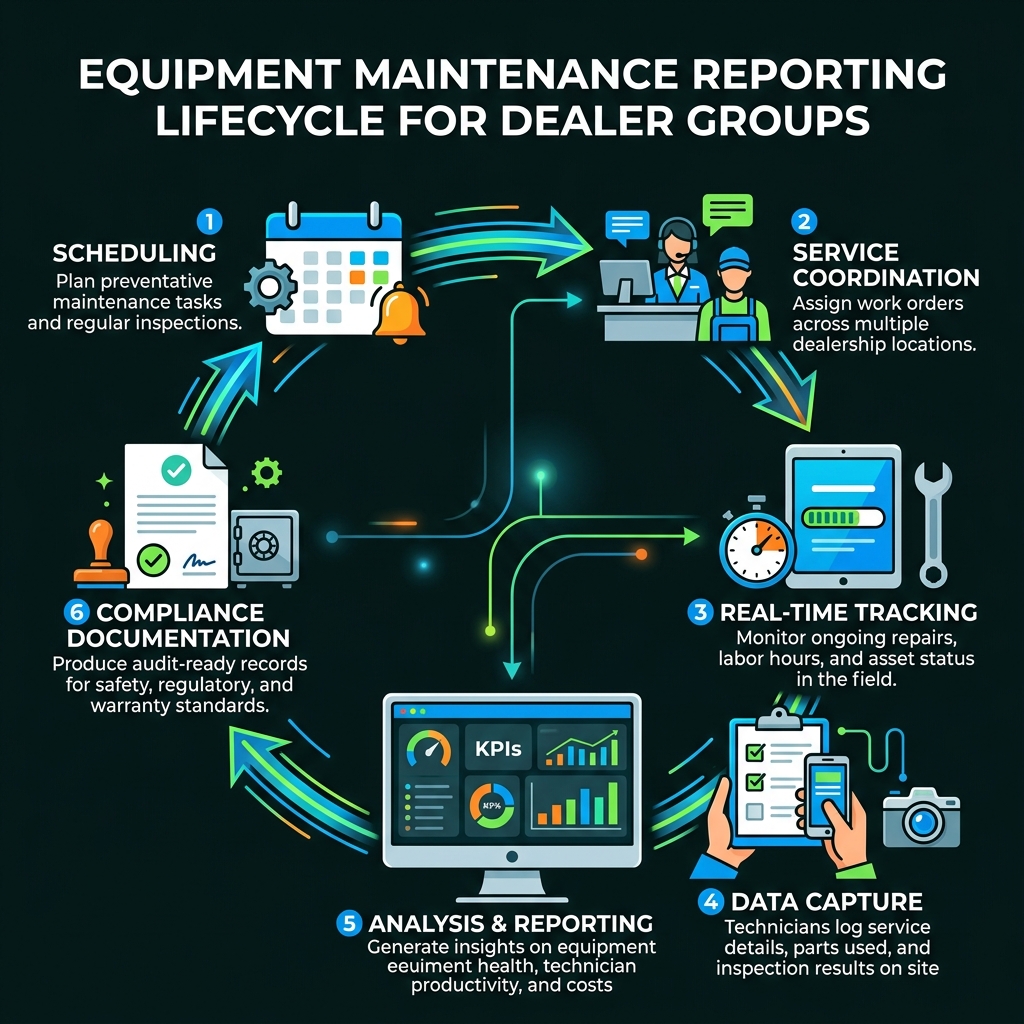
Here's what effective equipment maintenance reporting covers:
- Work order tracking — logging every repair, inspection, and service event
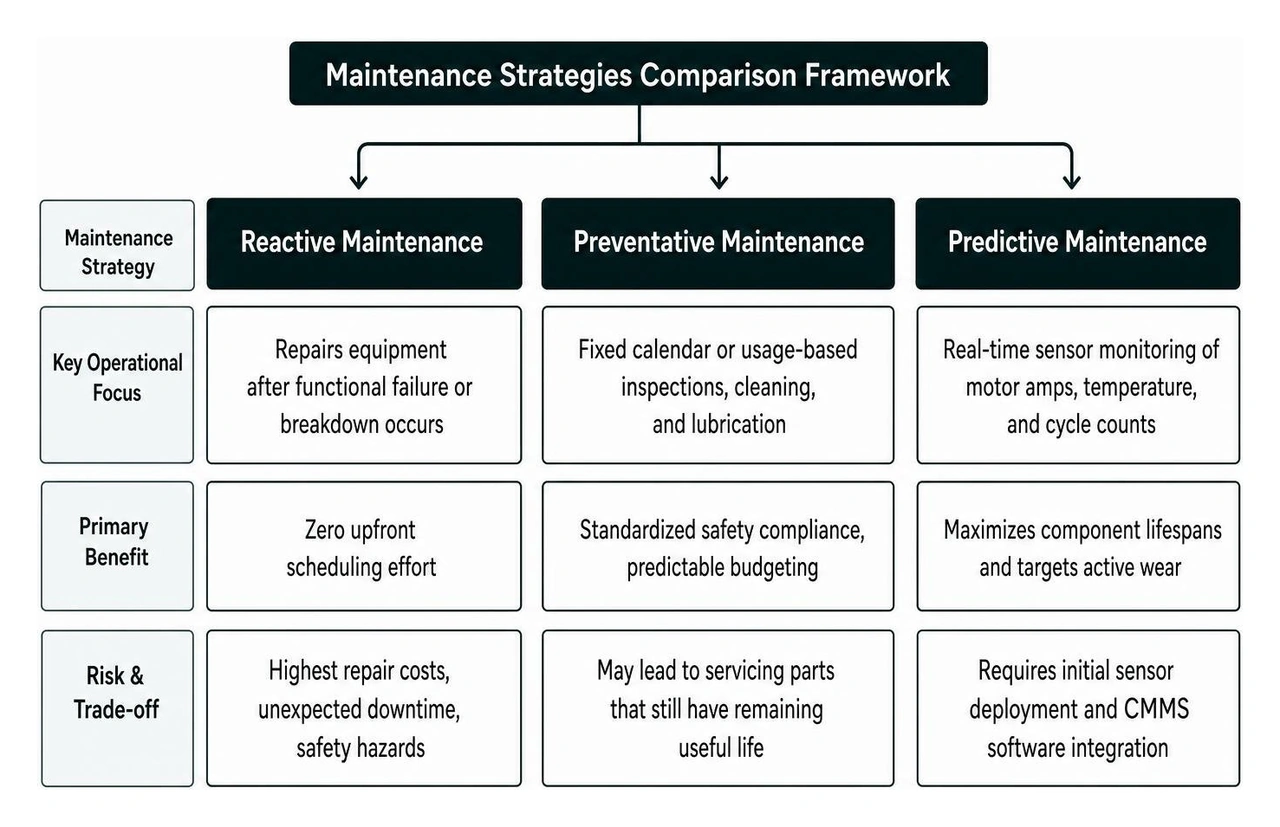
- Preventative maintenance scheduling — staying ahead of breakdowns before they happen
- Technician productivity monitoring — measuring labor hours against targets
- Parts and inventory sync — knowing what's on hand and what's needed
- Compliance documentation — keeping audit-ready records for safety and regulatory standards
- Multi-location visibility — comparing performance across all your stores in one view
Most dealer groups don't have a reporting problem. They have a visibility problem.
When your service department is running at full speed, it's easy to miss the warning signs: equipment that's overdue for service, technicians waiting on parts, or a lift that's quietly becoming a liability. By the time you notice, you're already losing money.
The stakes are real. A service department that runs smoothly can cover an entire dealership's overhead — some high-performing fixed ops departments achieve what's called a 100% absorption rate, meaning the service and parts departments alone could keep the lights on even if the sales floor went quiet. That kind of performance doesn't happen by accident. It's built on consistent, accurate reporting.
And yet, many multi-location dealer groups are still relying on spreadsheets, manual counts, or end-of-month DMS exports to make day-to-day decisions. That's a costly gap.
Quick look at equipment maintenance reporting for dealer groups:
- centralized equipment service coordination for dealer groups
- managing shop equipment maintenance across multiple locations
Understanding Equipment Maintenance Reporting for Dealer Groups
At AutoTech Solutions, we see it every day: a busy dealership in Charlotte or Novi is a whirlwind of activity. Between floorplan financing interest ticking away every day an asset sits on the lot and the constant pressure to move inventory, the "fixed operations" (parts and service) side of the business is your secret weapon for stability.
Equipment maintenance reporting for dealer groups isn't just about making sure a lift gets greased once a year. It’s about asset lifecycle management. When you track every piece of shop equipment—from your fluid management systems to your heavy-duty truck lifts—you gain a clear picture of your Return on Invested Capital (ROIC).
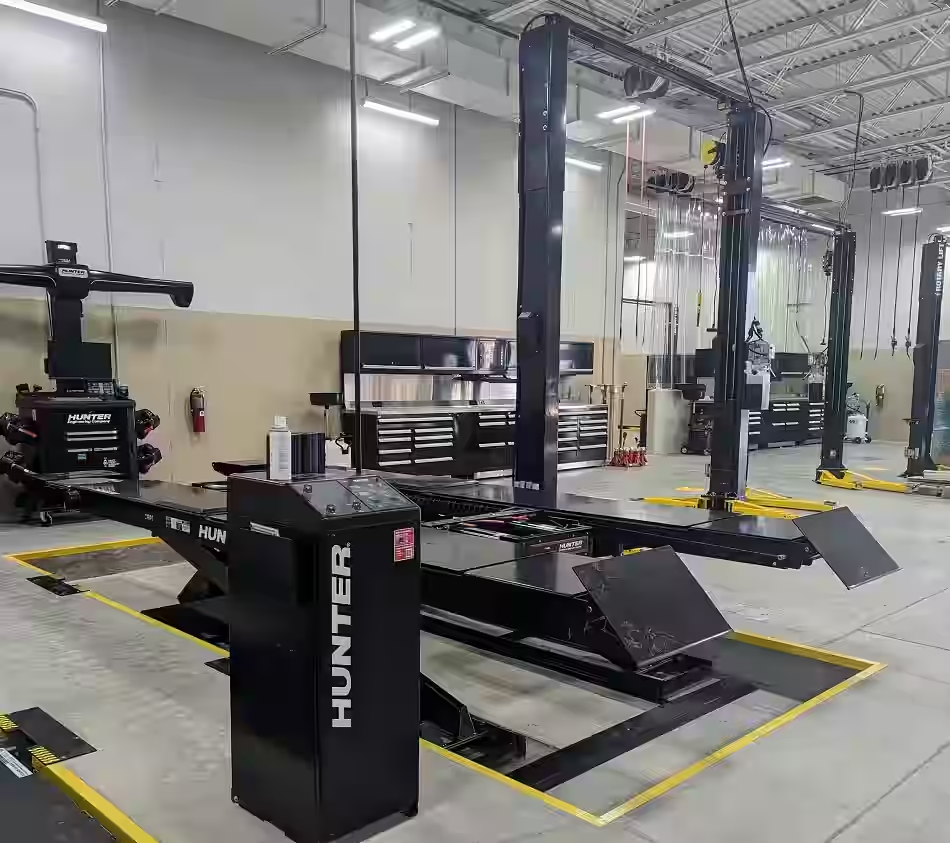
A Dealer Management System (DMS) acts as the central nervous system for these operations. While sales might grab the headlines, fixed ops generate the consistent cash flow needed to weather slow quarters. If your reporting shows that a specific shop's alignment rack is down 15% of the time, that’s not just a repair bill; that’s thousands of dollars in lost revenue from service labor and parts sales. By centralizing this data, dealer groups can shift from reactive "fix-it-when-it-breaks" mentalities to proactive uptime strategies.
Key Features of Modern Maintenance Reporting Tools
If you're still using a whiteboard to track which compressor needs a filter change, we need to talk. Modern reporting tools have moved far beyond the clipboard. For a multi-location group spanning from Raleigh to Michigan, you need features that provide "centralized reporting with decentralized action."
Key features to look for include:
- Real-Time Analytics: You shouldn't have to wait until the end of the month to see your effective labor rate or shop capacity.
- OEM Integrations: Seamlessly connecting with manufacturer data ensures that warranty claims are accurate and parts ordering is instantaneous.
- Telematics and IoT: Modern equipment can literally "talk" to you. Integrating telematics allows you to track Service Meter Unit (SMU) readings or odometer counts automatically, triggering maintenance alerts before a failure occurs.
- Mobile Accessibility: Your technicians are on the shop floor, not behind a desk. They need to be able to snap a photo of a worn hydraulic line and attach it to a digital work order instantly.
By utilizing centralized equipment service coordination for dealer groups, management can spot trends. If the shop in Novi is burning through tire changer parts twice as fast as the shop in Charlotte, you can investigate whether it’s a training issue or a faulty batch of equipment. This level of managing shop equipment maintenance across multiple locations is what separates the most profitable dealer groups from the rest.
Optimizing Equipment Maintenance Reporting for Dealer Groups via Automation
Automation is the "headache reliever" of the automotive industry. Manual reconciliation of parts invoices and service records is a hidden cost that eats away at your margins. We’ve seen cases where automating these workflows reduced check volumes by 80% and freed up nearly 20 hours of administrative time per month.
In the shop, automation looks like digital work orders that automatically update your parts inventory. When a technician pulls a filter for a preventative maintenance job, the system should log it, bill it, and—if stock is low—trigger a purchase order. This reduces the "paperwork lag" that often leads to unbilled parts or lost labor hours. Cloud-based data ensures that whether you are at the corporate office in Raleigh or on-site in Wade, you are looking at the same numbers.
Integrating Calibration and Maintenance Management Software
Precision is everything in modern automotive repair. If your torque wrenches or ADAS calibration tools are off, your repairs aren't just low quality—they're potentially dangerous. Integrating calibration management into your equipment maintenance reporting for dealer groups ensures that every tool meets ISO and safety standards.
This integration provides a "Simplified Approach" to audit traceability. Instead of digging through a filing cabinet for a calibration certificate during an inspection, you can pull up a full history in two clicks. This not only extends the equipment lifespan but ensures you are in full compliance with manufacturer requirements and safety regulations. For a deeper dive into maintaining these standards, check out our automotive shop equipment repair guide.
Overcoming Operational Challenges in Multi-Location Groups
The bigger the dealer group, the bigger the potential for inconsistency. One store might have a stellar service manager who keeps every lift in top shape, while another store's equipment is held together by hope and duct tape.
| Feature | Manual Reporting | Automated DMS Reporting |
|---|---|---|
| Data Accuracy | High risk of human error | Real-time, validated data |
| Reporting Speed | Delayed (End of month) | Instant/Live Dashboards |
| Technician Focus | Heavy paperwork/Admin | Focus on wrench-turning |
| Multi-Location Sync | Difficult/Fragmented | Unified across all rooftops |
| Parts Management | Manual counts/Shrinkage | Automated inventory sync |
To overcome these hurdles, we focus on service, repair, and equipment support that standardizes the "Repair Order (RO) Velocity." By tracking how fast a vehicle moves from check-in to completion, you can identify bottlenecks. Is the delay caused by a broken lift? A slow parts delivery? Or a technician who needs more training?
Critical KPIs for Equipment Maintenance Reporting for Dealer Groups
If you aren't measuring it, you can't manage it. Dealer groups should keep a hawk-like eye on these Key Performance Indicators (KPIs):
- Technician Efficiency: Are your techs billing 40 hours for 40 hours worked, or are they losing time to equipment downtime?
- Effective Labor Rate (ELR): Monitoring the actual revenue generated per hour helps identify where discounts or unbilled labor are hurting the bottom line.
- Comeback Rates: High comeback rates often point to faulty shop equipment or lack of proper calibration.
- Shop Capacity: Are you turning away work because equipment is out of service? Having a breakdown response plan for critical shop equipment ensures that "Service Unavailable" is a phrase you rarely have to use.
- CSI (Customer Satisfaction Index): Believe it or not, equipment maintenance impacts CSI. If your car wash is down or your alignment rack is inaccurate, your customers will notice—and they’ll leave reviews that reflect it.
Compliance and Safety Standards in the Automotive Industry
Safety isn't just a suggestion; it’s a legal requirement. In the automotive world, the gold standard is the Automotive Lift Institute (ALI) certification. At AutoTech Solutions, we emphasize that regular inspections are the best way to maximize ROI and protect your team.
Annual lift inspections by ALI-certified technicians are mandatory to meet OSHA requirements and minimize litigation risk. These inspections cover safety shut-offs, hydraulic systems, and structural integrity. Proper documentation of these checks—integrated directly into your equipment maintenance reporting for dealer groups—serves as your "insurance policy" against workplace accidents.
When a technician knows the equipment is safe and well-maintained, morale improves. When an auditor sees a perfect digital trail of automotive equipment repair, your risk profile drops. It’s a win-win for everyone involved.
Frequently Asked Questions about Dealer Group Maintenance
How does maintenance reporting drive dealership profitability?
It drives profitability by ensuring "Fixed Ops Absorption." When your shop equipment is 100% operational, your service department can cover all dealership overhead. Reporting identifies "revenue leaks" like unbilled parts, technician idle time, and frequent equipment breakdowns that prevent you from taking on more Repair Orders.
What are the top challenges in manual maintenance reporting?
The "big three" are human error, delayed insights, and fragmented data. If the service manager in Novi is using a different spreadsheet than the manager in Charlotte, corporate leadership can't make informed decisions. Manual reporting also wastes hours of technician time that should be spent on billable repairs.
How do telematics improve reporting outcomes?
Telematics allow for predictive maintenance. Instead of waiting for a machine to break, the system monitors actual usage (like hours of operation or cycles). It then automatically schedules service before a failure occurs. This turns an "emergency repair" into a "scheduled maintenance" event, which is much cheaper and less disruptive.
Conclusion
At AutoTech Solutions, we understand that running a multi-location dealer group is complex. Our mission is to minimize your downtime with expert support and fast repair response across Michigan and the Carolinas. Whether you are in Novi, Charlotte, or Raleigh, your equipment should be an asset, not a headache.
By implementing robust equipment maintenance reporting for dealer groups, you move from a reactive state of "putting out fires" to a proactive state of operational excellence. Consistent reporting drives profitability, ensures safety compliance, and ultimately keeps your customers coming back.
Ready to take the headache out of your shop operations? Explore our preventative maintenance programs today and let us help you achieve that 100% absorption rate.