Why Managing Shop Equipment Maintenance Across Multiple Locations Is Harder Than It Looks

Managing shop equipment maintenance across multiple locations is one of the biggest operational challenges for automotive service businesses that are growing or already running several sites.
Here's a quick overview of what effective multi-site maintenance requires:
- Centralized oversight - One system to monitor equipment status across all locations
- Standardized procedures - The same maintenance checklists and schedules at every site
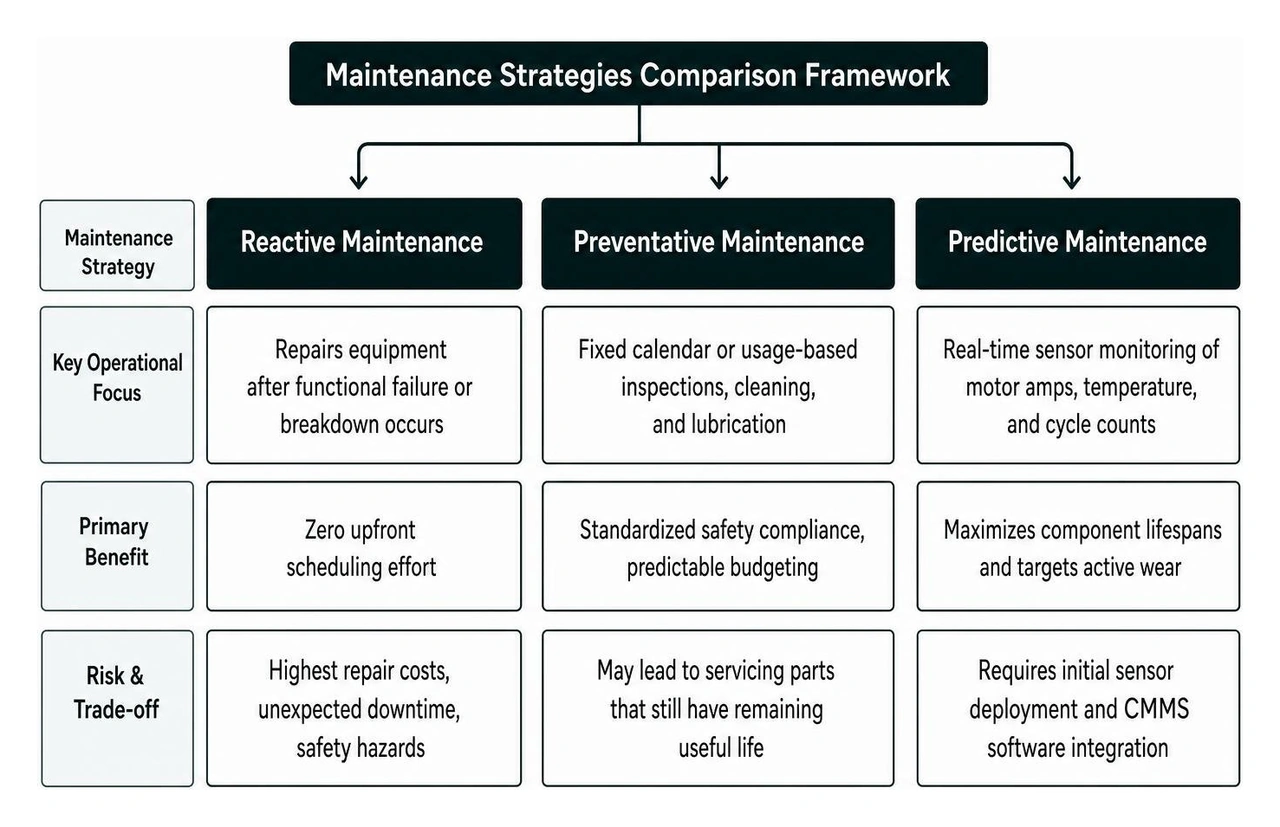
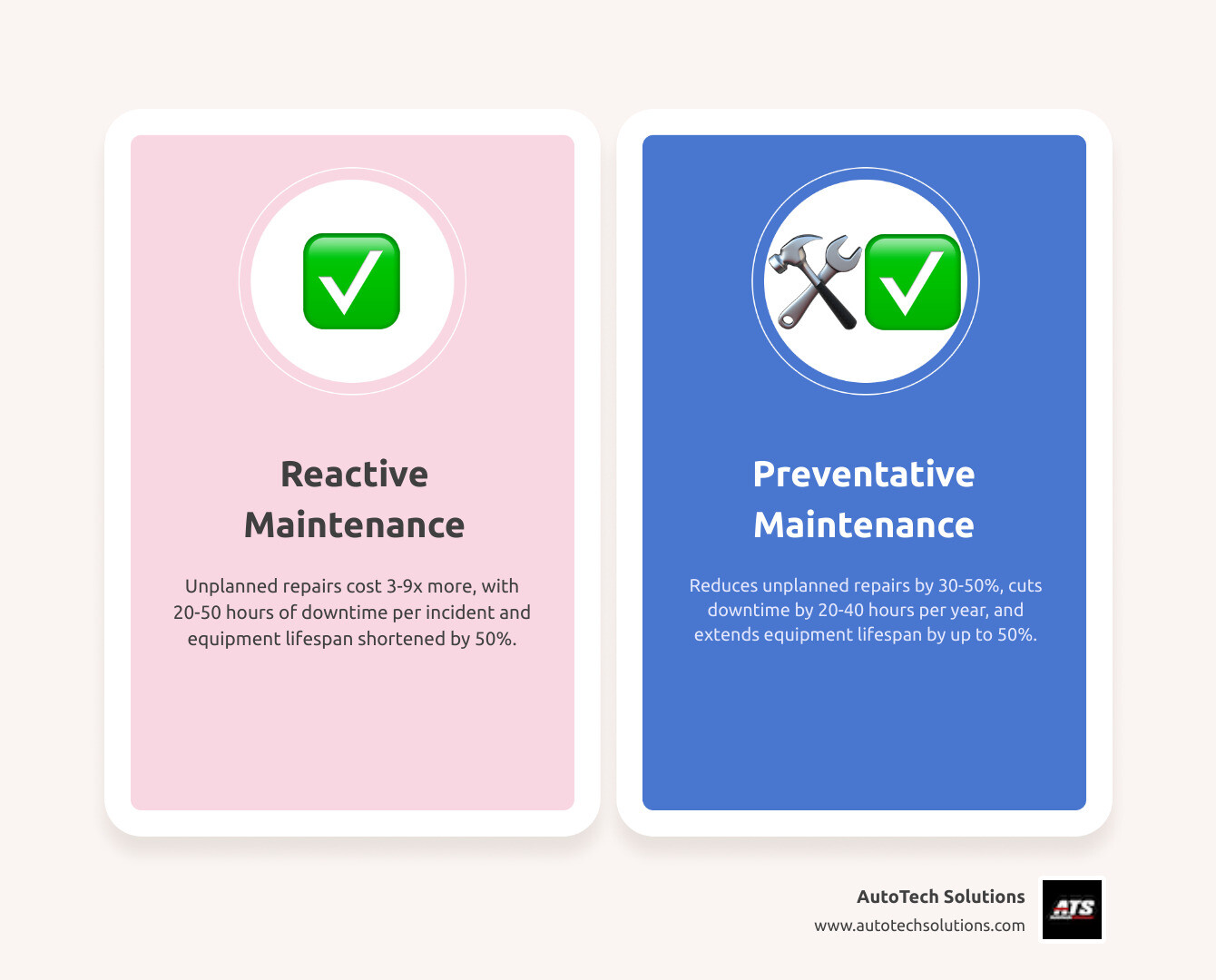
- Proactive maintenance - Scheduled preventive care instead of emergency repairs
- Vendor consolidation - Fewer suppliers, more consistency, better pricing
- Data and technology - CMMS software and IoT tools to track performance in real time
- Trained, coordinated teams - Clear roles and shared SOPs across all locations
Running one shop is complex enough. Add a second, third, or fifth location, and that complexity doesn't just double — it grows exponentially. Every site has its own equipment quirks, staff habits, and vendor relationships. Without a unified approach, things fall through the cracks fast.
The result? Unplanned downtime, inconsistent service quality, and rising costs that quietly erode your margins.
Think about a Monday morning where your Phoenix location has a lift that won't cycle, your Carolina shop is waiting on a compressor part, and your Michigan facility just missed a scheduled inspection. That's not a bad week — for many multi-location operators, that's just Tuesday.
The good news: with the right strategies and tools, these problems are very solvable.
The Challenges of Managing Shop Equipment Maintenance Across Multiple Locations

When we talk to shop owners from Novi, MI, down to Charlotte, NC, the same headaches keep popping up. Managing a distributed network of shops feels like trying to herd cats—if the cats were heavy-duty vehicle lifts and air compressors that occasionally decided to stop working at the worst possible time.
The primary hurdle is vendor variability. If your Raleigh shop uses one local repairman while your Wade location uses another, you end up with two different standards of "fixed." This inconsistency makes it impossible to predict when a machine might fail or what a repair should actually cost.
Then there are the communication gaps. Without a centralized system, critical information gets trapped in email threads or on grease-stained clipboards. If a technician in Novi notices a recurring issue with a specific tire changer model, that knowledge rarely makes it to the team in North Carolina. This lack of visibility leads to "ghost assets"—equipment that exists on your books but hasn't been serviced in years because someone forgot which bay it was in.
Perhaps most importantly, managing shop equipment maintenance across multiple locations involves significant compliance risks. Following ALI standards for lift safety isn't optional; it's a legal and ethical necessity. When processes are decentralized, ensuring every site has its up-to-date inspection sticker becomes a logistical nightmare.
Finally, we have the data silos. If you don't know your Mean Time Between Failures (MTBF) for your compressors across all sites, you can't make smart buying decisions. You’re essentially reducing downtime by guesswork rather than strategy.
Common Multi-Site Maintenance Hurdles:
- Inconsistent SOPs: Different shops performing "preventative" maintenance in vastly different ways.
- Geographic Dispersion: Difficulty in physically auditing equipment in multiple states.
- Varying Regulatory Standards: Keeping up with different local environmental or safety codes.
- Resource Allocation: Not knowing which shop needs the new equipment first because data is missing.
Strategies for Streamlining Multi-Site Operations
To get ahead of the chaos, we need to move from "firefighting" to "forecasting." The first step is implementing a centralized management system. Think of this as your shop's "central nervous system." It allows us to see every asset in every location on one screen.
We highly recommend establishing a unified asset hierarchy. This means every piece of equipment is categorized the same way, whether it's in Novi or Charlotte. When you use standardized naming conventions, your reports actually make sense. You can see, for instance, that your 10k-lb two-post lifts in Raleigh are costing 20% more to maintain than the ones in Michigan.
Standardizing your Standard Operating Procedures (SOPs) is the "secret sauce" here. Every technician should follow the same multi-point inspection checklist. This ensures that a lift inspection in Wade is just as thorough as one in Novi. By implementing these preventative maintenance programs, you aren't just checking boxes; you're protecting your bottom line.
Research shows that automotive service providers achieving this level of consistency can see a 15% increase in revenue largely due to return customers who trust the reliability of the service across all brand locations.
| Feature | Decentralized Model | Centralized Model (AutoTech Solutions Style) |
|---|---|---|
| Visibility | Limited to individual site managers | Real-time across all locations |
| Maintenance Style | Mostly Reactive (Run-to-failure) | Proactive & Predictive |
| Vendor Management | Multiple local vendors; varying rates | Consolidated partners; fixed rates |
| Data Quality | Poor; scattered in spreadsheets | High; stored in a single database |
| Downtime | High due to emergency repairs | Lowered by 35-45% through PM |
Leveraging Technology and Data for Predictive Success
In the old days, we waited for a machine to make a weird noise before we fixed it. Today, we use IoT (Internet of Things) sensors to tell us a noise is coming before it even starts. By monitoring vibration, heat, and energy usage in real-time, we can cut equipment downtime by an average of 20%.
For example, if an air compressor in your Charlotte shop starts consuming more power than usual, it’s a red flag. It might mean a leak or a failing motor. Catching this early doesn't just prevent a breakdown; it's also a key factor in reducing energy costs by 3-5% across your facilities.
Implementing CMMS for Managing Shop Equipment Maintenance Across Multiple Locations
A Computerized Maintenance Management System (CMMS) is the engine that drives multi-site success. It automates work orders so that when a PM (Preventative Maintenance) task is due, the system notifies the right person automatically. No more "I forgot to check the oil in the compressor."
When a repair is needed, the CMMS tracks the entire history. This is vital for automotive equipment repair because it helps us identify "lemon" equipment. If a specific tire changer has been repaired four times in six months, the data will tell you it's time to replace it rather than sink more money into it. Plus, mobile accessibility allows our technicians to log work right from the bay, ensuring data entry is accurate and immediate.
Inventory Best Practices for Managing Shop Equipment Maintenance Across Multiple Locations
Poor inventory management is a silent profit killer. Did you know that the typical cost of storing extra parts is between 12% and 20% of the purchase cost? If you're overstocking parts in every location "just in case," you're literally letting money leak out of your storeroom.
Conversely, understocking is just as bad. It's estimated that shop technicians spend 10% to 25% of their time just trying to find parts. When you have multiple locations, you can optimize this by having a centralized view of your car lift parts for sale and other critical spares. If Raleigh is out of a specific seal but Wade has three, you can shift resources rather than placing an emergency order with overnight shipping fees.
Inventory Tips for Multi-Site Success:
- Identify Critical Spares: Know which parts cause the most downtime and keep them on hand.
- Set Minimum Stock Levels: Use your CMMS to trigger a reorder when you hit a certain threshold.
- Eliminate Obsolete Parts: Regularly audit your shelves to clear out parts for equipment you no longer own.
Optimizing Vendor Relationships and Compliance
One of the smartest moves a multi-site operator can make is vendor consolidation. Instead of managing 15 different relationships, you partner with one reliable provider like AutoTech Solutions. Automotive groups that consolidate vendors frequently report 10-20% savings by reducing redundant service fees and leveraging economies of scale.
In fact, more than 60% of large automotive service networks have moved toward this model because it creates operational efficiency that "mom-and-pop" vendor setups just can't match.
Consistency in service is also about safety. Whether it’s regular lift inspections or automotive paint booth maintenance, having one partner who understands your entire network's needs ensures that no site falls out of compliance. We make sure every shop is audit-ready, every single day. This reduces litigation risk and, more importantly, keeps your employees safe.
Frequently Asked Questions about Multi-Site Maintenance
How does vendor consolidation improve shop equipment quality?
When you work with a single partner, you establish a baseline of quality that applies to all sites. It simplifies billing, but more importantly, it allows for performance benchmarking. You can hold the vendor accountable to a single Service Level Agreement (SLA). If a repair takes four hours in Novi, it should take roughly the same in Charlotte. This accountability drives up the quality of every service call.
What KPIs are most important for managing shop equipment?
To truly master managing shop equipment maintenance across multiple locations, you need to track:
- Mean Time Between Failures (MTBF): How long does equipment run before it breaks?
- Cost Per Repair: Are certain sites harder on equipment than others?
- Equipment Uptime: The percentage of time your bays are actually operational.
- PM Compliance Rate: Is the scheduled maintenance actually getting done?
- Technician Productivity: How much "wrench time" are your techs getting versus searching for parts?
How do I build an accurate asset inventory across multiple sites?
Start with a digital audit. Every piece of equipment needs a unique ID (like a QR code or barcode). Use standardized naming—don't call it a "Lift 1" in one shop and "Two-Post A" in another. Once tagged, record the make, model, serial number, and install date. If you're feeling overwhelmed, our shop design and consulting team can help you map out your equipment layout and inventory from the ground up to ensure scalability.
Conclusion
Managing equipment across a growing footprint doesn't have to be a headache. By moving toward a centralized, data-driven model, you can turn your maintenance department from a "cost center" into a competitive advantage.
At AutoTech Solutions, we specialize in helping shops from Michigan to the Carolinas stay ahead of the curve. We are your one-stop-shop for automotive equipment sales, installation, service, and preventative maintenance. Whether you are running a light-duty repair shop or a heavy-duty collision center, our goal is simple: minimizing downtime.
With our expert support and fast repair response in locations like Charlotte, Raleigh, Wade, and Novi, we ensure your equipment works as hard as you do. Ready to stop playing "whack-a-mole" with your equipment repairs? Check out more info about our services and let’s get your shops running like a well-oiled machine.