
What Is an Industrial Paint Booth — and Why It Matters for Your Facility
An industrial paint booth is a purpose-built, enclosed finishing environment designed to apply coatings to large parts, heavy equipment, and high-volume production runs safely and consistently.
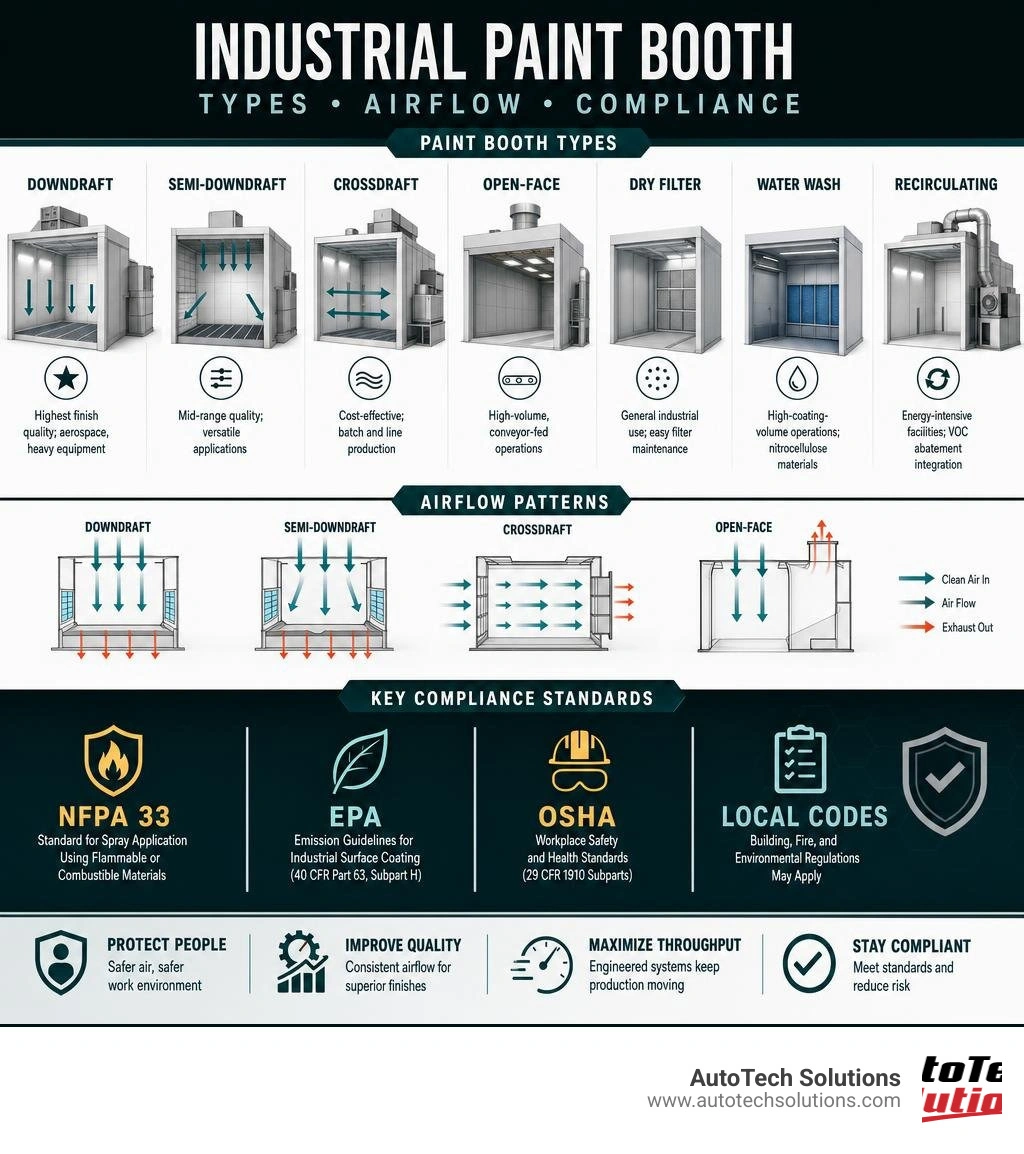
If you're evaluating options, here's a quick overview of the most common types:
| Booth Type | Best For |
|---|---|
| Downdraft | Highest finish quality; aerospace, heavy equipment |
| Semi-Downdraft | Mid-range quality; versatile applications |
| Crossdraft | Cost-effective; batch and line production |
| Open-Face | High-volume, conveyor-fed operations |
| Dry Filter | General industrial use; easy filter maintenance |
| Water Wash | High-coating-volume operations; nitrocellulose materials |
| Recirculating | Energy-intensive facilities; VOC abatement integration |
These booths go far beyond what you'd find in an automotive refinish shop. They're engineered for scale, throughput, and regulatory compliance — handling everything from transit buses to heavy manufacturing components.
For facility managers and shop operators, the stakes are high. A poorly specified booth creates bottlenecks, compliance risks, and costly rework. The right system, properly installed, protects your technicians, meets NFPA 33 and EPA requirements, and keeps production moving.
This guide walks you through every key decision — from airflow design and filtration to companion equipment and code compliance — so you can choose and operate the best system for your operation.
Understanding the Power of an Industrial Paint Booth
When walking through a high-volume manufacturing plant or commercial finishing facility in Novi, Michigan, or Charlotte, North Carolina, the sheer physical presence of an industrial paint booth is hard to miss. These are not merely oversized metal boxes; they are highly engineered, dynamic air-containment systems designed to handle demanding, continuous-duty production cycles.
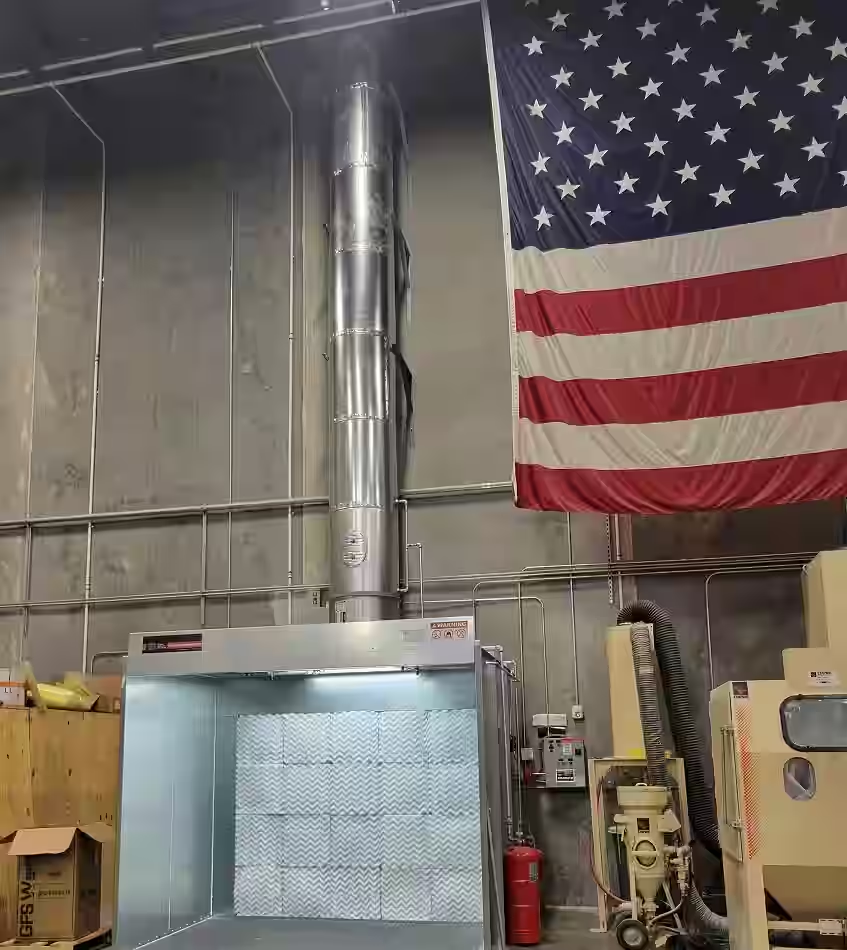
Key Differences: Industrial Paint Booth vs. Automotive Systems
While a standard Auto Body Paint Booth is optimized to paint passenger vehicles and light trucks, industrial booths are designed to accommodate a diverse and often unpredictable array of workpieces.
- Physical Scale and Structural Integrity: Industrial systems are built using heavy-duty structural steel and thick, precision-punched 18-gauge G90 galvanized steel panels. They are designed to withstand massive static pressures and physical wear. Large industrial paint booths frequently feature heavy-duty hinges and reinforced structural steel columns to support oversized doors.
- Conveyor and Process Integration: Many industrial finishing lines operate on automated overhead monorails or conveyor systems. Unlike automotive booths, which are typically batch-oriented, an industrial paint booth must accommodate conveyor slots. Industry standards allow conveyor slots to make up to 25% of the booth’s open front area without requiring an additional exhaust fan, provided the airflow remains balanced.
- Continuous Duty and Airflow Capacity: Automotive booths run intermittently. Industrial booths, however, often run across multiple shifts daily. This continuous operation requires heavy-duty, AMCA-certified aluminum blade fans powered by totally enclosed, fan-cooled (TEFC) motors, moving tens of thousands of cubic feet of air per minute (CFM) to maintain safe levels of airborne particulates and volatile organic compounds (VOCs).
Why Your Commercial Facility Needs an Industrial Paint Booth
Investing in a dedicated industrial spray booth is a major step toward operational maturity. For commercial operations in the Carolinas and Michigan, the benefits are clear:
- Throughput Optimization: Consistent, predictable airflow and integrated curing systems mean parts dry faster, allowing you to move more products through the line each shift.
- Flawless Finish Quality: By pulling airborne dust, lint, and overspray away from the wet painted surface, these booths minimize finish defects, eliminating the need for labor-intensive sanding and repainting.
- Technician Safety: High-velocity ventilation systems capture hazardous overspray and fumes, routing them through specialized filtration media to protect your team from toxic exposure.
- Environmental and Regulatory Compliance: Modern industrial paint booths are designed to capture particulates and volatile compounds, helping your facility meet strict EPA, OSHA, and local fire marshal requirements.
Airflow Configurations and Filtration Technologies
Achieving a high-quality finish requires precise control over how air enters, moves through, and exits the spray chamber. Choosing the wrong airflow configuration can lead to turbulent pockets of air, poor overspray capture, and excessive energy bills.
Downdraft and Semi-Downdraft Systems
For operations demanding absolute finish perfection, downdraft configurations are the industry gold standard.
- Full Downdraft: In a full downdraft booth, clean air is drawn through a fully filtered ceiling plenum and pulled vertically downward over the workpiece. Overspray and dust are pulled straight down into a filtered pit or grated floor plenum. This vertical path ensures that overspray is immediately pulled away from the operator and the painted surface. To explore this design further, you can read more about Downdraft Paint Booths - Rohner.
- Semi-Downdraft: If excavating a concrete exhaust pit is not feasible due to facility constraints or budget, a semi-downdraft booth is an excellent alternative. Air enters through the ceiling plenum but is exhausted through a filtered back-wall plenum instead of the floor. This provides a diagonal airflow path that still offers strong contamination control without the need for concrete pit excavation.
When planning a new installation, understanding the structural and financial requirements of pit excavation is crucial. Be sure to consult a comprehensive Paint Booth Installation Cost Guide to budget accurately for these modifications. For a detailed breakdown of the setup process, refer to our guide on Downdraft Paint Booth Installation.
Crossdraft and Open-Face Booths
For many high-volume manufacturing applications, horizontal airflow configurations offer a highly reliable and cost-effective solution.
- Crossdraft Booths: In a crossdraft configuration, air enters through filters in the front doors and flows horizontally across the workspace before exiting through a filter bank at the rear of the booth. This design is highly efficient for painting long, linear components and is much simpler to install than downdraft systems.
- Open-Face Booths: Often used for batch-type or conveyorized production lines, open-face booths draw air through the open front and exhaust it through a filtered back wall. A standard 12'W x 12'H x 7'L open-face booth, for example, might utilize a 36-inch diameter fan powered by a 5 HP motor to deliver 18,000 SCFM of horizontal airflow, keeping the workspace clear of overspray while allowing operators easy access to incoming parts.
Dry Filter vs. Water Wash Technologies
Deciding how to capture paint overspray is another critical choice.
- Dry Filter Booths: These systems utilize disposable fiberglass or multi-stage synthetic filter media to trap particulates. They are highly popular due to their low initial cost and straightforward maintenance. Leading manufacturers offer more than 500 pre-engineered models of dry filter paint booths in a wide variety of sizes and options to fit almost any footprint.
- Water Wash Booths: For high-volume coating operations or when spraying materials like nitrocellulose lacquers (which pose a high risk of spontaneous combustion when dry), water wash systems are highly effective. These systems use a continuous curtain of water to scrub paint particulates out of the exhaust air.
- Recirculating and Advanced Systems: Modern high-efficiency systems are pushing the boundaries of energy conservation. For example, some advanced configurations, like the EcoProBooth – One Spray Booth for All Painting Tasks - Dürr, utilize up to 95% recirculated air and only 5% fresh air, reducing energy consumption by up to 75% compared to conventional wet scrubbers.
Compliance, Safety, and Companion Equipment
Operating an industrial paint booth comes with significant regulatory responsibilities. Because spray-applied coatings often involve flammable or combustible materials, safety and code compliance must be integrated into the booth's design from day one.
Regulatory Standards and Code Compliance
Your finishing system must meet a complex web of local, state, and national standards:
- NFPA 33: This is the national standard for spray applications using flammable or combustible materials. It dictates structural requirements, such as maintaining a minimum of 3 feet of clear space between the spray booth and other operations (or separating them with a 1-hour fire-resistance-rated partition).
- OSHA Regulations: OSHA closely monitors employee exposure to hazardous fumes and particulates. Airflow velocities must meet minimum standards (typically around 100 feet per minute for standard industrial applications) to protect operators.
- EPA NESHAP: The Environmental Protection Agency enforces strict regulations regarding hazardous air pollutants. This often requires multi-stage, NESHAP-compliant filtration systems to capture fine particulates before exhaust air is released into the atmosphere.
- Electrical Classifications: All electrical components inside the booth must be rated for Class I, Division 1 hazardous locations. This includes spark-resistant fans, sealed LED light fixtures, and interlocked control panels. Any electrical equipment within 3 feet of a booth opening must meet Class I, Division 2 standards.
Essential Companion Equipment for Finishing Lines
To maximize the performance of your paint booth, several companion systems are typically integrated into the finishing line:
- Air Makeup Units (AMUs): An AMU replaces the massive volume of air exhausted by the booth's fans. It tempers (heats or cools) the incoming fresh air to maintain stable temperatures and humidity levels, which is crucial for consistent paint adhesion and curing.
- Curing Ovens: To speed up production, parts are often transferred directly from the paint booth into a high-temperature curing oven to bake the finish.
- Paint Mixing Rooms: To safely store and prepare coatings, a dedicated mixing room is essential. If your mixing room is located within 6 feet of the spray area, NFPA 33 dictates that your combined paint storage cannot exceed 120 gallons. If separated by more than 6 feet, you can store up to 300 gallons in the mixing room and 60 gallons in the spray area. For details on setting up these spaces, read our guide on Paint Mixing Room Equipment.
- Drying Systems: For facilities utilizing environmentally friendly waterborne coatings, integrating a dedicated Waterborne Paint Drying System uses targeted, high-velocity air movement to flash off water molecules quickly, dramatically reducing cycle times.
Frequently Asked Questions
How often should you change filters in an industrial spray booth?
Filter replacement schedules depend entirely on your production volume and the type of coatings you apply. Rather than relying on guesswork, the most reliable method is to monitor your booth's differential pressure gauge (manometer). When static pressure rises above the manufacturer’s recommended threshold, it indicates the filters are loaded and must be replaced to prevent airflow drop-offs.
For facilities spraying nitrocellulose lacquers, NFPA 33 requires daily filter changes due to spontaneous ignition risks. For general industrial applications, keeping a detailed log and performing daily visual checks is a best practice. For more details, consult our resource on Automotive Paint Booth Maintenance.
Can you recirculate air back into the facility?
For liquid spray operations, recirculating exhaust air back into the plant is highly restricted. It is only permitted if you install continuous vapor monitoring systems that automatically shut down the booth if solvent vapors exceed 25% of the lower flammable limit (LFL).
However, powder coating booths have much more flexibility. Since powder coatings do not release volatile solvent vapors, filtered air can often be safely recirculated back into the facility, provided you have proper particulate filtration and safety interlocks in place.
What is the difference between pre-engineered and custom booths?
- Pre-Engineered Booths: These are standardized, catalog-model booths designed to meet common dimensional and airflow requirements. They are highly cost-effective, have shorter manufacturing lead times, and are perfect for standard parts and batch processes.
- Custom-Engineered Booths: When dealing with unique facility constraints, heavy structural steel assemblies, or complex conveyor lines, a custom-engineered booth is necessary. Engineers use Computational Fluid Dynamics (CFD) modeling to optimize airflow around complex part geometries, ensuring uniform air distribution and precise contamination control.
Whether you are looking to purchase a new system, exploring a Paint Booth Rent Complete Guide, or searching for a Used Auto Body Paint Booth for Sale, working with experienced installation experts is the key to a smooth project.
Conclusion
Selecting, installing, and maintaining an industrial paint booth is a major project that directly impacts your facility's safety, throughput, and bottom line. From choosing the correct airflow pattern to ensuring strict compliance with NFPA 33 and OSHA standards, every decision requires careful planning.
At AutoTech Solutions, we are your trusted partners for commercial shop equipment. As a premier resource for sales, professional installation, and preventative maintenance, we serve light, heavy, and collision shops across Michigan and the Carolinas. Our primary mission is to minimize your downtime with rapid repair response and expert support.
If you are looking for a Paint Booth for Sale MI, need to connect with qualified MI Paint Booth Installers, or want to explore our Paint Booth Sales in Michigan options, our team is ready to help. We also provide ongoing Paint Booth Service and troubleshooting tips through our Paint Booth Repair Tips Guide to keep your exhaust fans spinning and your finishes flawless.
Ready to upgrade your production floor? Learn more about AutoTech Solutions facility buildout services or reach out to our team at any of our regional locations in Novi, MI, Charlotte, NC, Raleigh, NC, or Wade, NC. Let us help you design a high-performance finishing line that keeps your team safe and your production moving.