
Why Getting a Car Lift Installation Right the First Time Matters
If you're planning to install a car lift in your garage facility, the difference between a smooth operation and a costly shutdown comes down to preparation.
Here's a quick overview of what a successful commercial lift installation requires:
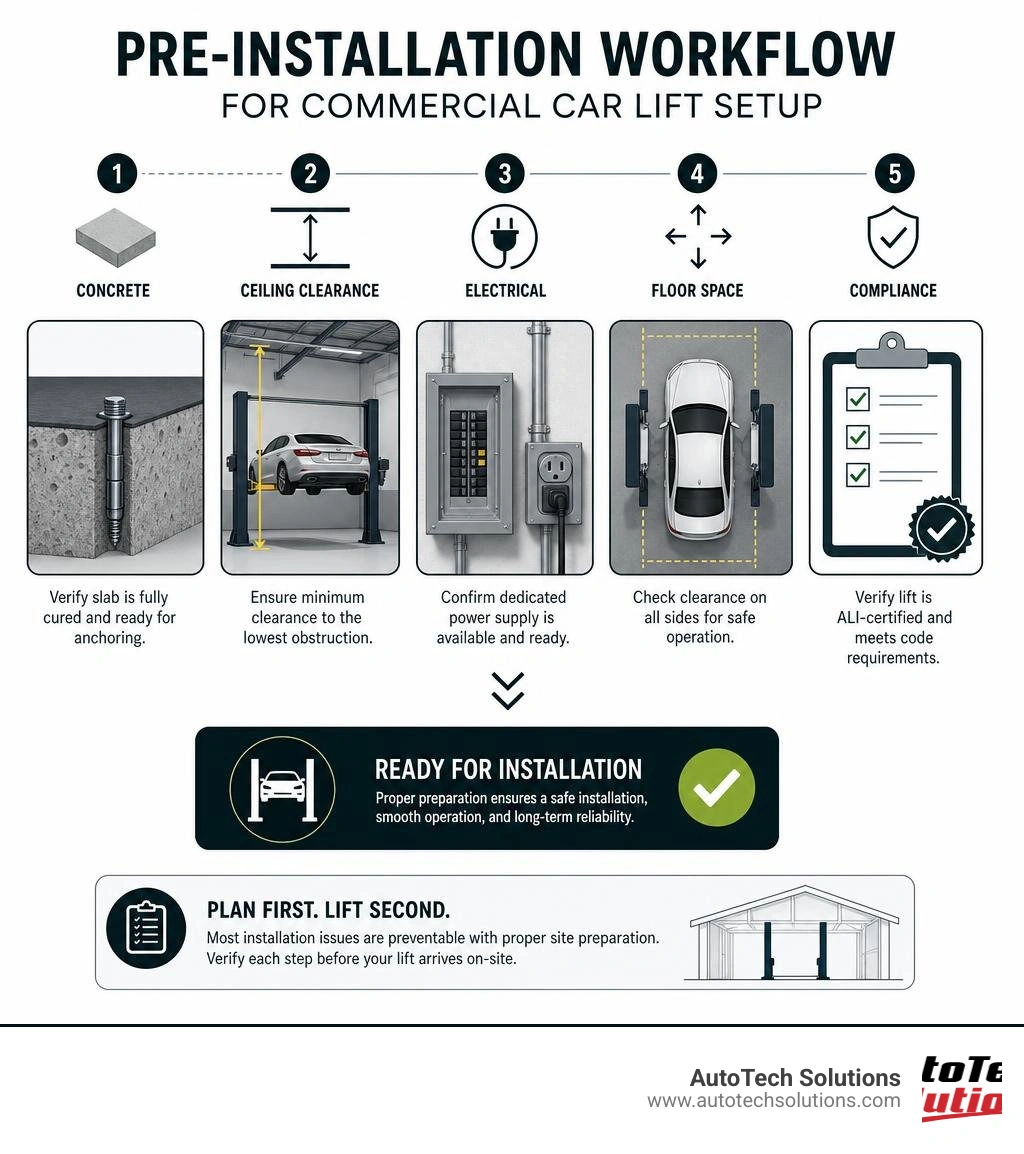
- Concrete slab — minimum 4 inches thick, 3,000 PSI compressive strength, fully cured
- Ceiling clearance — minimum 11–12 feet for most 2-post lifts, measured to the lowest obstruction
- Electrical supply — dedicated 220V single-phase circuit with a 30-amp breaker
- Floor space — adequate clearance on all sides for safe vehicle access and technician movement
- ALI-certified lift — required under the 2024 International Residential Code in 49 U.S. states
- Professional installation — required by most manufacturers to maintain warranty coverage
Most installation failures happen before the lift arrives. Facilities discover their concrete is too thin, their ceiling has unaccounted obstructions, or their electrical panel can't support a dedicated circuit — all after equipment is already on-site.
A 4-post lift installation typically takes a two-person crew 3–5 hours. A 2-post lift runs 4–8 hours depending on site conditions. Neither timeline accounts for site prep that wasn't done in advance.
This guide covers every critical requirement — concrete, clearance, electrical, anchoring, and compliance — so your shop stays productive and your technicians stay safe.
Install car lift in garage terminology:
Critical Site Requirements to Install a Car Lift in Garage Facilities
In a commercial workshop, fleet bay, or collision center, a vehicle lift is the heartbeat of your daily operations. Whether you are expanding an existing facility in Novi, MI, or setting up a new multi-bay shop in Charlotte, NC, you must treat the installation site as an engineered system. Failing to verify your site specs can lead to catastrophic structural failures, damaged customer vehicles, and severe workplace safety hazards.
Before purchasing any heavy-duty equipment, you must evaluate three core physical parameters of your service bays: the concrete foundation, the clear overhead height, and the surrounding floor space. For a detailed breakdown of these parameters, refer to our Automotive Lift Guide.
Commercial vehicle lifts transfer massive, concentrated point loads directly through their columns into the floor. A standard 10,000-lb two-post lift, for example, exerts thousands of pounds of pressure on a footprint of just a few square inches. If your facility floor cannot handle this concentrated force, the anchors will pull out, or the slab itself will crack and tilt.
Verifying Concrete Slab Integrity and PSI Strength
Your shop floor is the absolute foundation of lift safety. For standard commercial two-post lifts with capacities up to 10,000 lbs, manufacturers require a continuous, reinforced concrete slab with a minimum thickness of 4 inches and a compressive strength of at least 3,000 PSI. If you are installing heavier commercial lifts (12,000 to 15,000 lbs or more) to service medium-duty work trucks in Raleigh, NC, your slab must be at least 6 inches thick with a compressive strength of 3,500 to 4,000 PSI.
To ensure a safe and compliant Car Hoist Installation, never guess your concrete's specifications. Many commercial buildings have older "rat slabs" or unreinforced concrete that is only 2 to 3 inches thick in certain spots.
To verify your foundation, we recommend performing a core test. A technician drills a small test hole in the proposed column locations to measure the physical thickness of the slab and extract a sample to verify the compressive strength.
If your core test reveals that your concrete does not meet these minimum requirements, you cannot safely proceed with anchoring. Your options are to:
- Pour localized reinforcement pads: This involves excavating a 2x2x1-foot section of the floor at each column location, tying in rebar, and pouring new high-strength concrete.
- Repour the entire bay: For older facilities with severely cracked or uneven concrete, pouring a fresh, engineered slab is the most reliable path forward.
New concrete must cure for a minimum of 28 days before you can drill anchor holes or apply any operational loads.
Measuring Ceiling Clearance and Avoiding Obstructions
One of the most common installation mistakes is measuring only the distance from the floor to the ceiling joists while ignoring hanging obstructions. You must measure the "effective ceiling height," which is the distance from the floor to the absolute lowest obstruction in the bay.
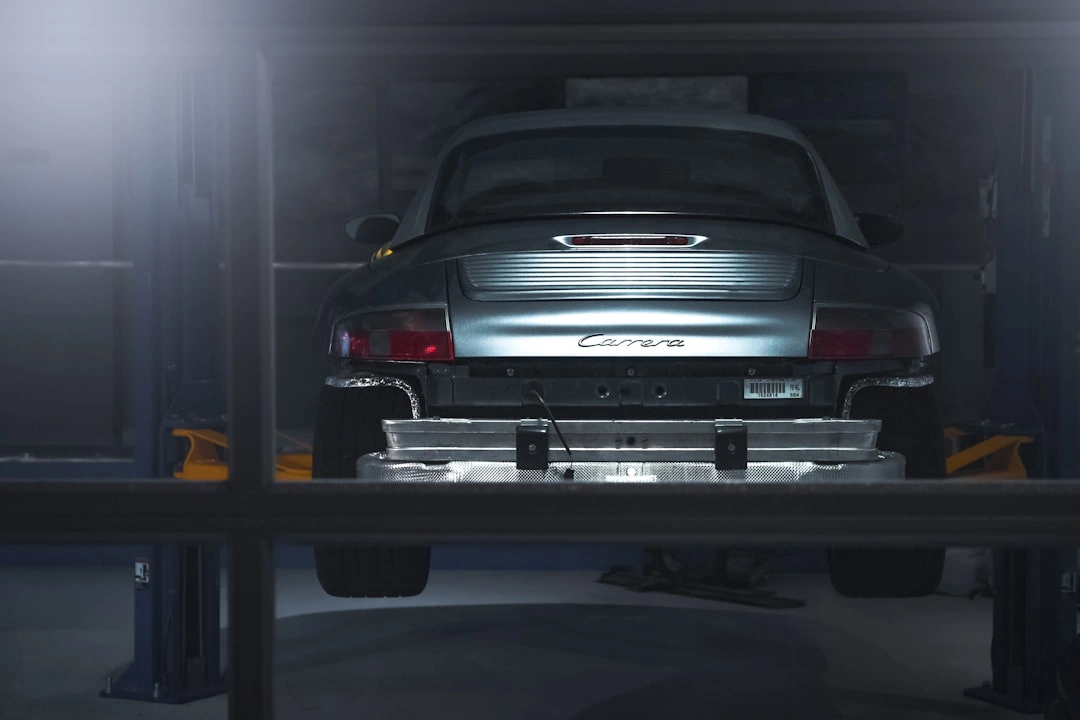
When planning your overhead space, account for the following common obstructions:
- Overhead garage door tracks and openers: Standard tracks curve directly into the path of an elevated vehicle. You may need to convert your shop doors to high-lift or vertical-lift tracks to keep the doors flush against the wall when open.
- Lighting fixtures: Suspended LED or fluorescent shop lights are easily crushed by rising SUVs or vans.
- HVAC ductwork and overhead plumbing: Ensure these utilities are routed completely clear of the lift's maximum rise height.
- Exhaust extraction systems: Ensure your overhead hose reels or extraction ducts do not hang down into the active lifting zone.
To calculate your minimum ceiling clearance for a service bay, use this simple formula:
$$\text{Vehicle Height} + \text{Lift Runway/Adapter Thickness} + \text{Safety Lock Clearance (typically 6 inches)} = \text{Minimum Clearance}$$
For most commercial clear-floor two-post lifts, you will need a physical column height clearance of at least 11 feet 11 inches to 12 feet 3 inches.
Power Specifications to Install a Car Lift in Garage Bays
Commercial automotive lifts require robust, reliable power to operate their hydraulic pumps efficiently. While some light-duty, portable units can run on standard 110V power, professional-grade shop lifts require a dedicated 220V/240V single-phase or three-phase electrical circuit.
Using a shared circuit or running extension cords is a major safety violation that can trip breakers, overheat the motor, and void your manufacturer's warranty. For a standard 9,000 to 11,000-lb lift, you must have a licensed electrician install a dedicated 220V single-phase circuit backed by a 30-amp breaker. The electrical outlet or disconnect box should be positioned within 6 feet of the hydraulic power unit, ensuring it does not interfere with the vehicle door swing or technician workspaces.
For high-volume shops in Novi, MI, or Charlotte, NC, proper electrical grounding is critical to prevent static build-up and protect the lift's sensitive electronic safety sensors. For complete details on preparing your shop's electrical infrastructure, see our guide on Automotive Equipment Installation and Service.
Step-by-Step Professional Installation Process
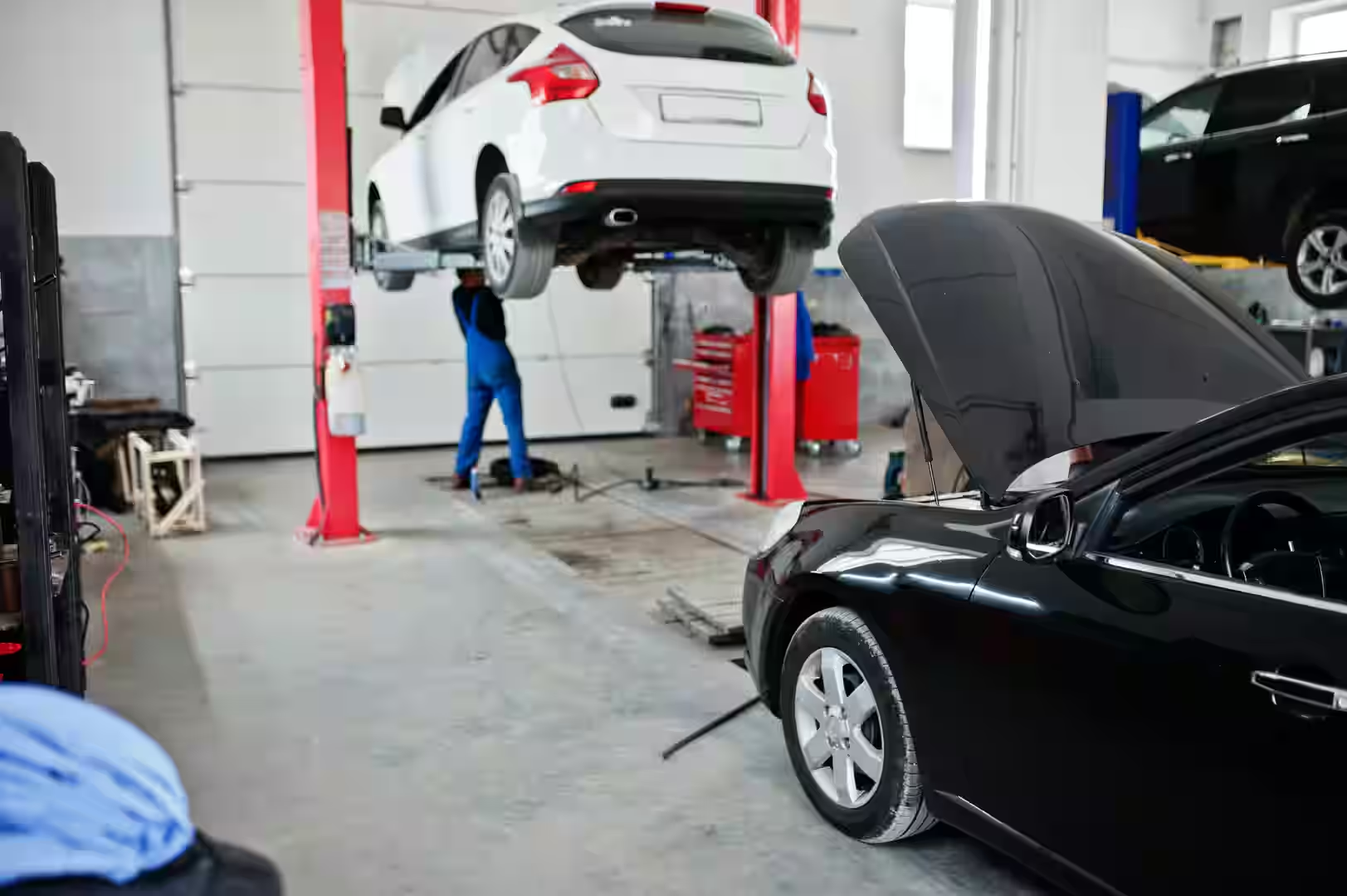
Once your site is fully verified and prepped, the physical installation process can begin. Installing a commercial lift is a highly technical procedure that requires specialized tools, including heavy-duty rotary hammer drills, precision dial indicators, laser levels, and high-capacity torque wrenches.
To maintain safety standards and preserve your equipment warranty, we highly recommend working with certified Automotive Lift Installation professionals.
Anchoring and Plumbing the Lift Columns
The structural integrity of a two-post lift relies entirely on how well its columns are anchored to the concrete floor. The process begins by snapping chalk lines on the floor to establish a perfectly square layout based on the manufacturer's exact specifications.
- Position the Columns: Stand the columns upright on the chalk lines. Double-check the outside-to-outside and diagonal measurements to ensure the columns are perfectly square. Even a minor misalignment can cause the lift carriage to bind during operation.
- Drill the Anchor Holes: Using the baseplate holes as a template, drill holes into the concrete using a rotary hammer drill and a carbide-tipped masonry bit. The depth and diameter of the holes must match the manufacturer's specifications exactly.
- Clean the Holes: Use a wire brush and compressed air or a vacuum to remove all concrete dust and debris from the holes. Leaving dust in the hole drastically reduces the holding power of the anchor bolts.
- Plumb the Columns: Before tightening the anchors, use a high-precision level or plumb bob to verify that each column is perfectly vertical. If the floor is slightly sloped, which is common in bays with floor drains, insert metal shims under the baseplate. Never use shims thicker than 2-1/4 inches.
- Torque the Anchors: Insert the heavy-duty anchor bolts, often using an adhesive-enhanced anchoring system like AC100+ Gold for added security in older concrete, and tighten them using a manual torque wrench to the exact torque specification, typically around 85 ft-lbs. Never use an impact wrench to tighten concrete anchors, as this can fracture the concrete surrounding the bolt.
Synchronizing Cables and Testing Hydraulics to Install a Car Lift in Garage Workspaces
With the columns anchored, the mechanical and hydraulic components can be installed. This includes routing the steel equalizer cables, mounting the hydraulic power unit, and plumbing the high-pressure fluid lines.
- Equalizer Cables: These heavy-duty steel cables connect the two carriages to ensure they rise and lower at the exact same rate. If one side rises faster than the other, the vehicle will tilt, risking a catastrophic fall. Adjust the tension nuts on the cables so that the mechanical safety locks on both columns click in perfect synchronization.
- Hydraulic System: Mount the power unit to the primary column. Route the high-pressure hydraulic hoses through the overhead gantry or floor cover, ensuring they are protected from pinching or rubbing against moving parts. Secure excess hose with heavy-duty zip ties or specialized routing brackets.
- Fluid and Purging: Fill the hydraulic reservoir with high-grade anti-wear hydraulic oil, typically ISO 32 or ISO 46 fluid. Most commercial lifts require 3 to 4 gallons. Once filled, cycle the lift up and down 3 to 5 times without a load to flush trapped air out of the hydraulic cylinders. Watch for any fluid leaks at the fittings and tighten as necessary.
Safety Standards, Compliance, and Initial Load Testing
Before placing any vehicle on the lift, you must verify that the installation complies with local building codes and safety regulations. In 49 U.S. states, the International Residential Code (IRC) and commercial building codes require that any automotive lift installed in a professional facility be ANSI/ALI ALCTV certified. Look for the gold Automotive Lift Institute (ALI) certification label on the lift column. For additional workplace safety context, review OSHA's guidance on vehicle lifts in automotive repair and service operations.
Once compliance is verified, perform a rigorous initial testing sequence:
- Unloaded Test: Raise the empty lift to its maximum height. Verify that the safety locks engage smoothly at every interval and that the carriages lower evenly when the manual release is activated.
- Light Load Test: Lift a lightweight shop vehicle, such as a compact sedan, roughly 2 feet off the ground. Verify that the weight is distributed properly, the arm restraints are fully locked into the gear teeth, and there is no unusual column deflection or noise.
- Full Capacity Test: Lift a vehicle near the rated capacity of the lift. Check the columns for expected structural flexing, monitor the hydraulic pump for strain, and ensure the safety locks click simultaneously.
For more information on professional safety standards, consult our Car Lift Installers Complete Guide.
Comparing 2-Post, 4-Post, and Scissor Lift Requirements
Choosing the right lift type for your commercial bays depends on your primary service offerings, available floor space, and concrete conditions. Professional commercial facilities have highly demanding operational needs that require heavy-duty, certified equipment.
Below is a detailed comparison of the three most common commercial lift configurations:
| Lift Type | Primary Application | Concrete Requirements | Floor Space Footprint | Installation Complexity | Freestanding Capability |
|---|---|---|---|---|---|
| 2-Post Lift | Undercarriage repair, brake/wheel service, suspension work | Minimum 4-6" thick, 3,000+ PSI | Moderate width, requires clear drive-through path | High (requires precise plumbing & heavy anchoring) | No (must be anchored) |
| 4-Post Lift | Wheel alignments, fluid changes, long-term fleet parking | Minimum 4" thick, 3,000 PSI | Large footprint (requires length for ramps) | Moderate (easier assembly, less anchor stress) | Yes (freestanding models available) |
| Scissor Lift | Quick-lube bays, tire service, detailing, bodywork | Minimum 4" thick, 3,000 PSI | Compact (completely flush or low-profile) | Moderate to High (for inground flush-mounts) | No (bolted or flush-mounted) |
- Two-Post Lifts: These are the workhorses of professional repair shops. By lifting the vehicle from the frame, they leave the wheels and undercarriage completely accessible. However, they require flawless concrete anchoring because all forces are concentrated on two columns.
- Four-Post Lifts: Ideal for wheel alignment and quick-lube services. Because the vehicle's weight is distributed across four columns, these lifts exert much less stress on the concrete floor. Some models are even certified to be freestanding, provided the floor slope does not exceed 1/8 inch per foot. They are also excellent for double-stacking vehicles to optimize parking space in tight urban shops.
- Scissor Lifts: Best for high-volume tire shops or quick-service bays with limited space or low ceilings. While mid-rise scissor lifts only raise vehicles 3 to 4 feet, they offer clear access to the wheels and sides of the vehicle without the wide footprint of a post-based system.
To learn more about professional installation standards, you can review our Car Lift Installers Complete Guide.
Frequently Asked Questions About Commercial Lift Setup
What is the minimum concrete thickness required for a commercial 2-post lift?
For standard commercial 2-post lifts up to 10,000 lbs capacity, a minimum concrete thickness of 4 inches with a compressive strength of 3,000 PSI is required. For heavy-duty lifts (12,000 to 15,000 lbs) designed to handle commercial trucks and fleet vehicles, you must have a minimum of 6 inches of concrete with 3,500 to 4,000 PSI strength. The slab must be a single, continuous pour and fully cured for at least 28 days before installation.
Do 4-post lifts always need to be anchored to the floor?
Technically, no. Many light-duty and commercial 4-post lifts are designed and certified to be freestanding because the weight of the vehicle on the runways naturally locks the footprint down. However, anchoring is strongly recommended for maximum stability in high-volume professional shops, and it is often required by local safety codes or insurance policies to prevent the columns from shifting or "walking" over years of heavy use.
How much does professional automotive lift installation cost?
The cost of professional installation varies depending on the lift type, capacity, and site preparation needs. Generally, labor costs for installing a standard 2-post or 4-post lift range from $800 to $2,500. If your facility requires extensive site preparation—such as excavating and pouring new concrete pads or upgrading your electrical panel to a dedicated 220V circuit—the total project cost can increase significantly. For more details on budgeting for your facility upgrades, see our Automotive Shop Equipment Complete Guide.
Conclusion
Installing a commercial vehicle lift is a major operational upgrade that requires meticulous planning, precise execution, and strict adherence to safety standards. Trying to cut corners on concrete testing, ceiling clearance, or electrical wiring will only lead to expensive downtime, broken equipment, and potential safety violations. To ensure your shop's installation is handled safely and professionally, working with certified commercial installers is essential.
At AutoTech Solutions, we are your one-stop-shop for commercial automotive equipment sales, professional installation, certified service, and preventative maintenance. Serving light, heavy, and collision shops from Michigan to the Carolinas (including Charlotte, NC, Raleigh, NC, Wade, NC, and Novi, MI), our mission is to minimize your shop's downtime with expert support and rapid repair response times.
Don't risk your technicians' safety or your shop's productivity on a subpar installation. Schedule professional installation and facility upfit services with AutoTech Solutions today to get your bays running at peak efficiency.